
At the beginning of VisionQuest, the Marvel miniseries that premiered on Disney+ this week, the eponymous synthezoid (played by Paul Bettany) is undergoing an identity crisis. “Who am I?” he asks as the first episode starts. “I am Vision. At least, I was Vision.” After a refresher on more than a decade of the character’s on-screen history, his monologue continues: “Now all that is gone. And yet, I live once more. Rebuilt. Same body, different mind. Something new. Disconnected. Lost. You see, I am Vision. And yet … I am not.”
If an existential conflict can consume an erudite, ultra-logical android, why can’t the same struggle beset a streaming service? VisionQuest’s home has the same body as the home of every previous MCU series. But this Disney+ is something new, disconnected, and (arguably) lost. For a few years after its November 2019 launch, Disney+ was the focus for a pair of Disney’s biggest brands, Star Wars and Marvel (specifically, the Marvel Cinematic Universe, which branched out from the cinema to colonize the small screen). Each year, Disney delivered several live-action originals between the two franchises. Now the company appears to be cutting that cadence to one or two titles per year. That diminished Disney+ output reflects a wider downsizing across the streaming landscape—but also, perhaps, an overcorrection to an overcorrection by a service that’s searching for a happy medium in the speed of its streaming assembly line.
“One of the fairy tales never adapted for the big screen by Disney is ‘Goldilocks and the Three Bears,’” the Entertainment Strategy Guy, a former studio executive who analyzes streaming data and the entertainment industry on Substack, tells The Ringer. “Which is ironic, because it describes Disney streaming behavior: They can’t find the right temperature of porridge, er, correct volume of Star Wars/Marvel series to make. … I think they made too many at the peak of their streaming boom (2019 to 2022-ish), but now they’re making too few.”
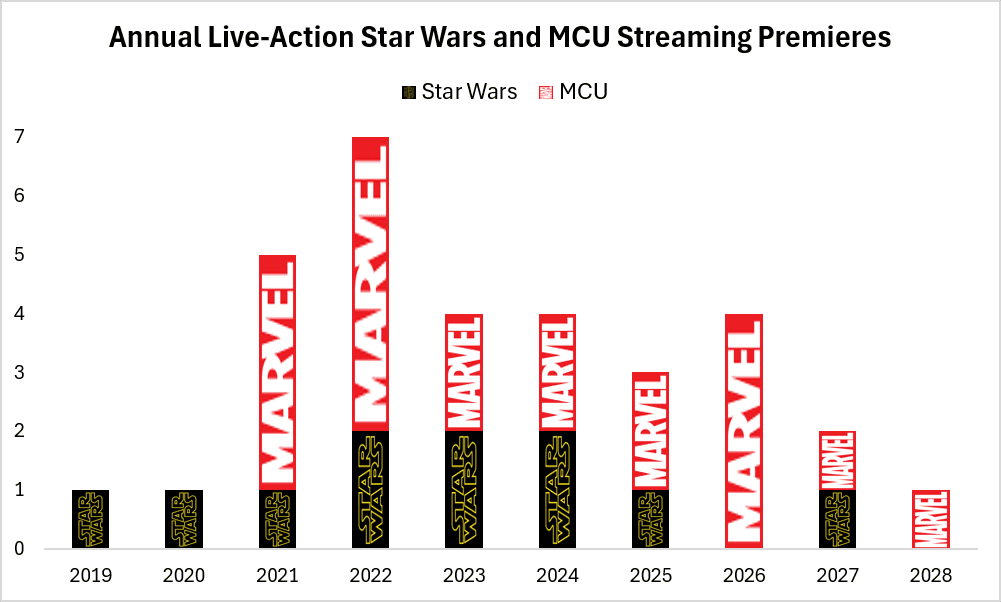
We can capture this rapid expansion and contraction by graphing the combined annual number of original, live-action Star Wars and MCU miniseries, seasons, and “special presentations” that have aired or been announced for the 10-year period from 2019 through 2028. The prospective totals for 2027 and 2028 count only confirmed projects, and additional series or specials for those years could yet be unveiled. But live-action Star Wars and MCU projects tend to be announced (or heavily rumored) with a lot of lead time, so it’s unlikely that a lot of live-action TV ticketed for those years remains under wraps.
In the beginning, there was The Mandalorian: The Star Wars franchise’s first foray into live-action TV (Holiday Special aside) launched alongside the streaming service itself. The adventures of Din Djarin and, even more memorably (and lucratively), the adorable baby later dubbed Grogu, produced a critical hit and popular phenomenon that immediately made Disney+ a destination not only for library titles but also for original live-action content exclusive to the platform.
The Mandalorian’s first two seasons ruled the roost in late 2019 and 2020, but the MCU boarded the Disney+ streaming experience with WandaVision in January 2021, less than a month after The Mandalorian’s Season 2 finale. After that, the franchise floodgates opened. Three more live-action MCU series—The Falcon and the Winter Soldier, Loki, and Hawkeye—arrived in 2021 (along with the animated What If…?), as well as Mandalorian spinoff The Book of Boba Fett.
If anything, that chart understates just how pervasive Disney streaming content became because some episodic releases spanned multiple years. The Book of Boba Fett, for instance, premiered in December 2021 (the week after Hawkeye concluded), but only the first of its seven episodes aired that year. The rest ran into February of the following year. December was the only month of 2022 that didn’t feature new live-action Star Wars and/or MCU streaming material—and some months boasted more than one release. (Andor, She-Hulk: Attorney at Law, and Werewolf by Night overlapped that October—all while House of the Dragon and The Lord of the Rings: The Rings of Power were competing for nerd-culture mindshare elsewhere.) It took a Temporal Loom to maintain Disney’s Sacred Streaming Timeline: From November 2021 through November 2022, at least one Marvel or Star Wars streaming project aired on Disney+ every month (not counting animated miniseries Tales of the Jedi and I Am Groot). In those days, the sun never set on Disney’s streaming empire.
Compare that wall-to-wall programming with where we are now. VisionQuest concludes a trilogy of miniseries that started with WandaVision. When WandaVision wrapped, three more live-action MCU series were mere months away. That’s more than the total number of live-action MCU series said to be in the Disney+ pipeline as VisionQuest airs.
As things stand, the only such projects publicly scheduled to follow VisionQuest are the third and final season of Daredevil: Born Again (which will air sometime in 2027) and the newly announced 2028 spy thriller Zodiac, which Deadline declared would join a “waning live-action TV slate at Marvel.” This is the first year without an original live-action Star Wars series since before The Mandalorian launched, and no others are known to be heading to Disney+ beyond Ahsoka Season 2, which will debut next January (more than three years after the first season). The highest-profile Star Wars products of 2026 have been the well-received video games Zero Company and Galactic Racer, which have benefited from the franchise’s Goldilocks gaming blueprint—not too many, not too few.
Disney+ still hosts a smattering of adult animated series, such as Maul—Shadow Lord and Visions for Star Wars and X-Men ’97 and Marvel Zombies for Marvel. But those shows—whatever their merits—tend to be smaller scale in terms of both budget and audience, and in some cases they sit outside the central Star Wars or MCU continuities. Star Wars and Marvel don’t represent the sum total of Disney+ programming, but precious few other live-action series have survived. Season 3 of Percy Jackson and the Olympians premieres in November (with the outlook for a fourth season uncertain), and comic adaptation Afterlife With Archie got a green light for 2027 this summer. Other than those, the cupboard seems to be bare, and the service hasn’t had a hit original in some time.
“My gut is they were hoping Hulu would fill the gap,” the Entertainment Strategy Guy says. (Disney completed its acquisition of Hulu last year.) “But I think that misses the real opportunity for regular, premium shows à la HBO, but for genre.” Lanterns is the latest such success for HBO, which will double (or quadruple) down on its recent “fantasy, sci-fi, and superheroes” strategy when Harry Potter premieres in December.
Of course, Disney+ remains in heavy rotation in my household (and many millions of others) thanks to monocultural kids’ juggernauts like acquired blockbuster Bluey and Spidey and His Amazing Friends, not to mention the combined classic catalogs of Disney Animation and Pixar. If you want to watch (and rewatch) old favorites, Disney+ is still a solid proposition. If you subscribe for new, exclusive stuff—which Disney Animation and Pixar have stopped producing for streaming—it’s a dicey deal. One study published this month found that new content in the Disney+ global catalog is down 41 percent year over year, far outpacing more modest declines for Netflix and linear (non-streaming) series. And Disney+ prices, along with those of other streaming services, keep increasing as companies increasingly prioritize profits over subscriber acquisition and retention.
The drop-off in Disney+ series has been in the works for a while. In 2018 and 2019, Disney CEO Bob Iger forecasted a slowdown in Star Wars movies, which turned into a protracted drought. In 2020, he reiterated that Disney would always prioritize “quality not volume.” Amusingly, though, Iger and Co. seemingly failed to apply the “less is more” lesson they’d supposedly learned about moviemaking to TV, and the boom-and-bust cycle repeated itself in the streaming realm.
In the summer of 2022, Marvel boss Kevin Feige enthused about several upcoming streaming series as the company promoted one of its patented packed project timelines. By early 2023, Feige had changed his tune, as he told Entertainment Weekly, “The pace at which we’re putting out the Disney+ shows will change.” Around the same time, Iger (who by then had stepped down as CEO and already returned, replacing his own successor, Bob Chapek) announced that Disney would “have to be better at curating” its tentpoles, that it “might have gotten a bit too aggressive” in seeking Disney+ subscribers, and that it would cut content costs and “be more judicious” in its streaming strategy.


The following May, Iger expounded on that theme as he tried to differentiate Disney’s cost-conscious revamp from its drunken-sailor spending as streaming “neophytes” years earlier. “As we got into the streaming business in a very, very aggressive way, we tried to tell too many stories,” he said. “Basically we invested too much, way ahead of possible returns. It’s what led to streaming ending up as a $4 billion loss.” The prolific, profligate approach, per Iger, “resulted in volume and not quality.”
This 0-to-60 ramp-up and subsequent dramatic deceleration (and layoffs) tracked closely with investors’ shifting attitudes toward streaming. In 2019, before the actual launch of Disney+, Disney’s share price reached an all-time high, propelled by bullish projections for streaming’s supposedly sky-is-the-limit potential. A few years later, Disney’s stock slumped as subscription growth stalled and losses mounted. This summer, one Wells Fargo analyst suggested that Disney abandon streaming altogether. Now, as Disney’s streaming market share stands pat, the company is licensing some streaming content to Netflix, in a selective, targeted, primarily self-promotional way.
As the Entertainment Strategy Guy says, “In some ways, this answers the core question of the streaming era: How could streaming afford to make über-expensive $20-$25-million-per-episode TV shows? It turns out the answer was: It couldn’t. Those production levels never really justified their budgets, except for the absolutely most popular shows, which was basically just Game of Thrones. Because, I’d add, this isn’t just Disney. We’re seeing Amazon, Netflix, and others pull back from crazy production budgets too. This also explains why Disney is trying to move these shows to theaters, where in success they do justify those budgets.”
As the box office has rebounded (albeit not all the way to pre-pandemic levels), big-screen blockbusters such as Spider-Man: Brand New Day and Avengers: Doomsday seem more viable. Disney still seems to be sorting out the implications for programming. In the Star Wars realm, the Mandalorian and Grogu movie subbed in for (and seemingly supplanted) a planned Season 4 and was neither a box-office hit nor a streaming one. Now, the property that put Disney+ on the map seems to have stagnated.
At Marvel Studios, which overhauled its small-screen production process three years ago, mixed signals abound. Earlier this year, the delightful but little-watched Wonder Man was canceled a few months after initially being renewed. Marvel Studios seems to have done an about-face on Daredevil, too. In 2025, head of streaming Brad Winderbaum laid out a plan for new seasons on an annual basis, saying, “Season 2 will come out next year, and then hopefully Season 3 and Season Infinity after that. I think this world is extremely rich, and there are many stories to be told on the streets of New York.” This week, in the wake of the news that the show is ending next year, he said, “The plan … was to culminate it at 3.”
Winderbaum may just be responding to what the markets—both stock and streaming—demand. Or don’t demand: As the Entertainment Strategy Guy documented last month, streaming ratings for superhero series (and not only the Marvel ones) have steadily declined since the heady days of 2021.
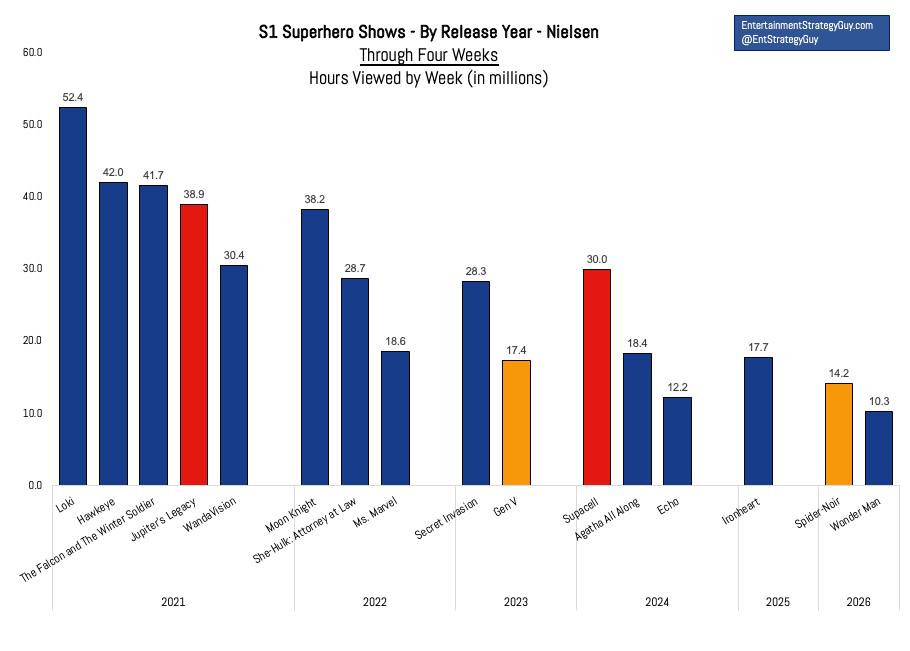
Maybe the pace of production compromised creativity. Maybe as franchises flooded the small-screen zone, the audience’s interest was sated. Or maybe mass interest in certain characters tapped for TV shows never really existed. “I think Disney also finally realized that the popularity of their characters matters,” the ESG tells me. “There is a tier of Marvel characters who showed up in Avengers and have decades of branding like Loki, Hawkeye, and Wanda/Vision, so naturally they did well on streaming. Newer characters with fewer fans did not. Star Wars had some of this too, going from a show featuring The Mandalorian (essentially Boba Fett, a beloved character) to brand-new characters in some cases, who needed to build their fans from scratch.”
Regardless of the reasons, the number of scripted series that premiere per year has dipped of late to less extreme levels—and the meager Disney+ originals lineup illustrates that downturn as well as that of any streaming service. As the ESG wrote in December, “Disney+ doesn’t make all that many original shows anymore. … At this point, Disney has pivoted entirely away from making big-budget TV shows for Disney+ to making … almost nothing for Disney+? Sure, Disney’s spending circa 2019-2022 was unsustainable, but now they’re pivoting too far in the other direction. At some point, Disney needs to stop shifting strategies so wildly. Really, Disney should have made fewer shows for Disney+ at launch and the shows they did make at that time needed to be made at more reasonable budgets. And they should adopt that strategy now.”
In only five years since WandaVision, or seven since The Mandalorian, Disney+ speedran the streaming circle of life: overexuberance, disillusionment, retrenchment. As Vision, referring to WandaVision’s setting, insists in the season premiere of VisionQuest, “Westview was a fantasy.” And like the Hex that surrounded that town, the streaming bubble was bound to pop—and, in the process, reduce Disney’s streaming output by almost the same percentage as Westview’s population. Now, as Vision wrestles with his self-conception, Disney+ is doing the same.