
The conceit of Spider-Man: Brand New Day is that no one knows or cares about Peter Parker. Thanks to some misadventures in the mystic arts, the man behind the spider mask has been wiped from the world’s memory. He lives alone in a silk retreat of solitude (a.k.a. a cluttered Queens apartment) where he illicitly surveils the city, experiments on his own DNA, and instructs delivery guys to drop off pizzas at the door. He’s unloved and lonely, living vicariously through his former friends’ vertical videos because he has no one to talk to except a police detective, a homicidal, traumatized vigilante, and his latest AI assistant.
Yet even in this sad scenario for the web-head’s alter ego, Peter’s alias, Spider-Man, remains mega-popular. As the forlorn hero buries himself in his work, his approval rating in New York rises to Brunsonian heights. He receives the key to the city (in costume, of course), and when an injury puts Peter in the hospital, throngs of well-wishers congregate to display their support for whoever’s inside the suit. Peter may be cast down and downcast, but nothing can keep his character from being beloved.
Despite significant impediments to Spidey’s appeal, the Spider-brand is still strong in real life, too. With a domestic take of $360 million in its opening weekend, Brand New Day surpassed Avengers: Endgame’s all-time record for a box office debut. (Provided we pretend that inflation disappeared in the Blip, as coverage of film finances often does because it keeps things simple and leads to hookier headlines.) The movie made $932 million worldwide, trailing only Endgame among global launches. Inflation adjusted or not, those are titanic totals, and they’re especially striking at a time when audiences are supposedly sick of superheroes, sequels, and well-worn IP.
The notion that franchises are failing is a bit overblown, but the superhero subgenre has certainly seen its fortunes fall from their peak popularity, both at the box office and on streaming. It’s a little silly to ping-pong between so over and so back based on whether the most recent release bombed (Supergirl) or boomed (Brand New Day), but it’s pretty apparent that on the whole, supes have surrendered some of their earning power, critical acclaim, and cultural cachet since the heady days of Endgame.
Yet Spidey seems to be the exception, judging by Brand New Day’s Endgame-esque start. In fact, Spider-Man seems to be picking up steam on the big screen, even as assorted cinematic universes stumble: Assuming the latest blockbuster’s earnings don’t turn out to be unusually front-loaded, each of Tom Holland’s four films as Spider-star will have made more than the last. So why is the wall crawler immune to the superhero swoon? Let’s lay out the reasons.
Spider-Man is popular.
Ringo Starr joined the Beatles in August 1962. The same month, Spider-Man debuted in Amazing Fantasy no. 15. Some things stand the test of time: The Beatles are still pretty popular, and so is Spidey.
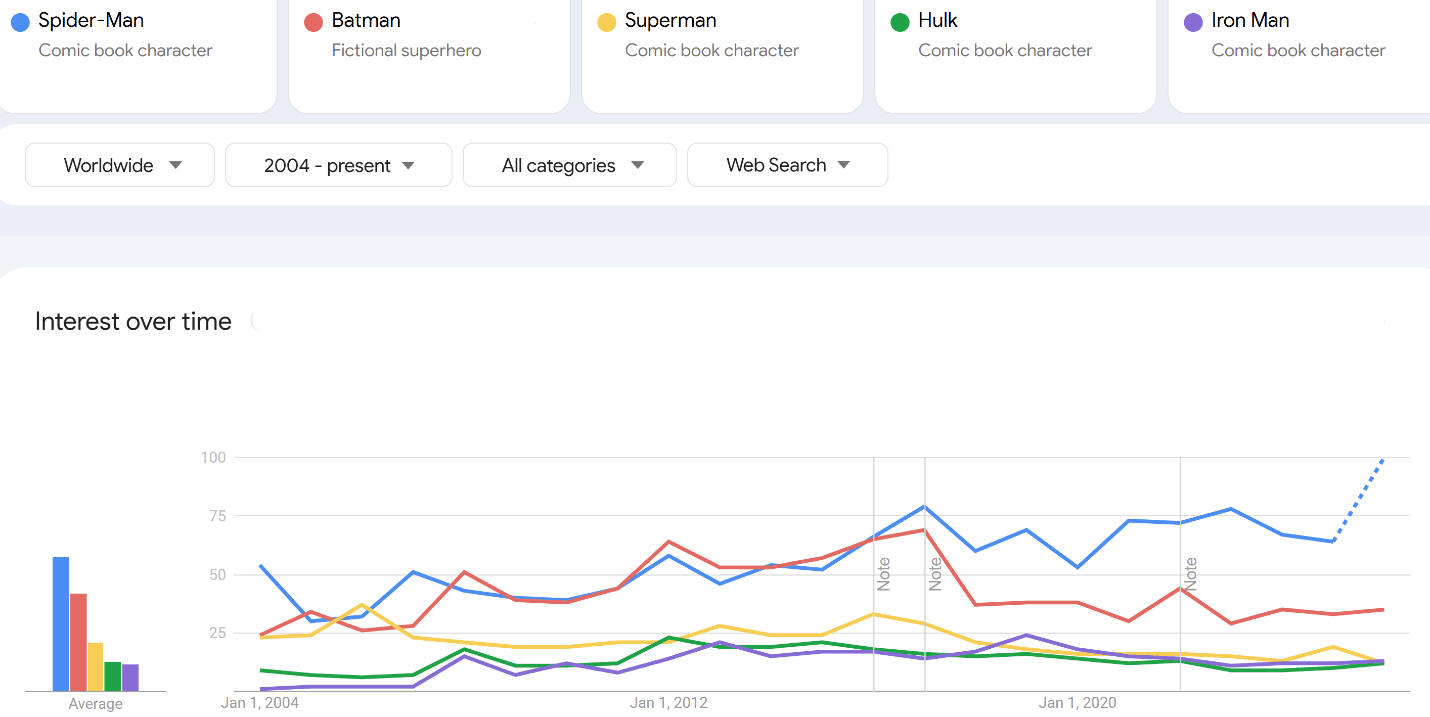
It’s a bit tautological to say that a Spider-Man movie is popular because Spider-Man himself is popular, but it’s partly true. Just as the Beatles are a big enough draw to justify a four-film cinematic event 60-plus years after “Love Me Do,” Spidey still has the juice to headline a lucrative four-film franchise equally long after Peter Parker’s first run-in with a radioactive spider. Various recent studies of superhero popularity (all admittedly derived from dubious methodology) put Spider-Man at or near the top of the hierarchy of (super)power, as did some surveys conducted decades ago. Historically speaking, Spider-Man places just below Batman and well above Superman in estimates of lifetime franchise revenue, even though those non-hyphenated heroes had 20-plus-year head starts. (Spidey ranks third in comic sales, albeit with far fewer issues.) As of 2013—a few years before Spider-Man entered the MCU—Spidey had generated almost double the annual retail revenue of the Caped Crusader and the Man of Steel combined.
In other words, Spider-Man’s prominence in the present draws on and flows from the fan affection, interest, and loyalty that legions of Spider-Man storytellers and corporate stewards (or both, in the case of cocreator Stan Lee) have cultivated over decades—brand equity, if we want to be businessy about it. Spider-Man has a killer rogues’ gallery and lineup of love interests, a rich legacy of multimedia adaptations, and a reputation for being family friendly without solely catering to kids. (Every live-action Spider-Man movie is rated PG-13.) Spider-Man is sticky in many respects: personable but powerful, relatable but layered, a street-level hero who’s capable of cosmic exploits. His hook—high school kid gains great power and wrestles with ensuing great responsibility, as well as work-life balance—has generated mountains of Spider-material and could continue to for as long as coming-of-age stories still resonate. Basically, he’s a four-quadrant character.
Spidey’s long-standing drawing power has a bearing on Brand New Day’s success, considering that it’s still something of an open question whether “superhero fatigue” stems more from spectators tiring of superhero stories in general or from a lack of buzz about certain superheroes. Last month, Stat Significant’s Daniel Parris pointed out that much of the genre’s post-Endgame declines in box office grosses and online interest can be attributed to the introduction of a new cast of characters that didn’t resonate with moviegoers, even though established supes still did. “Split the post-2019 superhero landscape into Spider-Man and non-Spider-Man films, or into legacy characters and new character launches, and the pattern becomes hard to miss: The holdovers still perform, while new mythology does not,” Parris wrote.
It’s tough to untangle the causality here. Maybe the preexisting characters kept their hold on consumers because they’d laid claim to their attention when the superhero subgenre was ascendant and demand for supes still outstripped supply, while the characters that came along later struggled to gain a toehold because the market was saturated and viewers’ appetite for masks, capes, and spandex was waning. Or maybe the makers of superhero media made the same mistake as sports card manufacturers during the “junk wax” era: Eager to ensure that sales would keep climbing, they flooded the market and inadvertently confused consumers, compromised quality, and devalued their product.
In the case of superheroes, that meant expanding the hero roster from the A- and B-tier icons who had powered the box office breakout (Superman, Batman, Spider-Man, the X-Men, Hulk, Captain America, Iron Man, Thor) to C- and D-tier heroes who either hadn’t been around for that long or had endured but never really broken through to the mainstream (the Eternals, Moon Knight, Kamala Khan, Shang-Chi, Echo, Ironheart, Wonder Man, Black Adam, Blue Beetle). Per that interpretation, it’s not that Thunderbolts* made so much less than The Avengers because the movie was way worse or even because fans were fed up with the MCU; it’s that the New Avengers’ lineup lacked the clout of the Avengers’ household names. James Gunn may have helped catapult Groot, Rocket Raccoon, and other Guardians of the Galaxy from comics obscurity to Hollywood fame, but that’s a difficult trick to keep pulling off, and Gunn couldn’t make every comic book movie.
As usual, the explanation is probably a blend of both possibilities: Audiences grew less receptive to superhero adaptations both because they’d been force-fed so many of them and because the newer ones came to feature less famous figures as Marvel and DC dug deeper for source material. Either way, Spidey’s status is safe. Name recognition matters, and merely marketing a character as a “Marvel Legend” doesn’t make them so. Sorry, Morbius.


The movie is good.
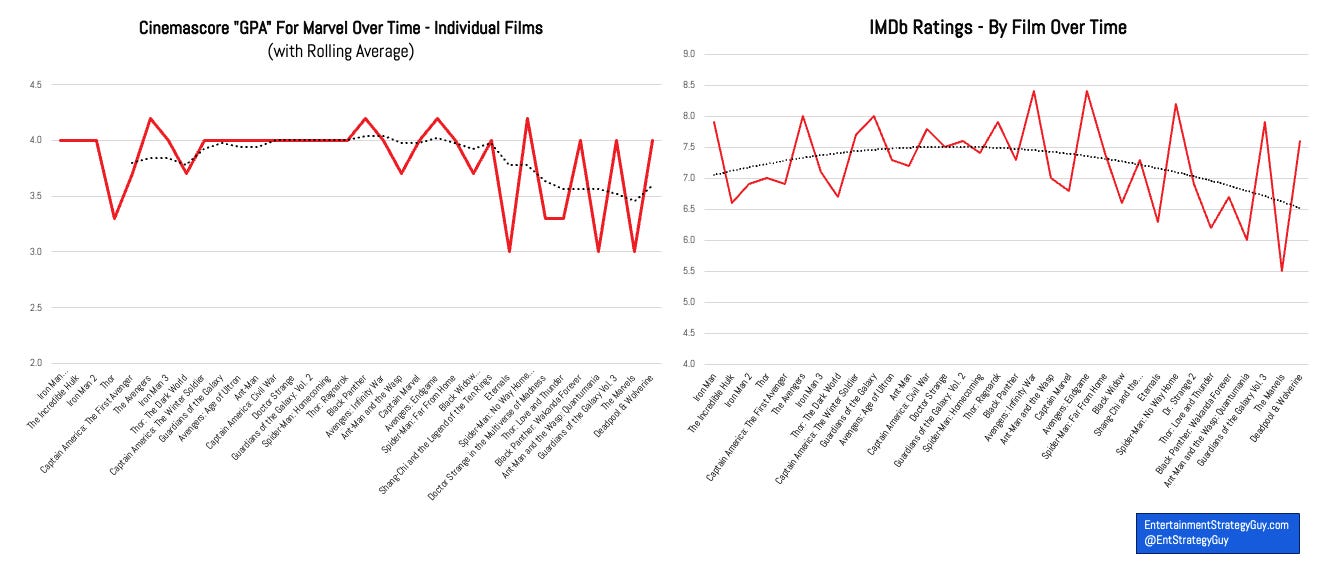
Speaking of Morbius—and, for that matter, many other movies in the conspicuously Spidey-less “Sony’s Spider-Man Universe”—quality clearly affects box office performance to some extent. Morbius tanked (twice) because the character of Michael Morbius wasn’t well known and because Morbin’ Time was delayed until 2022—past peak superhero—but also because the movie was terrible. As I noted last year, critics’ ratings for superhero movies slid significantly after the pandemic, as did audiences’ CinemaScores and IMDb user scores. Again, the causation is complicated: Maybe review scores sank in part because the desire for supes was spent and the featured heroes were inherently less alluring, not solely because the movies weren’t as well crafted. Regardless, critics and rank-and-file spectators liked them less, and thus they also saw them less.
Brand New Day, directed by Destin Daniel Cretton, is a good movie. Of the 11 MCU films since 2021’s Spider-Man: No Way Home, it’s only the fourth (after Black Panther: Wakanda Forever, Guardians of the Galaxy Vol. 3, and Deadpool & Wolverine) to receive an “A” CinemaScore, and it has the highest Rotten Tomatoes critics rating (89 percent fresh). Its current 8.2 IMDb user score is the third highest for an MCU movie, after Endgame and Avengers: Infinity War. Maybe Brand New Day is performing like a movie from Marvel’s heyday because it feels like a movie that could have been made during Marvel’s heyday.
Of course, Cretton’s previous MCU efforts, Shang-Chi and the Legend of the Ten Rings and Wonder Man, were also strong—they have higher Rotten Tomatoes ratings than Brand New Day—but they weren’t popular sensations. Brand New Day had hype from the start, as evidenced by its boffo trailer view counts and presales. Maybe the movie’s quality and compelling premise (based in part on the 2008 comics story line of the same name) were reflected in the trailers, and the positive reviews and word of mouth may have helped its opening blow by even the most bullish forecasts. (Its debut doubled projections from early July.) But audiences also seemed to be hungry for another Spider-Man movie.
Holland’s Spider-Man movies, cowritten by Erik Sommers and Chris McKenna, have all earned “A” CinemaScores and good to great reviews, but that hunger for a fourth film was enhanced by No Way Home, which grossed almost $2 billion worldwide, making it the top-grossing non-Avengers Marvel movie. Spider-Man movies have always been reliable earners: Even the worst-received and least lucrative installment, The Amazing Spider-Man 2, took in more than $700 million globally in 2014. But No Way Home propelled Spider-Man into a higher blockbuster bracket via its multiversal mash-up of three Spider-Men—Tobey Maguire, Andrew Garfield, and Holland—and their various nemeses.
Irrespective of No Way Home’s merits as a stand-alone story, the movie made the most of Spidey’s extensive on-screen history and reminded viewers that his Hollywood outings were rewatchable and precedent setting from the start. Blade (1998), X-Men (2000), and Blade II (2002) set the stage for the 21st-century superhero surge, but the success of Spider-Man (2002) was an even more convincing proof of concept (creatively and financially) for the MCU, even though Spidey wouldn’t join that party until 2016. It’s only fitting that the character who helped unlock the potential of modern superhero cinema would deliver the franchise from its doldrums now.
Spider-Man writ large is really on a roll.
No Way Home presaged Marvel’s memberberries embrace of its own big-screen halcyon years, and Holland was one of the MCU’s last links to the pre-Endgame Avengers until Marvel started resurrecting and recycling his former costars’ characters. But Spider-Man is more than a legacy act. In fact, the Spidey-industrial complex has been firing on all cylinders for almost 10 years, which created a groundswell of enthusiasm that has buoyed Brand New Day.
Spider-Man seems untouchable today, but a decade ago, the web slinger’s standing in the superhero firmament was tenuous. Spidey’s comics were at a low ebb in sales, Garfield’s reboot series was axed before planned third and fourth films could be made, and Broadway musical Spider-Man: Turn Off the Dark became a costly fiasco. The subhead of a Ringer feature published in July 2017—on the eve of Holland’s first star turn as Peter Parker in Spider-Man: Homecoming, albeit after his supporting appearance in 2016’s Captain America: Civil War—mentioned the character’s recent “rocky few years” and questioned whether Spidey was still “as relevant as he once was.” But the “uncertain future” that the story’s nut graf teased would turn out to be unbelievably bright, as Spidey turned into a trans-media hitmaker for all ages.
Not only was Holland a hit in the live-action flagship films, but the rapturously received Spider-Verse films—2018’s Into the Spider-Verse and 2023’s Across the Spider-Verse—also literally redrew the animation landscape. Meanwhile, two small-screen animated projects, Spidey and His Amazing Friends (2021 to the present) and Your Friendly Neighborhood Spider-Man (2025 to the present) became gateways to Spider-Man fandom for a new crop of kids. In addition, Insomniac’s PlayStation/PC smashes—Marvel’s Spider-Man (2018), Marvel’s Spider-Man: Miles Morales (2020), and Marvel’s Spider-Man 2 (2023)—leveraged the improved processing power of modern gaming machines to render breathtaking open-world visions of New York City as the settings of exhilarating, interactive Spidey simulators. And although the main Amazing Spider-Man book (which will mark its milestone 1,000th issue next month) is widely regarded as somewhat stagnant—possibly because it’s challenging to tell non-repetitive tales about a grown-up Peter Parker—there are still celebrated offshoots, such as the recently completed Ultimate Spider-Man and 2017-18’s Peter Parker: The Spectacular Spider-Man (not to mention Dan Slott’s mid-2010s comics creations, The Superior Spider-Man and Spider-Verse).
All of these gifts could keep giving for the next few years. Marvel may have a Spidey succession plan in place for the MCU—which will likely involve Miles Morales—but it doesn’t sound as if Holland is ready to sling off into the sunset just yet. (He’ll likely appear in next year’s Avengers: Secret Wars, although some Spidey may drop into this December’s Avengers: Doomsday.) The Spider-Verse trilogy is slated to conclude with Beyond the Spider-Verse next June, and Insomniac is making Marvel’s Spider-Man 3, potentially for 2028. Best of all, it seems as if Sony is finished sullying Spider-Man’s good name with its low-rent, Spidey-adjacent live-action spinoffs.
Essentially, there’s still a lot of life left in Spider-Man, which is a testament to the venerable hero’s timelessly attractive traits and to the ways in which generations of writers and artists who grew up with Spidey have repeatedly reinvented him. There isn’t a single architect of this era of peak Peter Parker—it takes a (friendly) neighborhood—but all in all, the brand management could hardly have been better, which acted as an effective force multiplier for Brand New Day anticipation.
There was pent-up demand for this specific Spidey.
As well as it’s worked out, that proliferation of Spider-content could have backfired. The profusion of Spider-People (and Spider-spinoffs) from the Spider-Verse films alone is dizzying, and taken collectively, the live-action films, animated movies and TV shows, video games, and comics mean a lot of different Peter Parkers and Spider-Man continuities to corral.
However, the fact that these projects employ independent narratives means that no one needs to watch, play, or read everything to keep up; fans are free to order only what they want off the Spider-Man menu. Plus, it’s hard to complain about quantity when the quality is consistently strong, which hearkens back to the debate about “superhero fatigue”: Are people tired of superhero stories, or only lackluster ones? Moreover, Holland himself hasn’t been overexposed as Spidey: The four-plus-year gap between the releases and stories of No Way Home and Brand New Day replenished demand and made the movies more distinct.
In that sense, Brand New Day is a template for the future of the MCU. Disney’s new mantra for Marvel (and Star Wars, for that matter) seems to be that less is more. Although franchise head Kevin Feige has charted a tentative course for the MCU through 2042, each year will, on average, bring fewer films (and far fewer streaming series), based on safer bets on big actors and characters: multiple Avengers movies, Black Panther III, Shawn Levy and Ryan Gosling’s Ghost Rider and, presumably, plenty of X-Men (an effort facilitated by Brand New Day’s introduction of Sadie Sink as telepathic/telekinetic mutant Jean Grey). That’s bad news for minor Marvel (including Cretton’s Wonder Man, which was just unrenewed) but good news for the odds of a return to Marvel movies as spectacular—and, Disney hopes, spectacularly profitable—events.
It has crossovers, chemistry, and star power.
All of the above would be sufficient to explain Brand New Day’s powerhouse start. But because everything keeps coming up Spidey, there are a few more flavors to the movie’s special sauce.
For one thing, Disney delivered (and to some degree, lucked out) when it came to casting. Zendaya became a bigger star in the years after she was picked to play MJ, thanks to prominent parts in Euphoria, Dune, Challengers, and The Drama. In addition, she and Holland started dating at some point(s) amid the making of their Spider-Man movies, which brought a parasocial celebrity-gossip element to how fans followed the franchise. After privately tying the knot earlier this year, Zendaya and Holland hard-launched each other as spouses in the weeks preceding the premiere, which didn’t hurt the promotional push. Plus, it’s possible that Spider-Man playing alongside The Odyssey—which also stars Holland, Zendaya, and Jon Bernthal—fostered some synergy as the acting trio propelled the tag team of back-to-back IMAX movies to the biggest weekend in box office history.
Then there are the crossovers. Whereas many MCU projects have faltered because they got sidetracked in setting up subsequent releases, Brand New Day feels focused. (Maybe because it’s one of the ends that those previous projects were mostly a means to.) The new Spider-Man movie is full of familiar faces—the Hulk, the Punisher, Yelena Belova—but they all appear for valid reasons and make the movie’s New York City seem vibrant. And while the secrecy surrounding the predictable identity of Sink’s character got extremely silly, perhaps it did add some urgency for fans who feared spoilers.
Brand New Day is also probably riding the rush of a few contemporaneous superhero-related plot points: Marvel’s Comic-Con reveals, the lower-grade excitement surrounding X-Men ’97’s second season, the impending premiere of DC’s HBO drama Lanterns, and, most notably, the forthcoming comeback of the Avengers. Much as Marvel may hope to rope in wayward watchers by playing the hits, Doomsday might fall short of the standard set by its Avengers predecessors. Judging by the buzz about its much-watched trailer, though, plenty of people will line up to find out. The MCU’s glory days are probably behind it, but trading on the core memories minted by its biggest hits of old has given Marvel more momentum (or at least marketability) than it’s had in years. The halo effect of drowning out discussions of fatigue can’t have hurt Brand New Day, a movie whose title tries to signal a fresh start.
At some point—perhaps after Secret Wars soft resets the MCU—Holland will bow out, and Spidey will be recast and/or rebooted for the third time in 20-ish years. The future for Spider-Man is murky beyond that, aside from the certainty that as always, “Spider-Man will return.” In the medium term, though, Marvel has a fatigue-proof behemoth on its hands in the MCU’s cornerstone star. Which means that for now, this much can be said about Spidey: With great power comes great movies and, by extension, great revenue.