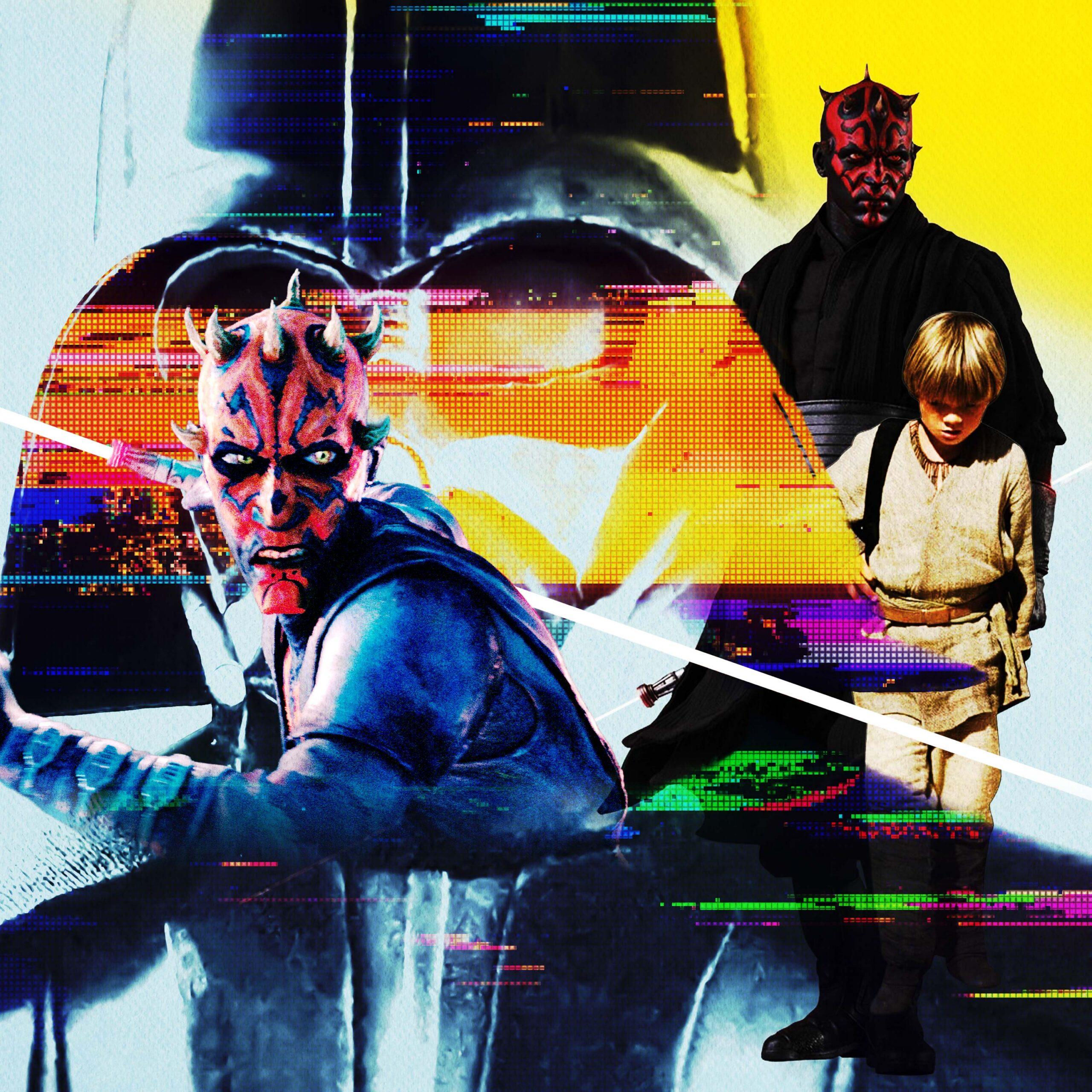


On May 22, Star Wars will make its modestly anticipated return to theaters. But for some subset of the franchise’s faithful, the month may have already peaked with the arrival of an even longer-awaited event—on the small screen, instead. In the wee hours of Monday, May the Fourth, Lucasfilm sprang a surprise in the Season 1 finale of the animated Maul—Shadow Lord: a Star Wars Day duel decades in the making. For the first time ever, outside of a noncanonical comic and fans’ fevered imaginations, the Shadow Lord met the Dark Lord, as Maul crossed sabers with Vader in a double dose of Darths. Maul-ennials who imprinted on the brooding Zabrak and the child version of Vader when the two ill-fated Force users shared a few frames of The Phantom Menace have permission to party like it’s 1999.
To paraphrase Yoda’s famous line from that film: Always two there are—an apprentice, and the apprentice who preceded him. That Maul would meet Vader at some point in the new Disney+ show seemed like a lock. But a confrontation so climactic and narratively rich figured to be something the series would save for its second season, whose production is already well underway. Not so: Their showdown in Shadow Lord closed out the first season on a high and left viewers wanting more, which the second season is certain to deliver. It’s a rare instance of Star Wars fan service that delivers something new and vital and doesn’t disappoint.
Technically, the Maul-Vader skirmish on Janix was the second encounter between the two iconic baddies, if you count their close encounter in Episode I. Anakin, drop!
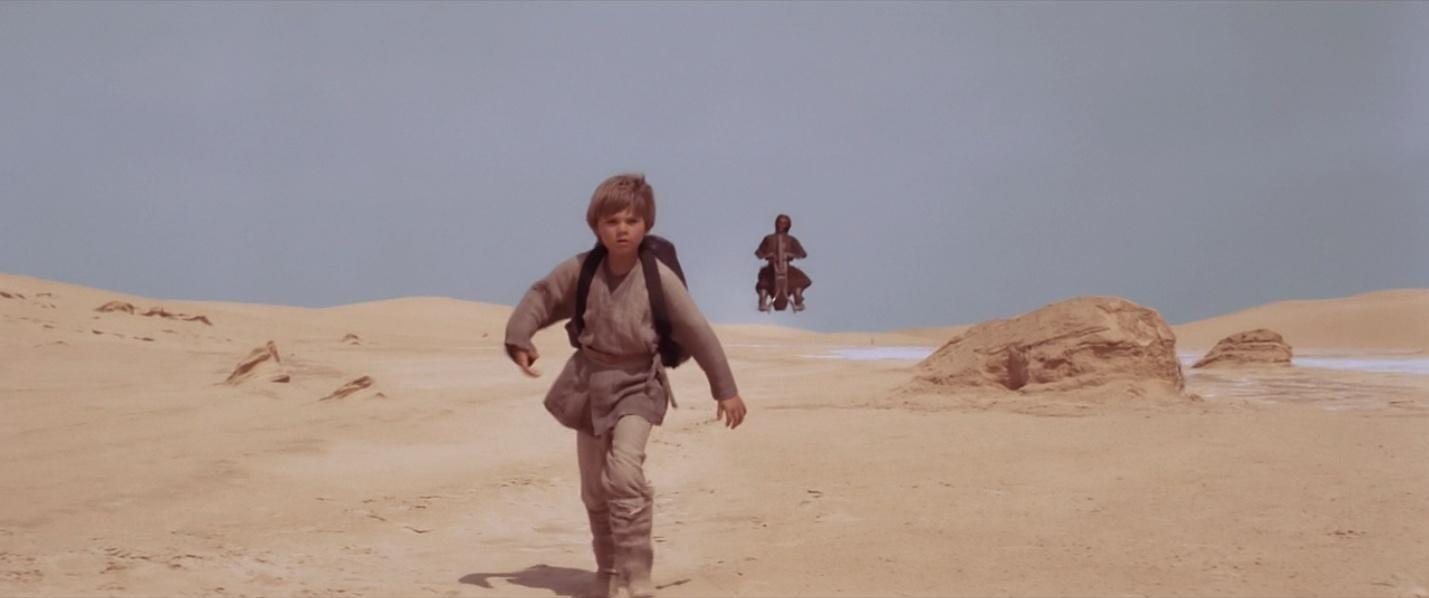
That drive-by aside, the two characters’ paths hadn’t crossed until the 10th episode of Shadow Lord, “The Dark Lord.” But their destinies intersected significantly. By killing Qui-Gon Jinn, Anakin’s Jedi abductor, savior, and surrogate dad, Maul set the tempestuous chosen one on the path to be trained by Obi-Wan Kenobi and, ultimately, to be seduced to the dark side by Darth Sidious. And by catching Chancellor Palpatine’s eye, young Anakin rendered Maul redundant. Forsaken by Sidious and supplanted at the Sith master’s side by the postpuberty incarnation of the kid he’d nearly sideswiped on Tatooine, Maul dropped his “Darth” and dedicated himself to seeking revenge—this time, on the Sith, not the Jedi.
In their first on-screen meeting, Obi-Wan warned Vader, “If you strike me down, I shall become more powerful than you can possibly imagine.” If the Maul of Phantom Menace had been more loquacious, he might have said the same to Kenobi. By cleaving Qui-Gon’s killer in half, Kenobi made Maul twice as interesting, granting him a fuller, elongated life in animation—both in comics and in a trio of TV series, The Clone Wars, Rebels, and Shadow Lord (plus a holographic, live-action cameo in Solo). As a crime lord with a grudge against the Empire, animated Maul (voiced by Sam Witwer) had much more to work with than he did in the prequels (well, prequel), where his stereotypically villainous name, devilish horns, and lack of lines might have made him a forgettable lackey if not for his double-bladed saber and actor Ray Park’s acrobatic choreography.
Maul’s post-apprentice life and vendetta against Sidious put him on a collision course with the Emperor’s sidekick, so if anything, it’s an upset that his rendezvous with Vader was delayed this long. It almost wasn’t: Maul was supposed to fight Vader, and die at his hand, in the Season 2 finale of Rebels, which aired in March of 2016. But Rebels (and Shadow Lord) cocreator Dave Filoni decided to spare and develop Maul, opting instead to set up a memorable battle between Vader and his former apprentice, Ahsoka Tano. In the summer of 2016, IGN asked Filoni whether a meeting between Maul and Vader was inevitable. “Not necessarily,” he said. “It sounds like a great idea and then you start to develop it and you worry it’s a little more fan service-y. If it makes sense, it would happen but I’d say it’s a little unlikely.”


Maul met his end in Rebels Season 3, when Kenobi finished the slaying he’d started on Naboo. That precluded a Vader-Maul matchup closer in the timeline to the original trilogy, but it left open the possibility of an earlier clash. In 2016, Filoni said he’d concluded “that if anything happened to Maul, it needed to have its proper time and its proper space.” Maul’s eponymous series provided the perfect stage for a conflict with Vader—the stuff of fans’ dreams—not to feel forced or perfunctory. Maul, after all, had run afoul of the Empire on occupied Janix and was escorting two Order 66 survivors, Master Eeko-Dio Daki and his Padawan, Devon Izara. The three saber wielders had held their own against two of Vader’s Jedi-hunting inquisitors, and the potential to bag a trifecta of Force-sensitives made it natural for Vader to intervene.
At this point, almost every possible permutation of character interactions has occurred somewhere in the Star Wars corpus; any characters who could come across one another probably already have, because it’s fun for storytellers to make like kids smashing toys together.
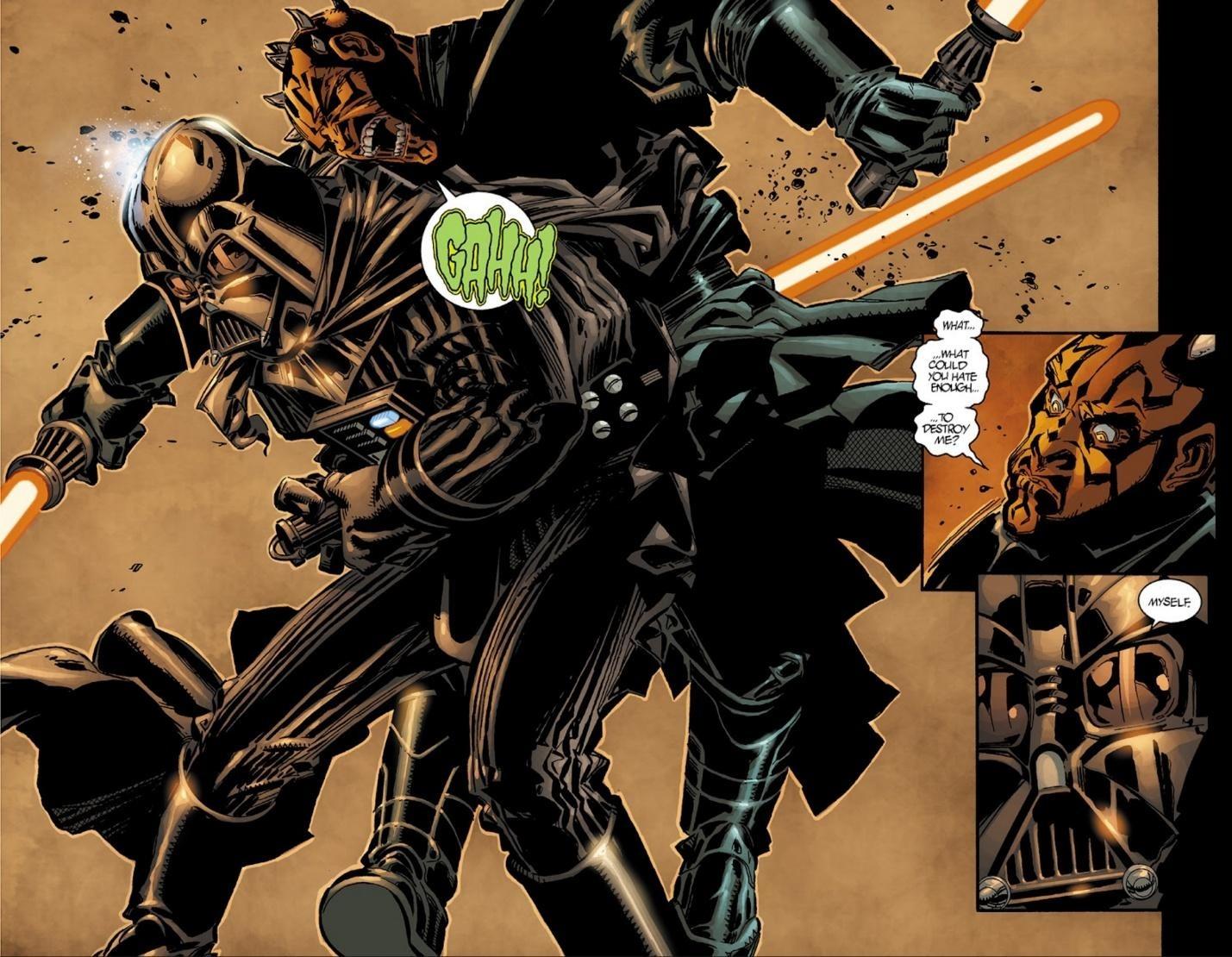
But the only previous tussle between Vader and Maul (at least since the two traded “Darths”) happened in print, in an issue of Star Wars Tales that was published in October 2001, more than a decade before Maul resurfaced for real on The Clone Wars. The Maul that Vader fought in that comic—in a test of Vader’s inner evil orchestrated by Sith adherents who (pretty presciently) feared that Vader’s Jedi past might make him less committed to their cause—may have been more of a projection or simulacrum than the genuine article. Moreover, Tales was considered quasi-canonical even before Disney de-canonized the “Legends” continuity that preceded George Lucas’s sale of the franchise. So Vader’s defeat of Maul—achieved by impaling Maul with a saber stuck through Vader’s body—doubly doesn’t count.
Because Shadow Lord is an interquel constrained by preexisting lore, the two past or present Sith lords can’t do much more than exchange lightsaber love taps. Maul, Vader, and the two inquisitors are ticketed for demises we’ve already seen on-screen, in later tangles against different foes. Devon is also imperviously plot armored; Maul is cultivating her as his apprentice (as he later tries to do with Ezra Bridger), and she needs to survive into the second season so that she can take her place by his side as a Twi’lek learner akin to the one Lucas had envisioned as Maul’s pupil in the Star Wars creator’s original plan for the sequel trilogy. That’s bad news for Daki: Few characters in fiction have ever been more marked for death than Devon’s Mosyk master. Sure enough, Vader skewers the peace-loving Jedi after Maul betrays Daki and slinks away to save his own skin. One more Jedi down.
The Maul of Rebels is terrified of Vader; “I cannot defeat Vader alone,” he admits. What made him so sure? Now we know. It wasn’t just the Sith lord’s reputation; it was Maul’s firsthand experience taking on Vader face to helmet. Granted, a damaged mechanical leg makes the Maul of Shadow Lord less agile, but even in tandem with the two Jedi, he barely fends off Sidious’s younger, stronger right-hand man. Of course, Vader is more machine than man, and Maul is roughly half-and-half. Maul can’t repel midi-chlorian counts of that magnitude, in an adversary whose hatred, self-loathing, and command of the dark side run as deep as Vader’s do. Just as on Rebels, Maul shrinks from the fight.


When you have an available villain as intimidating and recognizable as Vader, it’s hard to resist the temptation to trot him out often. Although Vader was absent from The Bad Batch and Andor, he pops up in numerous other stories set between Revenge of the Sith and the original trilogy, from the Jedi games to Outlaws to Tales of the Empire (and many a book and comic). As I wrote last year, “Usually, Vader is a presence I’ve not felt since … whenever the most recent Star Wars project came out.” And even Vader delivers diminishing returns if he’s deployed lightly.
“The Dark Lord,” written by Matt Michnovetz and Brad Rau and directed by Nate Villanueva, sidesteps that problem by distilling Vader down to his most nightmarish essence. This is the Vader from the end of Rogue One: implacable, inexorable, ruthless. And, crucially, silent, save for his haunted, haunting breathing, which the Force-sensitive fugitives hear before they see their pursuer appear from the fog. Vader must know who his horned prey is, both from their run-in on Tatooine and because it’s Vader’s job to apprehend powerful figures like Maul. But if so, he doesn’t let on. He’s there to exterminate, not to talk.
Maul knows, or strongly suspects, who Vader is, too. After the first melee, Daki tells Devon, “This enemy is something different. I fear what my instincts are telling me. … A Dark Lord of the Sith.” In the background, Maul mutters, “It can’t be … no, no, no, no …” In Season 7 of The Clone Wars, Maul confided to Ahsoka that he was well aware of Anakin’s importance to Sidious: “He has long been groomed for his role as my master’s new apprentice.” Upon seeing Vader in Shadow Lord—and, perhaps, recognizing some hallmarks of their mutual master’s training—he searches his feelings and knows it to be true: This is his superior successor. And when he tells Devon that she’s not yet strong enough to vanquish Vader, Maul might as well be speaking to himself.
“The Dark Lord” doesn’t definitively answer the schoolyard debate: Who would win, Vader or Maul? But maybe the answer is obvious. “He is very powerful,” Maul admits, and the normally confident dark sider’s apprehension is palpable. Vader can’t kill Maul because canon dictates that Kenobi be the one to end him. But just as no one could kill Anakin except his inner Vader, no one can kill Vader except his inner Anakin.
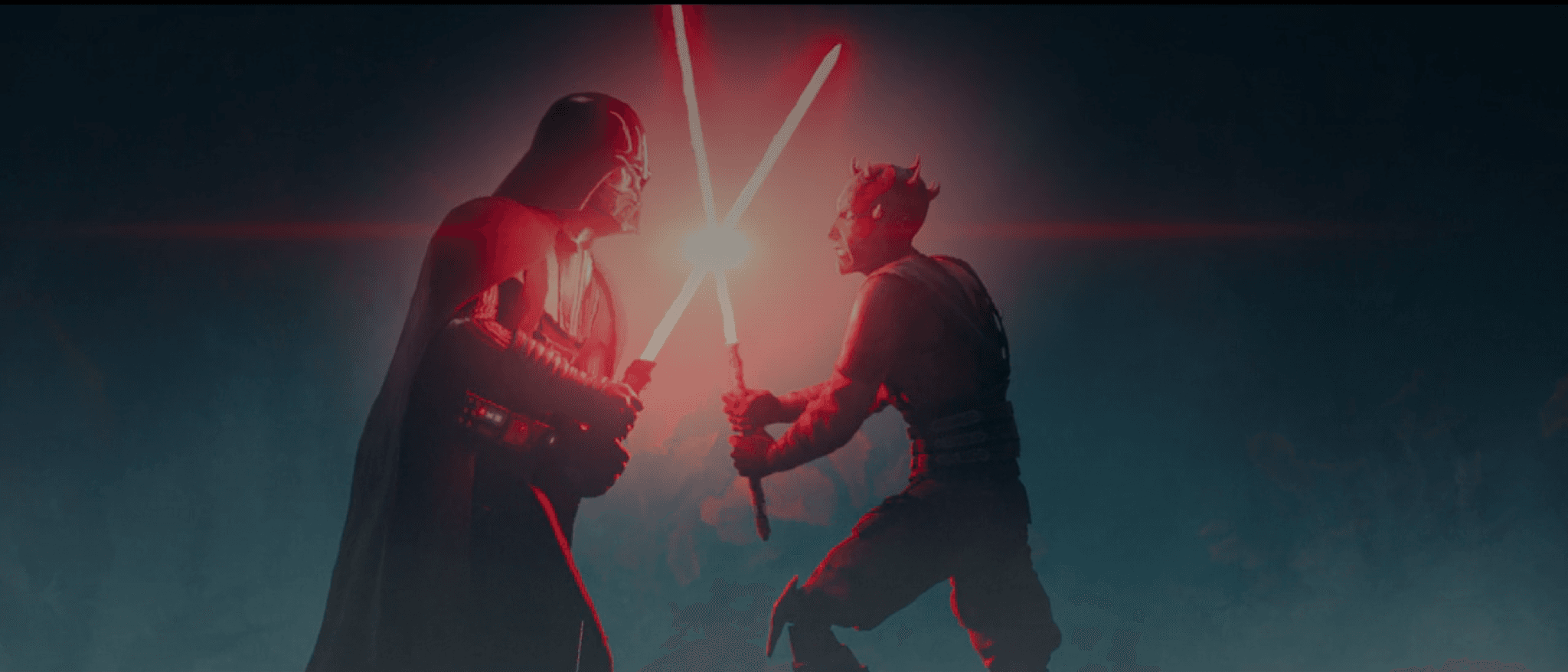
Unlike the extended duel between Vader and Kenobi in 2022’s Obi-Wan Kenobi—which may have looked and sounded cool, but hardly deepened the duo’s relationship and left us wondering why Obi-Wan would leave a vulnerable Vader alive again—this stunning encounter had a real reason to exist, apart from fan service and nostalgia. It supplied the first documented, post-Tatooine meeting between two legendary, dangerous wretches whose histories have overlapped and interlocked. It fleshed out our understanding of Maul’s behavior in Rebels. And although the battle—which worked in a few allusions to The Force Unleashed, another Vader-centric story starring Witwer—was suitably epic, it will probably prove to be a prelude to a second, even more substantial tête-à-tête.
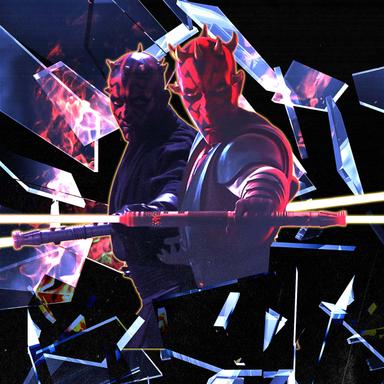
Next time Vader tracks down Maul—and he’s sure to pick up his quarry’s trail—they’ll be due for a dialogue. This pair has plenty to discuss, even if they aren’t likely to kick back and swap Sidious stories. At the end of Season 1, Maul has lost his allies—Mandalorian second-in-command Rook Kast, devious droid companion Spybot, Zabrak buddies (and brothers) Icarus and Scorn—but gained an in to Crimson Dawn, which he’s poised to take over (with Solo’s Dryden Vos installed as a figurehead). By the time Rebels rolls around, Maul will have lost his standing in the underworld, but we don’t know how his demise arrives. Maybe Vader has something to do with it. And although Maul may be no match for Vader with a blade (or even two), his words can cut, too. Maybe Maul will water the seeds of distrust Vader feels toward Sidious, psyching up the Sith to topple Palpatine. Maul can’t take on the whole Empire himself, but perhaps he can help engineer its downfall indirectly.
If Lucas is watching his protégé’s show, he must be smiling, because the finale of Filoni’s creation rhymes with Episode I: An unspeaking Vader cuts down Devon’s master, just as an unspeaking Maul cut down Anakin’s. And Devon has now started down the dark path that Anakin followed too far. Until the franchise breaks free of the narrative bonds binding it to a narrow portion of the timeline, it’s doomed to keep playing with the same set of action figures. But the makers of Maul’s show found a fascinating way to arrange them. On the macro-level, Star Wars may be stuck in something of a narrative rut, but in the short term, Shadow Lord should dominate its destiny.