

As the end of November nears, Major League Baseball’s collective bargaining agreement resembles the rose from Beauty and the Beast, just before Belle goes Beast mode. Barring a buzzer-beating declaration of love between commissioner Rob Manfred and union negotiator Bruce Meyer, the final petal will probably fall next Tuesday night, when the wilted CBA expires and the owners implement a lockout in pursuit of a salary cap. MLB claims that its fans fear for competitive balance, but the universal concern this winter is whether the league will play ball in bargaining, in order for its athletes to play ball next season.
Odds are the two sides will kick the cap down the road and, for the time being, find enough common ground to agree on continuing to make mountains of money. Eventually, the lockout will be lifted, a new CBA will be signed, and another Opening Day will dawn. At that point, public scrutiny will shift from whether there is an on-field product to what that on-field product looks like. And then, MLB will face a less existential but no less intractable problem that one wing of the league is separately trying to solve: a shortage of hits.
Recent scoring is in line with long-term norms, mostly because the home run rate—while down from its peak of the late 2010s—is still high by historical standards. But all-or-nothing offense is the order of the day. Batting average has long since lost its luster as a tool for evaluating individual players, but on a more macro level, dividing hits by at-bats can still shed light on a leaguewide issue. Major leaguers batted .244 in 2026, the seventh straight year in which they finished below .250. That ties 1904-10—the depths of the dead ball era—for the longest such streak. The 2020s stand alone as the longest stretch of sub-.249 seasons, and 2026 is saddled with the lowest seven-year rolling average (an average of averages) ever.
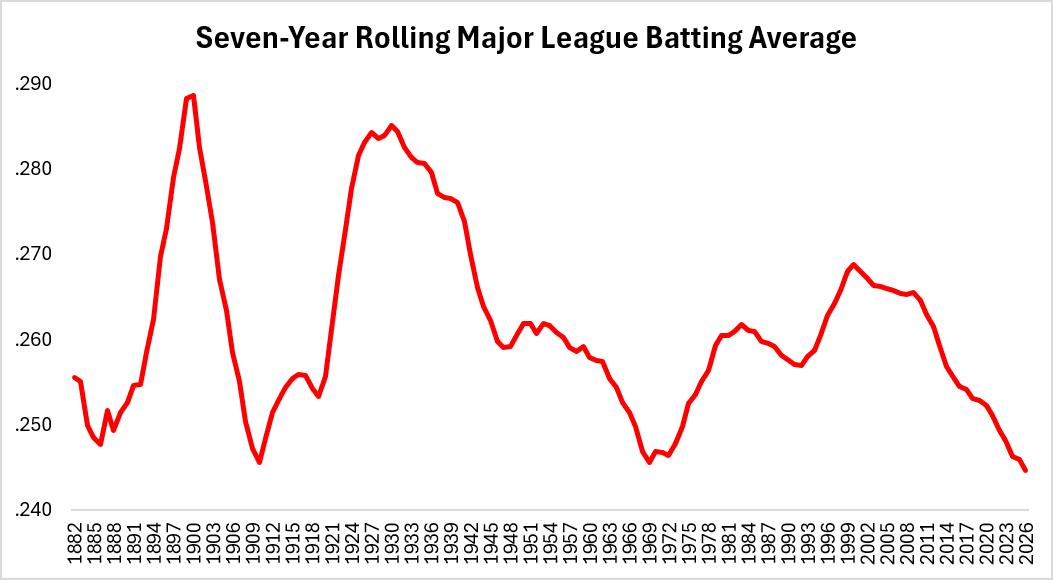
Generally, when batting average has bottomed out, big changes have swept the sport: in 1893, the relocation of the pitching distance to 60 feet, 6 inches; in the 1910s, the introduction of a cork-centered ball (and later, an even livelier model); in the late 1960s and early ’70s, a smaller strike zone, a lower mound, and the American League designated hitter. Recent years have brought big changes to time and pace of play, and ball-strike calls. Along with the smooth, successful incorporations of the pitch clock and the ABS challenge system, MLB has made a few tweaks designed to help hitters, such as banning infield overshifts and extending the DH to the National League. Those measures have done little to reverse the game’s three-true-outcomes emphasis, so it’s back to the drawing board.
“We think baseball is best when more players are involved,” says Joe Martinez, MLB vice president of on-field strategy. Martinez, a former major league player himself, makes the comp to the late ’60s: “We’re in a similar type of environment at this point, where the strikeout rate is very high. Batting average, obviously, is consequently low. Rates of doubles and triples are at or near historical lows. So [we’re] looking for ways to encourage more balls in play, get more action in the game, and just make the game more entertaining for fans.”
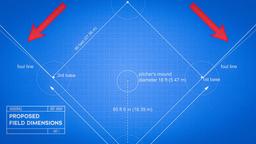
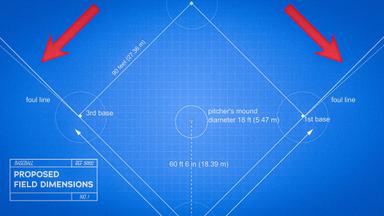
One possible solution played out in this year’s Arizona Fall League, whose six-week, prospect-packed season concluded in mid-November. MLB’s latest experiment, first reported by FanGraphs, hinges on angles in the outfield. The scheme seeks to restrict where outfielders can stand—a bold new version of an old idea, designed to produce more hits. “Based on what we’ve done with infielders,” Martinez says, “it made sense to take it to the next level and say, ‘What if we did something for the outfielders to put them in more traditional positioning?’ … It was a bit of a natural progression, particularly because teams are just getting so much better or so much closer to optimal in how they position their players, with all the information they have.”
That “what if” is no longer hypothetical. Although other sources assessed the trial’s results during the AFL season, we can now offer a full breakdown, in addition to the league’s first on-the-record comments about the thinking behind the initiative and potential next steps.
Let’s back up a bit—much as major league outfielders have. (More on that in a moment.) If we’re asking, “What’s the problem?” that led to low batting averages, the answer isn’t just that Ichiro retired. Really, there’s a two-pronged problem—not enough balls in play, and not enough hits on balls in play—with a common culprit: Defense got too good.
Pitchers’ stuff keeps improving, thanks to data-driven pitch design and selection, velocity training, and usage geared toward short-burst, max-effort outings. Couple that trend with a sabermetric fervor for pitcher whiffs, a reduced stigma surrounding swings and misses by batters, and a prevailing offensive philosophy geared toward swinging hard and doing damage in the air, and you have a recipe for more strikeouts—and, by extension, fewer batted balls, which can become hits.
The good news is that the once inexorable rise in strikeout rate has been halted, for now. The K rate this season (22.1 percent of plate appearances) was the lowest since 2017, or 2018 if we exclude pitcher hitters.
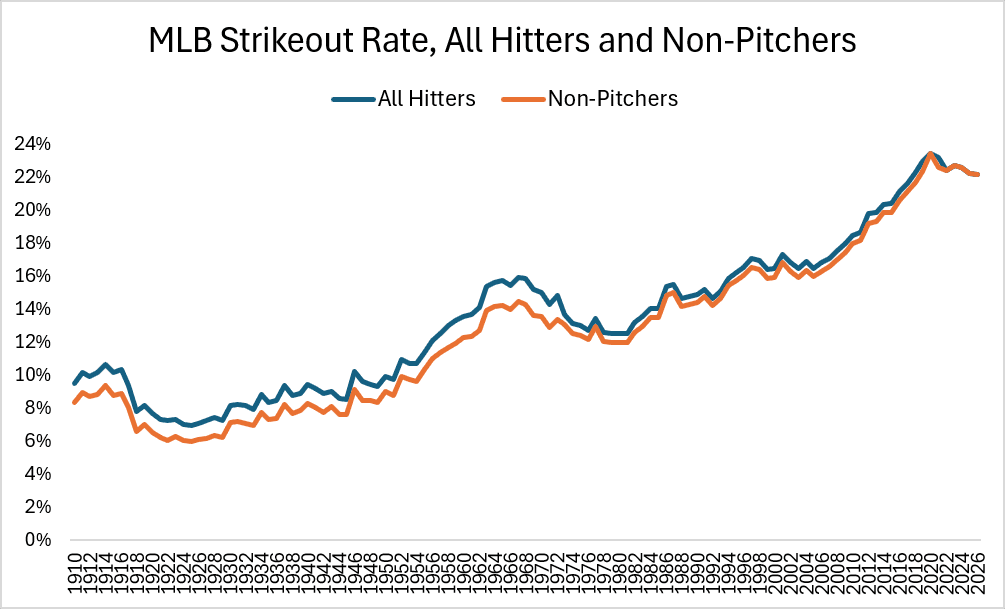
Martinez credits the universal DH and the crackdown on sticky stuff for the strikeout plateau, although he notes that a 22 percent rate is still too high. “Hopefully we can get some of those balls in play rather than just throw[ing] them back to the pitcher while the batter walks to the dugout,” he says.
But putting the ball in play is increasingly just another way to wind up back on the bench. Batting averages aren’t down only because of Ks; they’re down because of what happens when hitters make contact. In 2026, batters hit .290 when they put the ball in play. MLB hasn’t seen a lower league BABIP since 1992, a time before multiple rounds of expansion, pervasive PED use and strength training, and changes to the ball. The old maxim “Good things happen when you put the ball in play” hasn’t been less true in decades.
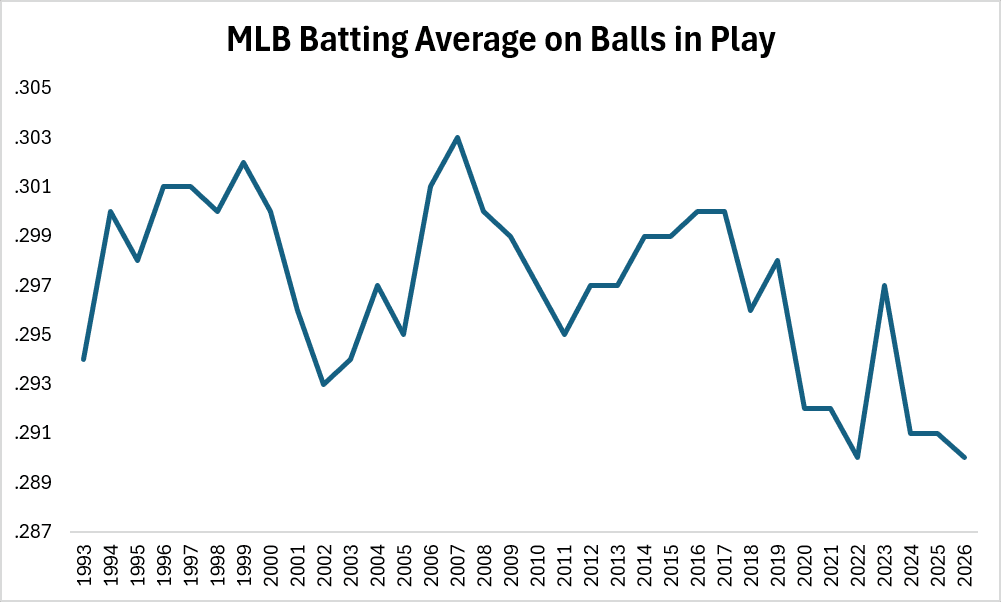
BABIP on ground balls is roughly as high as it’s been at any point in the past 20 years or so. The decline is coming exclusively on balls in the air. BABIP on line drives and fly balls has fallen from .409 in 2008 to .370 in 2026. With upward of 60,000 batted balls per season fitting those classifications, that BABIP drop translates to thousands of lost hits. And what looks like a reduction in strikeouts might be partly attributable to an increase in caught flies and liners. As Joe Sheehan wrote this past spring, “Every out created on a ball in play is a lost opportunity for a strikeout. … Baseball hasn’t solved its strikeout problem so much as it’s removed opportunities for strikeouts.”
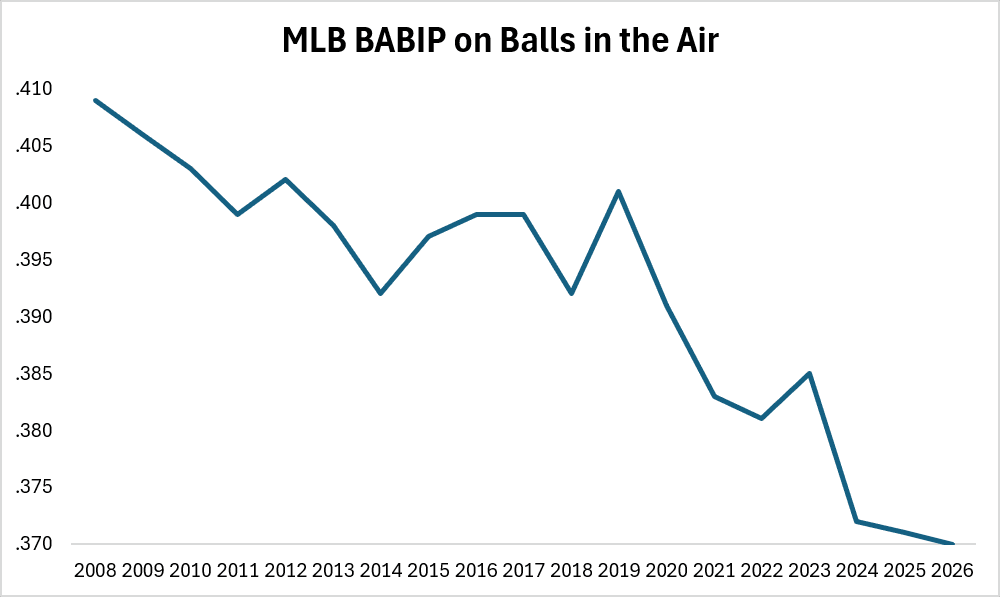
Why is air-ball BABIP dropping? As Russell Carleton observed in 2024, “It’s possible that the emphasis on hitting the ball upward means that the balls that don’t leave the yard are just staying in the air longer and are more catchable.” But that doesn’t account for the difference. It’s been apparent for several seasons that outfielders are simply more effective: They’re faster, better coached, and better positioned than ever. Compared with 2015, outfielders in 2026 stood 12 feet deeper in center and several feet deeper in each of the corners, on average.
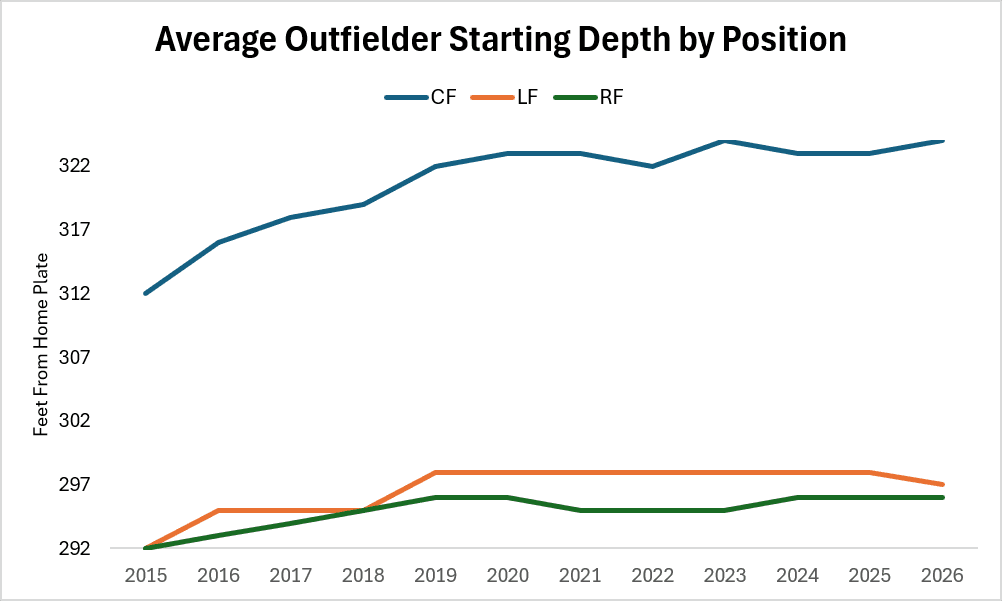
“Teams figured out that … if you can err on the side of preventing extra-base hits, even at the expense of maybe giving up a couple extra singles, that’s kind of a preferred approach or a more optimal approach for run prevention,” Martinez says. “Moving guys into deeper positions, closer to what used to be known as no-doubles defense, is actually a strategy that works pretty well when employed more regularly than just in late-and-close situations.”
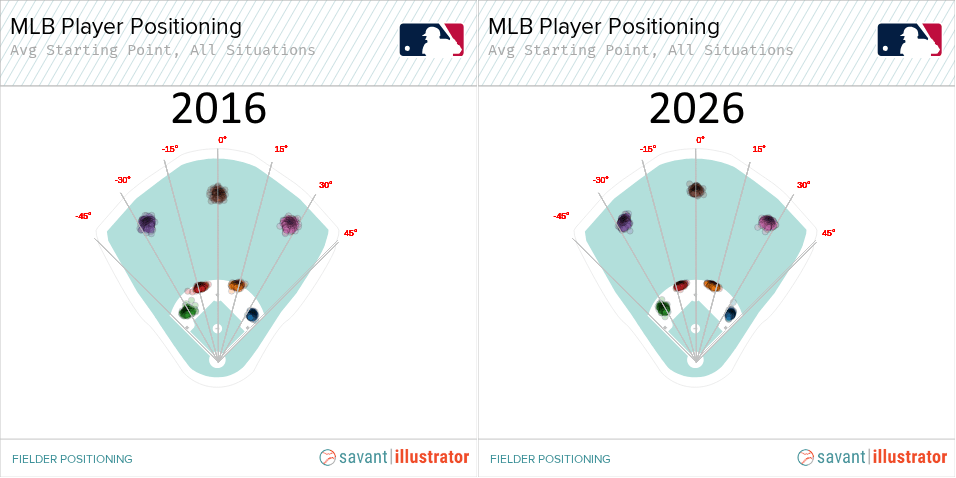
Maybe outfielders had been positioned inefficiently for ages, until tracking data and front office analysis revealed their mistake. Or maybe it made sense to play where they used to when hitters weren’t so often swinging for the fences. One way or another, it’s immensely challenging for modern batters to hit ’em where they ain’t. “You see these guys taking cards out of their pockets and pacing off their positioning,” Martinez says, “where even when guys are able to make contact, which is ridiculously hard to begin with, and even if they hit it hard, oftentimes there’s someone standing there just because the scouting reports and the information is so good.” As then–Brewers first baseman Rhys Hoskins said in 2024, “There are times where I’ve felt like there’s one big glove in the outfield. We’ve got guys out there now that run all over the place. Plus, they know where I’m going to hit it.”
There are two ways to nerf overpowered outfielders: Expand the territory they have to cover—say, by widening the foul lines—or artificially shrink their range. Enter this year’s AFL trial, an extension of past experiments that—for better or worse—is probably better positioned (so to speak) than those were to make a major impact.
In 2023, MLB banned four-man outfields and infield overshifts. The latter measure mostly restored the traditional appearance of infield positioning but, as had been widely foreseen, didn’t have a huge effect on BABIP or offense overall. “The outfield positioning rule has similarities to the infield shift restriction, as it aims to incentive hitters to put the ball in play and creates space for fielders (in this case outfielders) to showcase their athleticism and make great plays,” Martinez says. “The outfield positioning rule should have a more significant impact on BABIP.”
The concept of penning in outfielders isn’t a new one, as MLB is well aware. (“The Unglaub Arc?” Martinez volunteers when I allude to distant precedents, referring to dead ball–era infielder Bob Unglaub, who proposed a similar idea.) But unlike Unglaub’s suggestion or a very brief exercise in the Florida Complex League several years ago (which Martinez says “wasn’t really [an] official test”), the Arizona Fall League version—which was implemented at only one of six AFL parks, Salt River Fields—didn’t require any unsightly lines on the field.
Instead, dark green hash marks painted on the outfield grass and at points along the border between the infield and outfield indicated roughly where outfielders and infielders should stand. The Hawk-Eye tracking system that undergirds Statcast judged in real time whether they were close enough to those marks when the pitch was delivered. Meanwhile, an LED board beneath the press box, visible to the players, displayed red X’s or green O’s to indicate whether each player’s positioning was compliant. As with the existing infield-positioning rules, a violation would result in the batter being awarded first base.
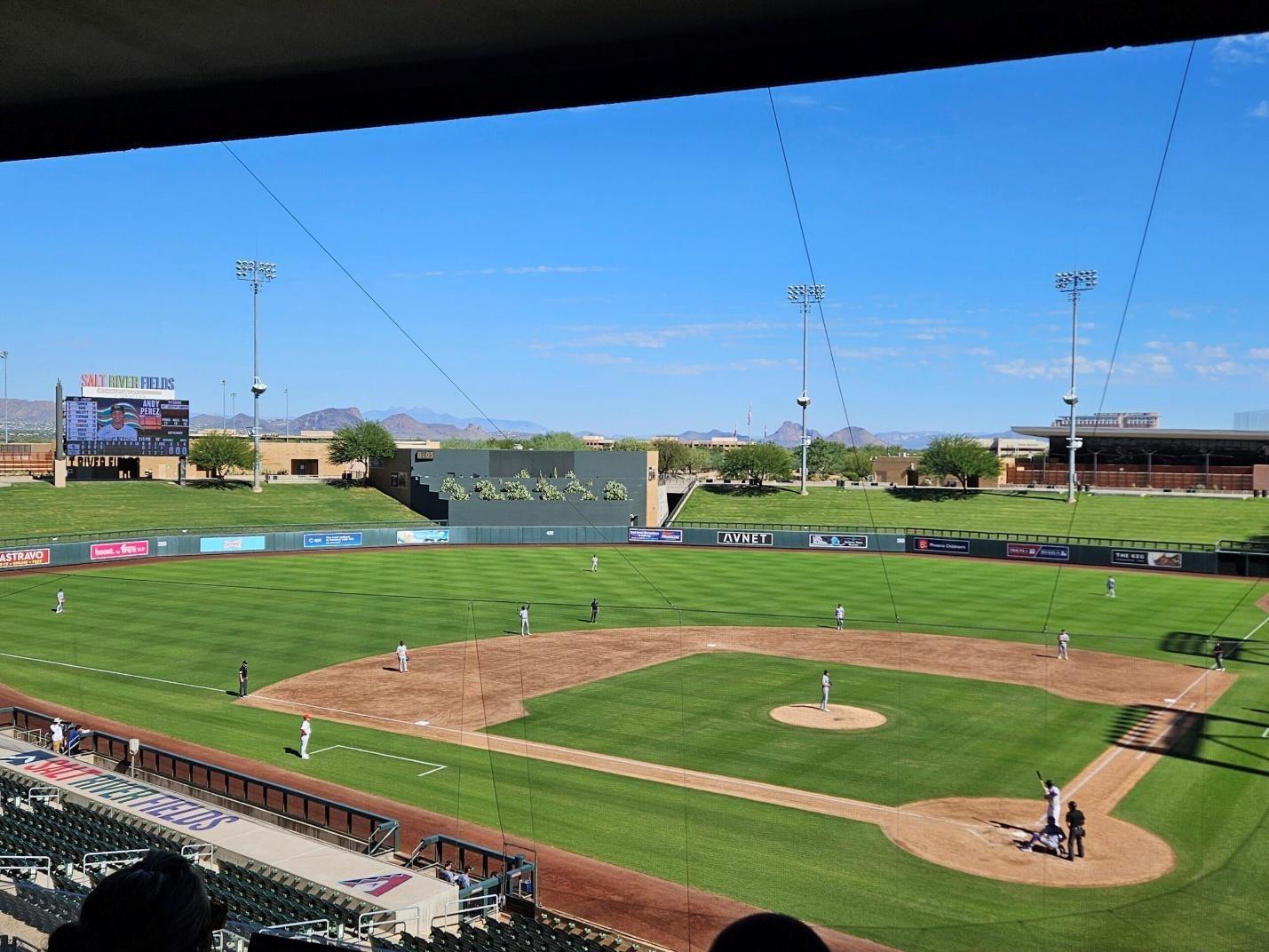
A photo taken by FanGraphs’ Eric Longenhagen shows the preordained positioning. Outfielders were forced to play straight up in center, close to the foul lines in the corners, and fairly shallow across the board, without the pronounced batter-to-batter shading and shifting that’s become customary in an age of precise scouting reports and positioning instructions.
Although much has been made of the decline in doubles and triples, that trend is partly a product of a reduction in batted balls, paired with an uptick in homers. There were almost 14,000 fewer balls in play, period, in 2026 than in 2007, a decrease of more than 10 percent. As a percentage of balls in play, singles have stayed fairly flat, and doubles are actually up. Only triples are truly dwindling, thanks to more uniform stadium dimensions.
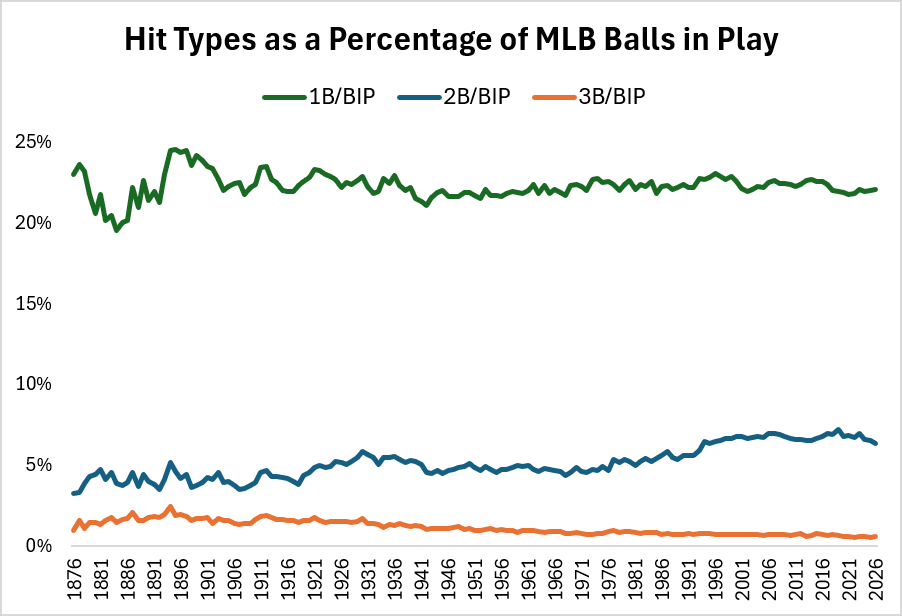
However, all non-homer hit types are definitely down on a raw, per-game basis. And mandating set starting positions in a way that opens up big gaps in the alleys and leaves a lot of room between outfielders and the fences would certainly seem likely to boost extra-base hits.
A secondary benefit would be reframing hitters’ goals. “It’s not just that pitchers are so hard to hit,” Martinez says. “It’s also, I think, hitting approach at this point, too. And hitting approach is also informed by how good teams are at positioning their fielders. If you hit it hard and on a line and there’s less hits out there, OK, well, just try to hit it over their heads and over the fence and then no one can catch it, right?
“Trying to create a framework that incentivizes maybe a more gap-to-gap, contact-oriented approach is one that would hopefully lead to more balls in play. You hear a lot about hitters being encouraged to catch it out front, hit the ball in the air to the pull side, because that’s where the most slug is. So if you can create some slug up the middle of the field, to the bigger parts where you don’t necessarily have to hit it over the wall, maybe that translates into hitters being incentivized to do things to put the ball in play a little more.”
The theory seems sound. And from MLB’s perspective, the experiment passed its limited audition. “Operationally, it went well,” Martinez says, adding, “It came out probably as well as we hoped it could have in terms of the impact and the rule itself. … It was definitely very effective.”
In a smallish sample (12 games at Salt River vs. 73 at all other parks combined), the difference in offense was stark. The table below compares stats in Salt River and elsewhere in each of the past five AFL seasons.
AFL Stats, 2022-26, Salt River Fields vs. All Other Parks Combined
Salt River games this season featured more than five more runs per game (for both teams together) than contests elsewhere. The difference came not from homers, but from balls in play. Salt River games featured fewer strikeouts, with a BABIP and batting average almost 50 points higher, and with twice as many combined doubles and triples per game. All of those gaps were far bigger than in any season since 2022 (when the ABS challenge system was tested at Salt River).
As Twins prospect Kyle DeBarge told the AP in October, “The hardest part is cutting off doubles in the gap, and they’re even turning into triples. That’s what they told us they wanted in the beginning. So it works.” If anything, it worked too well. “I think there is probably some room to fine-tune the requirements to make sure the impact isn’t even more significant than we want it to be,” Martinez says. Longenhagen reported that the leeway afforded outfielders was roughly three strides on either side of the hash mark, with a little more latitude in center. The precise specifications could easily be tweaked to be more forgiving.
Aesthetically speaking, reviews varied. Salt River Rafters manager Ted Tom told the AP, “The pros are that you’re never out of the game, it’s very exciting for the fans, and there’s lots of action.” But Nationals prospect Teo Banks noted, “I think there’s some part of strategy that’s taken away with something like this.” Martinez acknowledges, “Obviously there’s some mixed feelings about it being the right choice, which is fair.”
I have mixed feelings, too. On the one hand, the restrictions would put a premium on athleticism and speed. On the other, they’d enforce a conformity I find philosophically frustrating. Relative to the infield shifting restrictions, the AFL approach would at least have the virtue of, well, working by addressing a core cause of the BABIP crisis. It wouldn’t be window dressing. But is it actually satisfying if hits become more common not because batters adapted and got better, but because the league interceded to make fielders way worse? After all, extra-base hits are exciting partly because they’re difficult to obtain. Leagues should step in when games get out of balance. But in its efforts to bring back beloved events that used to be more common before analytics intervened—such as stolen bases, via pickoff restrictions and bigger bases—MLB might merely lower the bar to achieving them in a heavy-handed way that threatens to cheapen and deflate the accomplishments.
As a preliminary, low-effort measure, I’d like to see player positioning cards banned from the field, which MLB has considered. “I guess we don't 100 percent know, but I think our sense is that it wouldn’t do a whole lot,” Martinez says. “You’d probably just have teams preparing in other ways, maybe with numbers or someone, a coach in the dugout, waving guys around and trying to get them in the optimal position.” Although he adds that banning the cards is “never something that I think that would be completely off the table or dismissed entirely,” he notes, “If you’re going to make a change, you’d like it to be impactful and actually give fans what they want.” Martinez is probably right, although I’d still be in favor of a ban, if only for appearance’s sake.
I’m also partial to more pitcher-centric tacks that could cure the root problem of 21st-century pitchers playing by 19th-century rules. Bill James believes, “At some point Major League Baseball has to accept the fact that the pitching distance established in 1893 (60 feet, 6 inches inches) no longer works, and has to be adjusted. There are a hundred other things you COULD do to keep the game from being swallowed up by strikeouts, but those are all just buying time. At some point you are going to have to bite the bullet and adjust the pitching distance.” I tend to agree.
Speaking of caps, I still see restricting the maximum number of pitchers on the active roster as a possible panacea, one that would pressure pitchers to pace themselves and theoretically lead to longer outings, lower velocities, fewer injuries and pitching changes, and extra offense. MLB lowered the limit to 13 in 2022, with an eye toward subsequent tightening, but that number hasn’t budged since. Similarly, while MLB tested moving the mound back by a foot in the independent Atlantic League for part of 2021, there’s been no more movement, rhetorical or physical, on that front.
In 2023, MLB EVP of baseball operations Morgan Sword told me, “There is broad agreement that [lowering the roster limit] would be effective in the long run,” but he (understandably) cited some practical impediments to weaning teams off their reliance on light workloads. “Everything’s still in discussion,” Martinez says, but he adds, “Obviously, we’re very sensitive to the player health issue, just like the teams and players themselves.” Futzing with outfielders is probably a path of less resistance.
The good news is that MLB is open to anything and committed to an incremental, measured, scientific process that’s paid dividends with other rules. “We’ve discussed lots of ideas, and we’ve done some lab-type testing, not in game situations, with things like markings on the ball or a ball that’s a little bit bigger or different bat dimensions and things like that,” Martinez says. “We’re always trying to find new and creative ideas that may help get more balls in play while maintaining the integrity of the game. It’s a difficult question, and it’s one that is not quite as straightforward as turning the clock on and making people move around a little bit faster.”
Even if the outfield-positioning gambit survives scrutiny, its final form won’t reach the majors in the near future—and not just because MLB’s near future is so uncertain. Martinez describes the AFL experiment as a “very early proof-of-concept-type test,” adding, “I don’t think we have this figured out, or we’re convinced that this is absolutely the right answer. … We have to have some conversations internally with leadership to fully debrief on the results, get some feedback, and then determine what the next step is. … Part of the reason why the rule changes that have gotten to the big leagues have been successful is because we’ve done the diligence.” He concludes, “It’s not going to be something that’s going to be rushed just for the sake of addressing current trends.”
Of course, we can keep this quandary in perspective. As fans stare into the abyss of a work stoppage, most would happily sign up for six more months of MLB batting .240-something next year. Outs beat lockouts, strikeouts beat strikes, and more dead ball–era batting averages sure would beat batting .000 on staging a season at all.
Thanks to Robert Au of Baseball Prospectus for research assistance.