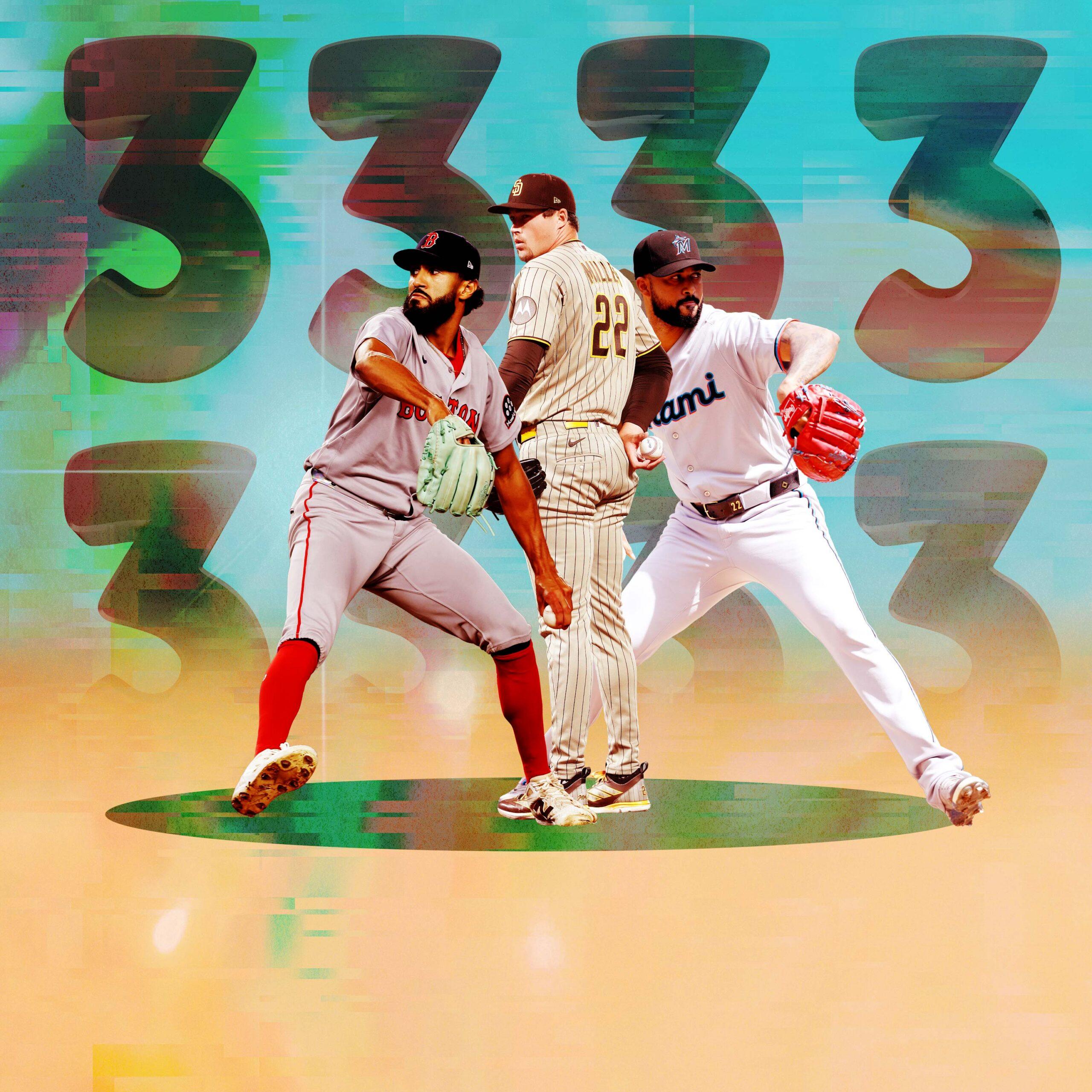

When the Miami Marlins’ ailing, ineffective closer Pete Fairbanks cut a comeback short and returned to the injured list in mid-September, Marlins manager Clayton McCullough didn’t anoint a new ninth-inning guy. “We’re not going to designate someone to finish games,” McCullough said. “We just look at using the best people we can to get to that point and then whoever’s left will get that opportunity.”
The only Marlin to record a save—two saves, to be precise—since then is … Sandy Alcantara. As in, former Cy Young Award winner Sandy Alcantara. Who, while no longer a threat to win that award, remains the Marlins’ highest-paid player, their best pitcher, and the major league leader this season in games started and innings pitched. Two of those innings came in relief, as he entered in the ninth on September 16 and 23 and successfully preserved one-run leads. In each case, his bullpen appearance came just two games after he took his turn in the starting rotation and threw five-plus frames.
Alcantara, Miami’s oldest starter, hadn’t pitched out of the pen since his 2017 rookie season in St. Louis—and no regular-season starter in decades had alternated between starts and saves the same way. Yet Alcantara isn’t alone on the Marlins staff in doing double duty as a starter and sometime reliever. The team’s youngest and second-most prolific starter, Eury Pérez, made his first professional relief appearance on September 22, when he entered a tie game against the Cubs in the eighth inning and struck out the side. One uncharacteristic outing, for a team whose closer and primary setup man (Anthony Bender) were both hurt and whose pen was depleted by an extra-inning game the day before, might have been an anomaly. Three times (four, if you count a late-August relief appearance by starter Janson Junk) is a pattern.
Starting pitchers typically throw bullpen sessions outside games on their “throw days” between starts. The Marlins seem to be recasting some of those sessions as high-leverage, in-game outings—not in the playoffs, where high drama and added off days encourage creative multitasking, but amid a low-stakes stretch run. This is, arguably, a pretty good idea. (Why waste perfectly fine frames?) But it’s arguably been a good idea for a long time. So why is it just being implemented now, by a non-October-bound team?
It might be because the Marlins have the right combination of unconventional thinking, scant public scrutiny, willing participants, and a shorthanded pen to give it a go. But it might also be a symptom of a leaguewide lack of arms, and a corresponding desperation to scrounge up innings. Because pitcher usage has evolved (or devolved) toward fewer, shorter outings by starters and relievers alike, teams no longer have enough arms to get through games.
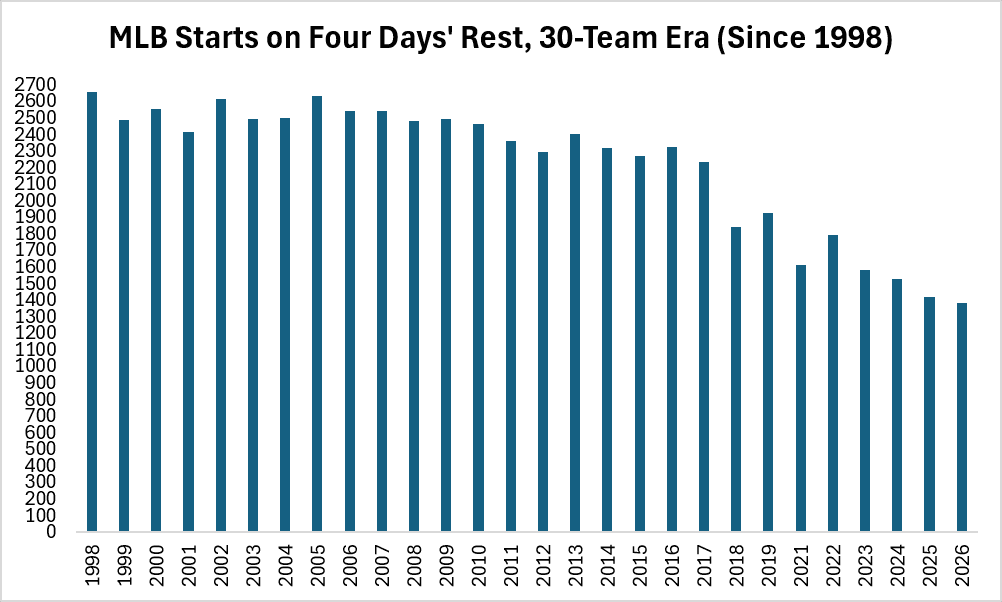
You’re probably aware that starting pitchers don’t go as deep into games as they used to (and thus, individually, aren’t as valuable as they used to be). All MLB pitchers put together have recorded 20 complete games this season—as many as Fernando Valenzuela alone racked up 40 years ago. Slightly less well known is that starters take the ball less frequently, too. Forget the former four-man rotation, in which starters would pitch on three days’ rest; such efforts, once common, are now almost unknown. Even starts on four days’ rest are dwindling, as the graph below (which covers the 30-team era, excluding 2020) shows.
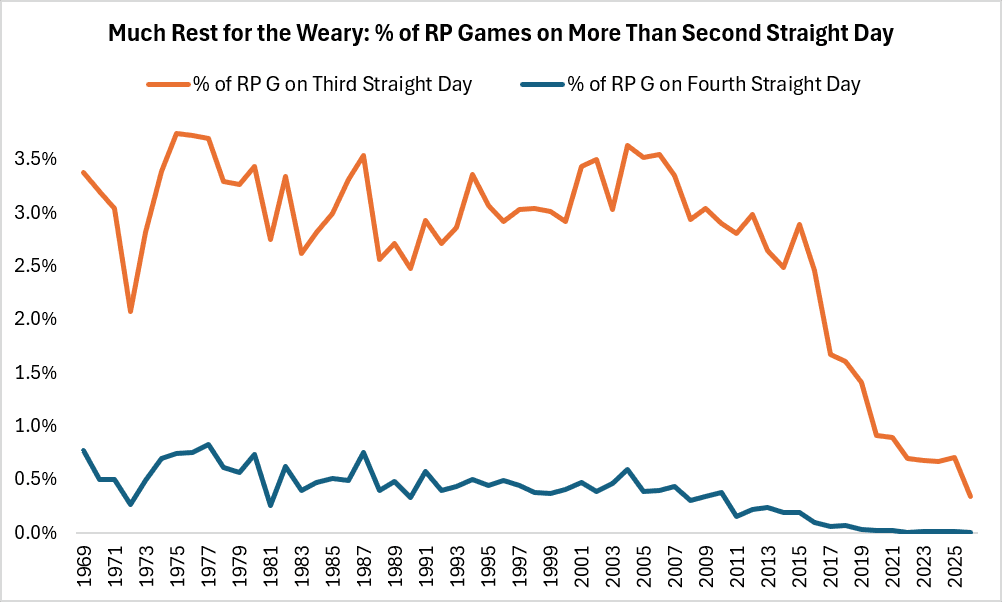
In the pen, we’re well past the era of iron man Mike Marshall and the firemen who made multi-inning appearances routine. No true reliever has thrown 100 innings in a season for 20 years, when Scott Proctor pitched in more than half of the 2006 Yankees’ games. (Perhaps relatedly, Proctor’s ulnar collateral ligament was later described as “mush.”) But as with the starters, the story here is as much about the frequency of appearances as it is about their duration. Teams have become increasingly reluctant to use relievers in consecutive games; 99.7 percent of relief outings this year have featured a pitcher who was working on no more than his second day in a row. No reliever this season has worked four days in a row, which happened a record 79 times in 2004; since Sam Dyson and Shawn Tolleson worked five days in a row in the last week of the season for the 2015 Rangers as the team battled the Astros to the finish for an AL West title (what else is new?), only one pitcher—Bryan Shaw in 2023—has repeated the feat.
So in search of improved pitcher efficiency on a batter-by-batter basis (a qualified success) and improved pitcher health (not so much), teams have whittled away at both the length and frequency of starts and relief appearances. Yet the season still lasts 162 games, and games still last nine innings. Zombie runner–shortened extra-inning affairs notwithstanding, managers need to get as many outs as ever. The power of pitch design, pitching labs, and aggressively refreshing rosters with fresh arms from the farm has increased the supply of pitchers, but not quite enough to meet the demand due to diminished durability. Something’s gotta give—and someone’s gotta give teams innings.
As Guardians GM Mike Chernoff told The Athletic’s Tyler Kepner in March, “It is a math equation, to some extent. You have to fill the innings and you have to fill them with high-quality guys. We’ve had a lot of success in finding them, but I’m not confident that we can keep finding them. My job is to be panicked all the time, and pitching depth is probably the thing that general managers are most panicked about at all times.”

The Marlins’ new approach is repurposing overqualified pitchers (starters who can go through a lineup multiple times) as inning-at-a-time relievers. On the other end of the pitching-prowess spectrum are the underqualified pitchers pressed into service as mop-up men: position-player pitchers. Despite some modest restrictions on when position-player pitchers can be used (which may soon be made more stringent), teams are deploying them more often than ever, much to many fans’ frustration. A’s outfielder Carlos Cortes has pitched nine times this year himself, amassing a 10.61 ERA and an 11.02 FIP. Sadly, the ambidextrous switch-thrower (and natural lefty) hasn’t even pulled a Pat Venditte and pitched from both sides to sweeten the deal.
Collectively, position-player pitchers are throwing more slowly than ever, getting hit harder than ever, and generally disgracing the game in their sporadic roles as sacrificial lambs and players who pour fuel on fires. They’re the prey at the bottom of the baseball food chain—the most vulnerable members of the soft underbellies of bullpens, which have been asked to assume so much work that relievers as a whole have hardly been better than starters this year (a difference of .06 FIP). In fact, for the first time on record, starters have thrown speedier four-seam fastballs than relievers, on average.
Barring tactical forfeits to obviate the need for position-player pitchers (whose appearances amount to gentleman’s forfeits), the solution to the proliferation of fake pitchers is making real pitchers—however far down the depth chart—last longer. As Jay Jaffe wrote for FanGraphs earlier this month, “The way to tighten the screws on PPP usage is to make long relievers and third lefties throw an inning when they’re down 9-1.” Fortunately, there are some signs that teams are getting a tad less precious about pushing certain relievers to stay in a little longer.
Sometimes, an obscure stat tells a story about larger leaguewide trends. A recent increase in catcher’s interference calls, for instance, reflected the fact that catchers were creeping closer to hitters to present pitches more persuasively to umpires—and that the inadvertent contact their gloves were making with hitters’ bats was more likely to be detected, thanks to instant replay. In the same vein, let me explain the significance of the resurgent three-inning save.
There are three conditions a pitcher can satisfy to record a save, all of which require him to enter a game with his team leading, preserve said lead, and finish the game:
- He can come in with a lead of three runs or fewer and pitch at least an inning.
- He can come in with the tying run on deck, at the plate, or on the bases.
- He can pitch at least three innings.
That last kind is the weird one that can produce a save even in an extreme blowout. It might be a misnomer—can you really “save” a game whose outcome is never in jeopardy?—but in the save column, it counts just the same as a clutch, nail-biting squeaker.
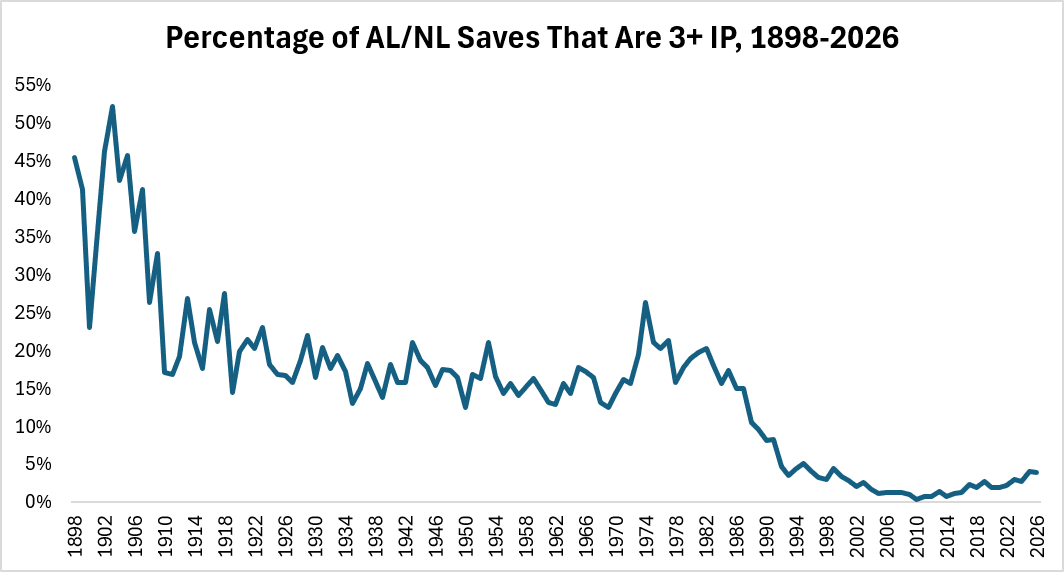
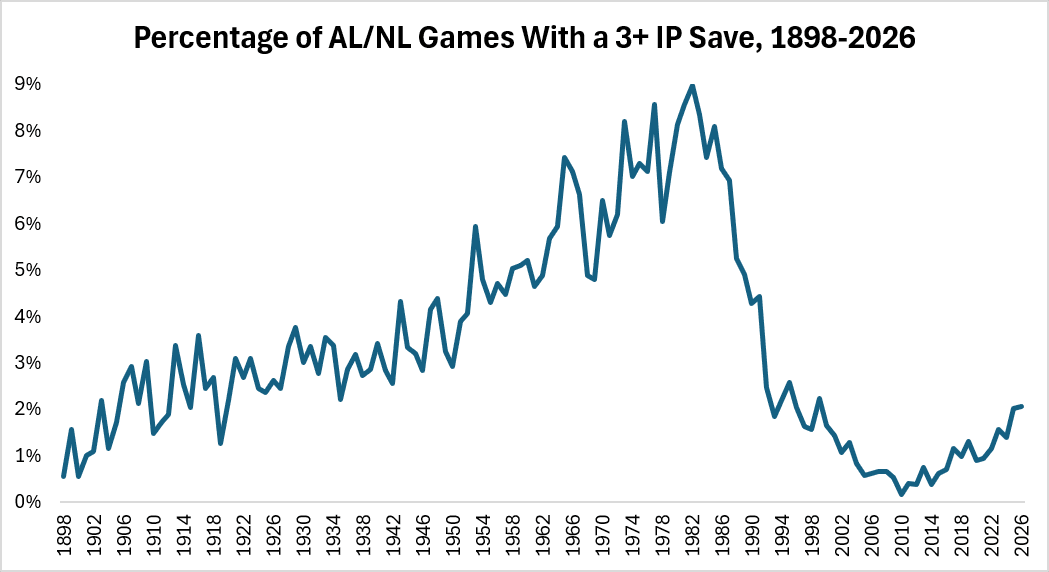
When Wes Littleton picked up that very silly save in a 30-3 Rangers victory in 2007, the three-inning save was deeply endangered. Three years later, it would bottom out: There were four three-inning saves in the majors in 2010. Since then, the three-inning save, like the orange-fronted parakeet population, has recovered. With three days of games to go, there have been 49 three-inning saves in the 2026 regular season, which is tied with last year’s total for the most since 1999 (54).
Now, don’t get too excited. We’re nowhere near peak three-inning save. From the mid-’60s through the ’80s, three-inning-save enthusiasts were living large. There were usually well over 100, and sometimes close to 200, three-inning saves per season (and that was with fewer teams in the league). But those same three-inning-save superfans, who definitely existed, didn’t know how good they had it. Along came Tony La Russa and Dennis Eckersley to demonstrate the dominance of a rigid push-button bullpen with a one-and-done closer who hogged and converted a high percentage of save opportunities. That model metastasized, bullpens swelled, and relievers specialized. Multi-inning outings were not the done thing. But now, the three-inning save—although still a rarity—has recovered more than tenfold from its nadir. Even on a rate basis, what once had almost flatlined is now picking up a pulse. And some solid clubs are leading the way: The four teams with more than three three-inning saves each (the Braves, Brewers, Cubs, and Red Sox) have all clinched playoff spots.
We can see the same slight resuscitation if we look at the average length of a relief appearance, and the percentage of relief appearances that go beyond one inning pitched, for each season dating back to when the save became an official statistic in 1969. The former has returned to its highest point (1.16 innings) since 2000, and the latter is at its high-water mark (26.0 percent) since 2004. The percentages of relief outings that last exactly two innings, two or three innings, and two to four innings have all bounced back to their loftiest points in at least several seasons as well.
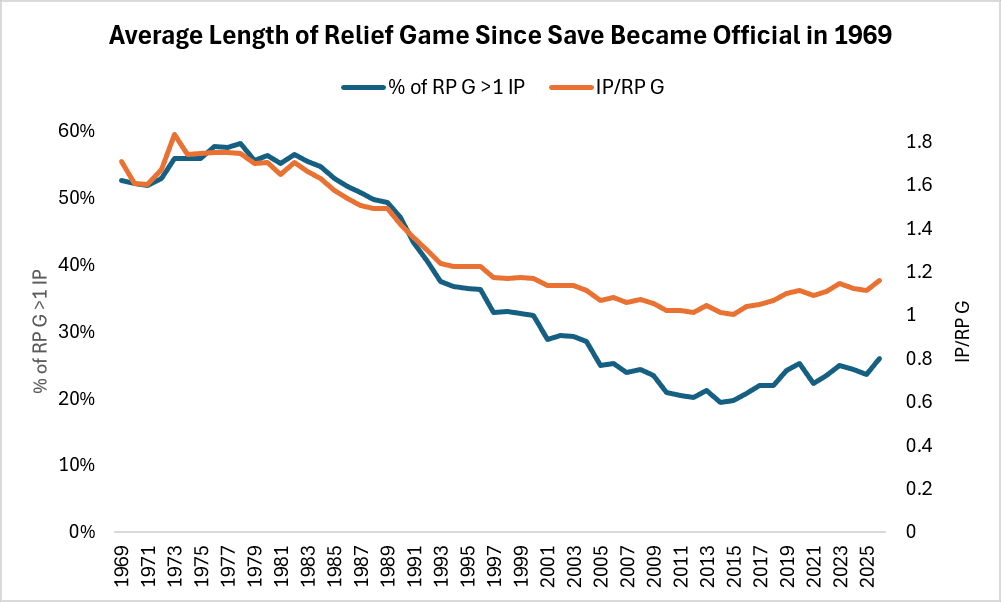
In other words, it seems that teams have turned back the clock roughly 20 to 25 years when it comes to their willingness to explore longer relief outings from selected arms. Granted, we’re still nowhere near ’60s-to-’80s-style usage. And it’s tough to untangle these trends from other developments related to rules changes or tactical innovations, including the decline of LOOGYs after the implementation of the three-batter minimum, or the use of openers and bulk guys, which slightly skews the starter/reliever splits. But maybe we’re moving toward a new (old) long-relief archetype.
Take, for instance, Red Sox reliever Raymond Burgos, who in eight games this season has entered anywhere from the fifth inning to the eighth and has gone at least two innings all but once. In his Boston debut on August 7, he entered in the seventh, polished off a win, and was rewarded with a three-inning save. The very next day, he entered in the seventh and finished off a loss, becoming the first Red Sox pitcher to throw at least three innings on back-to-back days since 1977. He got optioned to Triple-A for his trouble, but he later returned to the bigs and, in his first post-promotion appearance, pitched on both sides of a 2 1/2-hour rain delay. The 27-year-old lefty, who had no previous experience in this sort of role, has handled the difficult, low-profile assignment with aplomb and spared Sox fans some unsightly position-player pitching. Maybe more teams will try to find their own versions of Burgos. (The Sox have also converted Brayan Bello, who sports a three-inning save himself, into a valuable swingman after his early-season struggles as a starter.)


Will we one day wind up with positionless pitching staffs—amorphous mixtures of arms in unclassifiable roles who platoon, piggyback, and pitch a few innings apiece? If so, they’re still a ways away. But we are witnessing one breakdown of a rigid traditional role, via the decline of the closer’s cachet.
Alcantara is one of a record 256 (and counting) pitchers who’ve notched at least one save this season. The number of save-getters per season and the average number of save-getters per squad have spiked in recent years as the concept of the save as sole province of a capital-C Closer has slipped and more teams have employed McCullough’s committee approach. In a sense, this had to happen. Not only is it smart for teams to play matchups rather than be locked into a predetermined plan, but also, if any given reliever is available for fewer games per season, then closers have no choice but to relinquish some save opportunities and spread the high-leverage looks around.
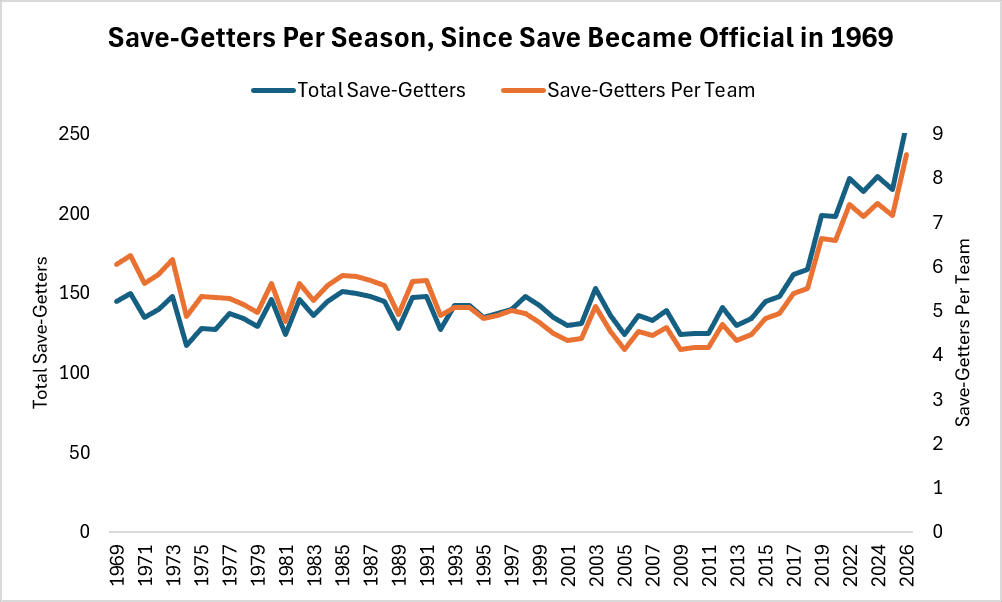
Naturally, some of the nastiest, best-established late-inning arms, like the Padres’ Mason Miller and the Phillies’ Jhoan Duran, still have fairly firm holds on their prestigious, prominent positions (and the entrance spectacles that go with them). But the democratic distribution of saves we’re seeing today is apparent when we graph the concentration of saves over time, according to the Herfindahl-Hirschman index (yeah). The chart below shows the annual normalized HHI, averaged across all teams, on a scale of zero to one, where one would indicate a perfect closer monopoly (one guy gets all the saves) and zero would indicate a perfect closer kumbaya (everyone splits the wealth equally, as with Sloan or U2 songwriting revenue). The HHI has fallen far from the height of the “closer mentality” era around the turn of the 21st century, when teams (possibly counterproductively) managed with saves in mind.
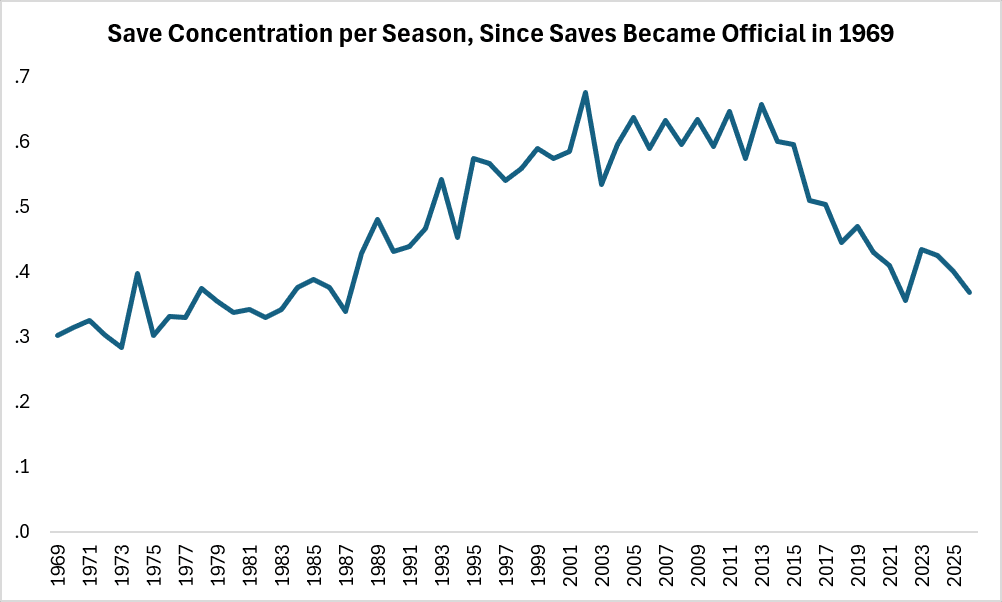
This decrease could have implications for how relievers are paid, considering saves are still integral to salary arbitration. And it could restrict future closers from Cooperstown: Barring big changes, it will be challenging for the current and upcoming classes of closers to climb the all-time saves leaderboard, where active pitchers Kenley Jansen (third, with 497 saves), Craig Kimbrel (fifth, with 441), and Aroldis Chapman (ninth, with 402) perch in the top 10. But it probably represents a sensible unclenching of the closer hierarchy by teams that are being a bit less precious about pitcher roles.
“You can never have enough [or too much] pitching” is not a new adage, but no matter how marvelous modern arms are from pitch to pitch and inning to inning, teams’ needs are never slaked. In an effort to protect pitchers and blow away batters, teams may have taken a low-volume, high-intensity turn so sharp that they couldn’t make their innings ends meet. (Incredibly, Alcantara and Cristopher Sánchez are this season’s lone 200-inning arms, although they may be joined by Michael Wacha this weekend.) And now, after decades of paring down pitcher workloads, clubs could be stepping back from the brink and looking for ways to stretch their staffs other than throwing utility infielders and backup catchers to the wolves in garbage time.
Will the commissioner crack down on such mockeries of the mound? Will the league tighten the limit on active pitchers from 13 to 12 (or below), or loosen the limit to 14 (or above)? Will recruiting or creating long relievers become a competitive advantage? These are crucial questions—but they’re also mostly matters for 2027 and beyond. The depth-dependent six-month marathon is almost over. When the postseason sprint starts, “low leverage” is relative, and all-hands-on-deck baseball begins.
Thanks to Dan Hirsch, Michael Mountain, and Joe Sheehan for research assistance.