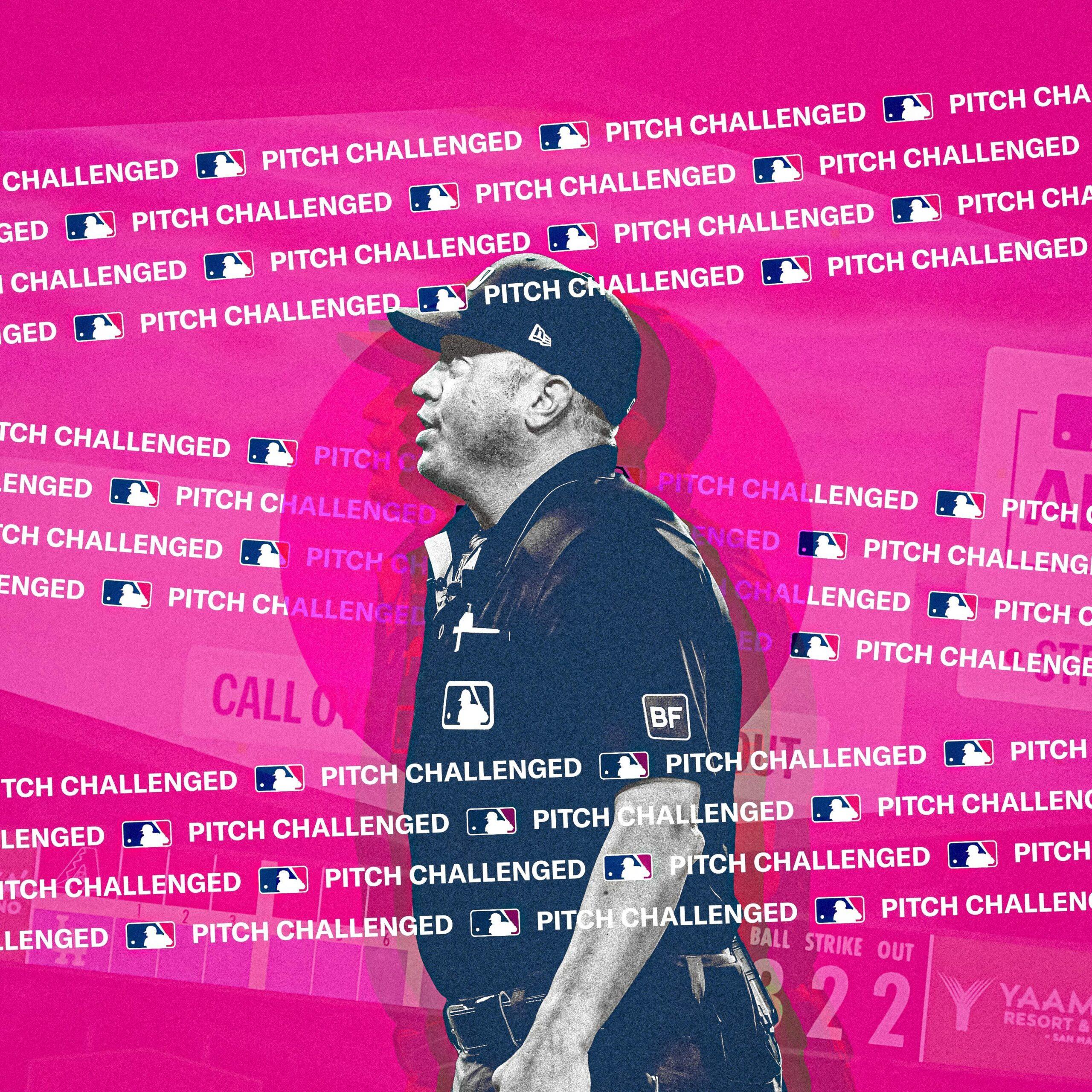

Vengeance, these days, is mine. I’ve been waiting and I’ve been hating. Mostly on authority figures: science teachers, tax collectors, my landlord, the New York Police Department. No disrespect but all disrespect. Sending out the pettiest possible vibes.
Historically speaking, wins have been few and far between. Volume is the name of the game. A true hater learns to cultivate a broad array of slights. If that existence sounds a bit futile, that’s because it is. Or at least, it was. Then Major League Baseball started gifting the viewing public with a daily dose of unadulterated comeuppance.
For 150 years of baseball, umpires stood hunched behind a plate and determined whether each pitch was a ball or a strike with the naked eye. In the sport’s early years, brawls broke out over disagreements. Somewhere along the line, folks started kicking dirt and screaming directly into umps’ faces. Given the physiological toolbox at hand, it all went better than could be expected, even if it gave rise to a class of untouchable supervillains. For the past couple weeks, though, the authority of the hunchers behind the plate has been undermined.
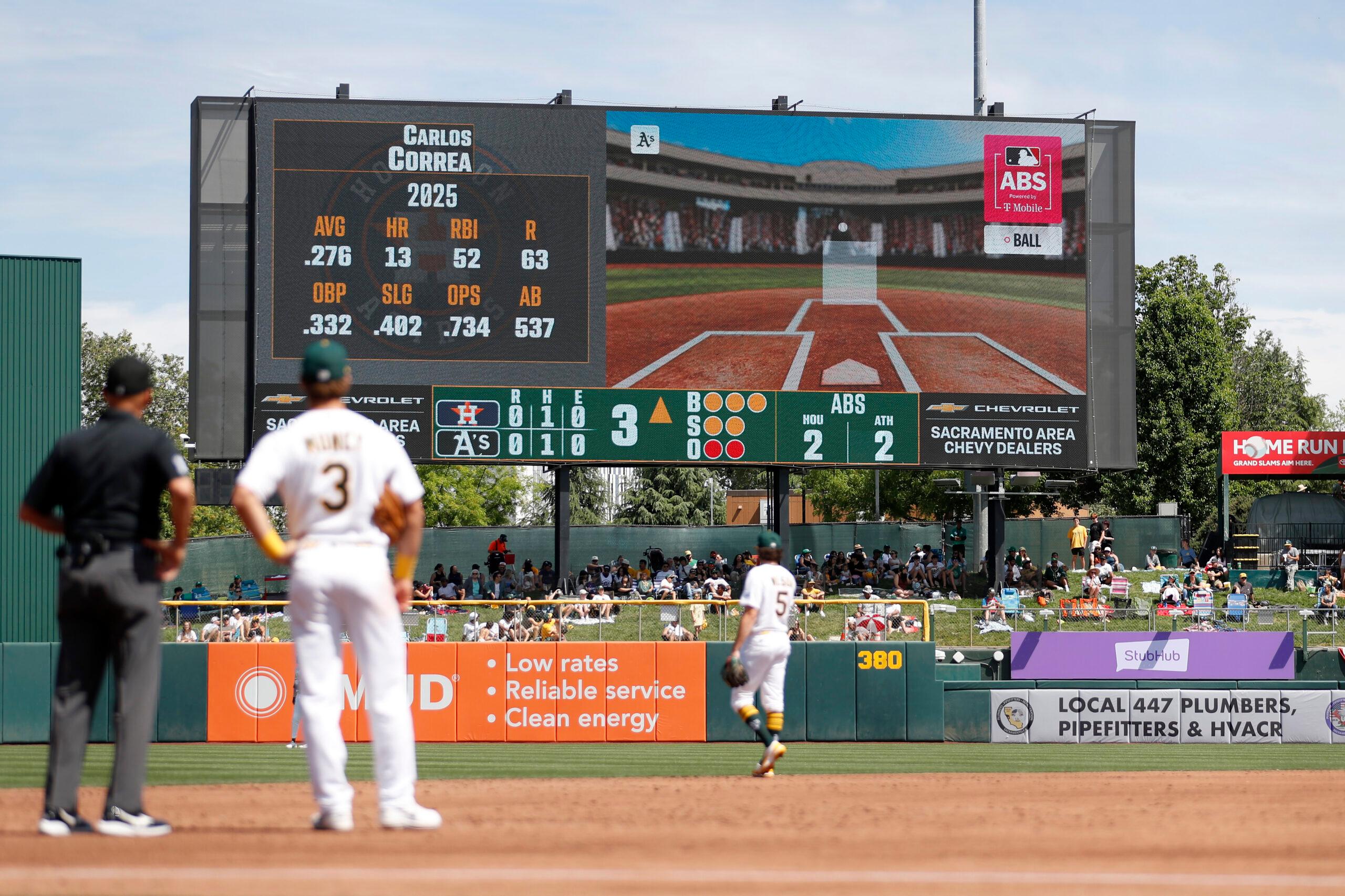
Last September, MLB’s competition committee approved the use of an automated ball-strike system (ABS) for the 2026 season. The rules are relatively modest: Each team receives two challenges; only the hitter, pitcher, or catcher can call for them; any challenges must be issued within two seconds of game action; if successful, the teams retain their rights to challenge. Squads are given additional challenges in extra innings. The plays in question are broadcast live and in-stadium thanks to five high-tech cameras that track the movement of the ball at all times.
Speaking for those of us with a vested interest in watching the group that’s played vengeful baseball gods for a century and a half be proved wrong, the rule change so far has been a positive delight. (I have no shame in admitting that I’ve watched as many highlights of haggard umpires misjudging arcing sweepers and blistering fastballs over the past two weeks as I have of actual play.) One needn’t be an entrant in the Playa Haters’ Ball to hold that ABS—and the inherent theater to it—has claimed main character status in this fledgling season. At minimum, the introduction of automation into the policing of baseball’s strike zone has fostered the ultimate rarity across the pastime: a common cause for praise.
Part of that acclaim is steeped in a broad yearning for the accuracy of MLB officiating to match the rigor and quality of its play. But another part of it—the one that if you know, you know—is that the game has never before had a more appealing means through which to deride its universally embraced punching bag.
Granted, umpire shaming was not exactly the driving force behind ABS. In fact, dating back to 2019, before the MLB Players Association softened its stance on introducing ABS, the Major League Baseball Umpires Association repeatedly consented to the development and implementation of an automated strike zone system in its bargaining agreements with the league. That is often overlooked given that the umpires’ union was one of the two voting blocs to cast a ballot against ABS when the system was ultimately approved by the MLB rules committee, though that action may have had to do with minor league testing of a fully automated system instead of a partial one. Still, it’s worth noting that despite their role in necessitating ABS, umpires have never been the primary impediment to its execution.
What does them in is that the better ABS works, the more plainly their mistakes are telecast. Through two weeks of games, ABS challenges have accounted for a fraction of all MLB pitches. According to data in The Athletic, only 542 ABS challenges were issued through April 5, of which 299 were successful. But when C.B. Bucknor misses 20 calls in a single game, or Adrian Johnson has seven of his calls overturned, or Alfonso Marquez is so shell-shocked by the extent of his miscall that he nearly spits out a clump of sunflower seeds, well, that’s what fans are going to latch on to. Active umpires rarely speak to the media, so the best information anyone has gathered on their thoughts right now came from retired crew chief Joe West, who pronounced of MLB’s ABS love affair: “They haven’t proven it’s as accurate as they say it is.”
Cowboy coping aside, the dialogue enveloping baseball right now isn’t new. In a lot of ways, it’s an extension of the most ancient argument in the sport. People have been bickering about the strike zone for longer than they’ve agreed that catchers shouldn’t stand behind home plate. The first zone in the history of the game was instituted in 1887 and measured from the top of batters’ shoulders to the bottom of their knees. The modern strike zone wasn’t codified until 1950, when it was condensed to the distance between the armpit and the top of the knee. The zone was enlarged in 1963, then reverted to the 1950 standard six years later. In the late ’80s and early ’90s, the top and bottom of the zone were again modified, this time to their modern measures.
As the strike zone was fine-tuned—and, crucially, as television and instant replay technology advanced—contentions around how umpires are and are not judged for performance have evolved. MLB has long assigned grades to field and home plate umpires, but the details of that system are equal parts obscure and lenient. Even into the 2020s, the league had a 2-inch margin of error when assessing the accuracy of calls off the corners of the plate. As ESPN’s Jeff Passan has reported, this resulted in an environment in which the highest-ranked umpire per MLB graded out at 98.5 percent in terms of accuracy, while the lowest-ranked ump graded out at … 96 percent.
That opacity and lack of accountability is why the introduction of ABS is so satisfying. There are legitimate questions as to whether the strike zone it relies upon, a proportional measurement beginning at 53.5 percent of the batter’s standing height and ending at 27 percent, is reflective of the measurement that has long defined the game. But the system undeniably provides a balance to the previously unchecked power of MLB’s on-field authority figures. That it does so while forcing umpires to publicly confront their mistakes—with an inevitable and humiliating level of theatricality—only adds to the experience.
Context matters here, too. It’s no coincidence that I and countless other viewers are celebrating strike zone justice at a time that’s a historic nadir of societal accountability. What I would really like is for robber barons to have their empires dispersed and for politicians to pay a material price for indecency. For the people who keep getting away with it to face consequences. For our institutions to cling, at least in some small way, to the concept of doing the right thing.
Since it appears I cannot have that, for a few hours I will settle for the glorified mall cops who rule my favorite sport being publicly laughed at a handful of times each day. One must not forget: A true hater learns to cultivate a broad array of slights.