
Next week, Major League Baseball’s team owners will almost certainly lock out the players. The long-awaited work stoppage, which is bound to be imposed the second the current collective bargaining agreement expires on Tuesday night, is a bargaining tactic designed to further the owners’ pursuit of a salary cap. A cap is mostly a means of restricting spending on player salaries, ostensibly to promote competitive balance but primarily to provide the kind of cost certainty that inflates franchise values. If the owners get their way—which probably won’t happen in this round of bargaining, and definitely won’t happen without a lost season and a disastrous setback for the sport—then we will have seen the last of a hot stove staple: high-payroll teams signing free agents to long-term, record contracts.
Precisely the kind of contract the New York Mets signed starter Tarik Skubal to on Sunday.
Skubal, who turned 30 on Friday, agreed to become a Met in exchange for $450 million over the next nine years. The structure is fairly straightforward: $30 million is deferred, and Skubal gets a no-trade clause and the first $45 million as a signing bonus. The whole proposition is pretty simple, really: A deep-pocketed team with weak starting pitching addressed that deficiency by making MLB’s best pitcher MLB’s best-paid pitcher.
By both FIP-based and RA-9-based WAR, Skubal has been the most valuable pitcher in baseball over the past three seasons. (By FIP-based WAR, he’s also been the best over the past four or five seasons.) Although he missed six weeks this past spring after having a piece of calcified cartilage the size of “a fat lima bean” removed from his elbow, and looked a little shaky in his first few starts back, he soon returned to form. Over his final 16 regular-season starts, he led the majors in innings pitched (barely) and FIP-based WAR (by a lot), before turning in two decent postseason starts for the Dodgers, who had traded for him at the deadline. The Mets, meanwhile, ranked 19th in starting-pitcher WAR last season and, as of early November, were projected to rank 16th next year. Signing Skubal propels them to fifth.
Because the Mets had both the means and the motive to land the lefty, this pairing of player and team isn’t a surprise. Many surveyors of the free-agent market had named New York as a favorite to win the Skubal sweepstakes. But the haul Skubal and agent Scott Boras secured was richer than any prominent outlet had envisioned before free agency opened.
Tarik Skubal FA Contract Predictions
Every source expected Skubal—the biggest star by far in a weak free-agent class—to surpass the 12-year, $325 million deal that a 25-year-old Yoshinobu Yamamoto signed with the Dodgers in December 2023, which was the biggest pact for a pitcher before Skubal’s windfall. But few foresaw Skubal raising the bar by almost 40 percent. Of the 27 “industry insiders” ESPN surveyed in October about Skubal’s earning potential, just four figured the contract would be for $450 million or higher. Only three other players—new teammate Juan Soto, old teammate Shohei Ohtani, and Vladimir Guerrero Jr.—have signed deals with more guaranteed dollars. Skubal’s $32 million salary in 2026—a record for an arbitration-eligible player—was modest relative to the $50 million average annual value of his new agreement, which trails only Soto’s and Kyle Tucker’s.
The Mets appear to have blown away the other leading Skubal suitors (per scuttlebutt, the Blue Jays, Padres, and Dodgers). Los Angeles—whom many Dodgers doomers viewed as a lock to re-sign Skubal as soon as the team traded for him—reportedly never made an offer. (Cue another round of Mark Walter Watch.) The Padres were priced out. The Blue Jays, who’ve landed several high-profile free agents in recent offseasons but missed out on many more, offered “a little over $400 million,” which was roughly in the range of the Mets’ initial bid. But Mets owner Steve Cohen upped his offer by about as much as he once dropped on a Jackson Pollock drip painting, and that seems to have sealed the deal.
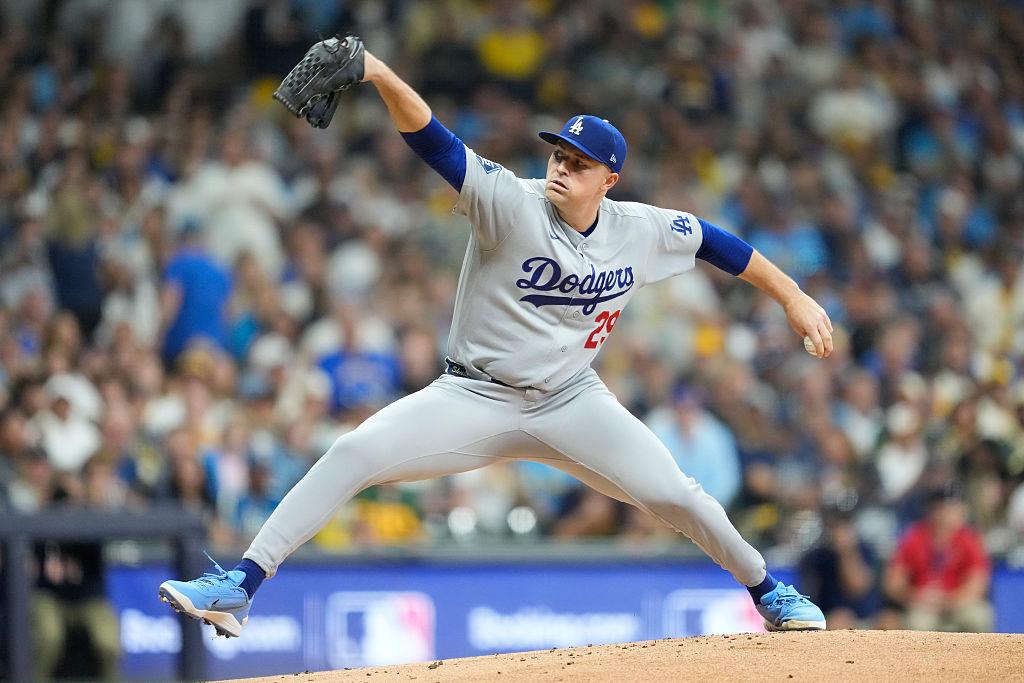
Tarik Skubal throws a pitch against the Milwaukee Brewers
Maybe Skubal (who has to pass a physical to cement the signing) will be an iron man, the Mets will win a title or two during his stay in Queens, and the teams that failed to match Cohen’s offer will wish they’d ponied up. Older pitchers have held up better than older batters of late, and Skubal is brilliant. Alternatively, this signing could turn out to be a textbook example of the winner’s curse. Skubal’s left arm has gone under the knife three times: for Tommy John surgery in college, flexor tendon repair in 2022, and loose body removal this year, which would have been more costly—in terms of time and money—if not for the NanoNeedle (a.k.a. “Skubal scope”) procedure that shortened his recovery. These days, hardly any experienced pitchers are untouched by a surgeon, and even the unscathed ones aren’t likely to stay that way. Even so, Skubal’s injury history is unsettling.
Skubal could continue along the trail of lefty lightning blazed by another unanimous AL Cy Young Award winner who pitched in New York, Ron Guidry. Their workloads and WARs through age 29 are almost identical.
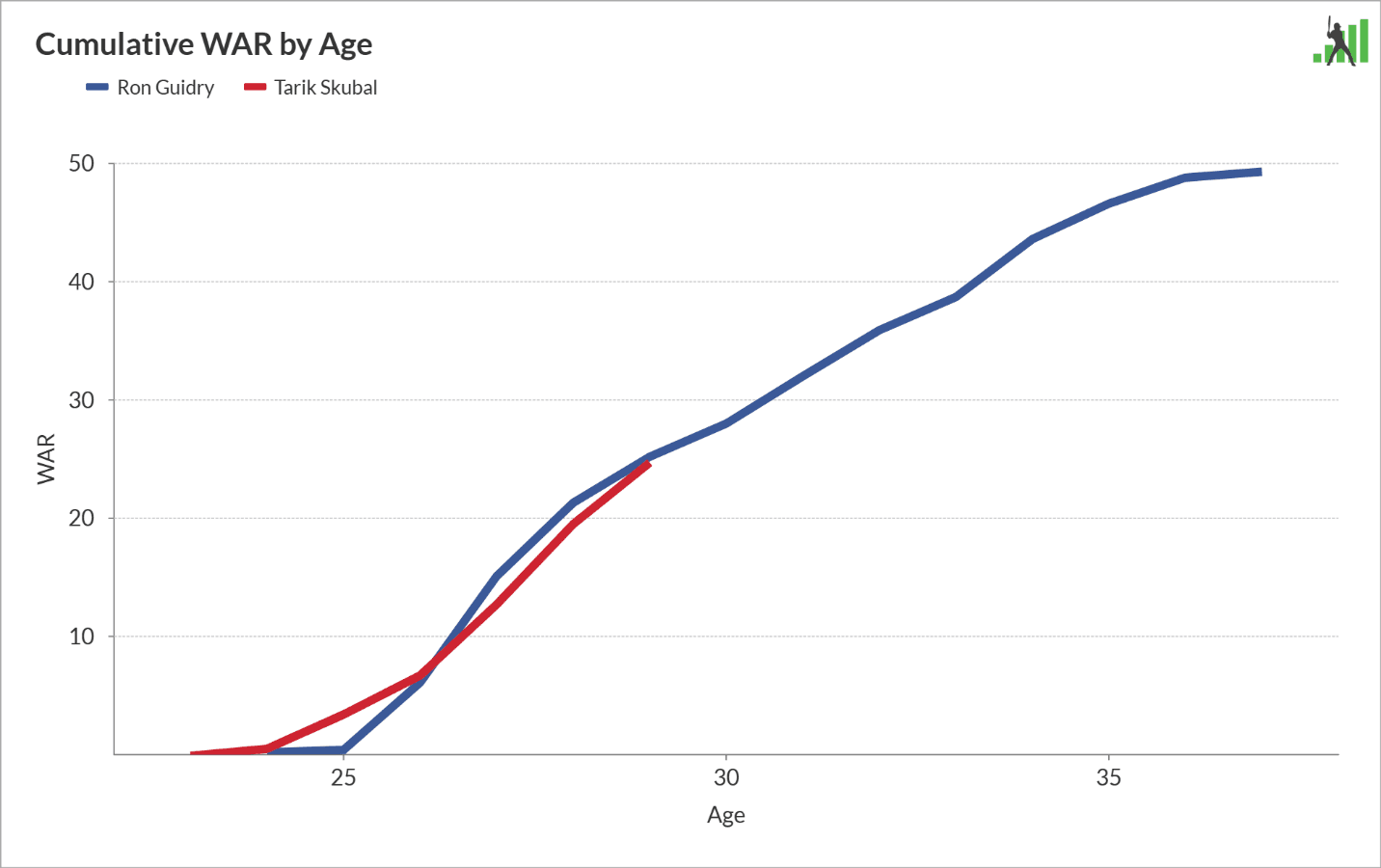
Of course, good as Guidry was through the first half of his 30s, he succumbed to elbow and shoulder injuries after age 37. Maybe Skubal will age as gracefully and supply as robust a return on free-agent investment as fellow late-blooming Tigers ace Max Scherzer. Or perhaps he’ll fall flat immediately. According to Bill James’s “similarity scores” system, Skubal’s most comparable pitcher is Corbin Burnes, who’s sandwiched 14 starts and 0.4 WAR around a UCL reconstruction since the Diamondbacks signed him in December 2024.
Either way, Cohen will stay solvent. The Mets boss may have slipped to second among MLB owners in net worth, behind Stan Kroenke, but he boasts a much higher dollars-to-franchises ratio than the new Angels owner and his vast sports-club collection. And if the Mets’ payroll (second only to L.A.’s) turns into a money pit, well, Cohen has been there before.
Last winter, the Mets bid goodbye to several veterans and bid high on their replacements as they sought to erase the taste of 2025’s late-season collapse. Their ambitious (and perilous) offseason overhaul yielded catastrophic results. President of baseball operations David Stearns’s not-so-magnificent seven big-ticket additions—free agents Bo Bichette, Devin Williams, Jorge Polanco, and Luke Weaver and trade acquisitions Marcus Semien, Luis Robert Jr., and Freddy Peralta—made $134 million from the Mets and generated 3.7 FanGraphs WAR (or 1.5 Baseball-Reference WAR). Thanks to what Joe Sheehan characterized as “one of the worst offseasons of any sports executive ever,” Stearns’s Mets finished in the NL East cellar at 74-88.
In August, Cohen critiqued Stearns’s plan to remake the roster so sweepingly with injury-plagued players as posing “too much risk.” Signing Skubal to such a large, long-term deal—which Stearns has historically resisted doing with pitchers—is pretty risky, too. At least the lefty, like Soto, is an elite talent, the type teams feel a little bit better about taking a chance on. But Cohen seems to have decided that the only way out of the Mets’ predicament is to keep spending and hope he’s not throwing good money after bad. No team has more free agents on its current roster than the Mets, who also signed lefty reliever Darwinzon Hernández last week. And they probably aren’t done adding.
If the new plan works, it probably won’t be just because Cohen papered over the club’s flaws with free agents and Skubal avoided the worst-case scenario for his 30s. It’ll be because a young core came together to grow what Cohen has called “green shoots.” Three Mets—Carson Benge, Nolan McLean, and the just-extended A.J. Ewing—showed up in NL Rookie of the Year voting results. And the team narrowly edged out the young, playoff-bound White Sox and Guardians for the most FanGraphs WAR produced by rookies. The Mets need Skubal to be great, but they also need the likes of McLean, Christian Scott, Zac Thornton, and Jonah Tong to help round out the rotation.
Most Rookie WAR by Team, 2026
After completing his purchase of the team in late 2020, Cohen declared his intention to turn the Mets into the East Coast Dodgers. Since then, they’re 13th in wins, with twice as many stinker seasons as postseason appearances. To make the Mets into the East Coast counterpart of the powerhouse he hoped to emulate—as opposed to some facsimile of the still dangerous but declining modern-day Dodgers—Cohen and Co. need homegrown guys. Or at least early-career guys, not just because they’re cost controlled but because they’re in the age cohort that prime production comes from in a young man’s league.
Even for teams with far higher payrolls than the Brewers and Rays, that youthful foundation is crucial to consistent contention. MLB has argued that a salary cap is imperative to prevent wealthy teams from dominating the majors. But the Mets, with virtually no limit on their spending, have thus far managed to hamstring themselves.
If you buy the competitive-balance case for the cap, though, then this sequence of Skubal transactions only fans the flames of unrest. The Tigers, who drafted and developed Skubal, felt so certain that they wouldn’t or couldn’t extend or re-sign him that they dealt him when they were 2.5 games out of a playoff spot, a bad look for the league. Worse, when Detroit decided to part with Skubal, he was swallowed by MLB’s two biggest spenders, one after the other. Taken together, these moves reinforce fears that the deck is so stacked against certain teams that they can’t keep their players and therefore can’t compete.
Then again, the Tigers didn’t have to trade Skubal, and perhaps they could have kept him if they’d dug deeper and/or budgeted more judiciously. They aren’t doomed to watch all their draftees depart, as demonstrated by their extensions for Kevin McGonigle, Troy Melton, and Colt Keith. Plus, the Tigers finished 23-28 after the trade; 10 starts by Skubal, strong as they may have been, wouldn’t have made them a playoff team. As for the Dodgers, they didn’t win the World Series with Skubal; instead, they got swept by the Brewers, who’d tried to trade for him but had been outbid by L.A. And although the Mets splashed their cash to sign Skubal, they’ve yet to prove that they’re truly a threat. The Dodgers’ trade for Skubal was broadly demoralizing; the Mets’ is half frustrating, half funny, tinged with the sneaking suspicion that whatever they do, and however much they spend, their inner LOLMets will win (or lose) out.
Other owners have grumbled about Cohen for years, and he’ll probably be cited as a bogeyman in bargaining again. Maybe Uncle Steve was just trying to squeeze in one more megadeal before a new CBA forces him to turn off the tap. (How he’d actually get under such a cap quickly remains a mystery.) Or maybe he’s just up to his typical tricks. Despite the Mets’ repeated paper losses, Forbes estimates Cohen’s net worth at $26.7 billion, up from an even $23 billion this time last year and $21.3 billion this time in 2024. The Mets may have had a miserable two seasons, but Cohen’s portfolio did fine. The year-over-year growth of his holdings is more than some MLB owners’ net assets. That certainly helps him not sweat the Skubal stuff.
So, no, the playing field isn’t level. It never has been, and it never can be completely, even with a cap and floor. Is it worth scuttling a season, killing the league’s momentum (and thriving business), and dealing a punishing blow to baseball’s popularity to ensure that contracts like Skubal’s can’t be signed? To the owners, maybe. To the fans? Not likely. Caps cut costs, but the proceeds don’t trickle down.