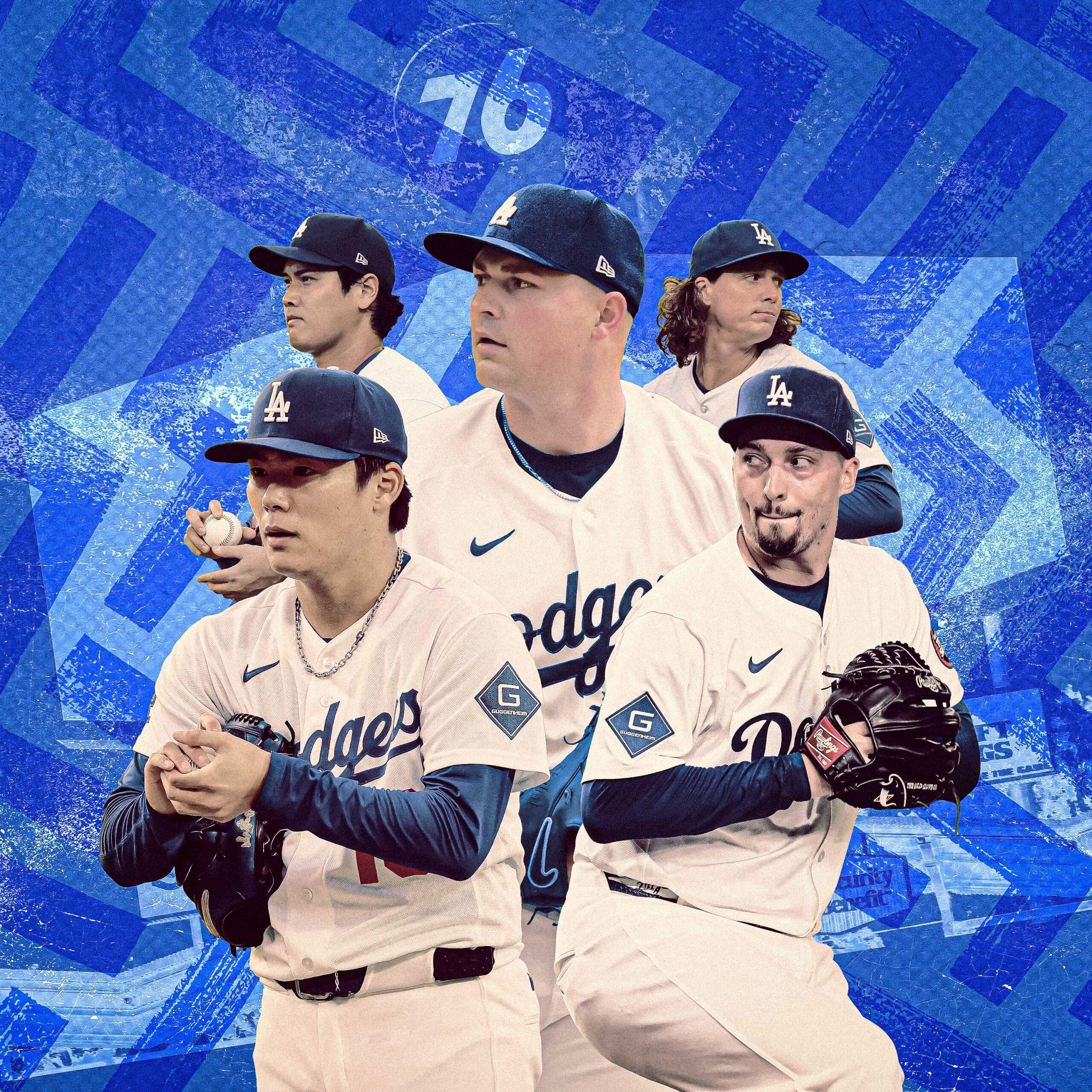

Major League Baseball fans felt a familiar foreboding on Saturday night, a little after 7 p.m. Tulsa time. That was when word circulated that Zyhir Hope, a 21-year-old outfielder for the Dodgers’ Double-A affiliate, the Tulsa Drillers, had been scratched from the starting lineup shortly before first pitch. Just as a communications disruption can mean only one thing—invasion—a playing-time disruption for a heralded but expendable Dodgers prospect two days before the trade deadline can mean only that the best team in baseball is once again poised to snap up the best player available. Predictably, the next Dodgers domino fell a few hours later, when the two-time defending World Series champions acquired the Tigers’ two-time defending Cy Young Award winner, Tarik Skubal. Hope headlined the prospect package sent to Detroit, along with right-handed pitching prospects River Ryan and Brady Smith. Ironically, the team that lost Hope was the only one that gained hope from the trade.
The “BREAKING” that began Jeff Passan’s tweet about the blockbuster could have described the brains of the baseball fans reading his report. For the Dodgers, acquiring the best player on the market has become an annual (if not biannual or triannual) occurrence. Last offseason, the Dodgers signed the most coveted closer (Edwin Díaz) and position player (Kyle Tucker). The winter before that, they landed the most desirable reliever (Tanner Scott) and two of the top three starting pitchers (Blake Snell and Roki Sasaki). The winter before that, they signed the two best free agents (Shohei Ohtani and Yoshinobu Yamamoto) and traded for Tyler Glasnow. The first few years of the decade brought their own marquee L.A. acquisitions: in 2022, Freddie Freeman; in 2021, Trevor Bauer, Max Scherzer, and Trea Turner; in 2020, Mookie Betts. Now the dynastic Dodgers, the owners of a double-digit lead in the NL West, have added baseball’s best starter—save for Jacob Misiorowski, maybe—to a hand that held four aces already. As another Los Angeles San Andreas legend once said, “Ah shit, here we go again.”
You don’t have to be suffering from Dodgers Derangement Syndrome to think this shit is getting old. While there’s something to be said for having a heel to hate, it’s hard to argue that baseball wouldn’t be more interesting, equitable, and competitive if the Dodgers shared the wealth WAR-wise. Usually, “wealth” is the operative word when the Dodgers pounce on a superstar: Undeterred by the fortunes it shells out in revenue sharing and competitive-balance taxes, the team matches or exceeds any rival offers for the elite talents it targets. The Dodgers don’t always succeed in signing the stars they set their sights on, but their hit rate is high. Typically, ties go to L.A., thanks to the competitive track record, creature comforts, favorable location, and developmental resources the Dodgers can dangle in front of free agents and players who have to approve potential trades.
This time is different, even though the outcome is the same. In this case, the only thing necessary for the triumph of the Dodgers was for the other good teams to do nothing. Skubal is an impending free agent, and his salary for the remainder of this season—about $10 million—shouldn’t have been budget-breaking for any serious contender. And Skubal had no say in his trade destination: The lefty lacks a no-trade clause. This was solely the Tigers’ swap to sanction or reject, and Detroit had no reason to do the Dodgers a solid. Thus, all the other Skubal suitors had to do to stop the Dodgers from claiming the deadline’s biggest pitching prize was to top the trio of prospects L.A. offered. None of them did, and the Dodgers walked away winners again. If Skubal makes the difference in defeating a playoff opponent come October, the loser won’t be able to point to payroll alone. The Dodgers anted up and pushed their prospect chips in while the rest of the league let them.
Skubal, 29, has been the most valuable pitcher in baseball since the start of 2023, despite dealing with multiple elbow injuries and ranking 42nd in games started over that span. He missed half of 2023 while recovering from a flexor tendon repair and six weeks of this season after undergoing a procedure to have a loose body removed from his elbow joint. (His absence would have been longer if not for an innovative, recovery-quickening tool called the NanoNeedle Scope 2.0—or, as agent Scott Boras branded it, the “Skubal scope.”) In the immediate aftermath of his accelerated return, Skubal was uncharacteristically homer-prone, but he subsequently regained his stingy form, even though his pitch speeds have sunk slightly since last season.
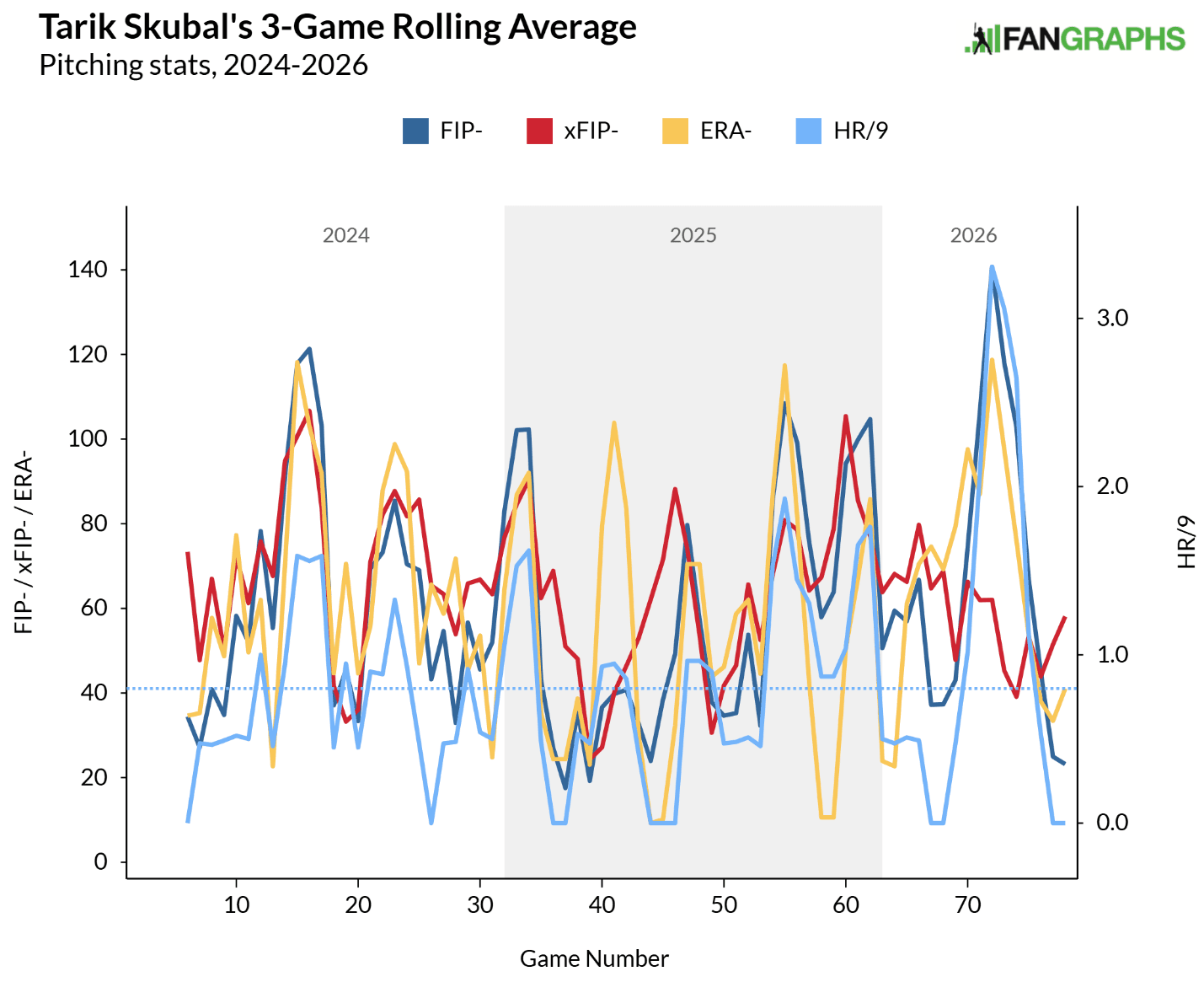
Since June 30, when he made his fourth post-surgery start, Skubal leads all pitchers in FanGraphs WAR. In his penultimate start as a Tiger, on July 24, he struck out 12 Royals. In his final Tigers start, on July 29, he recorded his 1,000th career K.
“Rival executives believe the Dodgers plan to be greedy,” Bob Nightengale noted in late July, and adding Skubal certainly qualifies. For them, baseball’s best pitcher is an extravagance. Although Skubal could help them secure a stronger postseason seed, they’re in no danger in their division, which they lead by 10 games. Only the Brewers have boasted a better rotation, and that’s with some of L.A.’s topflight arms sidelined for much of the season. The Dodgers now have the no. 1 (Skubal), no. 12 (Ohtani), no. 16 (Yamamoto), no. 21 (Glasnow), and no. 23 (Snell) starters in baseball, by FanGraphs’ projected rest-of-season FIP. Snell and Glasnow haven’t pitched since May, but both are nearing returns, and Ohtani (who’s lately been limited to DH duty by a bum knee and sore biceps) is expected to pitch again too. If those guys get healthy, some of the team’s most productive pitchers to date (All-Star Justin Wrobleski, Emmet Sheehan, and a revamped Sasaki) will wind up in relief—much like they did last fall, except that this year, L.A. already has a half-decent bullpen.
Once again, any preseason forecasts that the Dodgers could be headed for a record-setting regular season have fizzled amid an array of injuries that the club can afford to take its time treating. (In addition to all the ailing arms, catcher Will Smith has missed almost a month with an inflamed disk in his neck, and he might not be back until September.) Díaz and Tucker, whose signings were the source of such preseason consternation, have combined for less than one win above replacement; Díaz, who had his own issues with loose bodies, returned from a lengthy IL stint last week, and Tucker’s disappointing play has been as nondescript as his public persona. The Dodgers are old and injury-prone; that’s not new. Nor is it new that they’re deep enough to weather all the aches and declines. The Dodgers finished Saturday half a game behind the Brewers for the best record in baseball, and they hold slim leads over Milwaukee in run differential and BaseRuns record. Not bad for a team that’s free to coast until October.
In most respects, this season—in which payroll has only weakly correlated with winning—has served as a rebuke to the notion that MLB has a parity problem. Entering Sunday’s games, only seven teams were more than four games removed from a playoff spot, which limited the market for impact players beyond Skubal. Even the Tigers are only 2.5 games out of a wild-card spot and 5.5 games out of first in the AL Central, which they lead in run differential. Two years ago, Detroit stunned the sport by surging to a playoff appearance after trading a starter (Jack Flaherty) to the Dodgers at the deadline; if they did the same this season, sans Skubal, it wouldn’t be such a surprise. But maybe this trade tells us how much stock some teams put in an outside chance to be one of 12 teams in the tournament.
Naturally, the Tigers’ chances are worse without Skubal than they were with him: Having held on to Skubal this long, they could have kept him for one last stretch run. Instead, they pulled the trigger on the trade with an eye toward turning an expiring contract into years of team control. Hope is a three-true-outcomes type with a 130 wRC+ at Double-A; as soon as next season, he could complete the Tigers’ outfield of the future, alongside Riley Greene and new call-up Max Clark. Ryan is an oft-injured starter who had a few big league outings in 2024; he’ll turn 28 this month and pairs a sexy six-pitch mix with a high flameout factor. Smith, the Dodgers’ third-round pick in 2023, is a 21-year-old, surgically repaired righty with strikeout stuff who was recently promoted to High-A. The table below shows where Hope and Ryan were ranked in the midseason top-prospect rankings published by Baseball America, Baseball Prospectus, FanGraphs, MLB Pipeline, ESPN, The Athletic, Just Baseball, and TJStats.
Midseason Overall Prospect Rankings
Hope’s average ranking was no. 35. Ryan’s ratings varied widely: Multiple sources had him higher than Hope, and others left him off their lists. Three prospects whom most fans haven’t heard of hardly sounds like a haul for a pitcher of Skubal’s caliber, but Hope, Ryan, and Smith actually constitute a substantial return in an era when teams simply don’t surrender top prospects for rentals anymore. That doesn’t mean teams can’t still strike prospect gold in a deadline deal for a short-term player—as the Cubs did when they snagged Pete Crow-Armstrong in the 2021 Javier Báez trade—but they’re no longer going to get a player who’s viewed as a no-doubt dude at the time.
Deadline deals are rarely determinative, and adding a star at midseason isn’t necessarily enough to push a good team over the top—as the Dodgers learned in 2017 (when they traded for Yu Darvish and two Tonys), 2018 (when they added Manny Machado), and 2021 (when they acquired Scherzer, Turner, and Danny Duffy). All in all, the deadline doesn’t alter the playoff picture more than a week’s worth of games, so the irresistible intrigue of trade season often outstrips its impact. Heck, sometimes a team brings in a big bat only for him to get hurt in his post-trade debut. And the letdowns work both ways: Most prospects traded at the deadline don’t pan out. It’s not as if the Dodgers missed the youngsters they surrendered for Darvish (A.J. Alexy, Willie Calhoun, and Brendon Davis), Machado (Dean Kremer, Zach Pop, Breyvic Valera, Rylan Bannon, and Yusniel Díaz), or Scherzer and Turner (Josiah Gray, Keibert Ruiz, Gerardo Carrillo, and Donovan Casey).
Chances are they won’t cry over spilled prospects this time, either. Hope was the Dodgers’ third- or fourth-ranked outfield prospect, after Tulsa teammates Josue De Paula and Mike Sirota and, according to some evaluators, High-A understudy Eduardo Quintero. The Dodgers’ system is stacked enough that this trade can be both defensible for Detroit—which otherwise would have had only a compensation pick to show for Skubal’s presumptive departure—and barely painful for L.A.: With 25-year-old Andy Pages entrenched in center, Tucker committed through at least 2027, and two superior prospects in the pasture on the way with similar L.A. ETAs, Hope was talented trade bait.
The Dodgers’ offer was strong, but it wasn’t unbeatable. Two lower-payroll teams with the need and desire for Skubal, the Rays and Brewers, were reportedly willing to pony up his pay, but perhaps not the prospects. It’s not that they couldn’t have checked both boxes: FanGraphs (like Baseball America) rates the two teams’ farm systems first and second, respectively, ahead of the third-place Tigers’ and fourth-place Dodgers’, and both Tampa Bay (Theo Gillen) and Milwaukee (Jésus Made, Luis Peña, Logan Henderson) have prospects or non-prospect-eligible rookies who are rated higher than Hope. But the blue-chippers were apparently off-limits for a two-to-three-month dalliance with Skubal. (The Rays settled on Sunday for former Brewer Freddy Peralta.)
Granted, the Dodgers’ institutional advantages made the prospect price they paid more affordable for them. For one thing, Skubal is more likely to stay with the Dodgers beyond 2026 than he would have been with any other team he could have been traded to. Of course, Boras clients rarely ink extensions, and even with a lockout due in December, Skubal will likely lean toward testing the open market (ideally after putting his elbow boo-boo behind him with a big finish for the Dodgers). Plus, even if Skubal does re-up with L.A. in-season, it’s not as if the Dodgers couldn’t have persuaded him to sign as a free agent.

More importantly, the Dodgers’ deep pockets permit them to play faster and looser with prospects than teams like the Rays and Brewers, who rely on copious cost-controlled, pre-arbitration/free agency players to help them compete with bigger spenders. The Dodgers’ longstanding knack for adept drafting and development—which isn’t something a salary cap could quickly curtail—allows them to keep making more prospects, despite never having high draft picks. In addition to that, though, the Dodgers might not need cheap, homegrown guys if they can keep poaching fully formed stars from other organizations. (Assuming those inexpensive standouts don’t sign long-term extensions before the Dodgers descend on them.) In fact, Hope and Ryan were both traded to the Dodgers for hitters they had no room to play (Michael Busch and Matt Beaty, respectively).
If the Rays and Brewers were too disciplined or conservative to throw caution to the wind for once, what about the bigger-market clubs that could have Skubal-blocked L.A.? Maybe the Yankees trusted enough in their strong starting five of Cam Schlittler, Max Fried, Gerrit Cole, Ryan Weathers, and Will Warren not to part with top prospect George Lombard Jr., but couldn’t the pitching-starved Cubs have cobbled together a competitive proposal from a few lower-ranked top-100 types? Couldn’t, well, anyone other than the Dodgers, yet again? For that matter, couldn’t the Tigers, by committing to a playoff drive of their own? Doesn’t any other team want to win as much as the Dodgers do?
The frequent—and, to some extent, fair—rejoinder to defenses of baseball’s competitive balance is that although MLB has had many distinct playoff teams and champions in the past 20 years, relatively few World Series winners have been of the small-market kind. It does help to have money, especially if it’s spent wisely. That’s what makes the Dodgers more formidable and frustrating than, say, the Mets: Not only are they rich, but they rarely make major missteps. When the Dodgers dominate, Rob Manfred hardly has to run ads for a salary cap; L.A.’s well-compensated squad does his dirty work for him. But you don’t have to see a salary cap as the solution to think that the star-studded Dodgers—whose ambition is laudable—have morphed from a model team into more of a menace.
“There just aren’t that many star-level players in the game,” Dodgers president of baseball operations Andrew Friedman told ESPN last week. “Any time one is available, we’re always going to participate in those conversations. We’ve shown to be very aggressive in the past.” Unfortunately for everyone but the Dodgers, that applies to the present, too—and the paucity of star-level players makes it more galling that the Dodgers have assembled so many of them.
MLB’s last line of defense against championships being bought or traded for is, as ever, playoff randomness. It remains almost impossible to picture a lasting Dodgers dissolution, barring some catastrophe to owner Mark Walter’s finances and/or health. But the Dodgers did draw the short straw in several postseasons, and it’s easy to imagine ways in which they could have gone 0-for-2 in the past two Octobers. The good news for the rest of baseball is that even with a top-20-ish starter lined up to pitch every postseason game, the Dodgers have less than a 1-in-3 chance of becoming the first NL team to three-peat. The bad news is that their odds of winning the World Series are more than three times better than any other team’s—and judging by the changes in FanGraphs’ playoff odds from Friday to Saturday, Skubal bumped their probability by more than 20 percent, or by roughly half the total championship probability of the next-strongest teams.
There’s no way to build a playoff-proof rotation or team. But to every other contender’s (partly self-induced) detriment, the Dodgers are damn well determined to try.