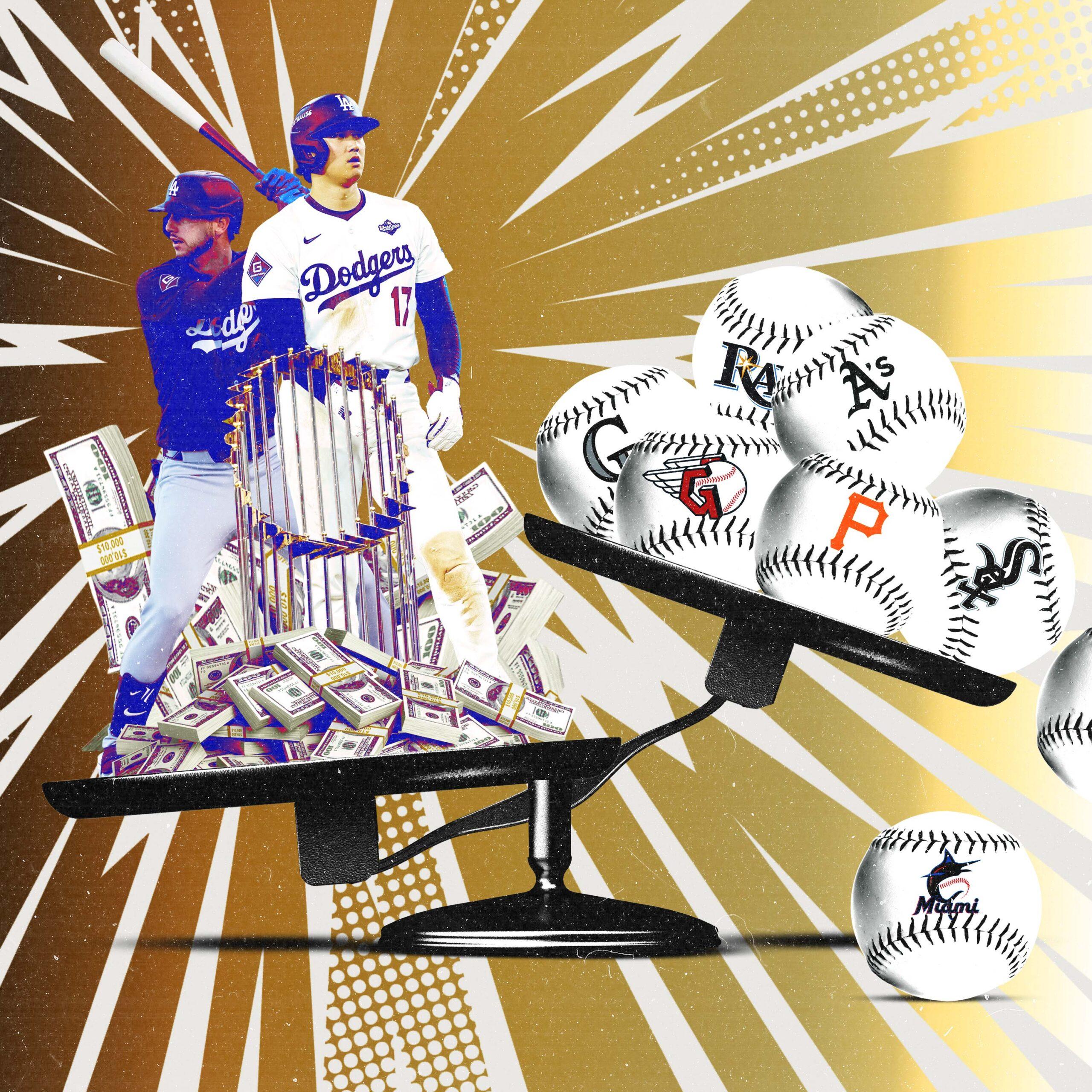
Baseball’s Dodgers Problem Is Eternal
The Dodgers are MLB’s supervillains. They’re also being scapegoated. Let’s dive deep into the team that will define the 2026 season—and shape where the sport goes next.Baseball’s Dodgers Problem Is Eternal
The Dodgers are MLB’s supervillains. They’re also being scapegoated. Let’s dive deep into the team that will define the 2026 season—and shape where the sport goes next.
It is, apparently, choosing time. Might be all year. You will have thoughts about the Los Angeles Dodgers, and you will like it. You will hone your contention. Standouts or scoundrels. Scapegoats or supervillains. Heralds of free enterprise or C-suite oligarchy.
If it all sounds familiar, that’s because it is. The baseball-watching public reran this conversation last year. And the year before that. Safe money is on another repeat next spring. Time is a flat circle. The existential tug-of-war is eternal.
No debate permeates the bedrock of modern baseball quite like the one surrounding whether the Dodgers have ruined the sport. This year’s apocalyptic flash point came in January, when the two-time defending champs scooped up the best position player on the market, outfielder Kyle Tucker, for $60 million annually. There were many hissy fits thrown leaguewide. The Athletic’s Evan Drellich reported that MLB owners were “raging” because of the signing, with one source saying it’s “a 100 percent certainty” that we’re headed toward a salary cap showdown. A team official told ESPN’s Jeff Passan that the sport’s plutocrats were “ready to burn the fucking house down.”
Pitchers and catchers reported for duty, and the counter-push ensued. More than half a billion spent on one team’s roster, Manny Machado said, is “fucking great for the game.” Bryce Harper, whose Phillies lost to L.A. in the divisional round last October, offered, “I love what the Dodgers do.” The uptown magistrate concurred. “They’re trying to get the best product on the field,” Aaron Judge told a gaggle of beat reporters. “I wish a lot of teams found a way to do that.”
That L.A.’s spending has become a proxy for baseball’s labor war, on the doorstep of a December CBA expiry date, is to be expected. MLB has repeated some version of this cycle every few years since Curt Flood admonished Bowie Kuhn that “a well-paid slave is nonetheless a slave.” The upset here is that beneath the shameless posturing, many of the main gripes in this current debate—the gut instincts baseball watchers have about the state of the game and the Dodgers’ place within it—are relatively legitimate.

There is something off about the sport and its new Evil Empire. But the Dodgers are not the root of baseball’s broken equation. That has far more to do with L.A.’s competitors and the structure of the league as a whole than who does or doesn’t suit up in Chavez Ravine. On the cusp of MLB’s 150th season, those of us without a vested interest in the business of baseball are left to reckon with a paradox: The game does have an evident Dodgers problem, but the Dodgers aren’t the central problem with the game.
These Dodgers are, without a doubt, all-time MLB heels. Their peers hold them in bitter esteem. More than a decade has passed since they finished a full season with fewer than 90 wins. They have won three of the past six World Series. As accoutrements: five pennants and 12 division titles over a 13-year stretch. If they repeat again this year, they’ll become just the third team since the 1950s to capture three consecutive titles.
That renown alone, though, is not what elicits the fog of animosity that trails them. There have been other dominant franchises in the modern age—one was built atop a cheating scandal of literal refuse—and each was a collective of dream killers. What makes these Dodgers the Dodgers isn’t merely that they’re competitively brilliant or even structurally adept. It’s that they have the indecency to exist, at this moment in particular, as something akin to robber barons on the diamond.
This is the third straight year in which L.A. leads the league in payroll. Its $395 million figure clears the second-place Mets by more than $30 million and the third-place Yankees by more than $80 million. The Dodgers are set to pay an additional $161 million in luxury taxes; 12 teams’ entire rosters cost less than that. And while it is worth noting that this type of payroll discrepancy is not unprecedented in MLB—the early-2000s Yankees regularly lapped the field in salary—the Dodgers are truly singular in the extent to which they’ve been given their own set of rules and used them to maximize their spending power.
Reborn in the image of private equity, L.A. is a serial baseball tax evader. The roots of this can be traced back to Guggenheim Partners’ 2012 purchase of the franchise for a then-record $2.15 billion. Because former owner Frank McCourt filed the Dodgers for bankruptcy before agreeing to sell them, the organization had a path to a uniquely beneficial revenue structure by the time that Guggenheim CEO Mark Walter entered the fold. Weighed down by a notoriously messy divorce that resulted in a $131 million settlement, McCourt had hoped to complete a media rights deal with Fox for what he said would amount to $3 billion. (MLB insiders at the time estimated it would be closer to $1.7 billion.) When the league rejected the deal, McCourt chose to argue his case before a judge.
As part of a subsequent settlement between McCourt and the league, MLB agreed to interpret the “fair market” value of the Dodgers’ media rights as equal to the rejected Fox agreement. This effectively capped the amount of Dodgers broadcast dollars subject to revenue-sharing dues at $84 million initially, with escalators in the years that followed. (The league would take its standard 34 percent cut and distribute it evenly among its teams; the cut on local TV deals has since increased to 48 percent.) In January 2012, the Dodgers partnered with Time Warner Cable on the creation of a regional sports network, or RSN. The franchise received both 50 percent ownership of the channel and $8.35 billion over the next 25 years.
The annual sum L.A. gets from this deal, an average of $334 million over the course of the contract, is not fully counted for revenue-sharing purposes. Every other team’s media rights deals are taxed in totality; the Dodgers’ deal is taxed at a fraction of its actual figure. MLB’s attorneys at the time argued that this setup had the potential to create a competitive disparity between L.A. and the rest of the league: “Everybody’s got to be the same,” one representative argued at an arbitration hearing. “You can’t have the Dodgers and 29 others.” Guggenheim, for its part, cited this setup as part of why it found the acquisition so attractive. Per the Los Angeles Times, one attorney for the firm described the revenue-sharing framework as a “substantial component of the value proposition of the transaction.”
In 2013, the portion of the Dodgers’ media rights deal subject to MLB revenue sharing was adjusted up to $130 million. (Any profits earned as co-owners of the RSN aren’t subject to revenue sharing.) A few months ago, Forbes estimated that the amount the franchise will shield from revenue sharing over the 25-year length of the deal will be “somewhere around $2 billion.” By comparison, the Yankees—who own less than 30 percent of their RSN, the YES Network—are in the midst of a 30-year, $5.7 billion rights agreement, second largest behind the Dodgers. No other team in the sport has a deal over $3 billion, and many have recently seen theirs fall apart.
The economic divide between L.A. and the rest of the league doesn’t conclude there. If the Dodgers have a trademark spending flex, it’s the use of deferrals in multiyear deals. The crown jewel of that is Shohei Ohtani’s 10-year, $700 million contract—$680 million of which is deferred. For L.A., the appeal of this is plain: Deferred salaries count differently against MLB’s competitive balance tax (CBT) than non-deferred salaries do. The CBT is determined by calculating the sum of every contract’s annual average value (AAV) on a given roster. To assess the AAV of a deal, the present-day value is divided by the length of the deal. But the present-day value for deferred salaries is lower than the sticker price, at least for CBT purposes.
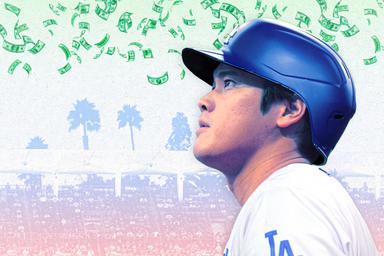
Ohtani’s heavily deferred deal has a present-day value of around $460 million and an AAV right around $46 million. The two-way star opted for this contract structure both because of its massive implications for his income taxes and because it opens up salary space for L.A. Ohtani’s deal, to boot, has already paid for itself. Last October, Sportico estimated that the Dodgers’ revenue rose by a staggering $200 million during his first year with the team. Joon Lee, an independent journalist covering MLB, reported in 2025 that sources told him “the Dodgers made back the entirety of the contract in Ohtani’s first season in tickets, marketing deals, [and] merchandise.” In January, the New York Post detailed that L.A.’s “sponsorship business alone is now believed to make as much money as roughly half of the league’s other 30 teams do overall.”
In the past four years, the Dodgers have inked contracts that deferred $60 million to starting pitcher Blake Snell, $21 million to reliever Tanner Scott, $57 million to first baseman Freddie Freeman, and $31.5 million to outfielder Teoscar Hernández. Those are just the free agent deals. The club has also incorporated deferrals into extensions for shortstop Mookie Betts ($115 million), catcher Will Smith ($50 million), and super–utility man Tommy Edman ($25 million). In 2024, the franchise created upward of $32 million in CBT space through deferrals; this year, it freed up even more. L.A. doesn’t have a monopoly on this maneuver, and kicking salary obligations down the road is not some sort of newfangled tactic. But it is fair to question whether the scale of these deferrals is replicable by anyone else.
And there is something dystopian for fans of small- and mid-market franchises about feeling like their team was just outfoxed by both a deeper-pocketed opponent and its army of corporate accountants. After all, the Dodgers can pursue so many deferred contracts in part because they have hundreds of millions in cash on hand. MLB rules mandate that deferred dollars be held immediately in escrow, even if the payouts are decades away. That means the less resource-liquid an organization is, the fewer deferred dollars it can offer. Since 2020, L.A. has totaled well over a billion dollars in deferrals, two-thirds of the collective amount deferred leaguewide. The next-closest teams don’t surpass one-tenth of the Dodgers’ total.
Taken separately, none of these windfalls fundamentally tilts the playing field in favor of the Dodgers. But they each exist in concert with one another. L.A. was gifted a singular revenue-sharing loophole; it exploited that loophole to build a roster loaded with the world’s best players; the world’s best players won multiple championships and made the franchise more and more money; that money has allowed the Dodgers’ dominance to keep compounding. But there’s more to the sport’s imbalance than the presence of one superteam.
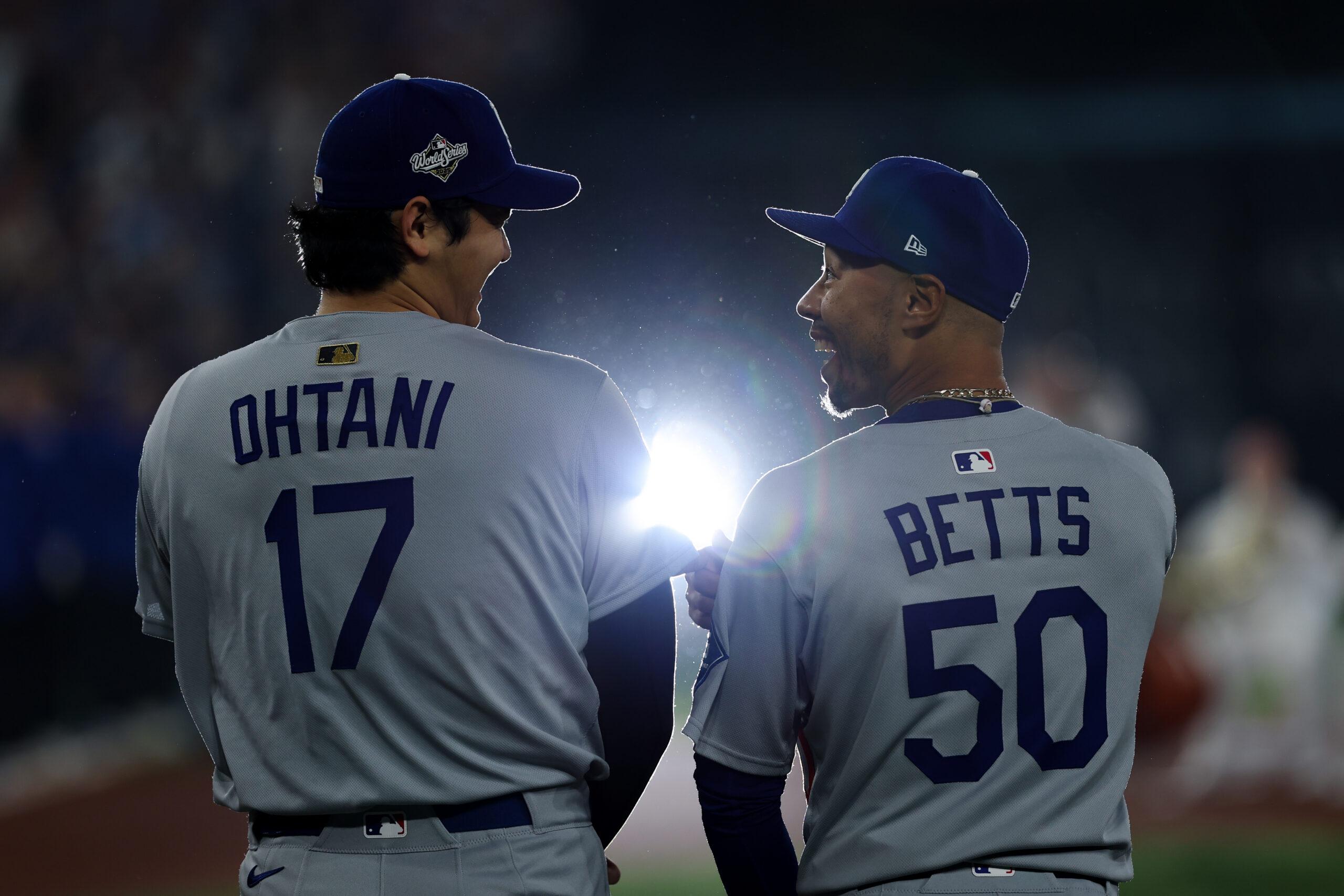
Another Dodgers title isn’t destiny. Maybe a small-market squad can’t field a half-a-billion-dollar payroll, but it doesn’t need to field one that’s even a sliver of that amount. As things stand, only seven teams are above the first CBT threshold. Half of MLB isn’t even within $50 million of it. A third of baseball isn’t within $100 million.
MLB’s economic landscape is marked by the vast disparity in funding received by the league’s lowest and highest spenders, both in terms of revenue sharing and the CBT as a redistributive tool. Though revenue sharing is ostensibly market-neutral—every franchise is taxed at the same rate and receives the same kickback—the teams with the lowest incoming revenue end up profiting off the system the most. That’s by design: Revenue sharing is explicitly supposed to bridge the competitive gap between the highest and lowest earners.
Where things get messier is in the CBT fees, which fund a substantial portion of that model. Thanks in part to the tax dollars taken from the teams that spent the most in free agency, many of the franchises with the lowest payrolls are able to consistently rake in profits by simply keeping player salaries below the sum they receive in revenue-sharing payouts and gate receipts. The calculus these teams continue to make is that it’s more lucrative—and desirable—to flounder than to spend to augment their rosters. That’s how you get a Pirates organization that’s 118 games below .500 over the past five years and has never once handed a position player more than $29 million in free agency; it’s how you get a Marlins club that has never won its division adding $20 million to its payroll and still being last in the league in spending by nearly the same amount.
The RSN economy, likewise, is not fated for perennial revenue stratification. Other sports leagues with small markets sell off their local TV rights and recoup far more than MLB. Commissioner Rob Manfred has recently pushed for this very adjustment but has yet to convince the teams that benefit most from the current system to agree to it. (It’s worth noting this is not because they’re wholly unwilling; they’d just kindly like something in exchange for their magnanimity.)
The league’s latest push for the introduction of a formal salary cap cannot be understood outside of this context. MLB’s ruling class is presenting a tool to stifle high-end salaries as its solution to improve competitive balance. These are separate concerns. There are ways to incentivize homegrown players to stay where they are, at dollar amounts that don’t price out half the league and don’t stifle salary growth. But a cap does not exist for this purpose, nor has it ever.
As MLB hurtles toward the precipice of a potential 10th work stoppage across its century-and-a-half history, the reality that faces baseball as an economic order is that many of the smaller-payroll teams don’t want to ameliorate the current system, because those teams don’t have much issue with how the system is working. The Dodgers are just an easy mark, a pretense for the league’s owners to press their labor base for the same salary concessions they’ve sought for decades. And while the Dodgers do have a distinct financial advantage that makes them extra loathsome to opposing fans, they’re also winning behind their stellar track records of scouting and development. Their financial advantage is not particularly replicable either, barring another tawdry divorce that produces a domino effect that ends in a dynasty.
A broken clock is right twice a day; Scott Boras throws strikes at roughly the same rate. He tossed one across the plate in January. “The Dodgers are not a system issue,” the superagent told reporters shortly after the Tucker signing. “They are the benefactors of acquiring Shohei Ohtani, MLB’s astatine. Short-lived and rare. No other player offers such past or present. Ohtani is the genius of elite performance and additional revenue streams of near $250 million annually for a short window of history. The process of acquiring Ohtani was one of fairness and equal opportunity throughout the league. A rare, short-lived element is not a reason to alter the required anchored chemistry of MLB.”
Whatever might be contemptible about this version of the Dodgers—its media rights tax avoidance and contractual scheming and tendency toward various unearned indulgences—is a reflection of what was already broken in MLB. What was flawed before the Dodgers morphed into a juggernaut, and what will still be flawed when the Dodgers have had enough of playing the heel.