
Judging by much of the coverage of Major League Baseball’s labor outlook, there’s only one adjective that applies to the forthcoming expiration of the league’s collective bargaining agreement and the work stoppage that will almost certainly ensue: looming. You’ll be hearing, and reading, about a “looming lockout” throughout the 2026 season, which is a testament to both the power of alliteration and the agita generated by the prospect of a shortened or canceled 2027 campaign.
It’s the week of Opening Day, which might seem like an opportune time to focus on hope and faith for this season, not whether and when we can expect an Opening Day in 2027. At The Ringer, we’ll be doing a bit of both. There’s no shortage of excitement surrounding this season, but the hype has been tempered a bit by wariness of what could be coming. (Sorry—looming.) Sometimes the best way to defuse a fear is to confront it, so today we’ll tackle the prospect of an extended work stoppage head-on.
All we know for sure is that the current CBA, which took effect on March 10, 2022, will expire at 11:59 p.m. ET on December 1, 2026. The rest is speculation. So let’s speculate, in as informed a fashion as we can. Here’s your FAQ on the likelihood of a lockout, the biggest issues at stake in the negotiations, the chances of a lost season in 2027, and, relatedly, how worried you should be in 2026.
Let’s just skip straight to the lockout question: Well, will there be one?
Um, will the Rockies finish last in the NL West? You’d better believe that a lockout is a lock. Last time the MLB CBA expired, on December 1, 2021, the owners immediately locked out the players, which initiated the league’s first work stoppage since 1995. Expect history to repeat itself, right down to the date and time. You can confidently, if sadly, set an “MLB lockout just started :(” calendar reminder for midnight on December 2 right now.
Commissioner Rob Manfred declared as much more than a year ago, when The Athletic’s Evan Drellich reported that Manfred “said an offseason lockout … should be considered the new norm.” Manfred sounded like he was counting down the days until he could get his work stoppage on. “In a bizarre way, it’s actually a positive,” he said. “There is leverage associated with an offseason lockout and the process of collective bargaining under the NLRA works based on leverage. The great thing about offseason lockouts is the leverage that exists gets applied between the bargaining parties.” In case you still weren’t convinced of the virtues of this strategy, Manfred added that compared with in-season work stoppage, an offseason lockout is “like using a .22 (caliber firearm), as opposed to a shotgun or a nuclear weapon.” Of course, a .22 can kill you, too.
Unsurprisingly, Tony Clark, then the executive director of the MLB Players Association, disagreed with Manfred’s pro-lockout rhetoric. But the union doesn’t doubt Manfred’s resolve. Last month, interim executive director Bruce Meyer said, “A lockout is all but guaranteed at the end of the agreement.” The Rockies have a 0.1 percent chance of making the playoffs, which might make the return of Rocktober more likely than the league and union agreeing on a new CBA before Manfred fires his figurative .22.
Wait, then–executive director? Interim executive director? What happened to Tony Clark?
It’s been an eventful few years for the union. Two years ago, Clark and Meyer, who was then the union’s deputy director, weathered a challenge from a former union lawyer named Harry Marino, who had helped integrate minor leaguers into the union. Marino and a contingent of players who weren’t pleased with the union’s direction tried to pressure Clark into dismissing Meyer, but Clark, who had led the MLBPA since 2013, quelled the mini-revolt and seemed to solidify his support.
Then the real trouble started.
A whistleblower complaint about Clark, filed with the NLRB, surfaced in December 2024 and reported profligate spending, self-dealing, nepotism, conflicts of interest, and other forms of mismanagement. Federal investigations ensued, pertaining to both OneTeam Partners (a company co-owned by several sports league unions that also fostered scandal at the NFLPA) and Players Way, an MLBPA-owned youth baseball company that generated scant revenue despite the union’s extensive investments in the business.
All of which made it something less than stunning when Clark suddenly stepped down as executive director on February 17. Until it was reported that the reason for his resignation was an internal review that revealed an “inappropriate relationship” with his sister-in-law, who had worked for the union since 2023. That part was certainly a surprise.

More on MLB
What does that mean for the union’s strength and strategy?
It sounds consequential, but most likely, not a whole lot. Clearly, it’s not ideal for a union’s leader to be forced to resign shortly before bargaining begins—but it’s better than the same drama going down after bargaining begins. And Meyer’s elevation, albeit on an interim basis, maintains continuity. Clark hired Meyer in 2018 in response to players’ (and outside observers’) perception that Clark had been outmatched and outmaneuvered in his first round of bargaining. Meyer, an experienced labor lawyer and skilled litigator, has already been leading the PA’s bargaining preparations, and he’ll match up against MLB’s lead negotiator, Dan Halem, a deputy commissioner and chief legal officer with almost 20 years of MLB experience.
Although Meyer is seen as less personable than Clark, a respected (at least before recent events) former player, Clark was actually the outlier—the only former player ever to have led the union. Meyer and Matt Nussbaum, promoted from general counsel to interim deputy director, fit the lawyerly Donald Fehr–Michael Weiner mold more. And Meyer will be a bulldog. At the end of the last round of bargaining, team player representatives voted 26-4 in favor of ratifying the deal, but union leadership—including the union’s eight-player executive subcommittee—actually opposed the agreement. “The subcommittee voted 8-0 against approving the 2022 labor contract and Meyer had advocated pushing management for a deal more favorable to the union,” the AP noted.
Maybe Meyer is slightly more likely to hold the line against a cap—and slightly less capable of rallying the troops—than an untainted Clark would’ve been. But as Drellich wrote earlier this month, “On both sides of the aisle, there’s a sense that individual leadership personalities matter less than the public might think. The issues themselves—the math, the money—usually provide the answers.”
So what are the issues?
Naturally, there are too many to list all of them. The current CBA runs 442 pages. Here’s how that compares with the page counts of the eight earlier CBAs available via SABR:
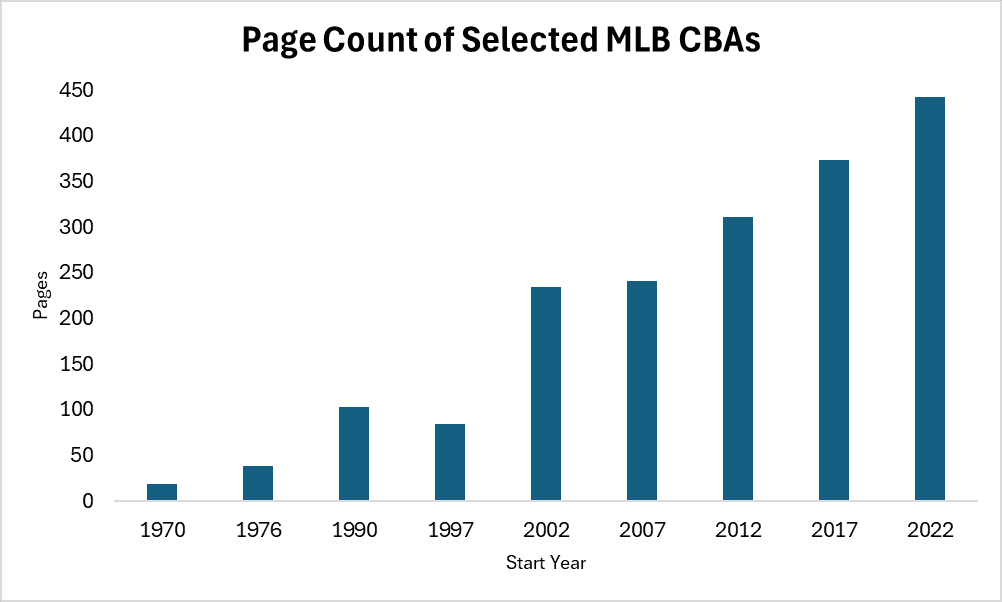
Of course, MLB revenues and salaries have skyrocketed over the same span; the bigger the business of baseball, the heftier the CBA. Could we be about to see the first 500-page CBA, whenever the next one is signed? The last two grew by 62 and 69 pages, respectively, so it could be close. Place your bets—er, predictions—with MLB’s new official prediction market exchange partner!
Ahem. There are numerous matters up for discussion, but the biggies are basically the same as ever. The union will try to get players paid earlier, via higher minimum salaries, quicker paths to free agency, and seemingly successful measures such as the pre-arbitration bonus pool and the Prospect Promotion Incentive. The league would like to do away with the arbitration system and adjust the revenue-sharing system. The international draft and qualifying offer, which were tied together in a league proposal that came close-ish to passing in 2022, will probably be back on the table. Expansion (to 14 playoff teams and 32 franchises) is sure to be invoked. And as the league experiments more regularly with rules changes, the players may push for a greater say in their implementation.
And then there’s the headliner, the owners’ fondest desire and the players’ strongest nonstarter: a salary cap (which would inevitably be paired with a salary floor). As Meyer said in February about the league’s desire for a salary cap, “This is something they've always wanted. It’s not new. ... Our union historically has been against it because we believe it’s quite simply not good for players. That position is not going to change.” That about sums it up. The league continues to saber rattle about pushing for a cap; the players continue to oppose it just as strenuously. It was always ever thus, except before free agency, when the league hardly needed a salary cap because the reserve clause was still in place. (Somewhere, Jerry Reinsdorf just wistfully sighed.)
The league argues that MLB needs a salary cap to promote competitive balance, thanks to the institutional advantages of the big, bad Dodgers, the Mets, and other serial competitive balance tax exceeders. Meyer retorts, “The problem isn’t the teams that are trying to win. The problem is the teams that aren’t.” In theory, a cap-and-floor system could address both desires, but the owners’ floor proposals haven’t come close to making a cap palatable to the players.
That’s largely because competitive balance is a persuasive justification for pursuing a salary cap that the owners would dearly desire regardless. In the other major American men’s leagues, owners obtained salary caps after breaking or weakening unions, which goes to show which side caps favor financially. The owners are sure to make a major push to harpoon their payroll white whale, but odds are that they’ll settle for tweaking the CBT system and kicking the salary cap can down the road for at least a few more years. For some of the more miserly owners, the floor that a cap would come with would actually cost them too much money to make it worthwhile. They may grumble about being outspent several times over by the likes of Steve Cohen, but they like pocketing big-market teams’ money, and they aren’t doing their part to shrink the payroll gap.
But I thought I read that owners and players are more determined than ever to achieve total victory?
There has already been a lot written about a salary cap, and there’s much more to come. We’ve heard how angry owners are and how resolute the union is. We’re bound to get a steady stream of leaks and provocative quotes laundered through prominent news breakers all year.
You can safely ignore almost all of it because very little of it actually is news. Really, it’s just good gossip and spin. For one thing, public opinion doesn’t matter that much in CBA negotiations; fans and media members don’t have seats at the table. For another, nothing will be decided soon. So don’t make too much of the posturing by anonymous owners, executives, and players. It’s not particularly predictive of how they’ll act, which is what matters.
Expect a compressed flurry of free agent signings between the World Series and the lockout—not that next offseason’s class is inspiring, Tarik Skubal aside—a lot of foot-dragging and photos of parking lots and baseballs with locks and chains, and a negotiation that goes down to the wire, much as the WNBA deal just did. Manfred’s file-and-trial-style brinksmanship may or may not hasten an agreement, but he’s right about one thing: An offseason lockout, however alternately boring and anxiety-inducing, is preferable to the in-season kind.
As Ronald Blum of the Associated Press, who’s covered baseball’s labor battles since 1988, put it last spring, “None of it means anything until March 1-15, 2027.” Blum added, “You can bluff and you can say, ‘We need a salary cap,’ but when you face losing real games, that’s when you have to show your cards. None of the bluster means anything until then.”
Does MLB have a competitive-balance problem?
That’s a loaded question, right up there with Luke Skywalker asking his aged Jedi mentors “How did my father die?” and “Is the dark side stronger?” Obviously, the two sides’ positions differ: The league says yes; the union says no. I say … it depends. (On, yes, a certain point of view.)
Part of the problem with the conversation about “competitive balance” in baseball is that there’s no single, accepted definition of the term. If you thought arguments about MVP or Hall of Fame candidates could be frustratingly imprecise, buckle up; arguments about competitive balance can be even vaguer, as partisans talk past each other without recourse to a standard such as WAR or JAWS.
Baseball Prospectus writer Rob Mains has shown that in terms of the inequality of regular-season records and the capacity of teams to move up in the standings or into the playoffs, this era isn’t particularly top-heavy or static. Sports researcher James Smyth has tirelessly documented how MLB stacks up to the NFL, NBA, and NHL this century (and over shorter spans) in terms of the number of franchises that have won their division, made the playoffs at least once or multiple times, advanced to certain playoff rounds, won a championship, etc. The answer is: quite favorably.
Of course, these cross-sport comparisons are apples to oranges—or, well, baseballs to footballs. Baseball, football, basketball, and hockey vary widely in a number of structural respects: the number of games in a season, the number of players on the roster and in games, how deterministic any given game or playoff series is, the revenue-sharing model, etc. Baseball has a built-in randomness, particularly in the playoffs, that acts as a safeguard against dominance. So does the fact that in baseball, a single superstar can’t completely transform a team. It seems sort of unearned to credit a league for balance that stems from an inherent feature of its sport, but the results are the results.
Then again, it’s not as if every MLB team has equal access to resources or success; as BP’s Ken Funck showed in January, “high payroll teams and low payroll teams have similar mobility, but high payroll teams are rarely big losers, and low payroll teams are rarely big winners.” Over time, teams with high payrolls do win more than teams with low payrolls. (Shocking, I know.)
MLB payrolls aren’t perfectly correlated with market size; some teams spend more or less than their surroundings would seem to dictate. But as Funck concluded, “running a high payroll greatly increases your chance of winning. And setting aside their willingness to do so, some teams by default have a much greater ability to do so. This is why so many fans feel MLB’s current financial structure is unfair and competitive balance is a problem that needs to be better addressed.”
A visual might be helpful here. Inspired by an old chart created by graphic designer John LaRue, I made two heat maps that show the connection between spending and winning, based on Opening Day payroll data from The Baseball Cube dating back to 1988 (which itself was sourced from USA Today and Spotrac). For each year, every team is listed in descending order of payroll rank, from highest payroll to lowest. The colors correspond to winning percentage—the better the team, the darker red the cell that corresponds to it. (It’s easy to pick out the crimson, 116-win 2001 Mariners, for instance, or the bright-white, 41-win 2024 White Sox and 43-win 2025 Rockies.) The first version, with somewhat more muted colors, applies the color scheme to the whole 38-season sample at once; the second version applies it to each individual year. An embedded GIF blinks between them.
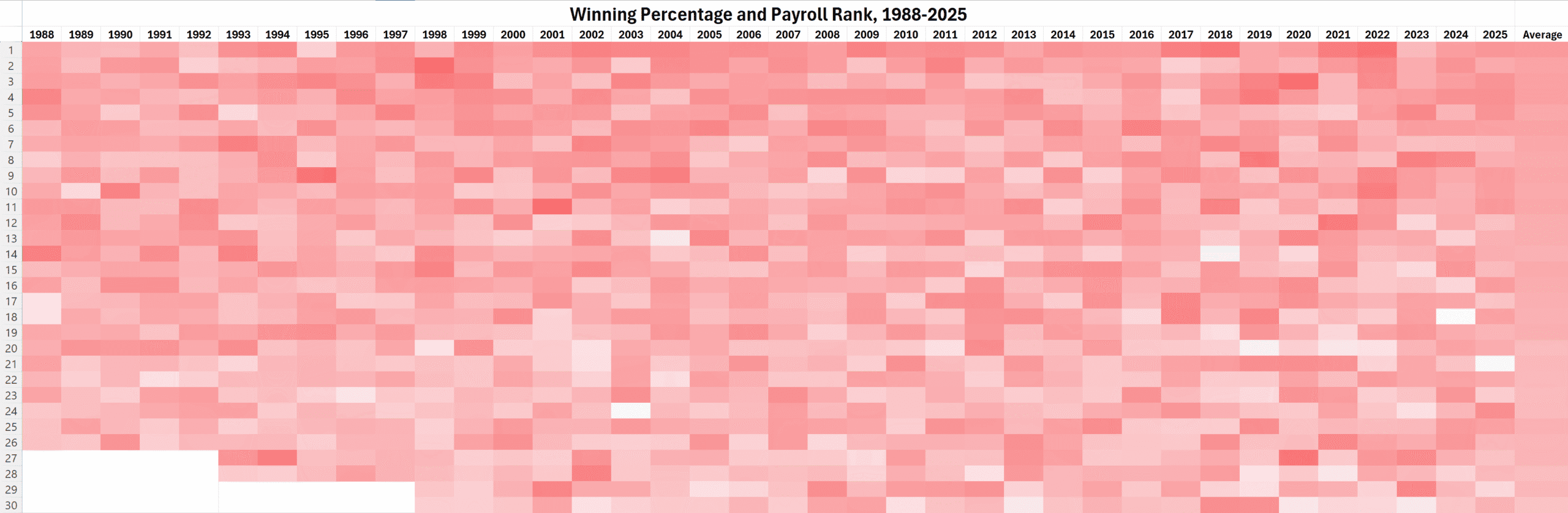
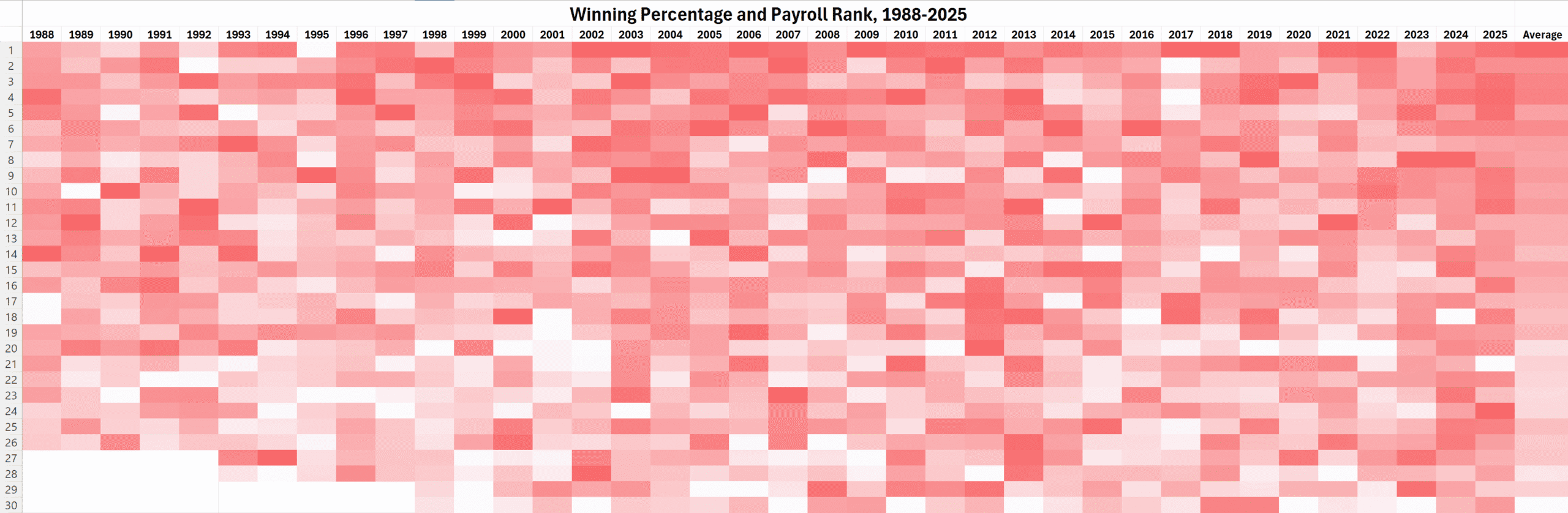
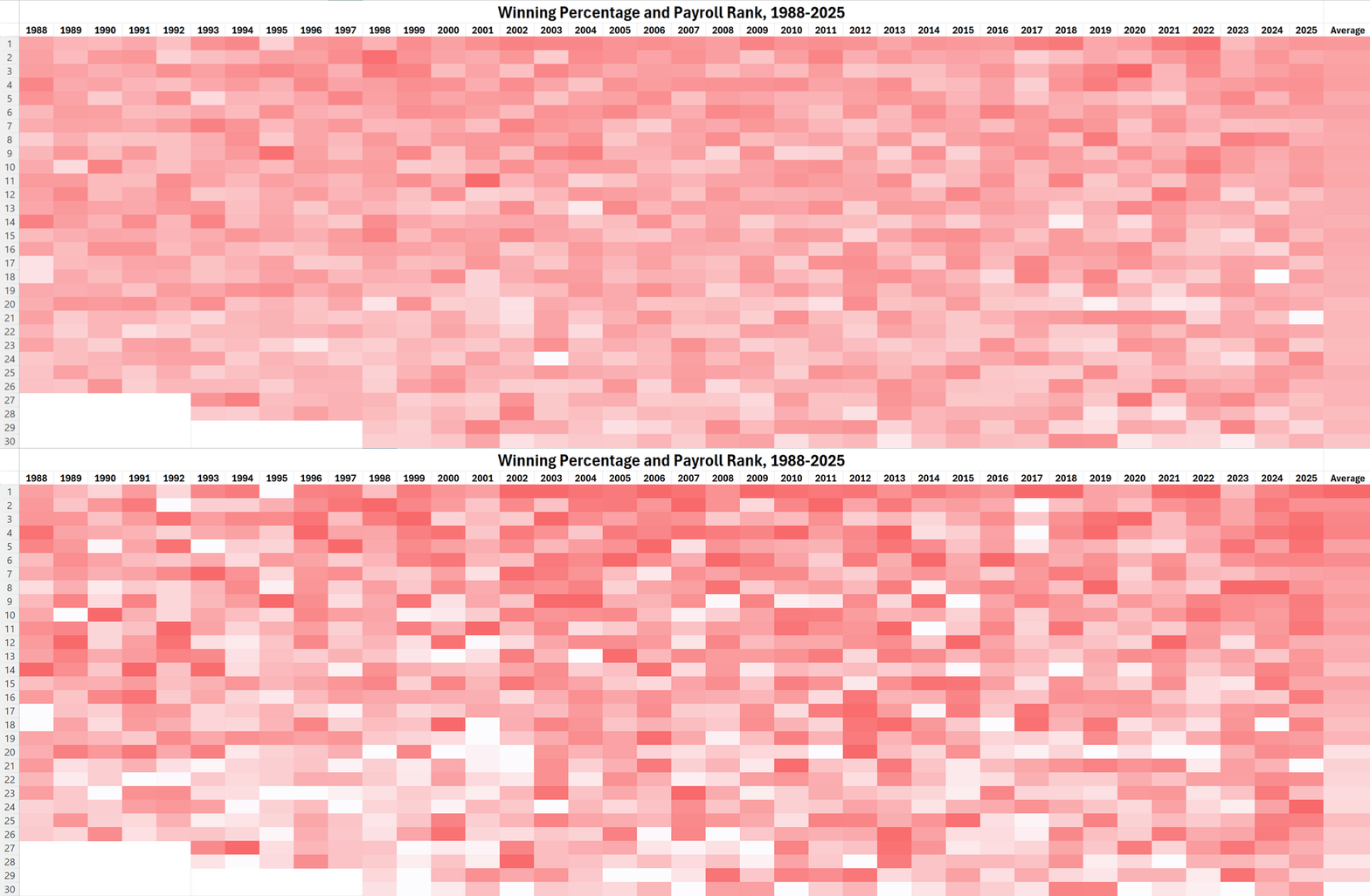
As a glimpse at each graph shows—pay particular attention to the right-most column, which averages winning percentages across each payroll rank—there is a relationship between spending and winning. Darker colors tend to cluster toward the top. But it’s hardly an ironclad law: There are plenty of light-colored cells (denoting losing teams) among the biggest spenders, and dark-colored cells (denoting winning teams) among the cheaper clubs.
Another, less colorful way to show that is via the annual correlation between payroll rank and wins rank. In most years, the correlation is modest, but it’s positive for every season in the sample except 1992, which indicates that as a team increases its payroll rank, it tends to increase its rank in leaguewide wins, as well. The lighter, 3-year-average and 5-year-average lines, which slightly smooth out the variability of the annual, black line, show that the relationship between spending and winning has gotten stronger lately, though it’s weaker than it was in the late ’90s and early-to-mid-2000s. (Recognizable revenue-sharing and competitive balance tax systems were implemented in 2002.)
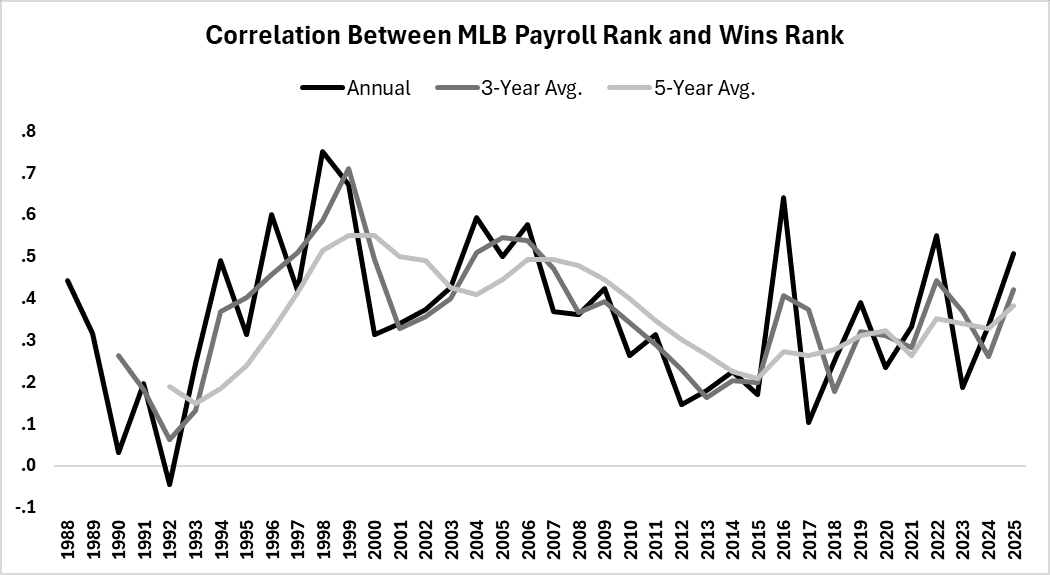
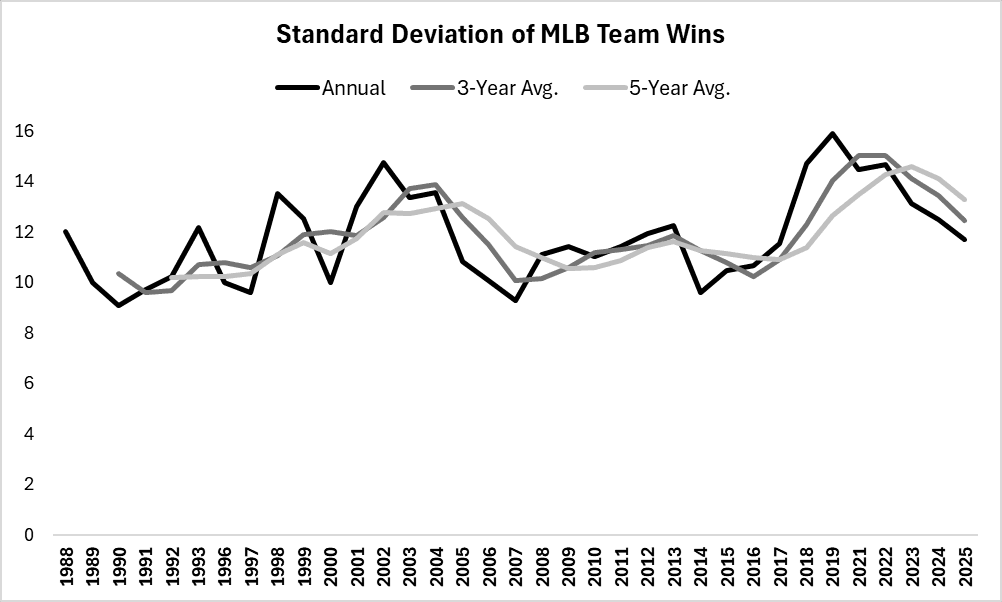
That increased correlation has coincided with an uptick in the standard deviation of MLB team wins—essentially, how closely clustered around the average win total the 30 teams are, or how stratified the league is. However, that standard deviation has started to sink as the recent superteam era has given way to great parity (or mediocrity), driven by an expanded playoff format that rewards teams for being good, not great.
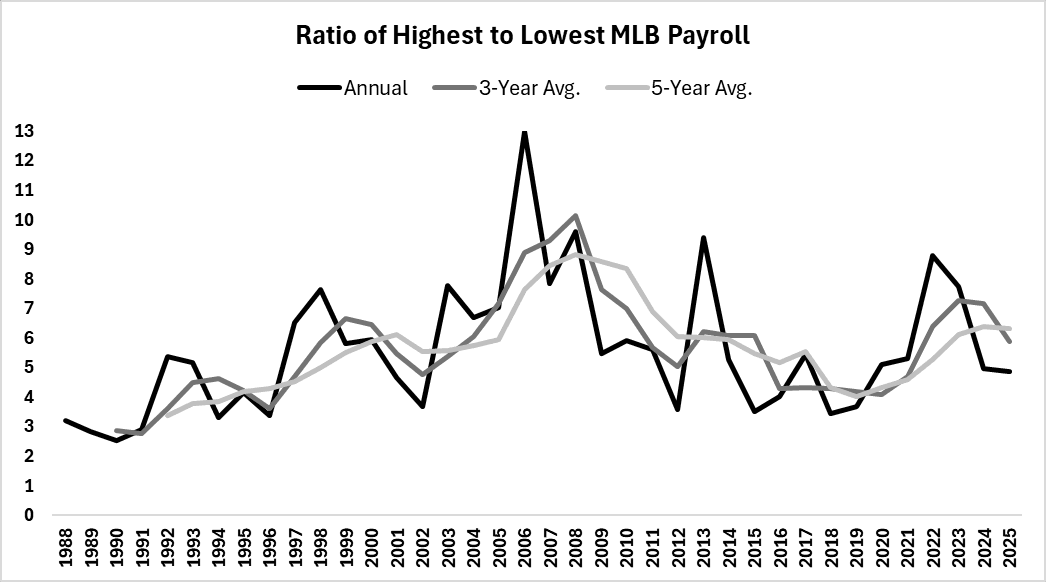
It might surprise some salary-cap-pilled fans to know that the ratio of the highest to lowest team payroll today (excluding CBT penalties) is not nearly as high as it was when the mid-2000s Yankees were signing every player.
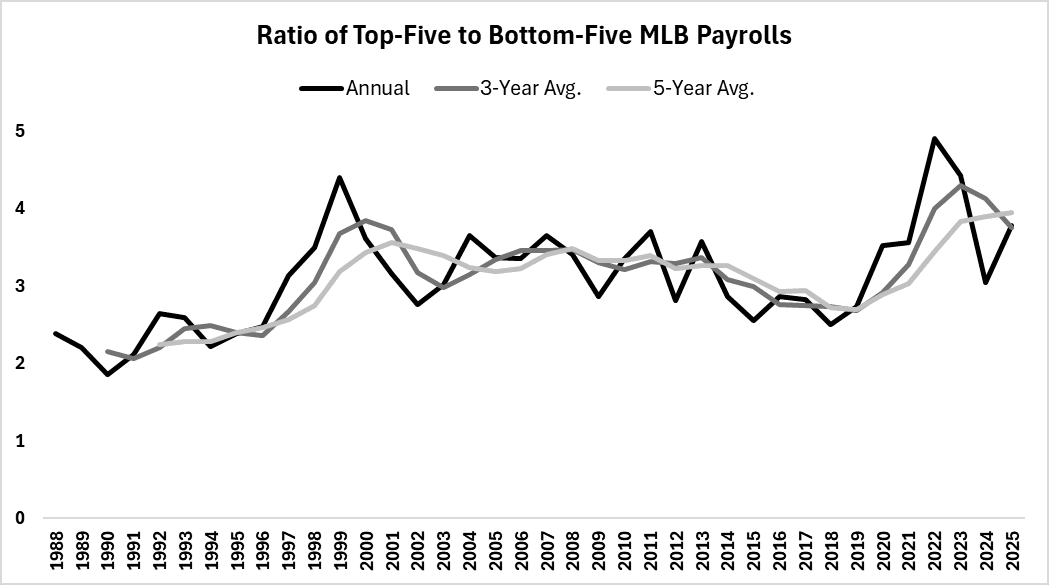
However, the ratio of the top-five payrolls to the bottom-five payrolls is the highest on record, at least according to the multiyear measurements. So the big fish are outspending the little fish by more than ever—though that doesn’t tell us whether Manfred or Meyer is right about the highest spenders or lowest spenders being the bigger problem.
Here’s what the competitive-balance problem boils down to: unfairness, or the perception thereof. MLB isn’t horribly imbalanced, if at all, compared to its past or to the present in other leagues. But its wildly unequal payrolls create a serious optics problem, which is only getting worse the longer the league lasts as the lone cap-free league among the so-called “Big Four.” As Joe Sheehan observed several years ago, “Having a payroll cap, in the minds of most sports fans, means you have competitive balance, full stop.” It doesn’t mean that, in practice, but it does mean that to many people, MLB success seems more like a product of payroll than smarts.
It doesn’t help that whereas recent powerhouses in the NFL, NBA, and NHL have hailed from Kansas City, Oklahoma City, and Miami, respectively, MLB’s juggernaut plays in L.A. A dynasty seems a little less objectionable if it doesn’t appear to have been born on third base, and being bad is a little more tolerable if that team’s fans don’t feel like their location has consigned them to a lower tier of competitive aspirations.
None of which suggests that it would be rational for the union to voluntarily cap its members’ earnings, unless it gets a big boost in salary from a lofty floor. But fans’ gripes (about this topic, at least) aren’t entirely delusional.
How worried should I be about all of this costing me Major League Baseball next year?
Not much of the early religious instruction I received stuck, but I am partial to the sentiment in the Serenity Prayer: “God, grant me the serenity to accept the things I cannot change, the courage to change the things I can, and the wisdom to know the difference.”
Unlike the Almighty, I can’t grant you anything, but I will offer wisdom on one point: Unless you’re a league negotiator or a member of the MLBPA bargaining unit, the fate of the 2027 MLB season falls squarely in the “things I cannot change” category. So, no, you shouldn’t worry about this. Worrying won’t help! Especially because bargaining hasn’t even begun yet, and in all likelihood, we won’t know whether the season will be lost or saved for close to a year. Why torture yourself until then?
Of course, the human mind doesn’t always operate via Vulcan-like logic. So if you like following Major League Baseball, it’s only natural to worry that there won’t be as much of it as usual next year. And sure, the disaster scenario could come to pass. Perhaps it’s prudent to hope for the best and expect the worst. Or, alternatively, to expect the worst and not hope for anything. That way you won’t be disappointed.
If you want to hold out hope, though, I can supply some. For one thing, MLB has never canceled a full season, and excluding the pandemic-shortened 2020 season, only two (1981 and 1994) have been severely curtailed. Work stoppages haven’t cost the league a single game since 1995, even though there have been multiple contentious rounds of bargaining over that span. So, while past performance is not necessarily indicative of future results, the baseline expectation should probably be “no lost season.”
Plus, there are plenty of reasons to think that one side or the other (or both) will pull back from the brink. For one thing, MLB is thriving, thanks in part to well-received rule changes: regular-season attendance and TV ratings are on the upswing; the average age of viewers and ticket buyers is decreasing; recent World Series and World Baseball Classic audiences have been huge. That doesn’t mean it’s incumbent on one party to cave for the good of the game, but both sides will be conscious of what they stand to lose if the season gets scuttled. If one side digs in so hard that 2027 becomes another ’94, any “victory” it obtains in terms of a more favorable deal will be pyrrhic at best. Fans will flee, revenue will plummet, and even a proportionately larger piece of the pie will be less lucrative than a smaller piece of a bigger pie would’ve been. In a game of chicken, both drivers can crash.
Beyond the incentive not to rock baseball’s boat in the midst of such smooth sailing, there’s the potential for big paydays a few years down the line if the league lets the good times roll until then. MLB’s national television deals with ESPN, Fox, Turner, NBC, Netflix, and Apple expire after the 2028 season. Meanwhile, local broadcast revenues are down, as cable subscribers continue to cut the cord and regional sports networks falter. As streaming TV analyst the Entertainment Strategy Guy wrote last week, “the revenue of the olden times isn’t coming back.” Manfred hopes to maximize MLB’s take in a diminished market by selling more national TV inventory and bundling together teams’ local rights, which will make for a fight among owners. MLB has assumed control of production and distribution for 14 teams in 2026, after a mass exodus from the floundering Main Street Sports Group. Manfred would love to offer a package of all 30 teams’ local rights to streamers in 2028, but to nationalize MLB’s TV offerings, he’ll have to get at least some of the big-market clubs on board, which might go against their short-term interests.
If the commissioner can seal that deal, he could end local blackouts and auction off a lucrative bundle that could give a big boost to the bottom lines of lower-revenue clubs. Maybe even more than the decades-old salary-cap conversation, this is the defining negotiation of the decade for MLB—and it depends on games going on. Per-game attendance fell by about 20 percent in 1995, following the extended strike that swallowed the ’94 playoffs. Most of those missing fans weren’t watching at home, because TV ratings sank also. Sure, fans flock back eventually, but MLB’s per-game-attendance figures didn’t return to their pre-strike highs for more than a decade. You think Manfred and the owners want to see the sport’s drawing power crater on the eve of a potential windfall?
To bring about his vision of a future-proof, TV-rich, accessible MLB, Manfred needs the players on board—not just to entertain TV viewers, but to give their consent to any sweeping changes to the sport’s economic model. As Hannah Keyser wrote last year, “Changing the way broadcast revenue works would also require changes to revenue sharing, which is subject to collective bargaining. That means the league will need the players to (sorry) play ball with whatever structure they’re trying to implement. That’s a pretty big bargaining chip for the union to have at their disposal.”
There’s also the matter of how the 67-year-old Manfred might want to be remembered. Manfred announced in 2024 (and recently reaffirmed) that he plans to retire when his current term ends in January 2029, which means his legacy is at stake. To this point, Manfred can claim that no games have been lost to labor issues during his tenure. That may not be strictly true—Manfred’s hardline handling of the season’s start in 2020 may have led to a shorter schedule than necessary—but there technically wasn’t a work stoppage, and there was a pandemic, so history probably won’t penalize him for a year no one wants to revisit. Manfred works for the owners, who aren’t going to roll over so that their emissary can look good. (Part of his job is being a public punching bag and absorbing blows that his bosses might otherwise take.) But his hopes of capping off (so to speak) what could, despite plenty of missteps, go down as a successful commissionership, hinge on delivering a deal and building on MLB’s resurgence to leave the league in good shape with its broadcast model and expansion plans. For what it’s worth, he’ll be motivated not to tank his own reputation.
Put it all together, and there are real reasons to look on the bright side of baseball. As ESPN insider Jeff Passan told me in late December (and reiterated last month), “I think that the game is in too good of a place for all of the parties involved to potentially ruin that. I fear the lack of institutional knowledge and people seeming to forget just how bad the aftermath of the strike was will be a hindrance to that, but at the end of the day, if you ask me, will they lose games or will they not? Right now I’m saying they will not.”
So am I. As Passan wrote in September, “As much as MLB wants a salary cap now, multiple owners said they believe the only real path to one would require missing the 2027 season. And as unpalatable as that is to players, it’s similarly so to owners, not just because of what they'd lose out on today but the money they would cede in the future.”
So, savor the 2026 season, regardless of what may or may not be looming beyond the baseball bend. And as for fears of whether we’ll be mourning in March 2027, there’s an old saying in the sport that perfectly applies: Just wait till next year.