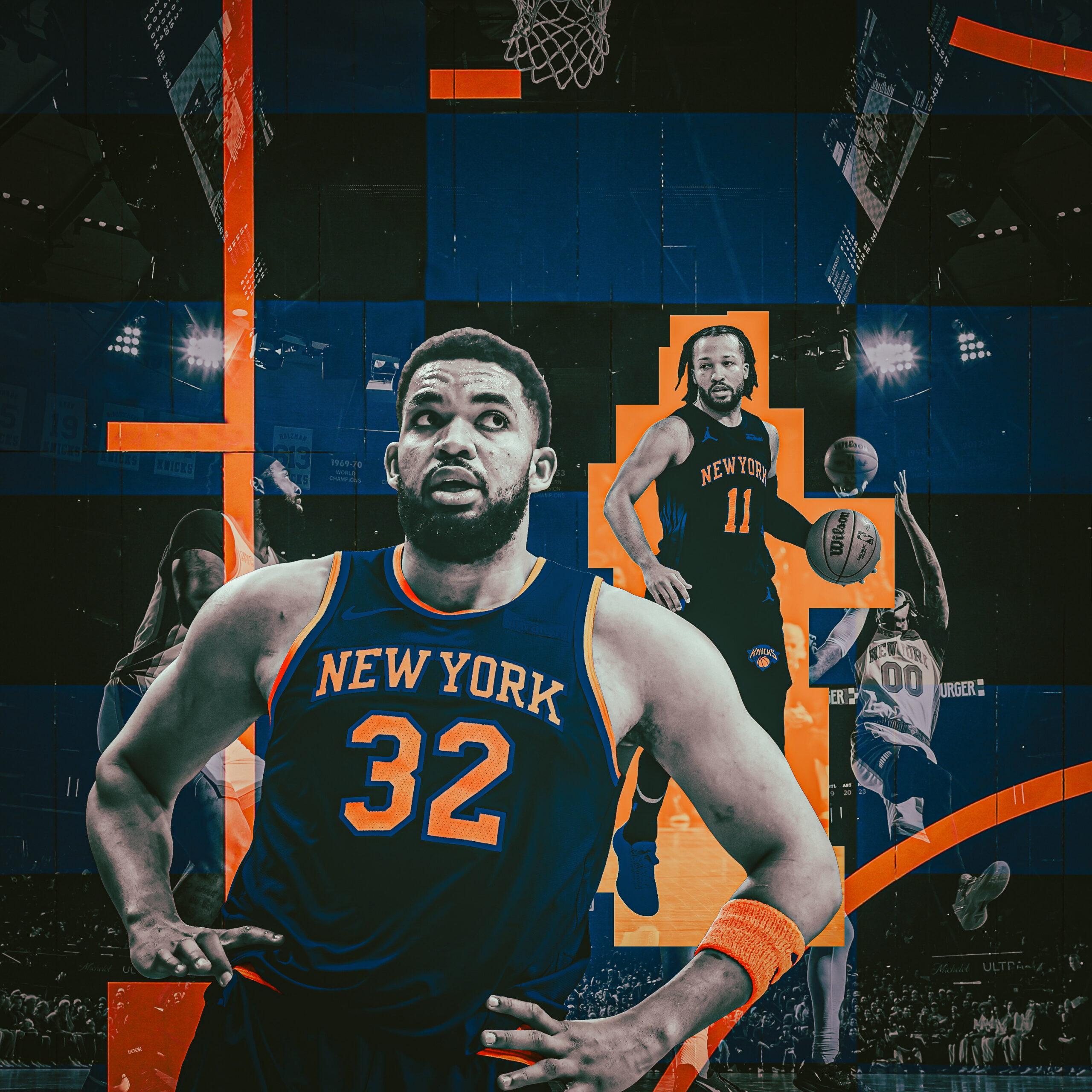

For all the preseason consternation about the state of the Eastern Conference, the top teams have made compelling cases for themselves heading into the playoffs. The Detroit Pistons set a new standard early in the season and, key injuries be damned, have yet to let go of the rope. The Boston Celtics defied popular prognostications long enough to tap into a higher echelon of championship upside with Jayson Tatum now back in the fold. And the Cleveland Cavaliers had already boasted a top-five offense for most of the season, but James Harden’s instant acclimation provided next-level jet fuel.
As for the New York Knicks? Hmm. Well, it appears that they’re trapped in an elevator, at the penthouse floor of basketball purgatory. They’re close enough to where they want to be that they can hear the thrum of the East’s elite on the other side of the doors. But they’re not close enough to announce their arrival.
Consistency has been the team’s biggest weakness. The Knicks were the swaggering NBA Cup champs—remember that?—in mid-December; just one month later, they lost nine of 11 games, by far their worst stretch in the Jalen Brunson era. The Knicks had a top-five defensive rating through 68 games; since then, they’ve regressed closer to league average. They’re likely to secure home-court advantage in the first round of the playoffs but have gone nearly a full month without beating a team with a winning record. That recurring whiplash has been the defining motif of the season, with the highs not quite reaching as high as you’d hope and the lows reinforcing the existential murmurs suggesting that Brunson and Karl-Anthony Towns are flawed cornerstones.
And then, on Tuesday night, those elevator cables snapped.
It’s hard to describe just how quickly the Knicks fell into disarray against the Houston Rockets, just days after their deflating loss to the Oklahoma City Thunder, the defending champions—both games broadcast nationally on NBC with a concern-trolling Reggie Miller on the call. Self-inflicted errors compounded the struggles of the already languid New York offense, which couldn't get into its actions with any urgency. The Houston defense ultimately took New York on a guided walk through basketball hell, culminating in a dispiriting 111-94 loss. Of course, the Rockets themselves had seemingly found a portal to heaven. In the first quarter, Kevin Durant hit four pull-up jumpers in 93 seconds. Tari Eason scored 10 points in 86 seconds. Houston started the game by hitting 13 of its first 15 field goal attempts. In a sort of perverse display of commitment, Knicks coach Mike Brown didn’t make a substitution until the Knicks were down 17, after having played only about seven minutes of basketball. It was the latest caricature of an all-too-familiar struggle for New York.
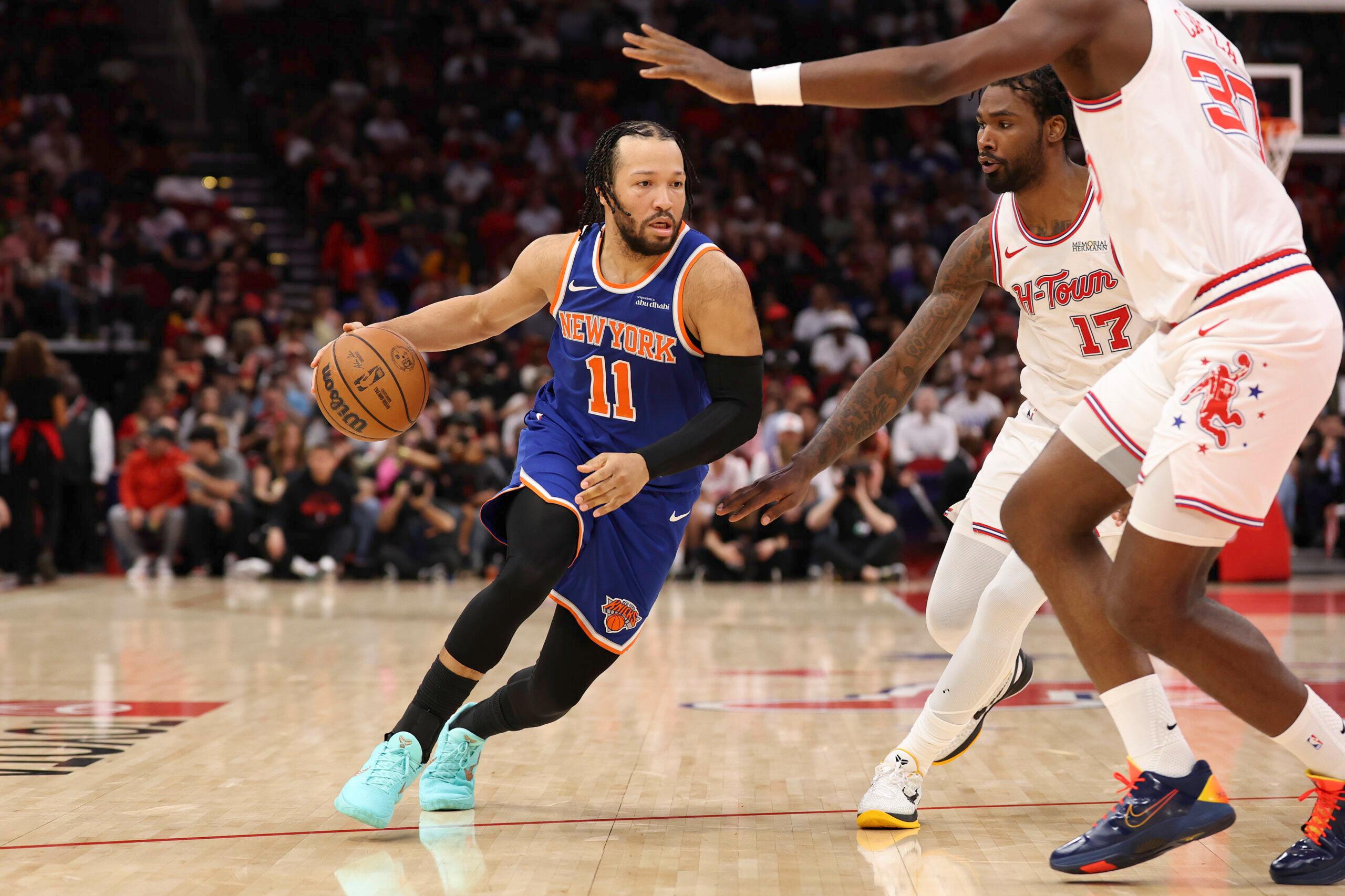
Jalen Brunson drives to the basket against the Houston Rockets
No five players in the league have logged more minutes together in the past two seasons than the Knicks’ starting lineup. Brunson, Towns, Mikal Bridges, Josh Hart, and OG Anunoby have played 1,769 minutes together in that span, including last year’s playoffs. That’s more than 29 hours on the floor, the durational equivalent of a nonstop drive from New York to Texas. It’s an awful lot of time committed to a lineup that is just barely winning those minutes. For the past two years, the Knicks’ starting lineup has had a worse net rating than the team’s overall number. Across 18 postseason games last year, the Knicks starters were outscored by 6.2 points per 100 possessions while on the floor together. But for whatever reason, the franchise has been steadfast in its commitment to starting games on the hardest possible difficulty setting—might as well start calling them the New York Battletoads.
It’s a rigid vestige of the Tom Thibodeau era that Brown is seemingly determined to preserve. Outside of that, though, the team’s infrastructure is completely different. Brown was introduced as Thibodeau’s replacement as a means of finding a new ceiling for the team, which had mortgaged its future for the present. The newly implemented system largely tells the story of the past decade of basketball. A deeper, more balanced rotation. A greater spirit of collaboration that trickles down from the coaching staff to the players. Operating in motion and flow rather than rigid sets. Overstimulating the defense with decisive off-ball movement that generates matchup advantages for the ball handler. It’s all theoretically sound—but it hasn’t added up in practice.
Towns has been the avatar of the season, representative of all its ups and downs. After a career year in 2024-25, he’s had his least efficient season since his rookie campaign. He’s sacrificed playing time and has contributed more to the team’s defense than he ever had in years past. But KAT’s offensive inconsistencies seem like part of a greater disconnect endemic to Brown’s systemic overhaul. “I had to adjust to him as well. That's what a season's about. We're not playing the same way offensively as we did at the start of the year,” Brown recently told reporters. “So I had to make some adjustments to try to figure out how to get him involved a little bit better.”
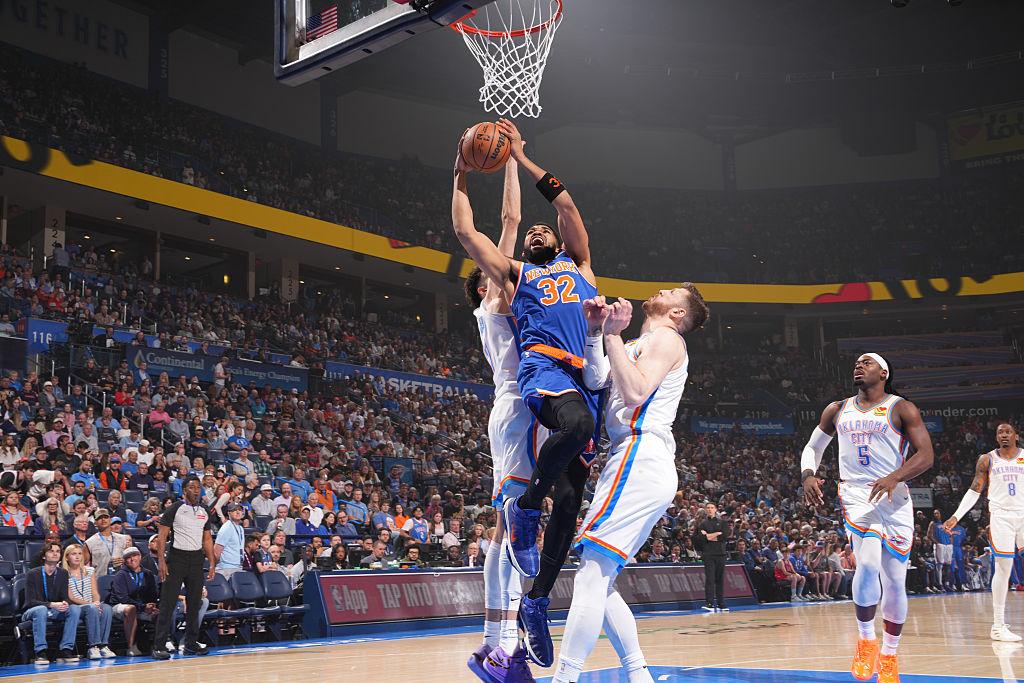
Karl-Anthony Towns drives to the basket during the game against the Oklahoma City Thunder
It’s all come to a head this week. On Sunday, Towns caught flak for attempting only two shots in the first half against the Thunder; he had only four attempts in the first half against the Rockets. Because the book on the Knicks’ starting lineup is the longest book in print, crossmatching a wing onto KAT and putting the center on Hart has become leaguewide conventional wisdom. The calculus checks out: By stationing a big (very) loosely on Hart in the corner, you get a roving helper who can survey the play in landscape mode, ready to pounce at a moment’s notice; if the trade-off is inviting KAT into a mouse-in-the-house trap down on the block, where he is turning the ball over on almost a quarter of his possessions, the defense will take that every time. Yet seeing Towns defended in the post by Alex Caruso, who is at least 7 inches shorter—on national TV, no less—activated the kind of reductive criticisms of KAT that he’s had to contend with his entire career. They are a fundamental misreading of who Towns is as a player. He can be an awesome post scorer, but he isn’t suited for mashing on the block incessantly—especially late in the clock, which hasn’t been a good strategy in, like, three decades.
KAT is built like a padded defensive end on ice skates, his athleticism expressed by an unorthodox combination of upper-body strength and lower-body dexterity. He’s built to seek out angles and exploit them. In each of the past four seasons, Towns has been the NBA’s most prolific driver taller than 6-foot-11. It’s not always pretty—there is an inherent instability in moving on a blade’s edge—but that’s an easy trade-off for a player his size capable of attacking downhill the way he does. So much of the game is hammering consistent, reliable offense where you can find it, manufacturing windows of opportunity where the offense has more options than the defense. There is infinite utility in getting KAT the ball at the top of the arc when he’s playing as the trailer. It sets up a double bind—Towns will always be a threat to pull up from deep, which grants him the space to charge toward the hoop with impunity.
More on the Knicks and KAT
If there was a positive to glean from Tuesday’s loss, it was the Knicks’ increased willingness to invert the pick-and-roll with Towns as the handler, effectively creating a Colossus in the two-man game. The template has always been there, from Nikola Jokic and Jamal Murray to Domantas Sabonis and De’Aaron Fox, something more intimately familiar for Brown. But like Brown’s system as a whole, the theory of KAT and Brunson as a complementary tandem hasn’t quite borne out. Still, there are pops of intrigue every once in a while. The Knicks have figured out how to counter the defensive crossmatching on a few Brunson-KAT pick-and-rolls since the All-Star break: As soon as Towns makes contact on his screen, Hart flashes from the corner to the elbow and fields the pass from Brunson to become a sort of pick-and-roll intermediary, drawing the center’s attention before unloading the ball back to Towns, who gets a clearer downhill runway:
As stagnant as the Knicks’ starting lineup situation has been across two regimes, it’s at least encouraging that the team is still finding ways to optimize within those confines. But make no mistake: There is an unmistakable air of procrastination in the team’s process. The Knicks aren’t good enough to just think they can “flip a switch” come the postseason, but that is invariably where the mind wanders—what if they’re just saving their best stuff for when it matters? The ghost of last season is both a curse and a lifeline—there is an understanding of how good this team can be, even if it has yet to manifest in any appreciable way. It’s an ideal that the team is clinging to, a final form waiting to emerge. “I don’t think we’ve seen it yet,” Towns told reporters earlier this week. “We still have these games to show it. I still think we’re learning what we’re trying to accomplish in the system and everything. … We have time. It can come randomly. It can come at Game 80 or 81.”
The Knicks are self-admittedly an incomplete project still figuring it all out on the fly, but it’d be a lot easier to process if the vibes were any good in this final stretch. Alas, the Knicks have lost three in a row. The sky is falling (again), yet they remain suspended at the 3-seed. It’s a strange crisis, if you choose to call it that. Where they’re “stuck” these days is a fate that most iterations of the Knicks from this century would be thrilled with. But this season, it seems like they’re meeting the bare-minimum requirements to get their entitlement. Such is the psychic pressure of expectations for the Knicks, who were two wins away from the NBA Finals last season and have the same squad still intact—for better and worse.