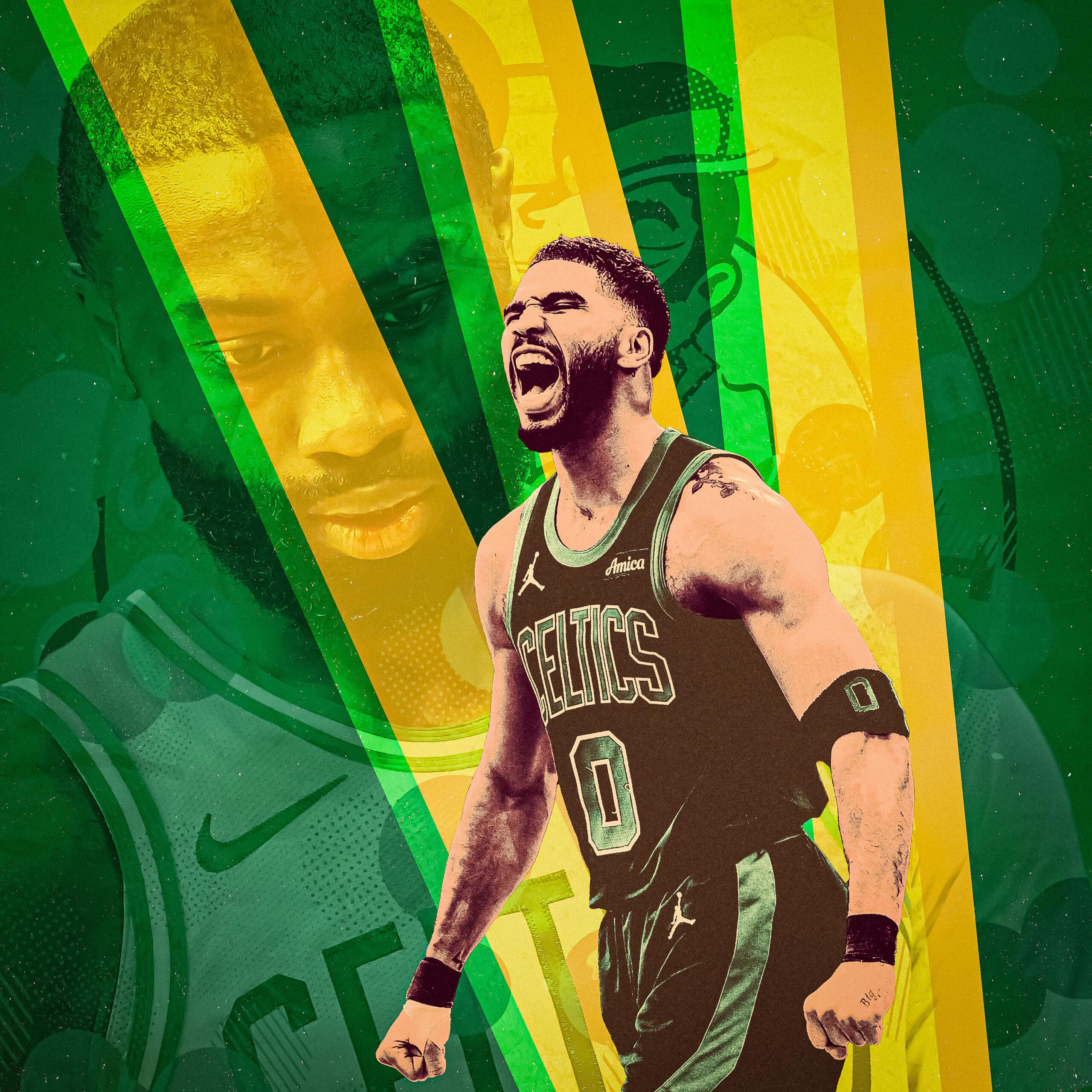

As is Jayson Tatum’s wont, his return—and all the weight it carries—brings to mind the titans of the game.
On Friday, Tatum will make his return to Boston’s iconic parquet floor, less than 10 months after rupturing his right Achilles tendon in Game 4 of the Eastern Conference semifinals. This is the NBA’s most high-profile return from an Achilles tear since Kevin Durant in December 2020, 18 months after he tore his Achilles in Game 5 of the 2019 Finals. This is also the most consequential late-season debut since … Michael Jordan’s comeback in March of 1995 after his first, brief retirement. The Bulls had been treading water for the entire season before MJ’s return; they’d win 13 of their final 17 regular-season games with Jordan back in the lineup. These Celtics, on the other hand, have been one of the best in the league in the new year and are the only team that ranks in the top five in both offensive and defensive efficiency. Tatum, a top-five player in the NBA before the injury, is returning to a new machine that has found its optimal frequency. He is a massive variable whose gravity pressurizes what most had written off as a gap year.
The Celtics, to the chagrin of much of the basketball-viewing public this season, had become a feel-good story of discipline and adaptation. They’re still that—but now with a recovered Tatum as their lodestar.
This is a truly unprecedented undertaking, a decision that not only influences the season’s championship picture but also increases the vulnerability of his body squarely in his prime years. That this risk is even a feasible option is a testament to modern medicine, Tatum’s perseverance, and timing. The ruptured Achilles tendon was surgically repaired less than 24 hours after the injury occurred. Three hours of physical therapy and weight training every day from then on. "I don't think I've seen a person's calf look as strong as his,” Tatum’s orthopedic surgeon, Dr. Martin O’Malley, told People. “At six or eight weeks he was doing double heel rises. He worked his calf so hard that the side effect of loss of strength, I don't think he's going to have any." Ten months later, there is footage of Tatum casually dunking at practice. He’s participated in five-on-five scrimmages with both the Boston and Maine Celtics teams over the past month— at this stage, the recovery seems to be about mental preparation and getting his rhythm back more than anything. The physical hurdle seems more or less dealt with.
“I’m not coming back to be no role player, Doc,” Tatum told O’Malley in the latest episode of his road-to-recovery docuseries, The Quiet Work.
It was the most quotable line of the series, a sort of mission statement for his return. It’s also a tad ironic. Tatum has had seven games of at least 50 points in his career thus far, but his play style has never been particularly commandeering—his path to superstardom was paved with a sort of omnipresence on the court, as if he inhabited five different role players at once. Tatum’s earnest, heart-on-sleeve Kobe Bryant idolatry obscures the kind of player he has actually become. Yes, he is one of the most prolific isolationists of the past decade this side of James Harden, but he is also the ideal wing screener, an excellent rebounder, a switchable defender who can handle assignments 1 through 5, an instinctive low-man helper, an increasingly fluent playmaker who can hit pinpoint crosscourt passes off a live dribble, and an off-ball mover who understands how to manipulate space as well as any player his size. There are players with individual skills that stand out more than any one of Tatum’s, but unlike just about any other player in the league, Tatum has no discernible weakness in his game.
His multivalence on the court is a full embodiment of the modern era’s philosophical shift, emphasizing versatility and apositionality. But because he can and does do everything, his impact becomes almost atmospheric, diffuse and widespread. It’s a rare archetype that is hard to latch on to. Tatum has consistently been deemed overrated during his career; Cooper Flagg, maybe Tatum’s only true stylistic acolyte, has similarly been downplayed amid one of the greatest rookie seasons ever.
The impulse from some to devalue Tatum’s influence on the Celtics has only grown with the team’s success in his absence. Boston’s scheme and points of emphasis changed overnight. Win the possession battle by crashing the offensive glass. Apply incessant pressure at the point of attack with a rotating cast of spirited wing defenders. Conjure an endless procession of off-ball screens to draw defenders away from the paint, clearing space for downhill drives and midrange pull-ups. Personnel changes in the offseason meant less mismatch hunting on offense and more conservative defensive coverages on defense. Tatum’s aforementioned versatility could alter the formula, although this could have been the direction coach Joe Mazzulla was planning to take the team in anyway. Tatum may have thrived in the C’s previous iteration, but it doesn’t take much imagination to think of the ways he’d augment their existing attack.

More on Jayson Tatum
Of course, the main point of tension in Tatum’s return is in relation to Jaylen Brown, who has more or less absorbed Tatum’s duties as Boston’s leading isolation scorer and on-ball creator. It’s been a breakthrough season that will make him an MVP dark horse and will certainly result in his second career All-NBA nod. (Tatum has been named to five All-NBA teams and was a first-teamer for the past four seasons.) For 62 games, Brown lived out the ultimate fantasy as the undisputed star. He shouldered the burden, he filled the void left in Tatum’s absence, and the Celtics look hardly any worse than they did last year. For 62 games, the team was his, and it ought to be his for the foreseeable future—or at least that’s how it’s being framed by the talking heads.
“For so long JB has sacrificed everything,” Carmelo Anthony said on his podcast, 7PM in Brooklyn. “Now it’s like, JT, what are you going to sacrifice?”
On the ESPN morning circuit, Who do these Celtics belong to? became the topic du jour ahead of Tatum’s return.
“It’s always been his team,” J.R. Smith said of Brown on the To the Baha podcast earlier this week, largely to the unease and skepticism of hosts Theo Pinson, Raymond Felton, and Charlie Villanueva. “For the players, I’m pretty sure it’s his team. For everybody else in the media, from the outside, it’s Jayson Tatum’s team. That’s what they want it to look like.”
Smith makes it seem as though this is some grand media conspiracy, and while it probably isn’t, there’s no denying that the most clickable Celtics story line of the past decade has been the Tatum-Brown dynamic. (Although Mazzulla’s unique neurochemistry is not far behind.) It’s a tension manufactured through a sort of scarcity mentality, of trying to understand relationship dynamics in the same zero-sum framework as the basketball game itself. There is a sense that greatness is an honor that has to be wrested from another to be valid—the yearly MVP discourse being a clear example. The Shaq and Kobe feud of the early 2000s set a new standard for dueling alphas. Of course, those two actually despised each other, where the Jays seem to genuinely get along and probably understand each other’s perspective better than anyone else possibly could. The championship in 2024 ought to have laid the issue to rest, but in reality it only amplified the difference between them: Tatum garnered all of the regular-season accolades, but Brown was the one who took home Finals MVP. There are so many voices claiming that Tatum is returning to Brown’s team, as if this Celtics era hasn’t been defined by the double helix that their conjoined and overlapping skill sets have constructed over the past 10 seasons.
At the very least, Tatum’s return will replace the straw man that had served in his stead and perhaps bring clarity to the Celtics’ true upside this season. The longtime Los Angeles Times columnist Bill Plaschke once wrote about how Shaq and Kobe setting aside their differences en route to the NBA Finals in 2001 became a civic rallying cry for L.A.’s marriage counselors and school administrators alike—If they can make it work, why can’t we? Tension demands resolution, even (or especially) in the stories we tell ourselves.
It could take awhile to get used to Tatum being back on the floor—for everyone involved. Jordan missed his first six field goal attempts in his return in 1995; he scored his first point of the game in the second quarter, after missing his first free throw attempt. He finished 7-for-28 from the field. Rust is real, but it isn’t forever. Four games later, Jordan had his legendary “Double Nickel” game at Madison Square Garden. By the playoffs, Jordan was fully back to being himself. Of course, MJ wasn’t coming back from one of the most devastating injuries in sports.
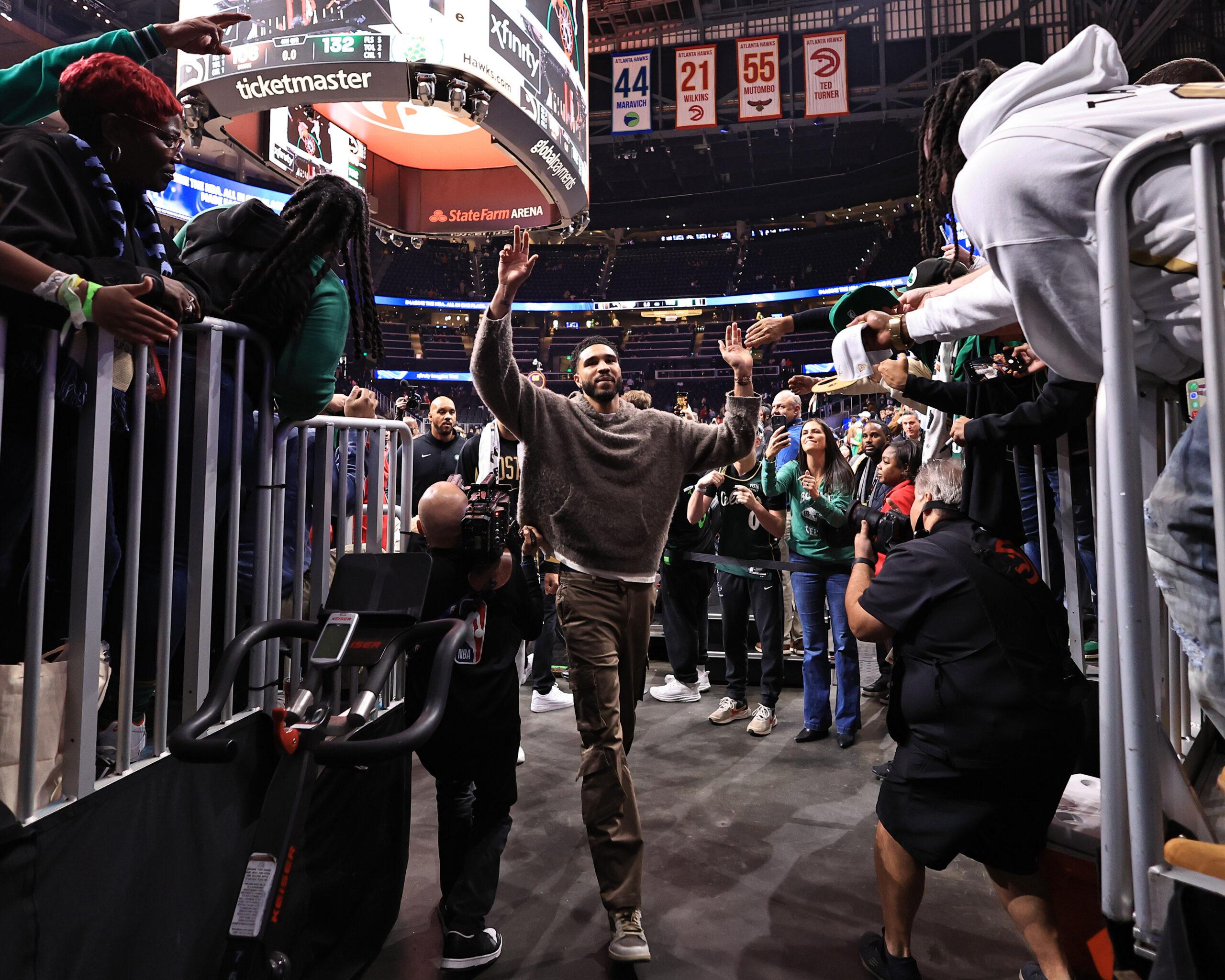
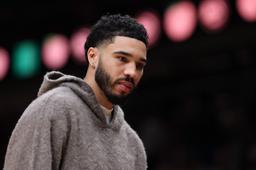
Jayson Tatum runs off the court after a game against the Atlanta Hawks on January 17
Tatum’s mere presence ought to open up a wider range of possibilities for the Celtics, who sit in second place out East in a field with only three other truly viable teams that could make it out of the conference. At the very least, Tatum offers some optionality on both sides of the floor. For a team that has long prided itself on its ability to take on unique defensive crossmatches because of its personnel, its current center rotation is awfully drop heavy in its affordances. Mazzulla could entertain more malleable small-ball lineups with Tatum back in the fold. Surefire Defensive Player of the Year finalist Derrick White is having the worst shooting season of his career, and Brown’s shooting percentages have begun to degrade with the immense self-creation burden placed on him—there’s a good chance that both players’ efficiency will pick back up once they settle into the team’s ideal order of operations. Even if he isn’t 100 percent, Tatum’s broad scope of competencies is its own force multiplier.
“He looks like Jayson Tatum,” Celtics wing Ron Harper Jr. said when asked how Tatum fared during a G League practice with the Maine Celtics last month.
There’s a lot of optimism being broadcast, and there’s no questioning the amount of work that went into Tatum’s recovery. But there are also remnant seeds of doubt. This injury used to be a career ender. Damian Lillard, who ruptured his left Achilles just two weeks before Tatum, and Tyrese Haliburton, who tore his right Achilles a month after, have both remained firm in sitting out the entirety of the season out of an abundance of caution. Tatum is diving into uncharted waters. Until he takes his first shot, until he takes his first bump in the lane, until he gets back up after his first tumble, until he makes it to the end of the Celtics’ postseason run, however long—the question will linger. Is he coming back too soon?
There was a 2023 New Yorker feature written by Cornell physician and researcher Dhruv Khullar examining convalescence—the state of recovering from an ailment—and why we value it less in the modern day. It coincidentally begins with a brief recounting of Durant’s Achilles tear in the 2019 NBA Finals as a result of playing on a compromised right calf. “After an infection, a surgery, or a panic attack, patients increasingly feel that they need ‘permission to recover,’ and treat convalescence less as a chance to heal than as something to get over with,” Khullar wrote. “And, when we prize efficiency over recovery, we risk ending up with less of both.”
I’m thinking about the idle moments Tatum must’ve had throughout this recovery process, all that time to imagine what the future might look like. He’s talked about finding inspiration in the projects that his idols Kobe and Peyton Manning had done in their post-playing days. The Quiet Work feels like a small gesture toward that ideal. I’m not coming back to be no role player. With that statement of intent, he has reset the expectations back to the standard that had been set for the Celtics the past half decade. Ready or not, Tatum has effectively ended Boston’s gap year.
The way he’s chosen to roll out this return places an unconscionable amount of pressure on him, but in a way, this is the closest Tatum has ever come to embodying Kobe. This is his first real foray into owning his own narrative and building out his own myth. His career as we all know it could very well hang in the balance. And it all hinges on him sticking the landing. It’s a risk, but it’d be one hell of a story, wouldn’t it?