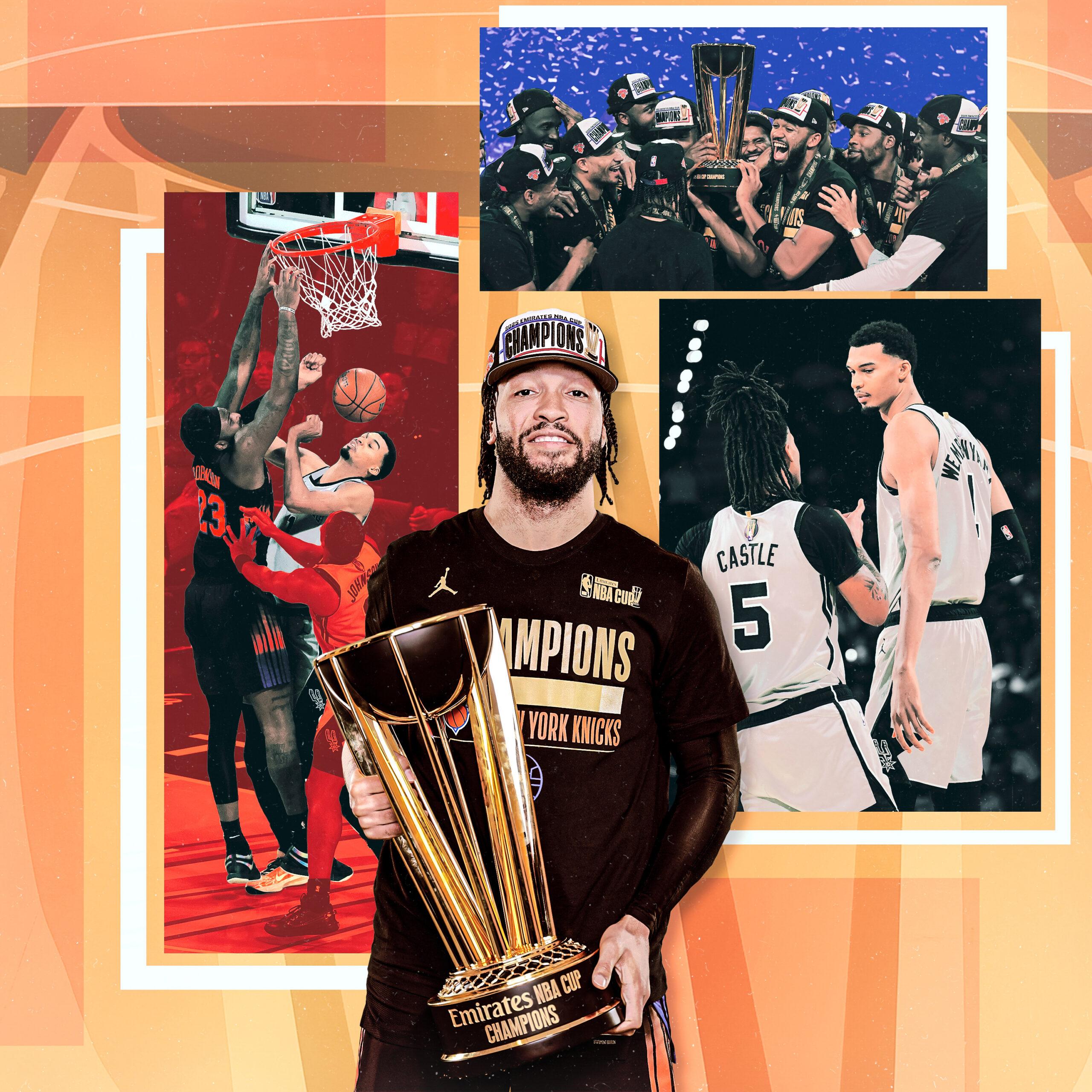

The third edition of the NBA Cup just wrapped, and once again, this tournament featured an up-and-coming team demanding the league’s attention. In 2023, it was the Pacers, and in 2024, it was the Thunder—the two teams that played for the title six months ago. This year’s big riser is clearly the San Antonio Spurs, but just like Indiana and OKC before them, the Spurs failed to win the final game of the tournament, ultimately falling 124-113 to the New York Knicks, who brought the bing-bong chants to the desert and are leaving Las Vegas with the 2025 Cup.
New York entered the 2025-26 NBA season as one of the favorites to come out of the Eastern Conference, and their performance in the Cup only cemented that status. When their knockout games ratcheted up the intensity, the Knicks’ stable full of vets responded, trouncing younger teams in three straight double-digit victories to win this thing. On Tuesday night, T-Mobile Arena was electric—it had the feeling of a playoff atmosphere—and the Spurs just couldn’t hang with New York down the stretch. Let’s run through four of the biggest takeaways from the Cup finale in Las Vegas.


The Knicks Have Leveled Up
When the NBA Cup finale got down to winning time, the Knicks simply overpowered San Antonio’s bigs on the glass and stole the game with second-chance points. Led by a ferocious Mitchell Robinson, who was insatiable on the glass, New York refused to let misses turn into failed possessions, ending the game with 32 second-chance points.
Robinson is no stretch 5, but he gives the Knicks a nasty changeup from lineups with Karl-Anthony Towns at the 5. Robinson is old-fashioned power and grit. He wiped the floor with the Spurs, single-handedly taking over the glass as New York ran away with the fourth quarter. Robinson ended the game with 10 offensive boards; nobody on the Spurs had more than seven rebounds total.
Cleaning up their own misses has become a signature weapon for Mike Brown’s Knicks. Last season, the team ranked 15th in the league in second-chance points. This year, they rank second. This team is also notably deeper than it was last season. Poetically, it was the Knicks’ bench—featuring Robinson, Tyler Kolek, and Jordan Clarkson—that sparked the comeback on Tuesday night. Clarkson poured in 15 points off the bench, and Kolek was a steadying force throughout the second half. Would Thibs have given them this kind of run?
Over a quarter of the way through the season, New York is pairing the league’s second-best offense with its 11th-ranked defense. That’s precisely the formula it needs to contend. Add in Jalen Brunson, who’s averaging a ho-hum 29 points per game on 49 percent shooting to go with his proven postseason track record, and this team’s profile screams contender.
Are the Knicks the team to beat in the East? The sportsbooks seem to think so. FanDuel has them as clear favorites, ahead of a stumbling Cavs squad and an unproven, though impressive, Pistons team. That says as much about the uneven East as it does about the quality of New York’s team, but the Knicks deserve their flowers today. They’ve adapted to Brown and done something no Knickerbocker team has done in a while: bring home a trophy.
The Spurs Lost, but They Proved They Belong
The Spurs may not have won the Cup in the end, but they leave Nevada as arguably the biggest revelation of the in-season tournament. Their Cup run has changed the perception of their team and their timeline, highlighting a progress that began long before they arrived in Sin City.
Remember this?
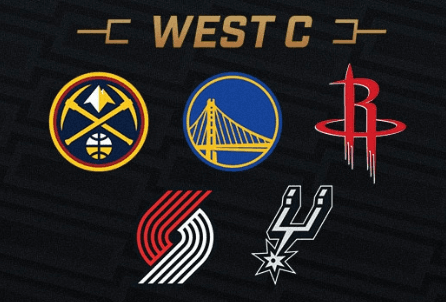
After being slotted in West Group C—a.k.a. the “group of death”—which also included the Nuggets, Warriors, Rockets, and Trail Blazers, San Antonio seemed like a long shot to even make the quarterfinals, let alone get to Vegas. Those doubts only amplified when Victor Wembanyama got hurt in November. But that was when the magic started.
The Spurs went 9-3 while Wemby recovered from a calf strain, including three road Cup wins in Denver, Portland, and Los Angeles. A season ago, this team was dead in the water without Wembanyama, going 13-23 in his missed games. But things have changed this season, which brings us to the single biggest trend driving the ascendant Spurs: a solar system of competence around their French superstar. And the numbers back it up.
Spurs’ Net Rating Without Wemby
It starts with De’Aaron Fox, who is blending volume and efficiency as a scorer at levels we’ve never seen from him—24 points per game on a career-best 61.1 true shooting percentage—but it doesn’t end there. Stephon Castle has leveled up as both a driving scorer and a playmaker, while rookie phenom Dylan Harper has arrived ready to thrive. Together, this trio has quickly coalesced into one of the league’s most relentless set of attacking guards, providing San Antonio with a budding offensive identity that carried the team in Wembanyama’s absence.
On the wings, the Spurs have three shooters who can make defenses pay for collapsing on those drivers. Harrison Barnes, Julian Champagnie, and Devin Vassell represent reliable catch-and-shoot threats, while Keldon Johnson has embraced his limited role and poured his energy into becoming a vital off-the-bench rebounder for the Silver and Black. Then there is Luke Kornet, one of the league’s best backup bigs, who has given this team much-needed depth up front.
This supporting cast has spearheaded an offensive awakening that has seen the team rise to seventh in offense this season, up from 19th last year.
Spurs’ Offensive Rating With and Without Wemby
Reintegrating Victor Wembanyama
As good as the offense has been without Wembanyama, the Spurs couldn’t handle OKC without him. In the semis, the Spurs won the 21 Wemby minutes by 21 points and lost the non-Wemby minutes by 19. His presence completely altered the shape and tenor of that matchup. On Tuesday night, Wembanyama came off the bench once again, but the team was –18 in his 25 minutes, as Wemby looked less comfortable offensively and struggled to keep the Knicks off the glass. As Wembanyama’s minutes ramp up and he returns to the starting lineup, San Antonio’s task is to incorporate him into the offensive identity that has been so successful lately. If it can marry its recent offensive success with Wembanyama’s sky-scraping defense, that’s a recipe for contention in a loaded Western Conference.
Wembanyama continues to be the single most impactful defender in the NBA. When he’s on the floor, the Spurs defense immediately becomes elite, basically becoming the only defensive unit in the NBA that’s nearly as stingy as the Thunder.
Spurs’ Defensive Rating With and Without Wemby
The defensive effect is basic but profound. His presence simply turns San Antonio into a championship-level defensive team by closing down the most important real estate in the sport. In his 21 minutes in the OKC game, the Thunder managed only eight paint points; in the 27 minutes he sat, that figure was 36 points.
When Wemby plays, the Spurs allow just 31.7 paint points per 100 possessions. When he doesn’t, they allow 54.9. That gap is greater than the difference between the Thunder’s league-leading mark (37.9 points per 100 possessions) and the cellar-dwelling Nets (54.9).
That’s defensive impact.
Currently, the Spurs are 18-7—the NBA Cup final doesn’t count against their record—and are on pace to win 59 games. They won 34 last year, and FanDuel had their preseason over/under at 43.5 wins. Already, they’re among the biggest overachievers in the league, and they are still getting better fast. Harper, Castle, and Wembanyama are coming for trophies—it might not be this year, but it might not be that far down the road either.

More on the NBA
What Happens in Vegas … Doesn’t Necessarily Need to Stay in Vegas
After the Knicks won, I walked out of the T-Mobile Arena and ran into a few bing-bong sidewalk bros trying to re-create Manhattan-after-a-playoff-win energy on a Las Vegas sidewalk. Noble effort. Totally awkward results.
Here’s the thing about the NBA Cup: It’s good. The games are intense. The players clearly care. And for a three-year-old experiment, it’s done real work in giving meaning to fall NBA hoops. But it needs a change of scenery.
Here’s why. It’s Tuesday at 4 p.m. in a flailing Las Vegas when fans start filing into the venue. The sun’s still out. The city isn’t exactly lit. Vegas doesn’t really hit its stride until later. The game itself was electric. The environment around it? Not so much. Anyone who’s seen this city come alive for a Golden Knights playoff game or an Aces championship parade or a major UFC card knows what Vegas at full throttle looks like. The NBA Cup just doesn’t move the needle that way. Not at this time. Not on this day. Not on this part of the calendar.
You can be pro-NBA and pro-Vegas and still admit this: A Tuesday afternoon neutral-site event isn’t how you unlock this city’s energy. And for die-hard fans who would travel for the semis or the final, the short notice makes a desert trip a tough sell. Spurs and Knicks fans didn’t even have a full week between finding out their team qualified for Vegas and booking their travel. It’s a lot to ask these fans to drop everything and suddenly fly to Nevada for Saturday and Tuesday games.
So the basketball works. But the setting needs attention. Where should it go? Adam Silver has to figure that out.