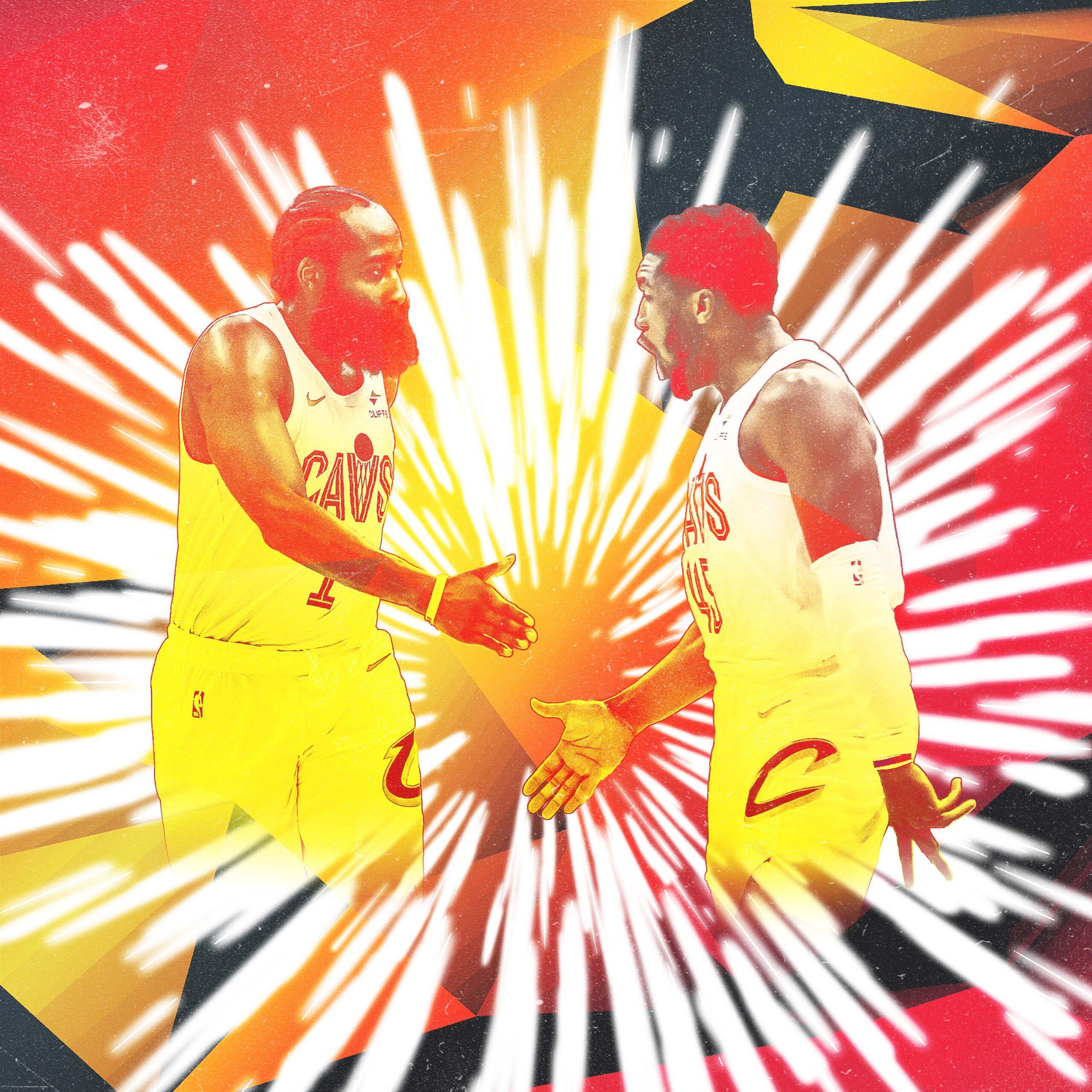

In 2019, I interviewed then–Houston Rocket Austin Rivers about his team’s undeniably effective albeit idiosyncratic offense. Sitting at his locker in Toyota Center before a playoff game against the Golden State Warriors, I wanted to know how, exactly, James Harden and Chris Paul worked so well together despite the two Hall of Famers spending most of their careers with the ball in their hands.
There’s so much that went into answering that question. But, from Rivers’s perspective, Houston’s excellence under Mike D’Antoni was defined by its simplicity: The best way to maximize those two iso-ball masterminds was for everyone else to become a statue. Don’t cut. Stand still and wait for one of them to break down the defense.
I think about that conversation a lot when I watch Harden on the Cleveland Cavaliers—how he has seamlessly accentuated a scheme that is diametrically opposed from the one that enabled his best tendencies in Houston and nearly resulted in a championship. Now, as he plays through a non-displaced fracture in his right thumb that didn’t appear to bother him in Brooklyn on Sunday afternoon—Harden finished with 22 points, eight assists, nine boards, and 12 free throw attempts in 36 minutes—the revamped Cavaliers look like the genuine title contender many expected them to be before the season began. They’ve won seven of the eight games he’s appeared in, with a well-balanced attack that’s already downed the Knicks, Hornets, and Nuggets. So far as trade deadline moves go, this one has looked like a best-case scenario for both parties.
Harden’s true shooting percentage in a Cavs jersey is 67.3, and he’s already proved to be an upgrade over Darius Garland, a talented albeit frequently injured point guard who can’t stabilize or carry an entire offense the same way. Garland comes with perks. He can zip around screens and draw attention without dominating the ball. But he isn’t as dynamic passing the ball, doesn’t get to the free throw line as often, and can’t exploit mismatches in the half court whenever he wants. To say nothing of their physical differences, Harden’s mere presence all but eliminates the overlapping defensive concerns Garland and Mitchell had in an undersized backcourt.


When Harden joined the Clippers in 2023, he proudly declared “I’m not a system player. I am a system.” He wasn’t wrong. In Los Angeles, Harden proved once again that he’s an all-time play-creating genius who makes good things happen when he’s allowed to commandeer a game plan. But right now, at 36 years old, Harden is also someone who understands that Cleveland—a.k.a. still Donovan Mitchell’s team—didn’t acquire him with the intention of reorienting their universe around his skill set. Instead, what they wanted is someone able and willing to enrich a system that was already in place. Thus far, at this stage in his career—older, wiser, more indulgent to his surroundings—Harden has done exactly that.
“I told them I’ll figure it out,” he said after a recent win over the Washington Wizards. “We’ll do some adjusting with each other but for the most part y’all do what y’all been doing and I’ll find my way in.” Harden finished that game with four shots and 11 assists. “I understand this team and the dynamic of it and how many offensive weapons we have,” he said. “I am top-10 in scoring all time. Scoring is not a problem for me. I want to play the right way. I want to take shots when necessary, be aggressive when necessary, and when there’s opportunities to get guys open, make the right pass.”
Cavaliers coach Kenny Atkinson echoed that sentiment on Sunday: “The great ones read the game, whatever the game tells them they do. Score 30, I’ll score 30. If it means I gotta get 20 assists and take four shots, I can do that. I don’t ever want him to, like, take a back seat.”
NBA strategy has evolved dramatically over the past seven years. Today, heliocentrism is primitive; in order to solve defenses that have become more elastic and complex than they once were, the most successful offenses emphasize action off the ball. Standing still as a spot-up threat now gives the opponent an advantage; any defense in 2026 wouldn’t allow the 2019 Rockets to play like they did.
The Cavaliers, under Atkinson, are near the forefront of this development. Cuts are common, choreographed, and precise. Role players create driving lanes and open looks with their gravity. Cleveland creates 28.6 percent of its shots off movement, which, per Sportradar, is the third-highest mark in the league. Meanwhile, the Clippers are down at 18.7 percent. Dead last.
Watching Harden do things like he does in the play below, fractured thumb and all, is a huge reason I think the Cavaliers will win the Eastern Conference:
Instead of settling after the Denver Nuggets take away its first option, Cleveland casually improvises with selfless activity. It’s pretty standard stuff from the Cavs. But what caught my eye was Mitchell, whose cut from one corner to the other distracted Jamal Murray and let Harden find Jaylon Tyson for the open 3. “Last game in Denver, last couple minutes of the game he just gave me the ball and let me facilitate and do what I do,” Harden said about Mitchell. “You don’t really get that from superstars in this league.”
In 127 minutes with both Harden and Mitchell on the court, the Cavs’ offensive rating is 16.5 points per 100 possessions above league average. That’s a small-sample-sized tsunami. (When padded—which offers a more accurate projection of what these lineups can potentially do by cutting some randomness from the actual number, it drops to plus-5.4, which is still excellent.) This shouldn’t be a surprise. Basically every team Harden has ever played for has had an elite offense that was significantly more efficient with him on the court. By and large, he’s had success alongside Kevin Durant (twice), Russell Westbrook (twice), Dwight Howard, Kyrie Irving (briefly), Joel Embiid, Paul George, and Kawhi Leonard.
Mitchell is a sensible costar and the two have already found so many different ways to lift each other up. “We’re pretty good, but the crazy part is we’ve had two practices,” Mitchell said last week. From perfectly tossed lobs to wide-open spot-up 3s, they’re directly interacting without stepping on each other’s toes as a pair of skeleton keys who naturally force defenses into rotation:
Harden ranks fourth in perimeter on-ball gravity and eighth in perimeter off-ball gravity. Essentially, he’s still treated like a high-priority threat. “Sometimes the biggest assist is having James on the court, and me driving and them hugged on him,” Chris Paul told me back in 2019. “There’s no stat for that though. There’s no stat for that. When I’m driving, and the guy is denying him, you know what I mean?”
Mitchell now officially knows what Paul means:
Harden hasn’t abandoned one-on-one basketball, and when he falls back into his bread-and-butter, the Cavs know how to space the floor and let him cook. But after averaging 14.4 isolation plays per game with Los Angeles earlier this season, Harden is down to just 6.6 per game with Cleveland. To boot, Harden’s on-ball percentage with the Clippers was 42.9. In Cleveland it’s down to 34.5 percent. (It was a season-low 27.3 percent in his debut against Sacramento.) His usage rate has fallen from 30.1 to 22.8.
Yes, he’s an unselfish and smart player, which helps explain these drops. But despite averaging three fewer minutes per game and not having the ball as often as before, Harden is also averaging more potential assists than he did with the Clippers. Mitchell being one of the most unstoppable scorers alive helps, but, of equal importance, every member of this supporting cast has an accessible superpower that won’t be wasted when Harden is on the court.
Jarrett Allen is a dynamic pick-and-roll partner who runs the floor, catches lobs, and has terrific touch in and around the paint. Sam Merrill and Tyson are two of the most accurate movement 3-point shooters in the league. Dean Wade and Keon Ellis are elite defenders who can shoot. Dennis Schröder is a third ball handler who doesn’t need any help scoring against a set defense. Altogether, the offense is a live wire.
And then there’s Evan Mobley, a defensive menace with offensive imperfections that currently make him somewhat of a question mark. A lingering calf strain has limited his time with Harden, but there’s no reason they can’t develop an excellent two-man game before the postseason, particularly when Allen isn’t on the court. Mobley’s athleticism and feel should give them a high ceiling; few players alive can make a big man feel more confident than Harden can. And not for nothing, but Mobley’s 23-point, 12-rebound, four-block performance against the Pistons sans Mitchell and Harden was a reminder of how imposing he can be when he’s aggressive:
It wasn’t too long ago that the Cavaliers were one of the league’s most desperate and disappointing teams. On December 19, they were 15-14, reeling from back-to-back losses against [gulp] the Chicago Bulls. Since then, they’re tied for first in winning percentage and have the second-best offense in the league. Lonzo Ball and De’Andre Hunter are gone, the backcourt has been reinvented, and they have the fourth-easiest remaining schedule.
Harden’s thumb notwithstanding, Cleveland’s depth, shooting, versatility, and athleticism, all brewing in a system that keeps everyone involved, is enough to insulate the Cavs from a postseason no-show (or two … or three). Mitchell is that volcanic, Mobley is that talented on both ends, the supporting cast is that competent, and it’s fair to hold a cautiously optimistic belief that Harden won’t wear down on a team that isn’t leaning on him to provide through-the-roof usage.
Harden’s substitution pattern is also very different in Cleveland than it was in Los Angeles, where he typically didn’t rest until the second quarter began. The Cavs, meanwhile, are removing him from the game with several minutes left in the first and third quarters, and then not bringing him back until a few minutes pass in the second and fourth quarters. Rest is up.
“I know he's used to playing big, big minutes, but we got a pretty deep roster. I like to spread the wealth,” Atkinson said on Sunday. “We got pretty good players to kind of supplant him when he’s off the court. But I tell you, when he’s off the court, I ask him a lot of questions. ‘Hey, what should we run with this group? A double drag or, you know, let’s run Hardy, or whatever.’ He’s got a computer brain, so I use him as, like, a fourth assistant coach.”
The ingredients are here. It’s just a matter of staying healthy, pressing the right rotation-related buttons, and finding new ways to maximize what has already been a mutually beneficial relationship. “We got a few more notches to get to,” Harden said last week. “We got what, 25 games? I think we can get there. Matter of fact, I know we can get there.”