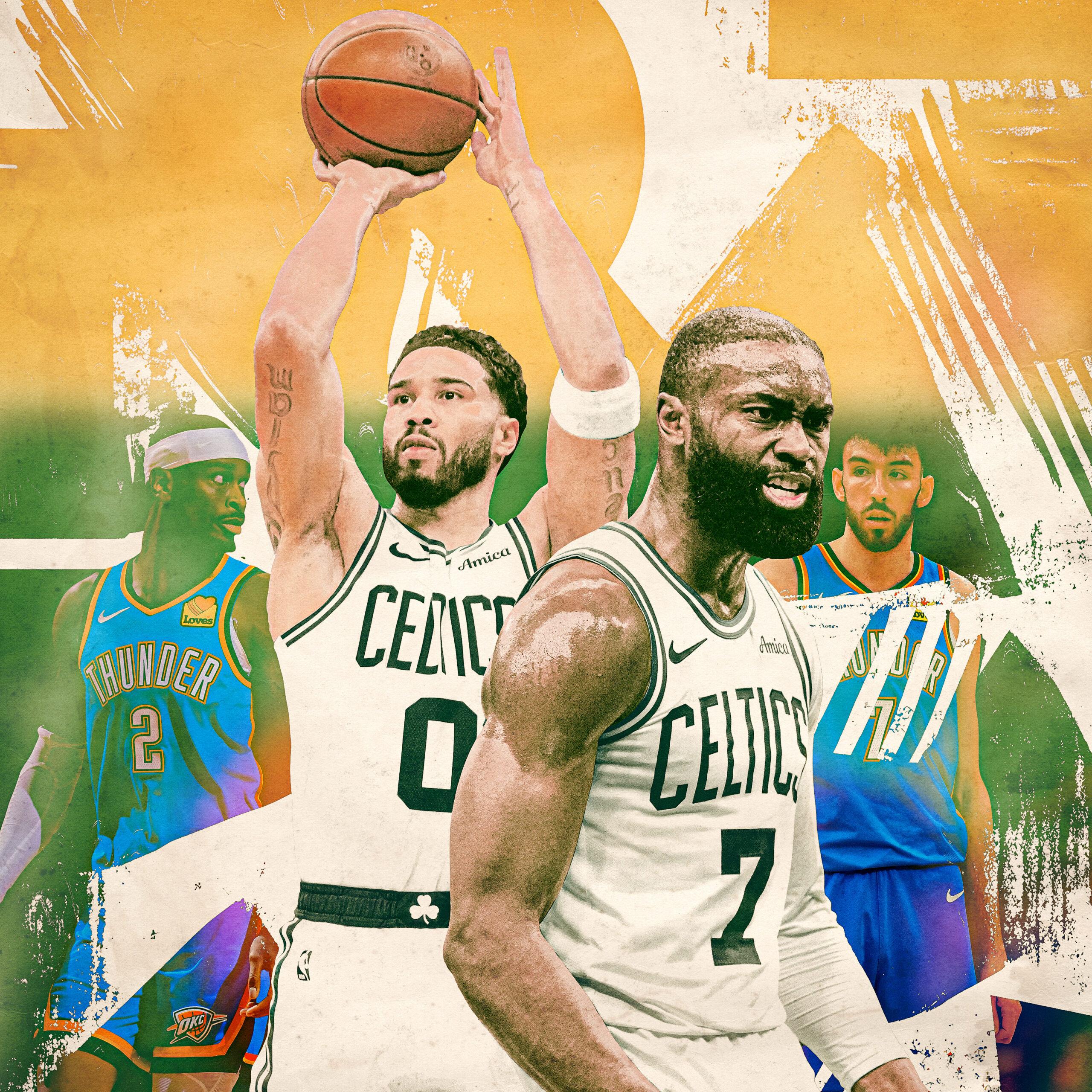

Predicting an NBA Finals matchup is, increasingly, a fool’s errand. But projection systems still exist, and according to pretty much all of them, there’s a decent enough chance that we’ll see the Oklahoma City Thunder and Boston Celtics face off in June. On Wednesday night, the two played a game with both sides basically at full strength, and, well, it was awesome.
In this clash of two stylistically similar teams that have won the past two NBA championships, Boston’s elite offense stuffed OKC’s elite defense into a wood chipper, winning 119-109 and posting a court-melting 145.8 offensive rating in the second half.
Parsing what actually matters in any one regular-season contest is borderline impossible. There are so many random variables and quite a bit of “make-or-miss-league” luck involved. The Celtics drilled 15 of their 31 non-corner 3s, while, on the other side, Alex Caruso, Cason Wallace, Ajay Mitchell, Jared McCain, and Jalen Williams combined to go 2-for-20 from deep.
Both sides went deep into their benches and unveiled a bunch of different lineups. Oklahoma City deployed 19 five-man units, and Boston threw out 20. So much will be different if and when these two meet in the Finals, but I’ll go out on a limb and assume that Thunder coach Mark Daigneault won’t give 11 different guys the chance to play for at least 12 minutes.
But, tactically speaking, this game seemed like it belonged in the postseason. There were fascinating strategic decisions, constant adjustments, and a possession-by-possession level of focus that’s rarely seen this time of year.
Also, critically, the stars really came out to play. Jaylen Brown’s efficient 31-point, eight-rebound, eight-assist gem is the headline, but it was even more impressive considering that the Thunder threw every one of their defensive stoppers at him without any success. Lu Dort, Caruso, and Wallace spent most of the night looking either helpless or frustrated.
Meanwhile, Jayson Tatum’s ninth game of the season (in which he played a season-high 35 minutes) was also his finest all-around performance since coming back from a torn Achilles. He finished with 19 points, 12 rebounds, and seven assists. Aside from a few live-ball turnovers that occurred when he was driving into the teeth of OKC’s defense, Tatum’s decision-making was vintage. Whenever the Thunder blitzed him in the pick-and-roll—which they resorted to after he drained a pull-up 3 over Chet Holmgren’s drop midway through the second quarter—he punished them.
The J’s combined to assist 40 of Boston’s points. The two stars took into account whether OKC was going big or small and either bullied a mismatch one-on-one or leveraged the attention they generated by making selfless plays:
It’s odd to see the Thunder trail by double digits in any fourth quarter, but it’s almost unheard of for it to happen on a night when Shai Gilgeous-Alexander looks invincible. The reigning MVP scored 33 points and had a 95.5 true shooting percentage. Oklahoma City also won the turnover margin considerably, committing just seven while forcing Boston into 13.
But the Celtics were disciplined about guarding SGA, filling gaps, forcing passes, and limiting him to only a dozen shots, which tied for his fifth fewest of the season:
All this on a night when Jalen Williams was covered in rust and Holmgren got played off the floor. I found the latter development, in particular, to be a fascinating subplot. The Thunder started the game big with Holmgren and Isaiah Hartenstein, but even though they won the minutes they shared the floor (plus-5 in 11 minutes), Daigneault mostly opted to stagger them, play Jaylin Williams with Holmgren (a disastrous stint), or bench both, which was what happened in crunch time.
There were two fundamental reasons Holmgren couldn’t have the type of impact against the Celtics that he normally does, particularly in larger units. When the Thunder were on offense, Boston stuck Tatum or another big wing on him—a.k.a. someone he can’t beat off the dribble or move in the paint. On defense, Holmgren is usually able to roam off a non-shooter. But against Boston, he started the game on Sam Hauser and then spent some time guarding Baylor Scheierman, two of the better movement shooters on the Celtics. At the start, Holmgren still lived in the paint, but letting these two jack up a bunch of 3s soon became untenable:
Once they started going in, Boston had more space and was able to move more freely against a team that does such a good job of inducing claustrophobia. Downsizing altogether, as OKC opted to do in the fourth quarter, theoretically created some space for Gilgeous-Alexander, but the trade-off there came on the glass and at the rim. The Thunder allowed 19 second-chance points and mustered a measly two themselves, while the Celtics were able to get the matchups they wanted and then attack downhill with quite a bit of success.
When the Thunder stayed home on the 3-point line—which Boston’s hot shooting eventually forced them to—Brown, Tatum, and Derrick White were able to do some damage in the paint.
What makes this matchup so compelling is the way it forces a pair of extremely disciplined, talented, relentless, and versatile contenders to box with their own reflection. Here we had two of the best half-court offenses trying to score against two of the best half-court defenses in a relentless test to see which team could out-execute the other.
The Thunder and the Celtics approach every game with a set of priorities that typically lead them to victory; both are excellent at identifying an opponent’s weakness and then repeatedly exploiting it. Even though they play each other only twice a year, there’s a sense when you watch them compete that each one pulls something out of the other that no other team can. They’re intimately familiar with each other’s processes and know what they want to take away—and what they are willing to live with.
Wednesday night’s game could’ve gone either way, and by the time you’re reading this, both teams have already moved on from the result. But if the Celtics and Thunder do meet again in the Finals, Wednesday night may have been the prologue to one of the more riveting championship showdowns in quite some time.