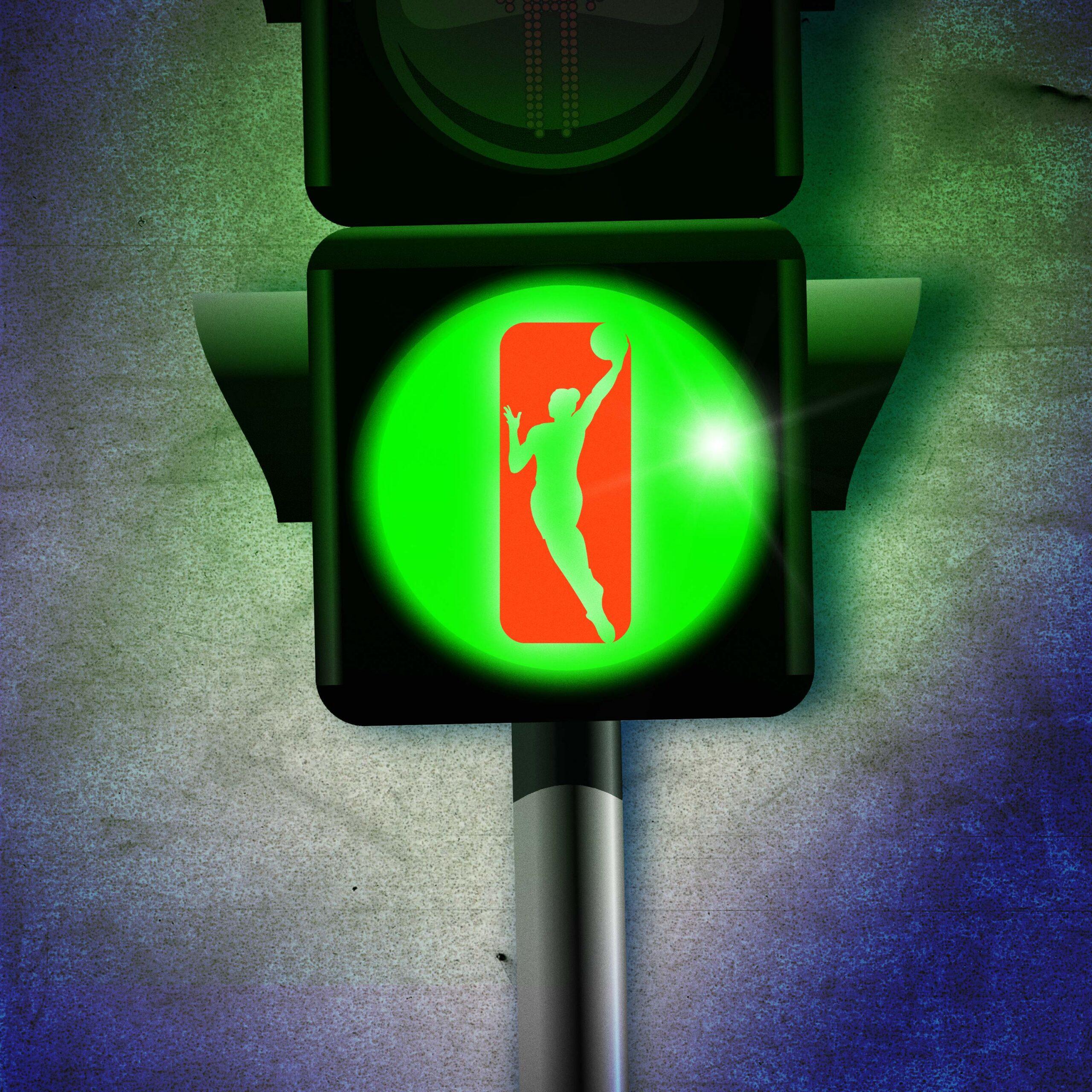

In the wee hours of Wednesday morning, the WNBA and WNBPA tentatively agreed on a league-altering collective bargaining agreement. After over 100 hours of productive back-and-forth negotiations over eight days, the two sides finally shook hands, as one era of WNBA history gave way to another.
The season, slated to begin on May 8, will officially start on time.
The broad strokes, from Front Office Sports and ESPN, are as follows: A new deal for seven years, with a mutual opt-out after the sixth. Team salary caps will start at $7 million and grow alongside revenue. The supermax will be 20 percent of the cap, or $1.4 million, with a new minimum salary of $300,000 (that’s worth $50,000 more than current max). WNBA stars will never have to go overseas for a second job to make a sustainable living again.
The union and the league will meet in the middle on revenue sharing, with players getting a 20 percent slice of gross—not net—revenue, according to Marisa Engemi of the L.A. Times. The reverberations of that win alone will alter the financial architecture of the league, and require it to be transparent about its books, a concession that means players will—for the first time—be considered meaningful stakeholders.
WNBA players are collectively projected to be paid the highest average salary in the history of women’s professional sports. A power shift that’s been taking place for the past three years is finally going to be reflected in the players’ salaries.
“For the first time, player salaries are tied to a truly meaningful share of league revenue, driving exponential growth in the salary cap, increasing average compensation beyond half a million dollars, and raising the professional standard across facilities, staffing, and support,” WNBPA president Nneka Ogwumike said in a statement. “It strengthens housing and retirement, and expands resources for family planning and parental leave. It redefines what it means to be a professional in this league.”
The players held firm, dragging the WNBA to a new age. Commissioner Cathy Engelbert, to her credit, figured out how to steer an old ocean liner through a new channel, moving on from a strategy devised by the league’s earliest architect.
The man who built the playbook the WNBA used to negotiate against players is the same man who conceived the league itself. In the late 1990s, with pro leagues popping up in the afterglow of the Olympics, David Stern wanted the NBA to have a monopoly over women’s pro sports, so he used the league's corporate might to attract stars and media deals, while pushing out competitors. It was an ambitious, visionary, and somewhat ruthless exertion of control. By 2002, with the league’s popularity waning and CBA negotiations dragging, Stern threatened to cancel the 2003 season if a deal could not be reached. It probably wasn’t a bluff.
The NBA was set to infuse $12 million into the WNBA that year. The financials have exponentially multiplied since then. Owners will rake in over a billion dollars in expansion fees over the next six years. Franchise valuations have skyrocketed. This season, for the first time in history, the league met its revenue sharing target and dispersed $16 million to its players.
And yet the WNBA still ran back all of Stern’s union-busting hits from over the years.
The league office condescended to players and underestimated their business savvy, while publicly devaluing their own product in an effort to suppress player salaries. They delayed negotiations and (probably) tried to sow the seeds of discord. They tried to take housing—the lifeblood of lower-salaried WNBA players—off the table, but the union fought hard for it. A letter questioning the union’s negotiation tactics and communication ability, signed by executive committee members Breanna Stewart and Kelsey Plum, circulated in the media. Its concerns were not corroborated and a poll conducted in the aftermath found that 84 percent of players wanted the union to keep fighting for a higher percentage of the revenue share. They imposed two arbitrary deadlines, trying to put the onus on the players for potentially delaying the season. The union blew past both of them.
None of this, if you were following the money or listening to what players were saying all along, should have been surprising.
The league has changed. The players have changed. Caitlin Clark happened. NIL happened. Unrivaled happened. The players, sometimes by way of necessity and sometimes by way of good fortune, learned the business of basketball. Entertainment and exploitation have long been bedfellows, but they can occasionally be broken up by collective bargaining.
“I think this can be summed up in two words,” said union executive director Terri Jackson. “Player empowerment.”
The union and the league met last Tuesday, and didn’t stop talking until a deal was agreed upon. The longer the players held firm, the more the league had to get closer to eye level with them. The WNBA, faced with the option of locking the players out or playing ball, finally made the concessions the league really didn’t want to give up.
These negotiations weren't just about money. They were about a recalibration of power and control, the very things Napheesa Collier famously stated the league valued over collaboration and innovation. Let’s hope, now that the players have taken back some of the former, that we get a renewed commitment to the latter.
The NBA, for its part, will likely consolidate plenty of power over the WNBA. The new deal will almost certainly force some ownership groups to sell their teams, and if the ordeal around the Connecticut Sun sale taught us anything, those franchises will be funneled to NBA owners in the sale process. There’s a bright side here: The more NBA owners buy into the WNBA, the more their goals align and the less complicated the ownership split between the two leagues becomes. In fact, it was likely the WNBA owners who also own NBA teams that helped the league move closer to the players’ number. Clara Wu Tsai, co-owner of the New York Liberty and the Brooklyn Nets, was present for all eight days of negotiations.
Much of the blame for the WNBA’s ills has fallen on Engelbert, but she managed to wrangle more money out of the owners without having a lot of hard power, a sign that perhaps her ability to communicate and sell the vision of the league has improved. Let’s hope that’s true. The commissioner of the WNBA, whoever they are, will have to balance the interest of multiple shareholders, including the players.
After dodging disaster, the WNBA has an opportunity to galvanize momentum ahead of a 51-day period that will include March Madness, the WNBA draft, two expansion drafts, what's sure to be a wild free agency, and the preseason.
A fully optimized version of the WNBA, where the league is a mainstream part of the sports conversation every day, would actualize Stern’s vision of 365 days of basketball. But there are still major fish to fry for the W to be successful, even in light of its new deal. That includes the state of refereeing, which reared its ugly head last season and will likely be a major topic of conversation at the competition committee meeting later this month.
The NBA’s infrastructural might and institutional wisdom can help fast-track the professionalization of the league, while the WNBA can bring in new people and energy to an occasionally stagnant sport.
The ramifications of this deal will be far-reaching. The players got a big-league bag and a big-league revenue sharing system. The big-league owners also prevailed, and more are on the way. The WNBA as we once knew it is over. This isn’t just growth. It’s ownership: of revenue, of leverage, and of the league itself.