
This is a request for pity. Not a personal one. It’s for someone else. They’ve had it worse, but they thought they had it better. Now they’re not so sure. Which, in the hierarchy of piteous things, rates pretty high.
I am talking about the Mets. More aptly, their fans. The Grimace lovers. The OMG signers. The ones who have been going through it, seemingly every day, all offseason. The hits keep coming. A very messy ordeal. If you haven’t checked in with them, now would be the time.
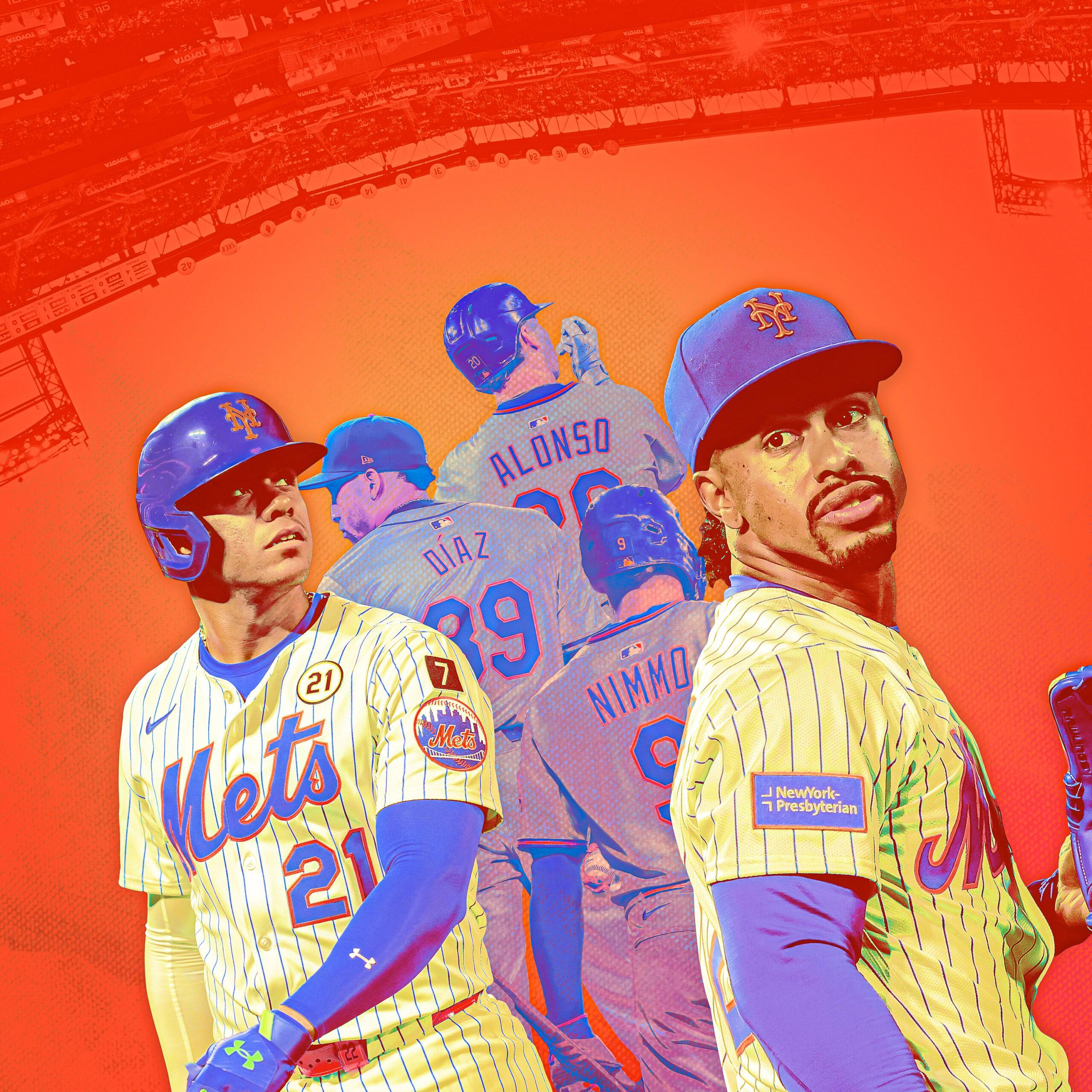
On December 9, the Mets saw their star closer Edwin Díaz—he of the ethereal Timmy Trumpet entrance—depart for the World Series champion Dodgers, over slightly less deferred money and a much better shot at a title. The next day, the franchise’s all-time home run leader, Pete Alonso, signed a five-year, $155 million contract with the Orioles. The Mets reportedly never even made him an offer.
In November, New York shipped out stalwart center fielder Brandon Nimmo, who has played all 10 seasons of his career in Flushing, to the Rangers in exchange for Marcus Semien—a highly paid 35-year-old second baseman whose defense is elite but who hasn’t registered an OPS above .700 in either of the past two seasons. This trade was accompanied by a back-page flurry in which the New York Post reported that incumbent second basemen Jeff McNeil and star shortstop Francisco Lindor had engaged in a “tense standoff” after McNeil misplayed a ball against the Phillies in June. The same report said that Lindor’s relationship with $765 million arrival Juan Soto was “chilly,” prompting “questions over who was leading the team.”
If locker room dysfunction wasn’t enough, New York fired most of its coaching staff after its historic 2025 regular-season collapse, including its pitching coach, hitting coach, bench coach, and third base coach. And the team’s transactional philosophy—both who has been let go and who has been acquired—seems to coalesce around one kink: Which former Yankees are available? Sure, Díaz is out. But relief pitchers Devin Williams and Luke Weaver are in.

All of this is a long-winded way of saying that these are confounding times for the Mets. Last week, Ron Darling looked out over an ornate lobby at the winter meetings in Orlando and said that he was “flabbergasted” by the recent events. On Tuesday, Mike Francesa said that the Nimmo trade was motivated by a Trump-related political skirmish between the outfielder and, you guessed it, Lindor. In Queens, when it rains, it pours.
A devotion to the Metropolitans—as with so many other New York sports teams—is best understood as a form of disaster preparation. You must steel yourself for the inevitability that anything that can go wrong will. Yet, even for folks acclimated to Mets upheaval, this moment feels different. The way last season ended and the way this offseason has begun have prompted not just a bout of collective mania but a full-on identity crisis. Are these Mets a financial Goliath? Analytical darlings? Lovable losers? Perennial underachievers? Some combination of the above? As much as the questions predate this moment, they also come together to explain it.
From ownership to management to the fans, nobody seems to know exactly what the Mets are—much less what they want to be.
Since Steve Cohen purchased the franchise from the Wilpon family for $2.4 billion in 2020, the defining feature of his ownership has been a willingness to spend. Over the past five seasons, Cohen’s Mets have ranked third, first, first, first, and second in MLB payroll, even as they’ve failed to win 90 games more than once during that span. As much as Cohen has opined about wanting to manage payroll, he has yet to rein in his spending habits. During his tenure, the Mets have signed a then-37-year-old Max Scherzer to a $130 million contract; extended Lindor for $341 million three months after trading for him; added Starling Marte for $78 million; enticed the then-40-year-old Justin Verlander for $86 million; and inked Soto to the richest contract in the history of professional sports, worth more than three-quarters of a billion dollars.
Cohen is almost never outbid. His franchise is not averse to big-money extensions, buyout options, or fat signing bonuses. When New York doesn’t land its targets, it’s not usually for a lack of trying. This commitment has changed how Cohen is perceived. It’s how someone who for decades was called the hedge fund king—a man who was best known for overseeing an investment firm that would later pay a record $1.8 billion fine for insider trading—has been able to curry enough good favor, despite the team’s pedestrian results, to win approval for one of three casino licenses recently issued in the city.
But what’s striking is that this reputation doesn’t seem to align with the front office’s preferred way of operating. David Stearns was hired as the Mets’ president of baseball operations in October 2023, and his tenure to this point has been outwardly governed by the principles that guide the league’s entire non-Dodgers upper echelon: the hunt for and maximization of value. Short-term, high-reward signings; identification of underutilized assets; a robust farm system; increased spending on analytics and new-age scouting. “We’re always weighing how certain transactions fit into the larger puzzle of the resources we have,” Stearns told ESPN at the winter meetings. “We have a lot of resources. No team has unending resources, and I’ve said that before. We’ve got all the resources we need, all of the payroll space. We need to put a really good team on the field. That doesn’t mean it’s infinite, nor should it be.”
What that’s meant in practice, at least so far, is that Stearns’s Mets have surrounded their elite players with a series of reclamation projects and experiments, especially on the pitching staff. And while Sean Manaea, Luis Severino, and Clay Holmes have all (at least momentarily) shown flashes of greatness, those guys can take you only so far—and their regressions can be brutal. (Manaea was one of MLB’s worst starters after returning from injury last season, just months after signing a three-year, $75 million deal with the Mets. From August onward, he posted a 7.06 ERA over 43 1/3 innings.) The dissonance between Stearns’s approach and the financial bully ball that marked the first few Cohen years is, particularly this offseason, what seems to be getting to fans.
The truth is that these goals need not be irreconcilable. But when a team fails to succeed both by excess and by trading on the margins, and that team then eschews its fan-favorite players and alienates its remaining stars by replacing reliable contributors with lower-priced, higher-risk options … well, even the folks with an inclination to figure out what lane the Mets are straddling can’t quite manage to do it. For a fan base that was on the precipice of ascending to another plane following the inspired 2024 playoff run and Soto’s signing, these developments have not only recalled the old demons of Wilpons past but also eviscerated the vibes that ’24 run fostered.
That this moment is not rock bottom for the Mets is exactly why so many of their fans are freaking out. This franchise has certainly been through leaner times, but it’s not the terrible years that kill you; it’s the ones that start off with real belief. This offseason isn’t over yet. Maybe all the fretting will turn out to be an overreaction—maybe the Mets will sign Cody Bellinger and Kyle Tucker and waltz to a matchup against the Dodgers in the NLCS. Maybe whatever money they choose not to spend this year will get reinvested in the roster next year. The Blue Jays just went from last place to a literal misstep away from a title. The Mets, with their resources and foundational pillars, could reach the same heights with a much less daunting climb.
But if this offseason so far and the reaction to it have shown anything, it’s that everyone involved would benefit from a plain sense of direction. What kind of a franchise are these Mets? Rebuild-proof? Judicious? In flux? It doesn’t have to be one thing. It just can’t be everything. Pity may or may not be appreciated, but these days, clarity is priceless.