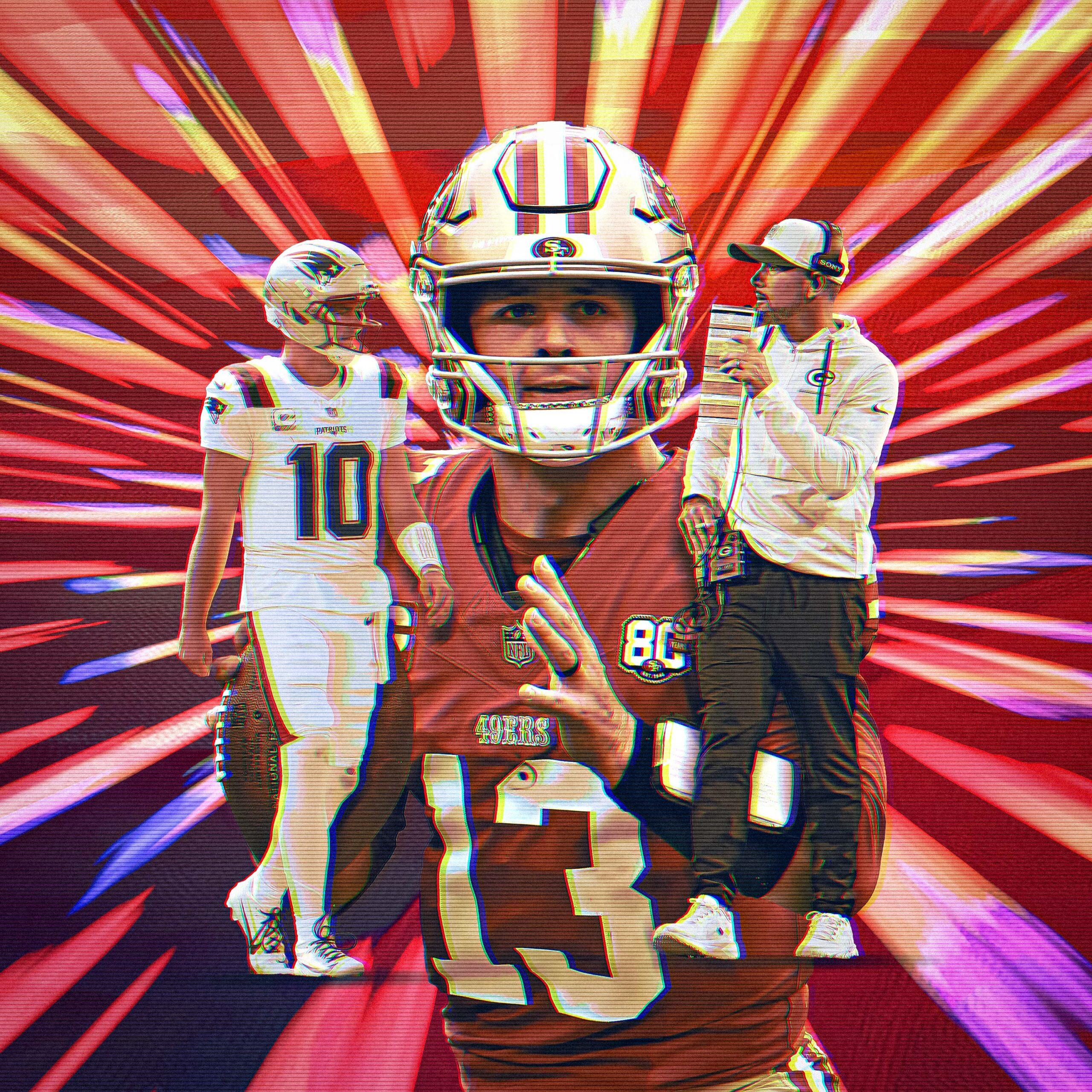

Welcome to the Week 3 edition of The Ringer’s Ball Knower’s Notebook. We’re back to take a closer look at the best players, most interesting plays, and developing story lines on the field.
This week, we’re spending time on a few surging (Brock Purdy and Geno Smith) and struggling (Drake Maye and Jordan Love) quarterbacks. We’ll also put a few of the best plays of the week into the all-22 spotlight. Let’s talk some ’ball!
What Went Well: Brock Purdy’s Efficient Passing
49ers quarterback Brock Purdy is dealing this season and coming off a 297-yard, four-touchdown performance against the Cardinals on Sunday. He’s leading the NFL in passer rating (at an inconceivable 133.1) and tied with quarterback Kirk Cousins for the lead in passing touchdowns (nine). The 49ers are undefeated and currently have the second-highest-scoring offense in the league—and these numbers don't even begin to paint the full picture of how effective Purdy’s been this year.
For my advanced statistics nerds, the only quarterback this century with higher expected points added on passing plays through the first three weeks is 2007 Tom Brady. Read that again, and then for a third time. Purdy is in rarefied air right now—on pace for a 4,000-yard and 50-touchdown season. That has happened only three times in league history (Brady in 2007, Peyton Manning in 2013, and Patrick Mahomes in 2018), and if Purdy hits those marks, it would essentially guarantee him the MVP award. This isn’t the first time Purdy’s production has put his name or his offense next to other all-time greats, either. In 2023, when he led one of the most efficient offenses we’ve ever seen, Purdy averaged 9.6 yards per attempt—the second-highest mark of this century, behind only Kurt Warner’s 9.9, at the height of the Greatest Show on Turf.
Skeptics of Purdy tend to credit head coach Kyle Shanahan and San Francisco’s loaded supporting cast for Purdy’s gaudy numbers in 2023, and there’s probably at least some inclination to do the same for his current stats. When you watch film of Purdy’s performance in Week 3, you’ll find clear examples of throws that were a by-product of Shanahan’s system, successful plays Purdy made because of his excellent decision-making or physical talent, and times when the coach and player came together to make the 49ers offense as effective as it is.
The play below is a good example of Shanahan designing a pass concept that breaks coverages and makes life easy for his quarterback. The 49ers are in empty here (with no one in the backfield) and motion receiver Jordan Watkins across the formation to put four receivers on one side, leaving tight end George Kittle as the only eligible receiver opposite the four-receiver side. It’s difficult to play zone defensive coverages against a four-receiver side because it's likely that one or more defenders will have multiple receiving threats in their area. That’s exactly what happens to Arizona here, as the 49ers stretch the Cardinals’ Cover 2 defense vertically with receiver Jacob Cowing, leaving Watkins wide open as he runs across the field for an easy completion.
This throw doesn’t take elite anticipation or arm strength; Purdy can just sit in the pocket and allow the play to progress until a receiver inevitably gets open. The credit for this explosive play deserves to go to Shanahan.
The play in this next clip is made possible only by Purdy, though. Again, the 49ers use motion to get four receivers on one side of the formation. San Francisco isn’t trying to push the ball as far downfield as it was in the last play we looked at, but this is another passing concept meant to stretch Arizona’s coverage vertically, with a deep corner route by receiver KhaDarel Hodge and an underneath swing route for receiver Deebo Samuel. The design of this play gives Purdy choices. He could dump the ball off quickly to Hodge if the defenders sink underneath, or he could drop the ball to Samuel and let him create easy yards after the catch. Purdy chooses neither of the easy buttons, instead holding the ball a bit longer in the pocket and drilling a completion to Kittle on a deep in route on the other side of the formation.
Go back and watch it again so you can truly appreciate what Purdy did to make this throw possible. And then watch this same play from the end zone angle below, and focus on the stripe down the middle of Purdy’s helmet. This is something coaches do when they watch film and can’t see their quarterback’s eyes. You’ll see that Purdy’s head doesn’t even shift to the side of the field where Arizona’s corner is covering the swing route. That’s because Cardinals linebacker Mack Wilson is working his way over to help on those routes. Purdy knew Wilson would be a third defender covering San Francisco’s two receiving options, an advantage for the defense. Purdy’s helmet is fixed on the next part of the progression—McCaffrey on a checkdown. While Purdy peeks in the running back’s direction, he’s looking to see if linebacker Jack Gibbens rushes up to cover McCaffrey. Gibbens does, and that creates a huge void in the middle of the field for his completion to Kittle.
Purdy’s understanding of Shanahan’s offense, ability to work through progressions, and ability to manipulate defenders with his eyes made this throw possible. Purdy manufactured his own passing window by getting his eyes on McCaffrey early in the play and forcing Gibbens’s hand, and that’s the kind of subtle nuance in play that I expect of elite quarterbacks. Purdy might not have dynamite physical tools, but plays like this help him produce like the most naturally gifted passers in the league.
And when his sharp processing combines with Shanahan’s quick passing concepts, the result is an unstoppable 49ers offense. In the next clip, Purdy beats a Cardinals blitz and finds Watkins on an explosive gain both because he trusts the timing-based nature of the offense and because he’s able to identify voids in the defensive coverage. The ball is out as soon as Purdy finishes his dropback, timed perfectly to when Watkins comes out of his break, and the ball is delivered right into the only open area.
You’ll notice that only one of these passes went to a superstar teammate of Purdy’s (the dig route to Kittle), and that big play was only possible because Purdy made it happen. If Purdy’s detractors still want to say his success is because of Shanahan’s system or Purdy’s supporting cast, they’re free to do so. I just know what I’m watching on tape, and that shows Purdy playing at a level that matches the sophistication of his head coach’s play calls and the excellence of his running mates.


More on the NFL
What Went Wrong: Drake Maye’s Turnovers
The Patriots offense has been a hard watch this season. That unit’s struggles date back to last postseason, even before they got blown out by the Seahawks in Super Bowl LX. Of all the teams to make the divisional round in last year’s playoffs, only the Texans had a worse EPA on passes. In fact, of all the teams to win at least one playoff game in the last 10 postseasons, the 2025 Patriots had the fourth-worst EPA on their dropbacks. At the center of this problem is quarterback Drake Maye, who looks nothing like the MVP runner-up from a season ago. He currently has the league’s second-worst passer rating at 58.6. He’s been sacked nine times and has turned the ball over a league-high seven times. And after Sunday’s 35-6 loss to the Jaguars—the fewest points New England has scored in any of Maye’s starts—I needed to jump into the film and see whether the problems were Maye’s fault, a reflection of a bad offensive infrastructure, or both. This first bad play is easy to diagnose; it’s simply a mistake.
Maye’s “empty hand” turnover isn’t something that signals a problem with his mechanics or confidence. And I’d say the same about all three of his sacks on Sunday, especially the one he took inside his own 10-yard line late in the third quarter, which you’ll see in the clip below. New England is already down 25 points to Jacksonville at this point, so Maye is hunting for big plays. But he has absolutely no time for downfield plays to develop. Defensive tackle DaVon Hamilton runs right by Patriots lineman Walter Rouse, forcing Maye to step into defensive end Bryan Thomas Jr. There’s no play call or quarterback footwork that can save a play that gets blown up this quickly.
I can’t say the same about his interceptions on Sunday. His first pick, by Jags cornerback Travis Hunter right before halftime, was a bad decision and a poor throw across his body. In this instance, Maye showed a complete lack of situational awareness. It was third-and-goal at the 2-yard line, and Maye’s primary job was to make sure that this possession ended with points—or, at worst, the end of the half. With no one open and pressure bearing down, he had two options: concede the sack and allow the clock to run down, giving New England enough time to attempt a short field goal, or throw it away and take another shot on fourth down. Instead, Maye did the one thing he absolutely could not do: turn the ball over. He was not a reckless quarterback during the 2025 regular season, so it was shocking to see him make this kind of mental error.
His second interception was another objectively bad throw. Receiver Kyle Williams was absolutely blanketed by Jacksonville cornerback Jarrian Jones before the throw, but Maye seemed determined to send it to Williams no matter what. Maye left the ball short and inside, giving his receiver no shot to fight to it. It was an easy pick for Jones and effectively ended New England’s hope to come back and make Sunday’s game competitive.
Maye is simply not as dialed in this season as he was last year. It would have been nearly impossible to replicate his impressive production from 2025, but even knowing that regression was inevitable for the young quarterback, it’s hard to be optimistic that things will turn around given the way he’s turning it over. Including playoff games, he now has 42 career giveaways, the most among all quarterbacks since 2024 (when he was drafted)—and he didn’t even start for the first half of his rookie year.
Without the explosive plays we saw last season, Maye just looks like another extremely talented but untrustworthy quarterback.
What Went Well: Case Keenum’s Return
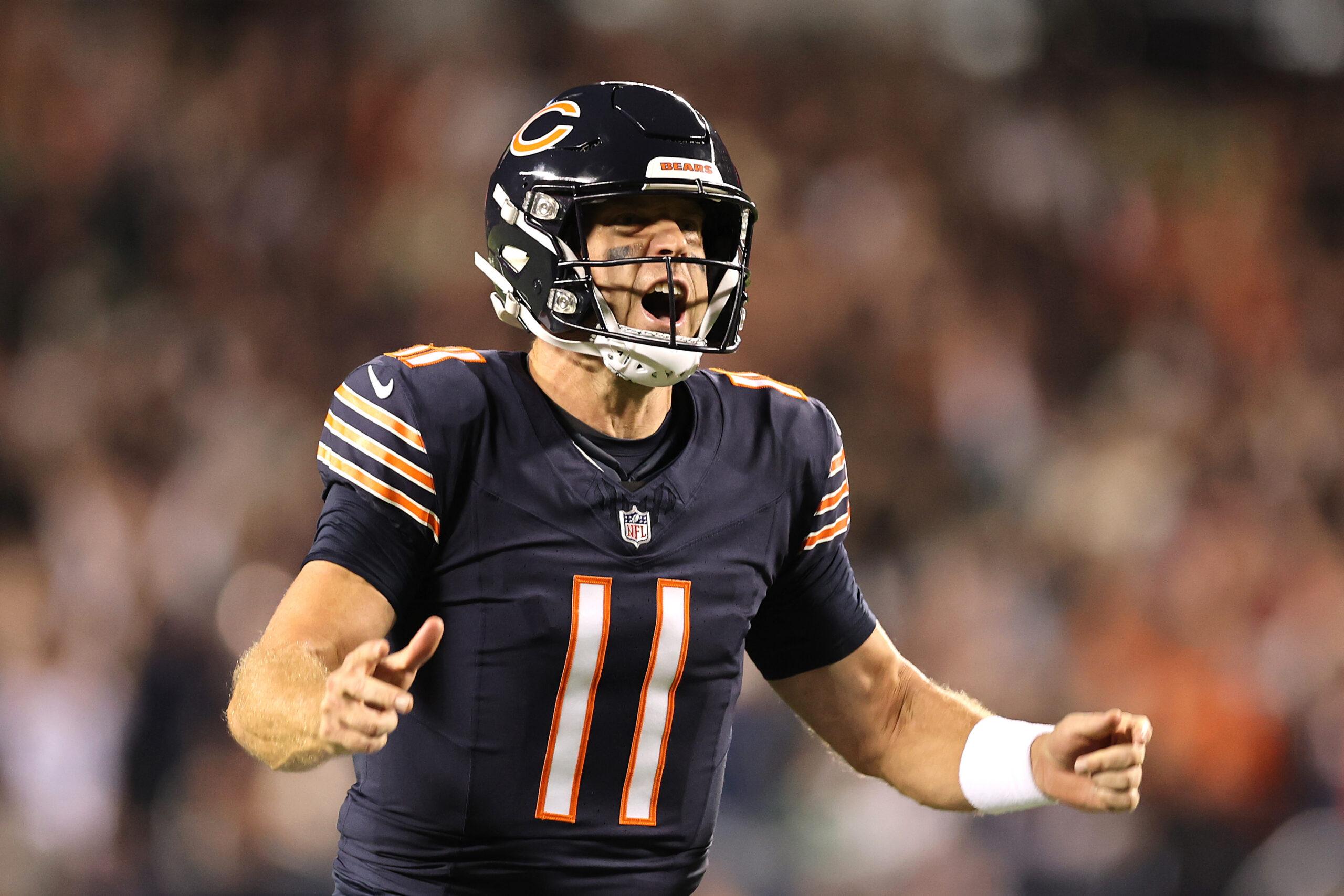
Ben Johnson put together a masterpiece in play calling as Chicago beat Philadelphia 27-7 with no. 3 quarterback Case Keenum, who before Monday night hadn’t thrown a pass in a regular-season game since 2023. Keenum cruised against the Eagles defense, ending the game with a pair of touchdowns and 247 passing yards while completing 70 percent of his passes. And Keenum wasn’t just good; there were moments when the game looked as easy for Keenum as it often does for starting quarterback Caleb Williams. It doesn’t get much easier than this:
Yet even when Chicago’s receivers weren’t sprinting through Philadelphia’s defense uncovered, Keenum was excellent. It was clear that Johnson trusted Keenum with an aggressive passing game—and he had to play that way because Philadelphia’s defense sold out to stop the run all night. Eagles defensive coordinator Vic Fangio dared Keenum to beat them from the pocket—and Keenum did just that. He threw with timing and anticipation, even fitting the ball into tight windows at times. If you didn't know any better, you’d think we were back in 2018, watching Keenum throw without fear for the Vikings when he was in the prime of his career.
Philadelphia was the toughest opponent on Chicago’s early schedule, and dominating this game makes the Bears’ outlook for the first half of the season much better—even if Williams will be out for a while with a hamstring injury. Johnson’s game plan for Keenum on Monday night just proved that defenses have to respect all aspects of this offense no matter who’s under center: Williams, Keenum, or QB2 Tyson Bagent, who recently cleared concussion protocol. That’s something only the best offensive play callers can accomplish.
What Went Well: Geno Smith’s Accuracy
I apologize to Geno Smith. I wrote him off (again), and I’m paying dearly for that take right now.
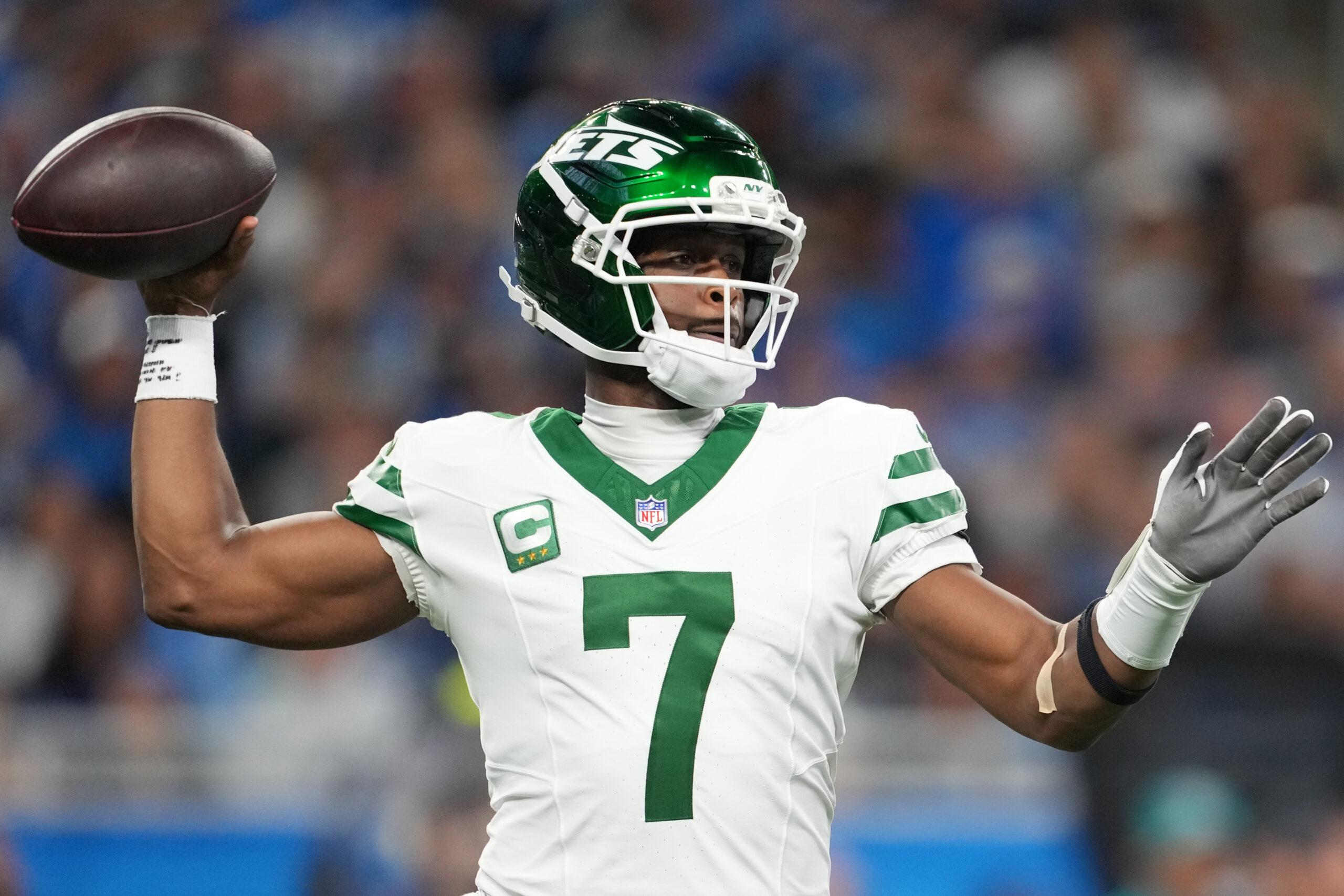
The Jets are 1-2, but have been competitive in losses to the Packers and Lions over the last two weeks. Smith has been sharp and efficient all season. The veteran quarterback has the fifth-highest passer rating in the league at 110 and is completing 75.5 percent of his passes, which leads the league. This is his best three-game stretch to open a season in his career, and the tape shows why Smith has been so effective.
Smith has managed to rediscover the accuracy that was missing from his game last year with the Raiders. Because of how aggressive Smith is as a passer, he has to be accurate or else he risks turning the ball over—as we saw last year, when he led the league in turnovers. In the clip below from Sunday’s game against the Lions, Smith perfectly layers in a throw 20 yards up the sideline to tight end Jelani Woods. That throw had to be perfectly placed, because Lions corner Roger McCreary was sinking underneath Woods and would’ve picked this off if it were underthrown at all. Smith didn’t necessarily make the best decision here. Receiver Sterling Shepard is breaking wide open on a dig route behind the linebackers, and the throw to connect with him would’ve been less difficult. To make a throw like this, a quarterback better be right and he better be accurate—and Smith was both.
His most accurate throw of the day came later on the same drive, a 24-yard scoring strike to tight end Kenyon Sadiq. As you can see below, the Jets are creating a bunched receiver set with two tight ends and receiver Isaiah Williams, while star receiver Garrett Wilson is isolated opposite the bunch. The Jets are going to run “four verts” from this formation, sending all receivers vertically downfield, and the Lions are playing Cover 6 (Cover 2 to Wilson’s side and Cover 4 to the bunched side) in hopes of taking away quick throws in the red zone. When this passing concept meets this coverage, it typically means there’ll be a one-on-one matchup up the seam, and that’s where Smith finds Sadiq for this touchdown. Sadiq is tightly covered by McCreary, but Smith throws a perfect ball. Again, we’re seeing Smith’s regained accuracy pay off the aggression that’s inherent to his play style. Smith can take these chances and turn them into explosive plays because his ball placement is as good as it's ever been.
When things were going sideways for Smith last season, it was because he was taking too many unnecessary risks when his first reads weren’t open—and he was coming apart in the pocket when pressured. Smith is still taking a lot of sacks (nine this season already), but he looks comfortable in the pocket, like he did during his best seasons in Seattle. In the play below, he shows how he can use his efficient footwork to get around interior pressure and reset his throwing platform, while never taking his eyes off his downfield progression. Once Smith evades the pass rush, he’s able to find Sadiq deep downfield.
Smith is playing the best ball of his career right now, just one year removed from looking like the worst starter in football. And while the Jets probably aren’t a talented enough team to be a serious factor this season, Smith is absolutely raising this team’s floor and keeping it competitive.
What Went Wrong: Green Bay’s Offensive Line
At 1-2, the Packers are one of this season’s biggest disappointments. We typically expect to see one of the league’s most efficient and explosive passing attacks every time the Packers play, but they’re currently 21st in expected points added on dropbacks and 22nd in points scored.
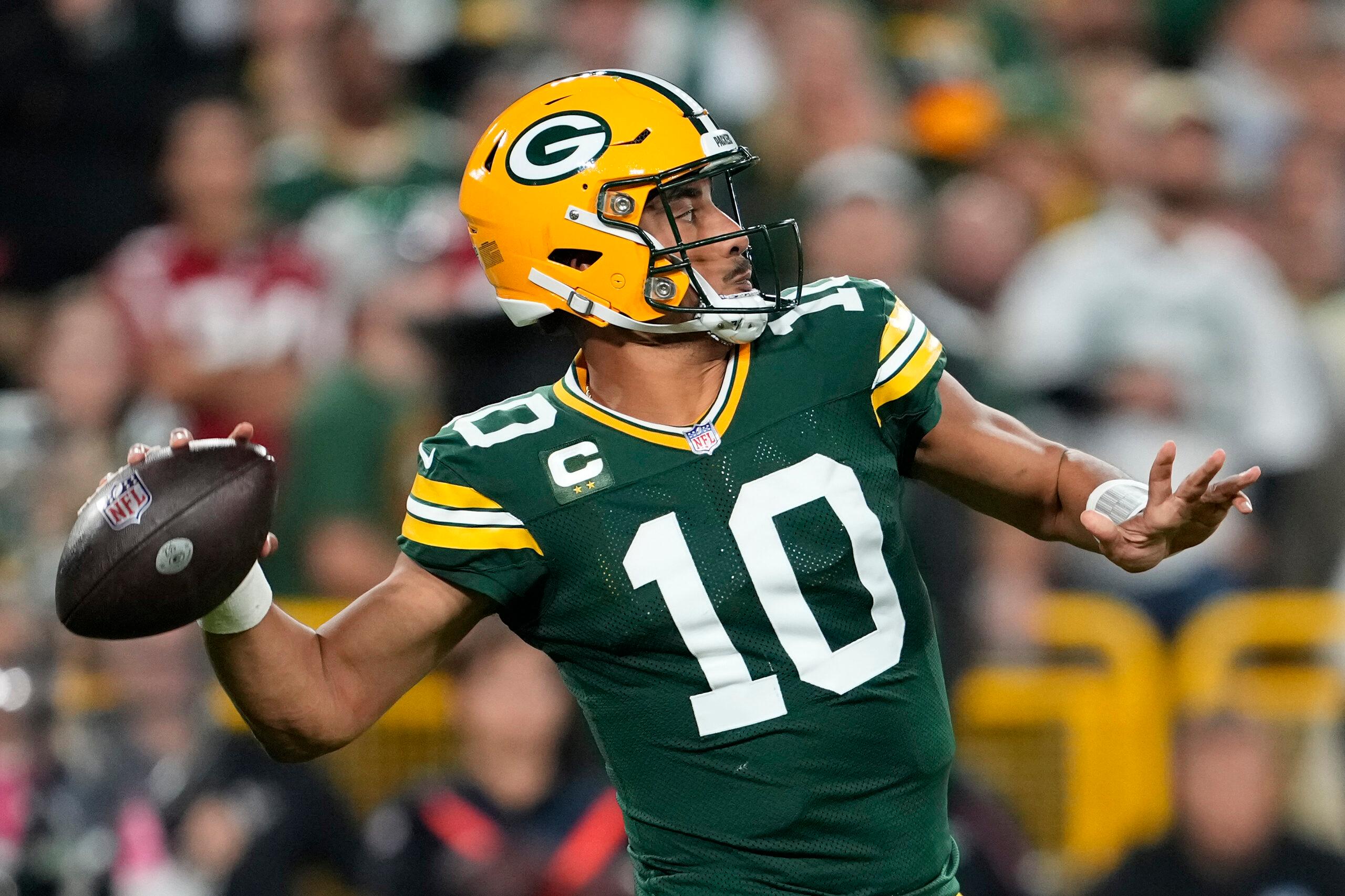
Head coach Matt LaFleur and quarterback Jordan Love are taking the brunt of criticism right now—understandably so for a team that’s lost seven of its last eight regular-season games. But when I watch the Packers offense, I struggle to see how anyone can call plays or operate in a pocket given the poor performance of the offensive line.
The Packers have the second-highest pressure rate allowed in the league right now at nearly 45 percent. There’s no offense in the world that can sustain itself when its quarterback is under that much duress. And it's not like Love is inviting pressure by being reckless in the pocket. Of Green Bay’s 59 total pressures allowed through three weeks, 24 have come within the first 2.5 seconds of passing plays (we’ll call these “quick pressures”). In the last decade, only five teams have dealt with that many quick pressures: the Cardinals in 2017; the Vikings in 2018; the Broncos in 2019 and 2020; and the Panthers in 2023. None of these teams made the playoffs.
Green Bay’s 35-14 loss to the Falcons on Thursday night felt like the total unmaking of LaFleur’s offense, with Atlanta’s pass rush rendering so many plays useless that I can’t even gauge where the silver linings are. In the clip below, which looked like it could have been a strip sack but was ultimately ruled an incomplete pass by Love, just watch linebacker Divine Deablo run through Green Bay’s line untouched. The offensive line never identifies where the blitz is coming from. Green Bay kept seven players in protection against Atlanta’s six rushers, meaning it shouldn’t be possible to have an unblocked defender. And yet, Love gets smoked by Deablo and is lucky his arm was moving forward as the contact occurred to keep the play from being a turnover.
This is the same problem that came up in our Week 1 edition of the notebook, as the Vikings blitzed the Packers endlessly. But Green Bay’s offensive line has been so bad that blitzing isn’t even necessary most of the time. In the next clip, Love can’t step up in the pocket because there’s too much push from Atlanta’s interior linemen. By the time he’s ready to throw to an open target (running back Chris Brooks), the pocket has totally collapsed and Love can only manage to scramble a few yards back toward the line of scrimmage.
The poor offensive line play exacerbates Green Bay’s other weaknesses, especially in high-leverage situations. Late in Thursday’s game, as Green Bay was chasing multiple scores and needed to push the ball downfield, Atlanta sent pressure and ran stunts to create confusion, assuming that Love would still be holding the ball in the pocket by the time a rusher broke free. That’s exactly what happens on the clip below, forcing Love to fling the ball and avoid another sack.
The Packers on Monday signed free agent offensive lineman Mekhi Becton to the practice squad, but there are few easy fixes for the line issues. That group has already lost its best player in Zach Bako-Bewele for the season. There’s no clarity yet on when edge rusher Micah Parsons will be back to help the Packers defense—or whether running back Josh Jacobs will return at all this year. And with as poorly as this year is trending for this offense, Green Bay is getting closer to being a non-playoff team than a contender this season.
All-22 Spotlight, Part 1: Genesis Smith’s Bounce-Back Week
In last week’s notebook, we pointed out a rough outing for Chargers rookie safety Genesis Smith—as the Raiders attacked him multiple times in coverage. This week, Smith had his retribution against the Bills, finishing Sunday’s game with five tackles and a pair of first-half interceptions.
While his second interception (shown above) is one of the best defensive plays we’ll see all year, our focus here is on his first pick because it shows how Smith improved his route recognition, the exact thing the Raiders exploited last week. In this clip, Buffalo tries to use an empty formation and motion by receiver Khalil Shakir to try to widen the defense and create a throwing window for an in-breaking route. Smith feels the route coming the whole way, and breaks on it before quarterback Josh Allen even begins his throwing motion.
Smith’s patience to not react to the motion and not panic as receiver D.J. Moore runs upfield makes this play possible. Smith flashed ball skills and anticipation like this at the University of Arizona, and his 6-foot-2 frame makes it easy for him to eliminate passing windows when he’s jumping routes.
All-22 Spotlight, Part 2: Marcus Mariota’s Big-Time Throw
The Commanders pulled off the biggest upset of the week, beating the Seahawks 33-31, in large part because of the gutsy play of backup quarterback Marcus Mariota, who threw for 183 yards and three touchdowns in his first start of the season in relief of the injured Jayden Daniels.
Mariota made my favorite throw of Week 3, ripping a pass between a linebacker and safety to connect with receiver Treylon Burks for an 11-yard score.
The Commanders here are running an in-breaking high-low concept, with a hitch route underneath and a dig route over the top. With defensive tackle Leonard Williams bearing down on Mariota, the quarterback is still able to see linebacker Drake Thomas stop his feet, and that gives him juuuuussssttt enough of a window to make this throw. By the time Seattle’s safeties converge on Burks, the points are already on the board. High-low concepts like these work great in the red zone—especially when defenses play Cover 4 like the Seahawks are here. If a quarterback is good with his eyes and doesn’t give his intentions away, he can find these tight windows.
If Daniels has to miss extended time due to his elbow injury, Mariota’s play on Sunday should give Commanders fans hope the offense will stay afloat.
All-22 Spotlight, Part 3: Mike McCarthy’s Perfect Play Call
Steelers head coach Mike McCarthy must’ve heard the critique from quarterback Aaron Rodgers last week, because he called a great game against the Bengals on Sunday. Pittsburgh beat Cincinnati 30-27 and Rodgers had 292 passing yards on just 19 completions, the second-most yards he’s had as a Steeler. The game seemed to come easy to Rodgers as a result of McCarthy setting him up for success, and that best showed up in Rodgers’s 23-yard touchdown pass to receiver Ben Skowronek. This was an excellent play-action design:
How does Skowronek sprint by a handful of Bengals defenders totally unnoticed? Watch how he sets up his route. Skowronek comes across the formation in motion and fakes as though he’s lead blocking for running back Jaylen Warren, releasing upfield between tight end Darnell Washington and right tackle Max Iheanachor like a fullback. Cincinnati’s defenders are more concerned with stopping the run than accounting for Skowronek as a potential pass catcher, and defensive backs aren’t used to vertical routes coming out of the backfield. For a brief moment, Bengals defenders treat him like an actual fullback and let him run by, thinking he’s going to block someone else. It isn’t until he flies past safety Jordan Battle that Battle’s radar finally goes off that he’s been duped, and by then it’s too late.