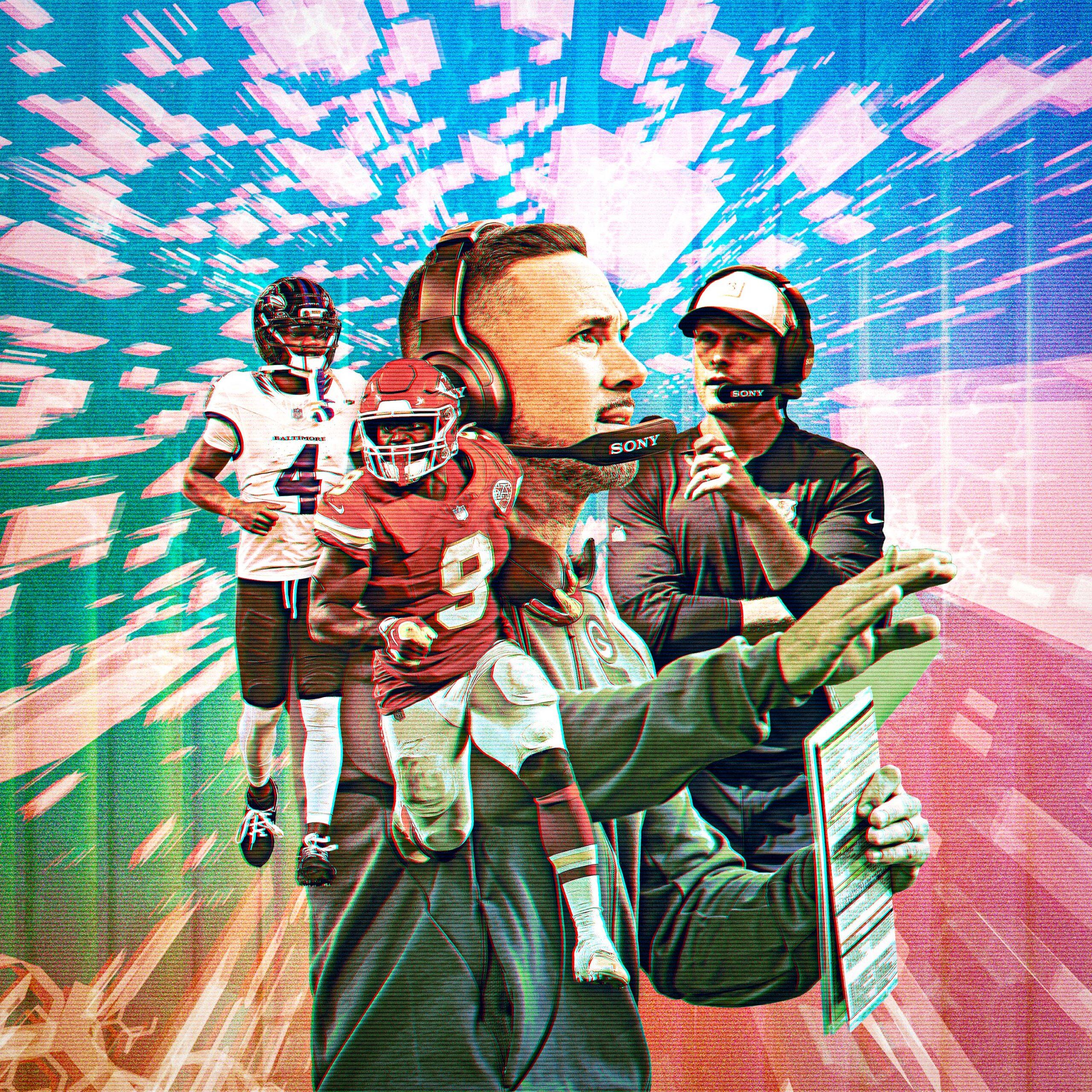

Welcome to The Ringer’s Ball Knower’s Notebook, where each week I’ll look at the coolest plays, standout performers, and most interesting game situations and put them under the microscope to explain what’s happening on the field.
This week, I’m breaking down a spectacular Kansas City debut for running back Kenneth Walker III, Baltimore receiver Zay Flowers’s exciting first half, Green Bay’s offensive meltdown, a bad first impression for Dallas’s new-look defense, and more.
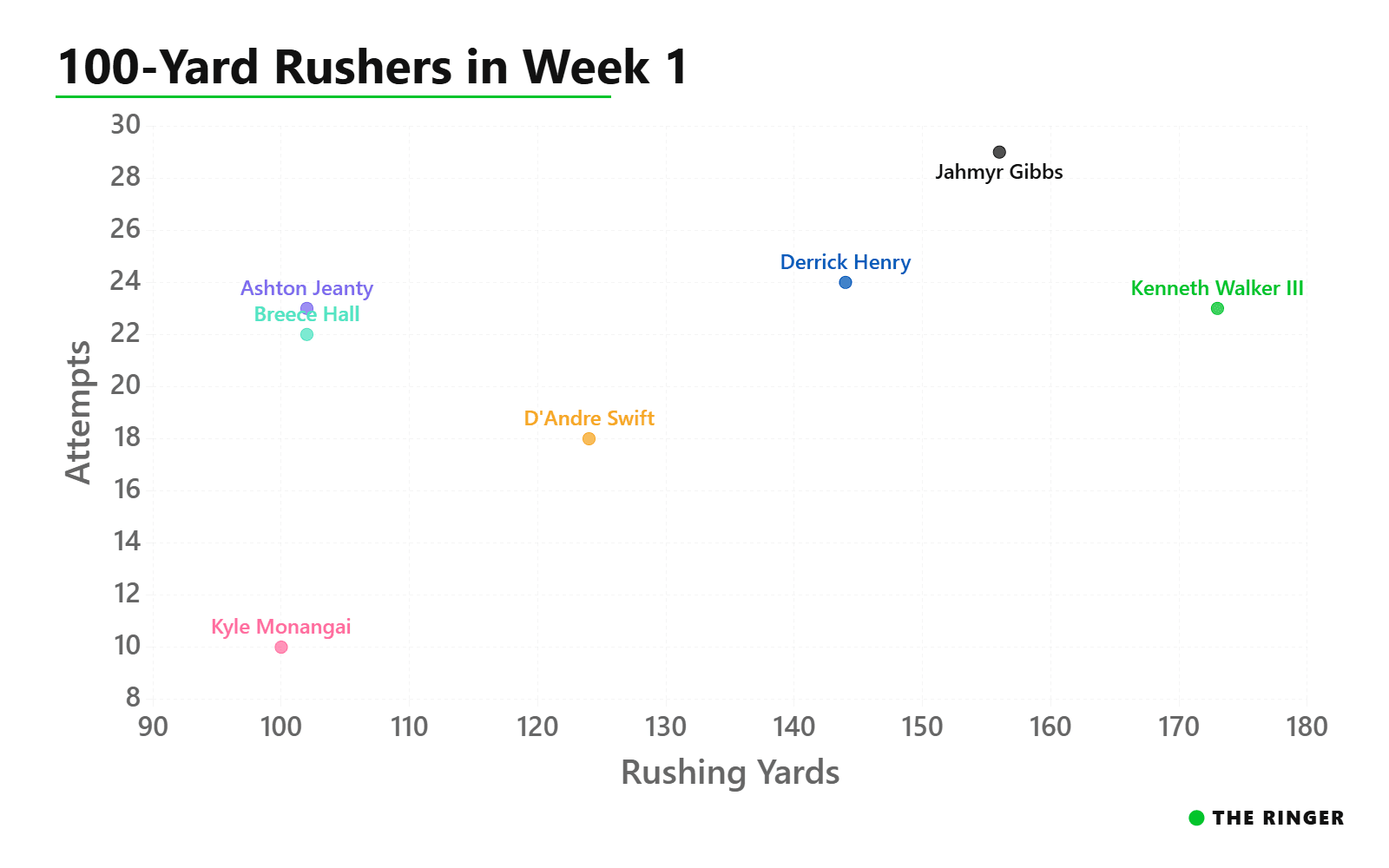
The theme of the week was explosive runs. Seven separate running backs ran for 100 or more yards, and the 3,851 rushing yards across the NFL in Week 1 is the second most we’ve seen in a decade. We’ll cover some of those rushing attacks here—and what made them so effective. It’s time to talk about ’ball.
What Went Well: Kenneth Walker III’s Debut in the Chiefs Offense
Am I in another dimension, or did I just watch the Chiefs offense dominate a game from start to finish without asking quarterback Patrick Mahomes to do … really much of anything as a passer? Running back Kenneth Walker III, the MVP of last season’s Super Bowl with Seattle and Kansas City’s big free agent addition, had 173 rushing yards on Monday night against a much-hyped Broncos defense. That was the highest rushing total of any back this week—and the most rushing yards in a game that Mahomes has started.
Since 2018, a Chiefs running back has surpassed 100 yards in a game only 16 times (out of a possible 134 games). When Kansas City signed Walker to a three-year, $43 million deal in March, it was with the hopes that he’d give the Chiefs the kind of dynamic playmaking they’d been missing. It’s been only one game, but he already looks like he could be the Chiefs’ best open-field playmaker since receiver Tyreek Hill.
The tackling here from the Broncos leaves plenty to be desired, but just look at the way Walker moved in space.
His 60-yard touchdown run—on a fourth-and-1, no less—blew Monday night’s game open and was a perfect example of the new dynamic Walker brings to Kansas City.
If the Chiefs tried to pick up a fourth-and-1 like this with Kareem Hunt last year, either the play would’ve been stuffed at the line of scrimmage or Hunt would’ve been tackled before he could turn the edge. Walker, though, was easily able to bounce outside, avoiding the mass of Broncos bodies expecting a run up the gut, and once he avoided the diving tackle attempt by corner Patrick Surtain II, he was home free.
Missed tackles were a theme on Monday night. Walker forced 14 missed tackles and averaged 7.8 yards after contact per rush. He carried the entire offense on his back, finding yards where there were none and masking what was actually a pretty troubling performance from Kansas City’s offensive line despite Walker’s big night.
For the Broncos, it was one of the worst tackling performances that I can remember, and Denver’s follies made it easy to initially overlook other issues with the Chiefs offense, namely in the passing game. But Walker’s near 200 yards from scrimmage and his pair of touchdowns in his Chiefs debut were so entrancing that it didn’t matter that the Chiefs linemen struggled to block, that receivers couldn’t separate, or that Mahomes looked shaky as a passer—and didn’t connect on a single pass that traveled more than 10 air yards downfield.
For the first time in years, the Chiefs can enjoy a victory in a game in which Mahomes plays below his own impossibly excellent standard as this team’s superhero—and can maybe ask Walker to take that responsibility off Mahomes’s shoulders more often.
What Went Well: Zay Flowers’s Role in Baltimore’s Offense
Hello, Baltimore. It’s nice to see you’re back to your old self again! After the general malaise of the 2025 season—which featured plenty of injuries and inexplicable losses—the Ravens came into this year with as much to prove as anyone. And just five offensive possessions into Sunday’s matchup against the Colts, they’d scored 28 points, and the game already felt decided.
In The Ringer’s Winners and Losers column on Sunday night, we covered how easy the game looked for quarterback Lamar Jackson and running back Derrick Henry. But the most explosive player on the field was receiver Zay Flowers, who had 150 receiving yards and a touchdown on just six first-half targets and finished Sunday with the second-most receiving yards of the day despite suffering a minor hamstring injury before halftime.
Flowers adds a dynamic layer to a Declan Doyle unit that’s already built to bludgeon defenses between the tackles and punish overly aggressive defenses with Jackson’s mobility. It seems he’ll be the player Baltimore uses to identify mismatches and exploit holes in zones, and once he’s fully healthy again, he’ll be the one getting the bulk of the targets.
Flowers’s first reception of the game came off a Jackson bootleg. Flowers is in a condensed alignment with teammate Rashod Bateman and easily runs away from cornerback Justin Walley’s attempt to play press coverage. When Flowers is closer to the ball, he has more space to work with on his routes, and his explosiveness shines in both his route running and his run-after-the-catch ability. This play was designed for Flowers to create his own space, and he did so to the tune of 49 yards and a near touchdown.
The next clip is one of my favorites from the weekend because it brings together all the best components of Baltimore’s offense. Bateman runs across the formation in a pre-snap motion, and the lack of a reaction from Indianapolis’s defense tells Jackson he’s getting zone coverage. The play-action to Henry forces the defenders on the left half of the screen to fly over and stop a nonexistent run, and the half rollout from Jackson forces the defenders on the right to widen out. That leaves an enormous gap in the middle of the field for Flowers, who wraps around underneath defenders and stops his route in open space. And once Flowers has the ball, you see him immediately change gears and reach his top speed. Even though this was one of Flowers’s shorter gains of the day—a workmanlike 17 yards—this play is a perfect example of how impossible Baltimore’s offense can be to stop, because every part of this play’s setup is designed to capture the defense’s attention.
But Flowers’s longest and most impressive gain of the day is the kind that should be keeping defensive coordinators up at night. On Flowers’s 54-yard touchdown catch, he starts the play aligned in the backfield—and running back Justice Hill is aligned as a wide receiver. This gives Jackson an immediate man-or-zone clue, because if the Colts were playing man coverage, a linebacker would’ve walked out to cover Hill and a defensive back would be in the box with Flowers.
With a linebacker aligned over Flowers, this is clearly zone coverage—and that linebacker blitzes on the snap, leaving a safety to drop into the void left open on the blitz. Before the throw, this looks like a successful Colts play call: Linebacker Jaylon Carlies is unblocked on his way to Jackson. But the Ravens have a great counterpunch for this blitz because Flowers is running a “choice” route out of the backfield, giving him two or three ways to run his route depending on the defense’s coverage. Against the Colts’ blitz, he finds the soft spot behind the safety and sits down, and Flowers’s speed does the work from there. He flies nearly untouched through the Colts defense on the way to the end zone.
Sunday’s 41-23 victory would be most offenses’ best performance of the year, but it felt like this Ravens unit was just scratching the surface of what it can do. Its 7.9 yards per play led all offenses in Week 1, and that number could have been even higher had Flowers been able to finish the game. The Ravens offense looks like one of the NFL’s best forces again, which is a bad omen for the rest of the league.
What Went Well: Chicago’s Run Game
Bears head coach Ben Johnson said he wants to break the NFL scoring record this season (that record is currently held by the 2013 Broncos, who scored 37.9 points per game), and Chicago’s 59-37 win over the Panthers was an emphatic step in the right direction. The Bears’ 552 yards of total offense are the fourth most we’ve seen in a season-opening game this century, and most of their damage came on the ground. Chicago had 291 rushing yards and six rushing touchdowns—good for the third-most Week 1 rushing yards and the most Week 1 rushing touchdowns since 2000.
Running backs D’Andre Swift and Kyle Monangai were two of the league’s top six rushers on Sunday, each eclipsing 100 yards on fewer than 20 carries. And both of their biggest runs of the game came from the same concept, a man-blocking scheme called “duo.”
Let’s break down Monangai’s 61-yard score from that concept, which you can watch from the end zone angle in the clip below. Chicago has only one tight end on the field, but receivers Kalif Raymond and Luther Burden III are aligned close to the box. This is by design: The offense wants as many extra blockers as possible at the point of attack on “duo” because then offensive linemen can create double-teams on the interior and still have extra blockers to deal with players on the edge. Burden goes in motion just before the snap, and Chicago has three separate double-teams before Monangai even receives the handoff—Burden and tight end Cole Kmet are blocking the defensive end, tackle Darnell Wright and guard Jonah Jackson are doubling a defensive tackle, and guard Joe Thuney is working with center Garrett Bradbury on another defensive tackle. Chicago’s offensive line gets so much push with these double-teams that the entire Panthers front is shoved outside the left hash before Monangai even reaches the line of scrimmage.
The key blocks that spring open this touchdown run are executed by Burden and Raymond. When Panthers safety Tre’von Moehrig reaches the line of scrimmage, Burden leaves his double-team and picks up Moehrig to seal the edge. That frees Raymond up to attack safety Lathan Ransom, and once Monangai makes his cut upfield, there’s no defender left in position to make a play. This is one of my favorite run concepts in football because it’s simple enough to be executed with any offensive personnel grouping, and (when blocked correctly) it generates explosive runs by forcing defensive backs to be stout run defenders.
If Chicago’s run game continues to dominate like it did on Sunday, the Bears will challenge the scoring record—and remain among the NFC’s best offenses.

What Went Wrong: The Packers’ Second-Half Meltdown
The Packers have some glaring weaknesses on their roster (namely at offensive line and defensive back), but they still have Super Bowl aspirations. And when they went into halftime on Sunday with a two-score lead over a Vikings team that had already lost its starting quarterback, my expectation was that Green Bay would control the game the rest of the way. Instead, the Packers gave up 29 unanswered points in a 39-22 loss, and head coach Matt LaFleur now finds himself on a six-game losing streak dating back to last season—which includes a blown 18-point lead in a 31-27 loss to the Bears in the wild-card round.
LaFleur will have to wear the shame of this upset loss, and that will compound the criticism he received for last year’s failings. But the Packers didn’t lose because LaFleur wasn’t an aggressive enough play caller. They lost because LaFleur’s play calling didn’t do enough to help quarterback Jordan Love in the second half, and Love crumbled under Vikings defensive coordinator Brian Flores’s relentless blitzing.
Love completed just 52 percent of his passes in the second half, and he took four sacks and turned the ball over twice while Minnesota mounted its comeback. Flores ratcheted the pressure up higher than any other DC in the league, blitzing Love on 18 of his 23 second-half dropbacks and 34 times overall on Sunday. Love punished Flores for the blitzes a few times (particularly on his 81-yard touchdown pass to receiver Christian Watson), but the game effectively ended on a two-drive sequence where Flores’s defense had a strip sack and then tipped an interception.
The strip sack—both forced and recovered by linebacker Andrew Van Ginkel—deserves a closer look. In the clip below, Minnesota has six defenders on the line of scrimmage, which is a staple of Flores’s defense. With so many defenders crowding the line, Green Bay’s pass protectors have to be in perfect communication to block the defenders that actually end up rushing. The offensive line will slide three or four blockers in one direction, and the running back will attempt to pick up any rushers left over.
Green Bay’s linemen slide to Love’s left, and right tackle Zach Bako-Bewele is responsible for Van Ginkel on the right edge, accounting for four of the five rushers Minnesota sends after Love. The only Vikings rusher left unaccounted for is linebacker Blake Cashman—and he should be the responsibility of running back Chris Brooks, who instead looks to release on a route after feigning a block. Cashman has a free rush, which gets Love on the move and gives Van Ginkel an opportunity to make a play even though Bako-Bewele is doing his job properly.
These kinds of protection breakdowns can happen to any offense—but this one is a reflection of a poor strategic decision by LaFleur. If you go back to watch Love’s best throws on Sunday, several came when Green Bay kept a tight end, running back, or both in the pass protection to account for Minnesota’s potential blitzers. There’s calculated aggression, and then there’s recklessness, and exposing Love to more pressure in order to get one extra receiving option was the latter.
LaFleur’s Packers have been off the rails since last December, and he’ll find his seat warming up if he doesn’t bounce back from Sunday’s letdown with a strong reminder of why he’s considered one of the best play callers in football.
What Went Wrong: Dallas’s Young Defense Blowing Coverages
Cowboys defensive coordinator Christian Parker is as highly regarded as you’ll find a first-time play caller. He’s spent the past half decade as the defensive backs coach for longtime NFL coordinator and former head coach Vic Fangio, and came into this gig with the Cowboys reputed as one of the best minds when it comes to understanding coverages and teaching those concepts to players.
You wouldn’t have known that for a single moment in Sunday night’s game between Dallas and New York, as the Cowboys blew several coverages and offered little resistance to the Giants offense in general. As someone who both coaches defense and has watched Parker’s secondaries closely in Philadelphia the past two years, I was compelled to turn on the tape and get a better sense of why so many Giants receivers were wide-ass open.
The Cowboys' worst sequence came late in the second quarter, when they allowed the Giants to march downfield on the way to a go-ahead score and a lead New York never relinquished. It’s third-and-long, and the Cowboys get cute with a simulated pressure—rushing an off-ball player to give the impression of a blitz but dropping several on-ball defenders into coverage to take away throwing lanes. Dallas is trying to play a version of Cover 2 here, with the cornerback at the bottom of the screen dropping to a deep half and edge rusher Donovan Ezeiruaku dropping into a zone underneath receiver Malik Nabers. What should happen is a deeper drop from Ezeiruaku beneath Nabers, running toward the receiver’s outside shoulder before settling. That would put him in the passing window quarterback Jaxson Dart exploited for a first-down completion. Parker’s intent with this play call wasn’t bad, but the rushing linebacker got picked up by New York’s offensive line easily, leaving Ezeiruaku in a difficult coverage position against New York’s best receiver. This was too easy a completion but was probably the least frustrating of Dallas’s coverage blunders.
Dallas’s next blown coverage came immediately after this, another chain-moving completion without a defender in the nearest zip code to contest the throw. This one was an unacceptable mistake, as it's not an exotic coverage concept or an unfair matchup. Cornerback Cobie Durant and slot defender Caleb Downs totally misplayed a basic Cover 3 play call.
Durant’s job is to be over the top of the deepest threat in his area. Different defensive schemes have different definitions, but we’ll say his area spans from the space between the numbers and sideline to the space between the numbers and hash marks. He has to be aware of the two receivers in that area as he moves downfield but can fix his attention to one when the other is no longer a threat to his area. That’s what should have happened when Giants tight end Isaiah Likely’s route began crossing the middle of the field, but receiver Darnell Mooney was already in Durant’s blind spot by the time he adjusted his coverage to find him.
Because Durant’s coverage responsibility makes him susceptible to routes in his blind spot, Downs’s job is to take his zone wide and deep enough to cover the passing window Dart has on this completion—not dissimilar to Ezeiruaku in the last clip. But Downs had no vision on Mooney’s route either and didn’t perceive the 10 or so yards of space between him and Mooney as the ball was delivered. Downs is a rookie, so these small discrepancies will happen, but that’s now two separate coverage breakdowns that brought New York into striking distance.
The final nail in this drive was a coverage miscommunication that led to a Giants score. This time, the Cowboys were in a “Quarters” (or Cover 4) concept, which defenses use in the red zone to keep offenses from manufacturing open passing windows in the end zone. In the simplest terms, Quarters is designed for cornerbacks to play the deepest receiving threat out wide, safeties to play the deepest threat in the slot, and the three underneath defenders expand (or shrink) the area they cover in relation to the nearest receiving threat. This is theoretically a great coverage in the red zone because each defender has multiple layers of coverage help from their teammates. As long as all defenders are on the same page about who’s responsible for which receivers, this coverage concept can be effective at forcing offenses to make tight-window throws.
That’s not what happened in the clip above, though. Cornerback Daron Bland and linebacker Dee Winters both jumped an underneath route and left Likely alone in the corner of the end zone. While we can’t know for certain who was wrong without the precise play call, we can look at the bottom of the screen for a clue about how things were supposed to play out. And what we see is Downs sinking underneath Nabers as his nearest receiving threat until he broke in toward the safety, at which point he relinquished coverage and got underneath the next receiver. I’d venture a guess that Winters was supposed to do the same thing with Likely and run with him in the event that his route broke out—just as it did. If Winters executed, there’d be nowhere for Dart to go with the ball, which is a valuable lesson for Winters and fans at home: All it takes is one breakdown to unravel an entire defense.
Parker’s analogy for getting his young defense to understand his scheme was going to school for a master’s degree, and Sunday’s game was “graduation day.” Sunday’s performance looked like the defense needs courses like “Introduction to Pass Defense” and “Not Allowing Easy Receptions: A Beginner’s Course.” The Giants might be a sleeper team in the NFC after all, but they shouldn’t ever have sequences when they move the ball that easily against Parker’s defense.
What Went Well: Kyle Shanahan’s Game Plan Against the Rams
Kyle Shanahan has to still be reveling in the glory of dominating the Super Bowl–favorite Rams 27-7 in Australia on Thursday, neutralizing Rams edge rusher Myles Garrett in the process.
Having a future Hall of Fame left tackle in Trent Williams certainly helped limit Garrett’s impact—as did plenty of chip blocks, screens, and quick passes that kept Garrett away from quarterback Brock Purdy all game. What I loved most, though, was Shanahan’s run game plan and how effective the 49ers were at pulling it off.
Part one was simple: call runs away from Garrett’s side of the formation, which meant the 49ers didn’t have to block him at all. Shanahan is a run game guru, and this is where he shines, getting extra blockers at the point of attack and finding the perfect angles to execute his outside zone blocking scheme. In the clip below, tight end George Kittle motioned toward Garrett’s side of the formation. All of the offensive players tapped their helmets, signaling a play change. Kittle motioned back across the formation and became a lead blocker for running back Kaelon Black, who gained a handful of yards before he was ever touched. Two objectives were accomplished at once: keeping the ballcarrier away from Los Angeles’s best defender and creating space for an easy run.
Of course, leaving an elite defender like Garrett totally unblocked can’t be the only part of the game plan. So San Francisco also used a concept called “split zone,” an inside zone run with a fullback or tight end blocking Garrett and taking him out of the action. In the clip below, tight end Luke Farrell’s job was to cut Garrett off, and Farrell did so by upending Garrett with a low block. This block helped the 49ers rip off another easy 6-yard gain for Christian McCaffrey—it could have gone for more if McCaffrey’s face mask hadn't been yanked.
These two runs weren’t knockout blows, but they are the type of plays that, when consistently executed, will plant seeds of doubt in an edge rusher's mind, making him wonder whether he’ll be unblocked or whether someone is coming across the formation to take him out. As great as Garrett is, he’s not immune to the kind of mind games a great play caller like Shanahan can play with opponents. Garrett’s hesitation shows up in the clip below, on one of the occasions when the 49ers ran the ball directly at him. He seemed to be anticipating a run away from him (or a pass), and that left him out too wide to help the rest of his defensive front and created an easy lane for McCaffrey to run through for a big gain.
If you’re Garrett, how is your head not spinning? What looked like the same motions and formations resulted in three totally different approaches to erasing him from the run defense, each using different blockers at various angles. The play in the next clip almost seems unfair, as this time San Francisco ran a crack toss, with receiver Deebo Samuel assigned to Garrett and Kittle looped outside to take on the cornerback. The result was Black breaking free for a big run, getting past the first-down marker before he was touched by a Rams defender—and Garrett again had no impact on the result of the play.
The 49ers had 14 carries for 124 yards when Garrett was on the field, a blistering 8.9 yards per carry. That stat alone tells the story of how thoroughly San Francisco controlled the game against what was supposed to be a vaunted defense. Garrett’s knee injury probably contributed to his lack of productivity, but most of these plays were set up to ensure he didn’t make a difference in the game no matter what.
Thursday’s season opener is why Shanahan will always be the gold standard of offensive play calling and why the 49ers always seem to rise to the occasion against elite competition.