
Welcome back to The Ringer’s Ball Knower’s Notebook, where each week I’ll be breaking down the best plays, highlighting the best players, and helping you make sense of what’s happening on the field.
This week we’re taking a deeper look at exciting offensive developments from three AFC West teams, breaking down Chris Olave’s role in New Orleans’s thrilling comeback against Baltimore, and examining Matthew Stafford’s return to form on Monday night. Plus, I’ll spotlight the best (and worst) plays from the all-22. It’s time to talk some ’ball.
What Went Well: Matthew Stafford’s Bounce-Back Week
If I could describe the Rams offense in a word in Week 2, it would be rested. Quarterback Matthew Stafford’s Week 1 accuracy issues were left in Australia, and his 327-yard performance against the Giants looked more befitting of a reigning MVP.
Even without Puka Nacua, who was sidelined with a hip injury, the Rams offense looked the way we expected it to heading into this much-hyped season. Stafford got the ball out of his hands quickly; his average time to throw of 2.32 seconds on Monday was second fastest of any quarterback this week—and nearly four-tenths of a second faster than it was last week against the 49ers. Los Angeles’s offensive line was in better sync, too, keeping pressure away from Stafford and allowing him to operate comfortably in the pocket. He was sacked only once, and the Giants pass rush had a pressure rate of only 6 percent, by far the lowest of any defense in Week 2. When a quarterback is in a good rhythm and his offensive line is keeping pass rushers away, you get beautiful throws like this.
The way Stafford played against the Giants defense reminded us of why he won the MVP last year. He doesn’t have to be the hyperaggressive, “let me show you how good my arm is”–style of quarterback anymore. And he doesn’t have to prove how tough he is by taking hits to push the ball downfield. The best version of Stafford can simply execute the design of head coach Sean McVay's offense, get the ball out to players in space, and wait until the right moment to unleash the kinds of sick throws that make football nerds ogle at their screens, like his fadeaway touchdown pass to receiver Davante Adams in the first quarter.
With Nacua sidelined, Adams went off, finishing the game with 195 yards and a pair of touchdowns on 10 targets. This was the 33-year-old’s first game over 100 receiving yards since Week 2 last season, and the first time he’s had over 150 yards since the 2024 season. Adams is the third-oldest receiver to start in a game this season, is somehow averaging over 20 yards a reception, and is still getting open against defensive backs who were in elementary and middle school when his professional career began.
Now that the Rams offense looks like itself again, we can all breathe and get back to regularly scheduled programming with one of the league’s presumed front-runners.


What Went Well: Klint Kubiak’s Game Plan for Kirk Cousins
This could have just as easily been a “what went wrong” segment focused on the Chargers secondary, but I find myself more impressed with the Raiders offense over the first two weeks than disappointed by Los Angeles’s defense over the same span. (The Chargers offense, meanwhile? Oof.)
Raiders quarterback Kirk Cousins finished with 253 passing yards and three touchdowns in the 26-14 Week 2 win, dicing up the outmanned Chargers secondary. So far, Raiders first-year head coach Klint Kubiak has done an excellent job of setting Cousins up for success in the passing game by giving him easy reads to open receivers.
Let’s start with Cousins’s 40-yard touchdown pass to receiver Tre Tucker. Las Vegas used motion and a play-action fake to pull the linebackers forward and ran Tucker on a deep post across the field. The Chargers were in a Cover 2 look, and Tucker was able to split the Chargers’ confused safeties. RJ Mickens (no. 27) had his back turned to the middle of the field, almost like he was playing receiver Jack Bech in one-on-one coverage. This is a no-no in Cover 2 zones, because getting enough depth to play routes like Tucker’s is more important than locking in on the most immediate threat in your area. The other safety, Genesis Smith (no. 22), went too wide and was too slow in getting over the top of Tucker’s route, allowing the Raiders receiver to run unimpeded to the end zone.
This kind of coverage breakdown is a result of Las Vegas going no-huddle and using the pre-snap chaos from the Chargers defense to its advantage. By the time Los Angeles recognized that it was a play-action pass, Tucker was long gone. Utilizing tempo to create that confusion was a great idea from Kubiak, and it made Cousins’s job easy.
Kubiak has also done a great job of mixing up which tight ends and running backs release on routes and which stay in pass protection. This makes it hard for defenders playing zone coverage to know who to track. In the next clip, Los Angeles rushed five defenders, and Tucker (again) was wide open thanks to a zone coverage breakdown. Smith was late to recognize that most of the players the Raiders sent out on routes were at the top of the formation.
Las Vegas hasn’t done anything innovative so far this season. The Raiders are simply finding explosive plays by manufacturing open spaces in zone coverage. Defenses’ natural response to this could be to play man against the Raiders—and that could be a winning formula given the lack of talent in the Raiders’ receiving corps—but that would run the risk of multiple coverage breakdowns as defenders chase the kinds of constant motion we see from Kubiak’s version of the Shanahan-McVay system.
So far, it looks like Kubiak’s play calling goods have carried over from Seattle, and Cousins looks like a half-decent starter again as a result.
What Went Well: Jaylen Waddle in Denver’s Pass Game
I usually get a good chuckle when the guys on The Ringer Fantasy Football Show give their raw reactions to each game. No player elicited a bigger negative reaction after Week 1 than Denver’s new receiver, Jaylen Waddle, who had just one catch for 2 yards in his Broncos debut.
Week 2 brought a bit of catharsis, as Waddle hauled in eight catches for 138 yards despite playing just 61 percent of Denver’s offensive snaps. Waddle averaged 15.3 air yards on his 10 targets—way up from just 4 air yards per target against Kansas City—and he looked every bit the player worth trading a first-round pick to acquire.
Waddle’s speed allowed Denver to manufacture explosive, coverage-breaking plays against the Jaguars—the same effect he had in Miami for the first half decade of his career. In the clip below, Waddle gets behind Jacksonville’s secondary with a deep “corner post” route and hauls in the 49-yard pass just short of the end zone. This deep shot was possible because the Broncos used deep “stop” routes—selling a go route for about 16-18 yards and then stopping in an open area—to pull the safeties forward and give Waddle the entire middle of the field. Even though quarterback Bo Nix faced quick pressure, Waddle got open fast enough that Nix was able to find him downfield after he escaped the pocket.
In the next clip, Waddle gets open on an in-breaking route combination for an easy 14-yard gain. This is a “double dig” concept that’s effective against zone coverage because it gets receivers on the move and into open windows between defenders. Jacksonville is running a zone blitz, which doesn’t leave enough defenders in coverage to account for Waddle’s deep in-breaking route after he runs past linebacker Branson Combs. The next-closest Jaguars defender is safety Caleb Ransaw, and he’s occupied by receiver Courtland Sutton on a deep post. This play by Davis Webb and Sean Payton manufactured an opportunity for Waddle to get open, and the Broncos were able to convert a key third down in the fourth quarter of the game.
Waddle’s last big gain of the day was a 29-yarder on the right sideline, made possible by a filthy double move on DB Jourdan Lewis.
Jacksonville was in man coverage, and Nix knew it when Lewis ran across the formation to follow Waddle’s pre-snap motion. Waddle shifted gears so smoothly, and Lewis had to honor Waddle’s stutter step. There just aren’t many defensive backs in the league who can recover when Waddle gets them off balance like that. A better ball from Nix probably would have made this a touchdown, but Denver’s offense sent its message all the same: play man coverage against Waddle at your own peril.
As the season goes on, I’ll be interested in whether Denver continues to use max protection to push the ball downfield to Waddle or other receivers. Early in Nix’s career, Denver’s offense was built around getting the ball out of the quarterback’s hands as quickly as possible to underneath receivers. If Denver can trust Nix to hang in the pocket and push the ball downfield, it will open up a new layer of this offense that will force defenses to choose between defending the run or protecting themselves against explosive plays.
The Ringer 107 Leaderboard
What Went Well: Kellen Moore Unlocking Chris Olave
When receiver Chris Olave signed his extension for $132 million last month, I thought he might become a cautionary tale for an unsustainable bubble in the receiver market. But so far, he’s been producing like a true WR1, and he’s second in the league in both receptions (18) and receiving yards (268) through two weeks. Saints coach Kellen Moore is making the connection between Olave and second-year quarterback Tyler Shough look easy.
There has never been any question about Olave’s speed, hands, or route running, but injuries (particularly a concerning history of concussions) and a bad offensive infrastructure in New Orleans in recent years were holding Olave back. The latter, at least, seems to be getting fixed this season. He had eight catches in the Saints’ come-from-behind win against the Ravens on Sunday, and five of them came in the fourth quarter, when it mattered most.
Olave was the catalyst for the Saints’ comeback, and he put his full skill set on display. In the clip below, Baltimore was trying to confuse Shough and the offensive line by walking several potential blitzers up to the line of scrimmage. Shough wasn’t fooled for a second and adjusted the protection and correctly pointed out where the blitz was coming from—slot cornerback Chandler Rivers. We can see Olave shift his eyes toward Rivers before the snap, and then Olave settles down in an open void the moment he sees Rivers rush. That gave Shough an easy outlet for a quick pass, and Olave had a chance to use his speed to pick up yards after the catch and move the chains.
In this next clip, New Orleans was on the edge of the red zone and one score away from tying the game. Pre-snap, Moore sent Olave on a motion intended to unveil the Ravens’ defensive coverage. Slot defender Kyle Hamilton didn’t run across with Olave, and when linebacker Trenton Simpson widened out with Olave, it gave away Baltimore’s zone coverage—most likely Cover 4. Moore was anticipating the coverage because it’s a popular defensive call in the red zone (it’s been the second-most common coverage between the 10-yard line and the 20-yard line so far this season), and he dialed up a route concept designed to attack the weaknesses in that zone. Olave scored here on this “Scissors” concept, as receiver Devaughn Vele ran a corner route to occupy the safety and Olave ran a post into another open void in Baltimore’s defense. By the time safety Malaki Starks recognized how New Orleans was trying to manipulate him, it was too late.
Our final example is less about play design and more about Olave simply using his individual talent to create his own offense. Moore still used motion to give Shough a clue on Baltimore’s coverage in the clip below, but the point of the motion here was to get Olave into a one-on-one matchup and then trust him to win. Baltimore was in Cover 4 again, but it was playing much tighter to the Saints’ receivers this time around. Olave was matched up on cornerback Nate Wiggins, and they ran stride for stride before Olave decelerated from his top speed and worked back toward Shough, allowing him to get the separation from Wiggins he needed for an easy completion and conversion.
Whether Shough identifies a defense’s weakness or Moore dials up the right plays in the right spots, every facet of New Orleans’s passing game is working to maximize opportunities for this team’s best receiver. Olave doesn’t just look like a receiver well worth the money he signed for; he’s playing like a truly elite and game-changing force.
Welcome to a new segment of our notebook: The All-22 Spotlight, where I’ll be breaking down singular plays that either swung the outcome of a game or immediately caught my interest as something you deserve to know more about. If your favorite team finds itself under the light, I hope it’s for a good reason!
All-22 Spotlight, Part 1: Ja’Marr Chase’s Toe-Tap Touchdown
Here’s my expert analysis: Ja’Marr Chase is fucking awesome. Behold:
This 32-yard touchdown catch isn’t all that complicated to break down: Chase was just better than Texans cornerback Derek Stingley Jr. on this rep. Houston is in its usual Cover 4 defense, which means each of its corners and safeties are responsible for the deepest receiver threats in their respective zones. The Bengals are running a variation of a passing concept called “989,” a broad term for passing plays with three deep routes and two potential checkdowns. Texans safety Calen Bullock keeps his eyes on tight end Mike Gesicki on a vertical route, leaving Stingley on an island against Chase. Joe Burrow throws a perfect ball, and Chase somehow maintains his balance after stumbling over Stingley and is still able to locate the ball and reel it in, all with the presence of mind to get both feet down in the end zone.
I can explain the sequence of events that led to the matchup, but don’t ask me how Chase hauled that in. I don’t know. He’s just better than everyone else! And this is the kind of stuff he does all the time. Since he was drafted in 2021, he leads the league in touchdowns on throws of at least 20 air yards. This particular touchdown showed off the ball-tracking ability, dexterity, and body control that make him one of the greatest players of this era—and he’s well on his way to being one of the best pass catchers of all time.
All-22 Spotlight, Part 2: Jaxon Smith-Njigba’s Career-Long Touchdown
Seahawks receiver Jaxon Smith-Njigba isn’t just the NFL’s reigning Offensive Player of the Year. He’s quickly landed in the conversation as maaaayyyybeeee the best receiver in the league. He catches everything thrown at him, and he’s much more explosive than anyone would have guessed based on his 40-yard dash time. The film shows that he’s consistently the best route runner on a weekly basis.
He showed all of that off on this 82-yard touchdown in Week 2 against the Cardinals.
This play paints a perfect picture of why he’s always wide open, even when defenses are in coverages specifically designed to stop him. Here, the Cardinals were in a Cover 2, which exists specifically to give corners help over the top against outside receivers. Smith-Njigba is lined up outside at the bottom of the video. Seattle’s offense is running a “stick” concept with Smith-Njigba and tight end Elijah Arroyo, where Smith-Njigba runs a go route and Arroyo runs a five-out. The Cardinals had the correct coverage, in theory, at least, with cornerback Will Johnson coming underneath Smith-Njigba and safety Budda Baker over the top. Smith-Njigba destroyed all of Arizona’s plans with the perfection of his route.
Watch Smith-Njigba’s lean and head-nod before he takes off downfield. That nod accomplishes three things that make this entire play possible. First, it forces Johnson to widen out, and he freezes while trying to anticipate whether quarterback Drew Lock is going to throw the ball to Smith-Njigba on a quick out-breaker. The head-nod and hesitation also help Smith-Njigba sync up the route timing with Arroyo. As Arroyo breaks to the outside, Smith-Njigba bursts up the field, forcing Johnson to stay in his underneath zone and honor Arroyo’s route, instead of sinking deep with Smith-Njigba. Finally, that subtle head-nod (along with Lock’s slight ball fake) makes Baker believe the throw is going underneath. The safety never sees or feels Smith-Njigba fly right past him.
These are the nuances to the position that make Smith-Njigba unguardable, even when he’s playing with a backup quarterback like Lock. That 82-yard touchdown was the longest catch of his career. All of Seattle’s opponents know he’s getting the ball as the Seahawks’ primary target, yet he still leads the league in receiving yards and touchdowns through the first two weeks.
All-22 Spotlight, Part 3: Aaron Rodgers’s Strip Sack
Anytime a video clip on NFL Pro is 40 seconds long, you know you’re in for a wild ride. And because I love our audience here at The Ringer, I want to present this circus play to you in its entirety and walk you through every layer of what makes the Patriots’ strip sack of quarterback Aaron Rodgers such a joy for non–Steelers fans to watch.
First, we need to appreciate all of the measures Rodgers takes to set the pass protection before the snap on this third down from just outside the red zone, each one ultimately going to waste. He sends tight end Darnell Washington in motion across the formation, which is supposed to give Rodgers an idea of whether the Patriots are playing man or zone coverage. No defender reacts, which sets off an alarm for Rodgers that the Patriots are probably trying to disguise a blitz.
On film, you can see Rodgers’s head move as his eyes scan back and forth, trying to decipher where the blitzers might be coming from, and he actually gets his offense set up to handle extra rushers properly. Rodgers changes the route combination—watch how he uses his arms to signal to the receivers on his right that there’s a new play—and calls out the new pass protection. He clearly knows he’ll have to get the ball out quickly. Pittsburgh guards Mason McCormick and Spencer Anderson communicate the protection change to running back Rico Dowdle, letting him know that while the offensive line is sliding to the four defenders on the left, Dowdle will be responsible for picking up one of the two defenders coming on the right.
Again, Rodgers and the Steelers have done everything right before the snap. This should work! Even if Rodgers’s receivers don’t get open immediately, the Steelers have a plan to account for all potential rushers. But when the ball is snapped, left tackle Troy Fautanu never sees New England linebacker Christian Elliss looping around the edge, Dowdle misses his block, Rodgers gets turned into a chicken parm sandwich between a pair of Patriots rushers, and the ball pops out.
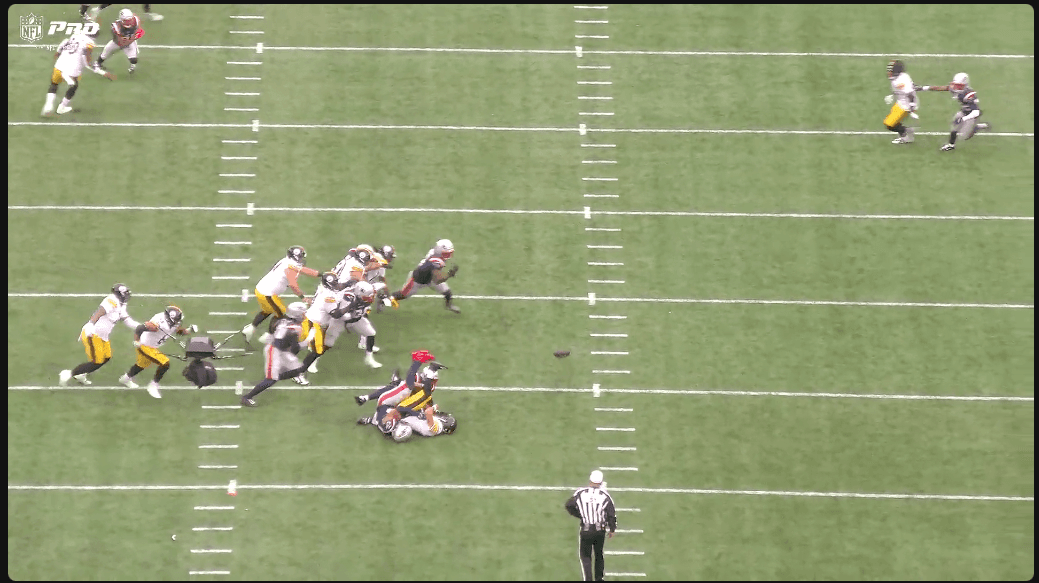
And after that, we get the glory of watching some of the biggest, fastest, and strongest athletes in the world batting the ball around and tumbling over each other like the damned Keystone Cops. The Steelers finally recovered the ball—back at their own 42-yard line—to set up a fourth-and-43.
There once was a time when Rodgers could easily escape a blitz (and blown protection) like this by bailing out of the pocket and throwing a perfect over-the-shoulder pass as rushers bear down on him. Those days are never coming back. Now, it’s like his 42-year-old feet are stuck in cement, and all he can do is stare receivers down in the hope that one of them will get open quickly enough to keep him from being crushed.
The only thing about today’s version of Rodgers that reminds me of the good old days is his passive-aggressiveness at an interview podium. After Sunday’s loss, in which the Steelers scored just three points, he said that Pittsburgh needs to be more “player-led” and that he needs to be more vocal about which plays aren’t working. We can—and should—read that comment as a direct shot at head coach and offensive play caller Mike McCarthy.
Rodgers has the second-lowest yards per attempt and fourth-lowest passer rating in the league through two weeks—but has taken the third-most dropbacks. We can probably question the offensive balance and why an aging quarterback is in so many passing situations, but the reality is that this offense isn’t failing because of McCarthy. It’s failing because, at this point in his career, Rodgers isn’t good enough, even when the play calls work as designed.
All-22 Spotlight, Part 4: Patrick Mahomes Running “Wasp” Again
Football fans rejoice: Mahomes’s deep passes are back! And so is Wasp. In overtime on Sunday night against the Colts, Mahomes and head coach Andy Reid took a heat check and dusted off a classic Chiefs passing play for a gain of 30 yards.
“Jet Chip Wasp” is the name of this concept. You probably remember it as the game-altering play from Super Bowl LIV against the 49ers that helped secure Kansas City’s first championship of the Mahomes and Reid dynasty. And just as Tyreek Hill left San Francisco’s defenders lost on the big gain in the Super Bowl, Tyquan Thornton shook free of the Colts defense to put Kansas City in position to take a late-game lead. Here is the play in full:
Kansas City ran the play from the exact same formation it used in the Super Bowl more than six years ago, this time using tight end Travis Kelce as the “chip” blocker on Colts defensive end Arden Key to help the offensive line hold up in protection. That gave Mahomes enough time to confirm Thornton would be open before letting the ball fly. The Colts were in the worst coverage possible for this pass play, rushing five defenders and playing man-to-man, which meant Thornton had to beat only one defender to get open.
In Week 1, Kansas City unveiled running back Kenneth Walker III as the newest game-breaking playmaker to support Mahomes and this offense. This week, the deep ball came back. At 2-0, Kansas City isn’t just back to being a serious factor in the AFC; this offense looks like a juggernaut again.
All-22 Spotlight, Part 5: Khyiris Tonga, Moving the Chains
But Reid wasn’t just in his bag when it came to explosive passes. He got creative for short yardage too. And leave it to Reid to show his big fellas a little love.
On fourth-and-1 in the second half of their game against the Colts, the Chiefs broke out a play that brought me back to my youth football days, when I played fullback and tight end. It’s commonly called “Strong I Right Tight 31 Dive”—a lot of words to signal a handoff to the fullback and run right up the gut. The fullback the Chiefs used here? A 6-foot-2, 335-pound defensive tackle named Khyiris Tonga, and he made the opportunity count, taking the handoff and bulldozing forward to easily pick up the first down.
Indianapolis knew this kind of play was coming and put hefty defensive linemen in every interior gap it could. But when the ballcarrier is as massive as Tonga, he’s also able to be his own lead blocker. Indianapolis safety Hunter Wohler had no chance to take Tonga down, so he dived at his legs and allowed Tonga to roll over him.
There’s only one thing about plays like this that I don’t love now that I’m an adult who coaches high school football. My players saw this, too. Now, all week in practice, I’m going to be listening to our defensive tackles tell me that this play will be unstoppable if I call it for them (and then they’ll inevitably show me their planned first-down or touchdown celebration).
So, if any of my Barons are reading this, Coach Lee’s answer is no.