
On Sunday, as MLB’s regular season reached its one-week warning, the two most spectacular players of 2026 strutted their stuff. In Cincinnati, Cubs center fielder Pete Crow-Armstrong singled, doubled, and hit his 45th home run in a 9-1 trouncing of the Reds. (He also stole his 38th base, putting him on the precipice of joining the 40-40 club.) Hours later, at Camden Yards, Brewers ace Jacob Misiorowski held the Orioles to one hit and lowered his ERA to 1.86 as the Brewers blanked Baltimore 3-0 for their major-league-leading (and franchise-record) 98th win.
A season’s most sensational player isn’t always its most valuable player—see Cal Raleigh last year—but PCA and the Miz check both boxes. They lead the majors in FanGraphs WAR for hitters and pitchers, respectively, and will win the MVP and Cy Young awards in the National League (which has established itself as the stronger circuit by owning the American League 375–323 in interleague play). PCA and the Miz; the Miz and PCA: Already All-Stars in 2025, they’ve made large leaps this year. The Cub has bolstered his bat speed and drawn more walks; the Brewer has upped his pitch speed and issued fewer walks. Born nine days apart in the spring of 2002, the two 24-year-old terrors of the NL Central have set the standards for hitting and pitching excellence and, in the process, made themselves the player stories of the season. In an MLB campaign whose compressed standings have caused fans to wonder which teams, if any, are actually good (especially in the AL, where the .500 Rangers lead the AL West), the left-handed hitter and right-handed hurler—whose clubs may meet in October—have left little doubt about their own extreme skills.
There’s also little doubt about how those skills stack up against each other—or, at least, what those skills are worth when they’re applied on the field. The “WAR leader” label lumps PCA and Misiorowski together as peerless players. If we had to choose between them, though, the answer would be easy: The Miz wins most of their head-to-head battles, but PCA wins the WAR. Crow-Armstrong, who’s hit .280/.371/.578 with superlative defense in center, has been much more valuable than Misiorowski, who’s held hitters to a .159/.225/.250 line and who’s struck out 247 batters (including PCA six times) while walking only 42 (including PCA twice). That’s no surprise: It’s now the norm for baseball’s best hitter to be a good deal better, WAR-wise, than baseball’s best pitcher. Which, in turn, tells us a lot about how hitter and pitcher usage—and entertainment value—have evolved.
Take Sunday’s action. PCA played the whole game in center, even though the Cubs had built a comfortable lead by the halfway point. The Miz, meanwhile, exited after three innings and 44 pitches, with the Brew Crew clinging to a 1-0 lead. With home-field advantage throughout October up for grabs, Milwaukee still had something to play for. But the Brewers elected to take it easy on their flamethrower, who has already exceeded his 2025 workload (including the playoffs) by 28 innings. As a result, Misiorowski amassed just 62 percent of the WAR PCA did on Sunday—and, on the whole, he’s managed only 63 percent of the WAR PCA has produced this season (6.5 vs. 10.4).
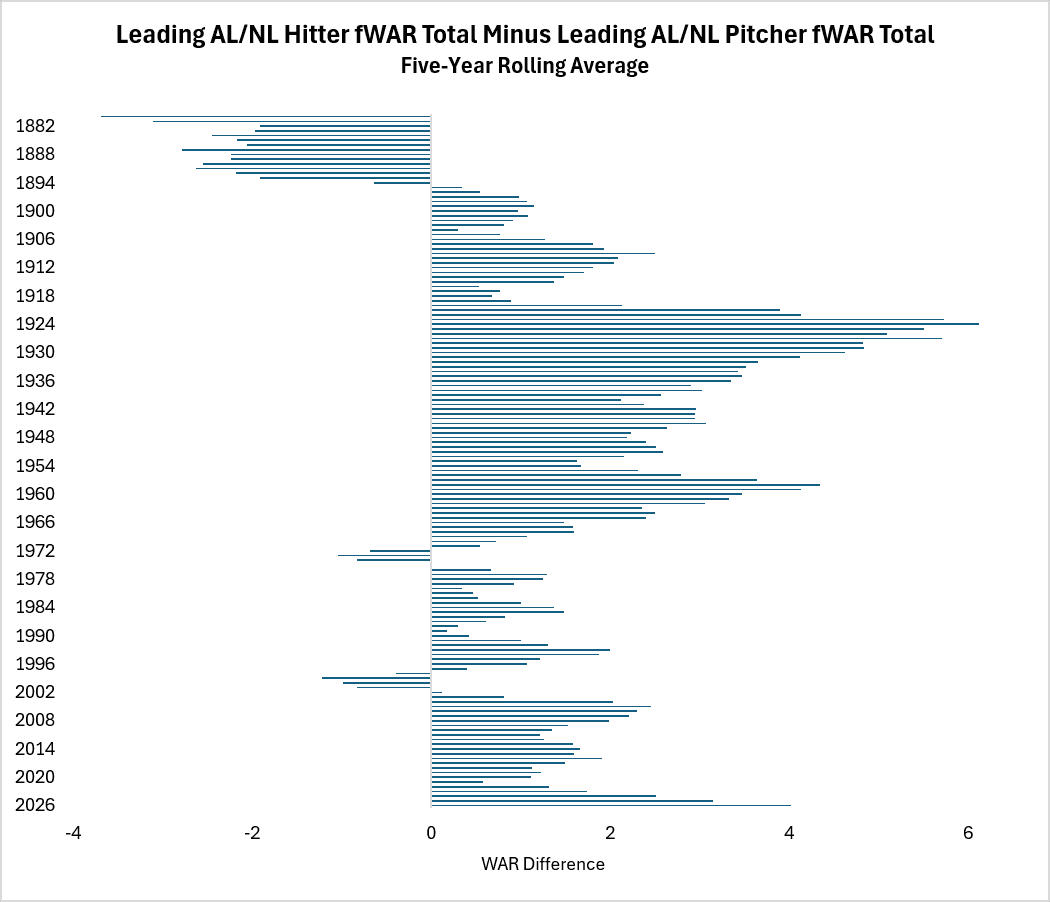
It wasn’t always the case that baseball’s best hitter would leave baseball’s best pitcher in his dust on the combined WAR leaderboard. The chart below compares the values of FanGraphs’ hitting and pitching WAR leaders for each season dating back to the beginning of the DH era in 1973. To smooth out year-to-year variation, each bar represents a five-year rolling average of the annual hitter-minus-pitcher WAR gaps from the listed season plus the four preceding seasons. Thus, the value for 1973 is really the average of the figures from 1969 to 1973, and the value for 2026 is really the average of the figures from 2022 to 2026.
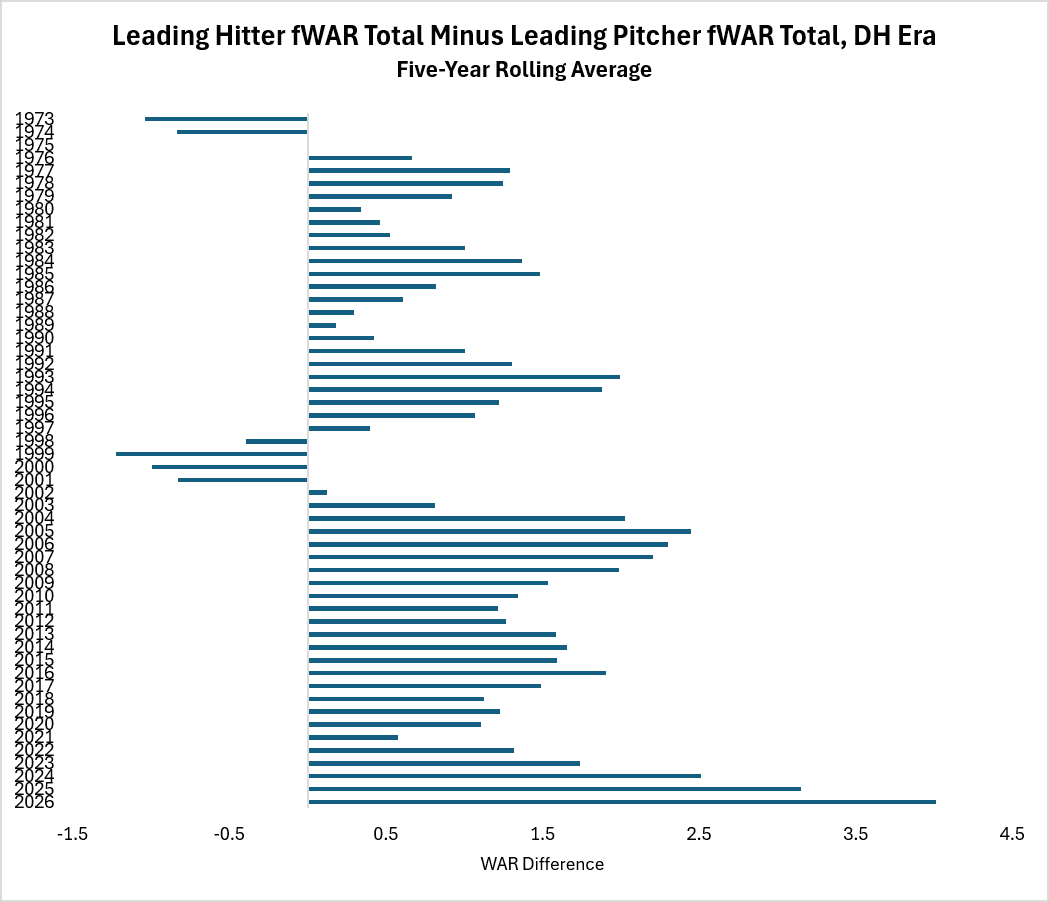
At the dawn of the DH era, when the iron men of the mound were still routinely topping 300 innings, the best pitchers were worth more than the best hitters. Pitchers also reigned supreme around the turn of the century, when the likes of Roger Clemens, Kevin Brown, and Randy Johnson were still topping 250 dominant innings, and Pedro Martínez posted the best pitching season ever by fWAR in 1999 (in a then-paltry 213 1/3 innings, which would lead both leagues in 2026). All in all, from the beginning of the DH era through the end of the 20th century, the leading hitter in any given year was worth only about half a WAR more than the leading pitcher, on average. From 1970 through 2000, the best hitter out-WARed the best pitcher 18 times, while a pitcher took the top spot 13 times. The battle for the title of baseball’s best player was typically close to a toss-up between the most overpowering pitcher and the biggest bat.
Over the past quarter century, though, the hitters have won in a walk. Beginning with 2001, when Barry Bonds morphed into his BALCO-boosted final form, the leading hitter has been about two wins better, on average, than the leading pitcher, enough to declare a conclusive victor despite the metric’s margin of error. During that span, best hitters have led best pitchers 25 seasons to one, with only Corbin Burnes’s slim edge over Trea Turner in 2021 preventing a clean sweep. And the gap is growing: Over the past five years, the leading hitter has been a full four wins better, on average, than the leading pitcher. In other words, baseball’s best pitchers aren’t worth what they used to be—but its best batters are.
This isn’t just a function of the no. 1 hitter lapping the no. 1 pitcher; although the average leads are less pronounced, the same trend appears when we expand the pool to each year’s top five hitters and top five pitchers.
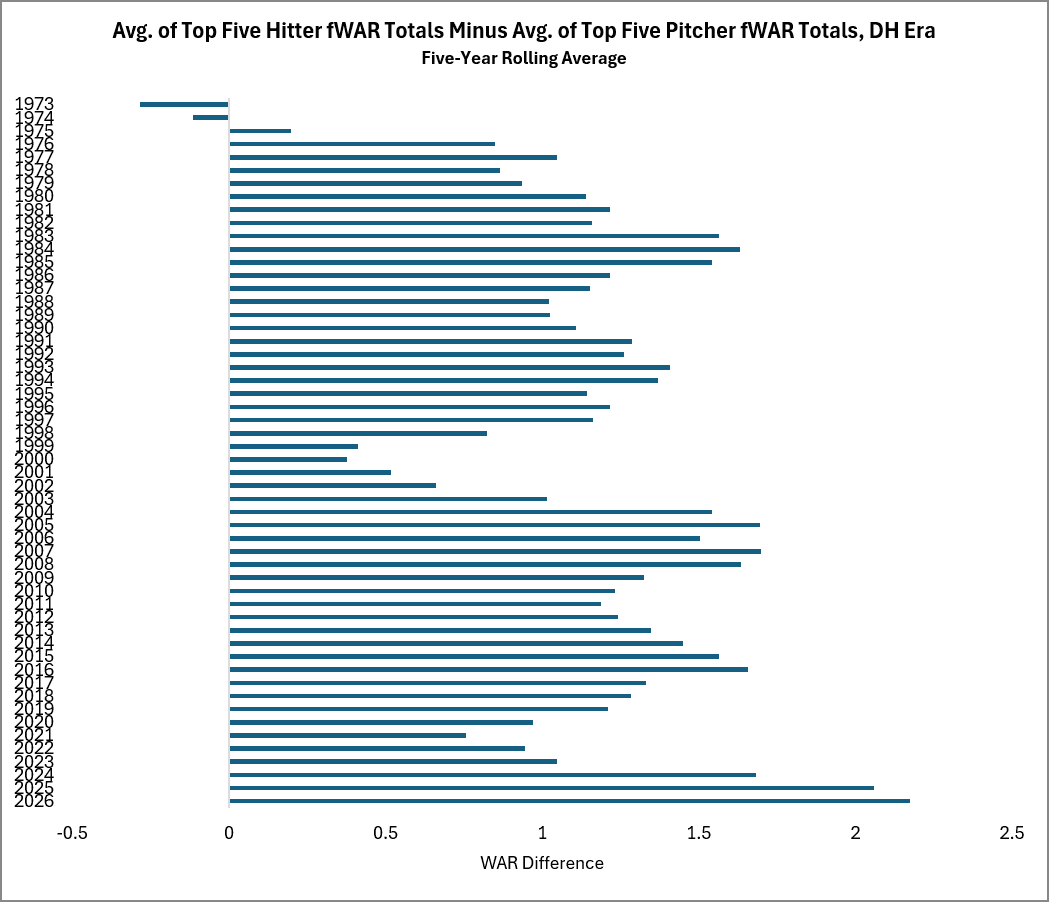
The wide disparity in recent seasons stems in part from an unusually strong run by baseball’s best hitters. The average of 10.4 WAR generated by the hitting WAR leaders in the past five years (Aaron Judge three times, and Ronald Acuña Jr. and PCA once each) is the highest total of any five-season stretch since Bonds, Alex Rodriguez, and Albert Pujols in the early-to-mid 2000s—and, before that, Mickey Mantle, Willie Mays, and Ernie Banks in the late 1950s and Babe Ruth, Jimmie Foxx, and Lou Gehrig in the early 1930s. But it’s also a product of the lowest-ever five-year average WAR tally for pitching pacers (6.4), with the exception of the pandemic-suppressed 2019 to 2023 period and a late-’50s stretch of historically lackluster leading arms.
The culprit isn’t much of a mystery: It’s the playing-time totals. Modern pitchers are working smarter, not harder. (Or, if we want to be charitable, similarly hard, but in shorter bursts.) Collectively, pitchers throw roughly the same number of innings as ever, and accrue just as much WAR. (FanGraphs allots 1,000 WAR leaguewide per season, with 57 percent going to hitters and 43 percent apportioned to pitchers.) But those innings and WAR are distributed across many more arms than they used to be, as innings eating nears extinction and the starting-pitcher protagonist of the past fades from view. This season will either match last year’s all-time full-season low of three 200-plus-inning pitchers, or further reduce the record, depending on whether Michael Wacha (who’s sitting at 194 1/3 frames) joins Sandy Alcantara and Cristopher Sánchez in the 200-inning club in his final start.
Modern major leaguers’ workload diminution is much more apparent for pitchers than hitters. The chart below shows the number of hitters and pitchers who qualified for the batting title and ERA title, respectively, in each season of MLB’s 30-team era (since 1998, excluding 2020). The height of the bars (blue for hitters, orange for pitchers) indicates the number of qualifying players; the numbers above each bar (which could still increase slightly for 2026) denote the average number of plate appearances or innings within each year’s qualifying cohort.
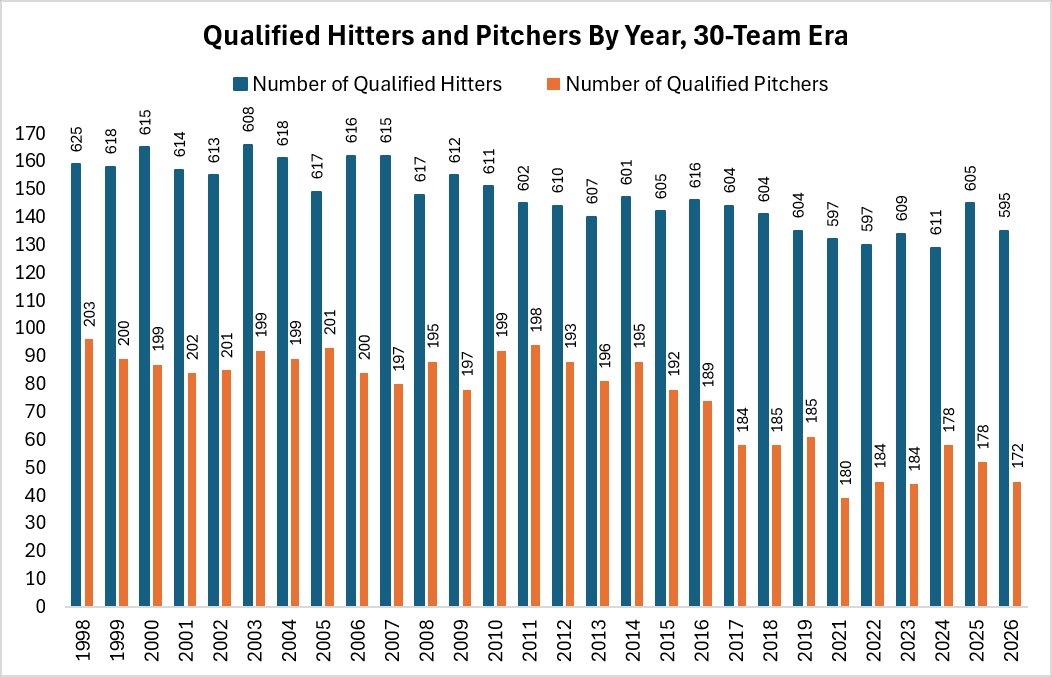
Matt Olson aside, hitters aren’t totally immune to load management. Relative to the late 1990s, the number of qualifying hitters per season has sunk by about 15 percent, and the average number of plate appearances among qualifying hitters has been trimmed by a couple percent. But that’s nothing compared to the cratering of pitcher playing time. The number of qualifying pitchers per season has plummeted by nearly 50 percent, and the average number of innings among the remaining qualifiers has dropped by upwards of 10 percent.
Hence the ho-hum WAR totals mustered of late by baseball’s best pitchers, in an era of familiarity-effect avoidance, rampant pitcher injuries and, relatedly, an increased emphasis on max-effort throwing. As dazzling as today’s top arms are on an inning-per-inning basis—especially fastball-slider monsters like Mason Miller, whose outings are mostly contained to one frame—their GIFable filth comes at a cost. They can’t have both blistering stuff and exceptional staying power.
There’s no perfect substitute for the bulk starters used to supply. In 2019, for instance, Astros starter Gerrit Cole broke J.R. Richard’s single-season franchise record for strikeouts, 40 years after Richard’s nasty 1979 campaign. That accomplishment led to a sentimental meeting on the mound between past and present Astros aces, less than two years before Richard’s death. But although Cole surpassed Richard’s strikeout total, he couldn’t match his complete contribution: Richard threw 80 more innings, and recorded 8.9 WAR to Cole’s 7.5. Even Cole’s 212 1/3 innings in 2019 would be a standout total today; beyond Burnes in 2021, no pitcher since Cole has broken the 7-WAR wall.
On a long enough timescale, almost everything in sports circles back around. Someday, new rules might restore the starter’s lost luster, or overdue expansion might lower the major league replacement level and make the most competent pitchers look like WARlords again. League-leading hitters of the 2020s may be mogging their pitching counterparts when we focus on the DH era, but if we go back to the beginning of the National League, when hurlers who threw 400, 500, or 600 innings ruled the roost, we spot two subsequent stretches when the best bats had it even better than they do now: that late-’50s, offense-friendly low ebb for aces, and the 1920s and early ’30s, when Babe Ruth reinvented offense and broke baseball’s value scale. Once upon a time (or two), this batter-pitcher imbalance wasn’t so strange.
For now, though, we seem to be stuck in a phase where the cream of the crop of pitchers pales in comparison to elite everyday dudes. The sinking ceiling of starting-pitcher value may have implications for how pitchers are paid and staffs are assembled (not to mention how prospects are hyped). Free-agent pitchers make as much money per win as free-agent hitters, but if teams start expecting fewer wins from star pitchers than they do from star hitters, even the scarcity of healthy ligaments might not keep pitcher contracts from shrinking (and dragging down overall player pay). From the fan perspective, though, the more relevant byproduct of this modern mismatch in the value of leading hitters and pitchers is a shift in how we experience and describe standout seasons.
Because hitter playing-time totals today are comparable to what they were a century ago, we can still celebrate league-leading hitters via counting stats alone. PCA, for example, has played in every Cubs game this season, and started all but one. (As of today, he’s the majors’ sole 700-plate-appearance man.) We can convey his greatness just by marveling at how many homers he’s hit and bases he’s swiped; “the first 40-40 center fielder” would sound spiffy. If we want to dig deeper, we could note that only Triple Crown contender Yordan Alvarez stands in the way of PCA becoming the first player ever to lead the majors in both batting and fielding value in a single season, which would be a two-way feat almost as mind-blowing as Shohei Ohtani’s pitching/hitting heroics. And if we want to cite WAR, well, that’s easy: With six Cubs games to go, PCA’s season already ranks among the 50 best batting years in big league history, and above every season in the past half century save for four by Bonds, two by Judge, and one by Bobby Witt Jr.
In 2026, pitchers tend not to throw enough pitches or innings to reach famous milestones in single games, single seasons, or careers, so the case for Miz amazement can’t be made by hailing his membership in exclusive, storied clubs. With one regular-season start remaining, the Miz hasn’t quite cracked the top 350 seasons by pitching WAR. (No pitcher has posted a double-digit-WAR season since the Big Unit in 2001.) The 300-strikeout club has been closed to new recruits since Cole and his teammate Justin Verlander went in together in 2019. As for old-school wins, he’s tied for second in the Senior Circuit with 15, not that anyone pays much attention to that column on the player page.
To appreciate the Miz, we must resort to rate stats and modest minimums. Among pitchers with at least 160 innings in a season, Misiorowski ranks 13th in park- and league-adjusted ERA, 12th in park- and league-adjusted FIP, third in WHIP and strikeout-minus-walk rate, and second in strikeout rate. He has the lowest opponent batting average and rate of hits allowed per nine innings, too, which would be more eye-popping if people still cared about batting average or if the league were hitting more than .244. Ultimately, the summation rests on the smallest of samples: a single pitch. At peak pitch speed, he’s the hardest-throwing starter on record (and in all likelihood, ever), and damn near the hardest-throwing pitcher, period.
In a sense, the Miz is just as impactful as PCA—he just hasn’t had as many chances to make an impact. PCA has paired his 702 trips to the plate (offensive chances, essentially) with 380 chances in center, for a grand total of 1,082 opportunities to determine the outcome of a plate appearance. Misiorowski has faced 646 batters, or 60 percent of PCA’s combined plate appearances plus defensive chances. If we look at things that way—i.e., by doing dubious addition—then the Miz has done well to accumulate 63 percent of PCA’s WAR.
Plus, in defense of Misiorowski and the constellation of starters who trail him by 1 WAR or less—AL Cy Young lock Cam Schlittler, Cristopher Sánchez, Chris Sale, Jesús Luzardo, and Dylan Cease—the tale of the 2026 WAR leader is as much about Crow-Armstrong vs. the field as it is pitchers vs. hitters. Only Ohtani and Witt sit between PCA and Misiorowski on FanGraphs’ WAR leaderboard, and both only barely lead the Miz. WAR is always subject to retroactive updates, but if none of the players clustered between 6.4 and 6.7 WAR—Ohtani, Misiorowski, Witt, and Alvarez—finishes strong, this could be the first unabridged season since 1950 (when teams played 154 games) in which MLB’s second-most-valuable player doesn’t touch 7 WAR. Fittingly, the AL’s MVP contenders are as underwhelming as the AL’s contending teams.
“Underwhelming” doesn’t describe Misiorowski. Of course, the quality that makes the Miz so awe-inspiring—he throws hard enough to remove a mortal’s arm from its socket—is also what makes him so anxiety-inducing. It’s not as if hitters can’t get hurt by running, throwing, or swinging hard—or even by standing somewhere in the vicinity of the on-deck circle, as Crow-Armstrong’s teammate Alex Bregman (whose WAR total since the All-Star break is exceeded only by PCA’s) painfully learned on Sunday. But they aren’t as prone to season-ending disaster as a matter of routine.
We delight in PCA’s uninhibited, prolific play, while we watch the Miz’s impressive but sparing appearances through splayed fingers. As Joe Posnanski pointed out in July, pitching might be the only assignment in sports where “simply doing your job is so scary and treacherous.” Not because an opposing player might flatten you, or because you might, say, stumble and get sliced by a skate blade, but because the fundamental motion endemic to your duty is hazardous to your health. Which helps explain why teams have sought to limit how often pitchers perform that motion, for all the good it’s done them. As it turns out, making that motion more dangerous but doing it less doesn’t make UCLs safer.
Misiorowski has survived the season with only minor, sporadic complaints: a hamstring cramp here, a dead arm there. To forestall more serious trouble, and to preserve their most prized pitcher for the postseason, the Brewers have handled him carefully. Since the All-Star Game (which he missed), he’s tied for 72nd in innings pitched, with two pitchers (Jack Perkins and Zebby Matthews) who have matching 4.94 ERAs over that span. But in October, when off days allow for compression of a pitching staff, an unrestrained Miz may emerge to shoulder more of Milwaukee’s workload and make overmatched opponents and concerned spectators alike quake like Ralph Wiggum. Over a season, or even a series, a position player such as PCA may amass more value. But in any given game, an ace can still slay.