

Steve Ballmer thoroughly dominated the NBA news cycle last week, commandeering the discourse with a Kardashian-level ferocity. The multibillionaire owner of the Los Angeles Clippers absolutely demanded our attention as the central figure in one of the biggest cheating scandals in NBA history.
The Clippers were found guilty of a massive scheme to circumvent the salary cap, violating one of the league’s foundational tenets. [CUE THE NEWS ALERTS!]
The punishment included a one-year suspension for Ballmer, a $30 million fine, and the forfeiture of five first-round draft picks. [CUE THE REACTIONS!]
Within hours, Ballmer’s lawyer fired back, threatening legal action. [CUE THE AGGREGATORS!]
And the frenzy won’t end anytime soon. The Ballmer story will spike again next week, when commissioner Adam Silver addresses the media after what promises to be a lively board of governors meeting in New York.
But if recent trends hold, Ballmer will merely be borrowing the spotlight … until the next NBA owner wilds out and wrests it away.
This entire summer—hell, damn near this entire calendar year—has been hijacked by the NBA’s billionaire class, who keep grabbing headlines for their lavish spending, drastic cutting, sketchy financing schemes, toxic power struggles, iffy political affiliations, and seemingly endless series of franchise sales and resales. It’s all been positively dizzying.
And, well, it isn’t normal! Or necessarily good. We’re not supposed to be talking about NBA owners this much. In normal times, they pop into the news feed when they’re hiring or firing a GM or, if they’re fortunate, when they’re hugging the Larry O’Brien Trophy. But that’s it. In normal times, owners write the checks and stay hermetically sealed in their luxury boxes—mostly out of sight and mostly out of mind. But these days, we can’t go five minutes without thinking about them.

More on the NBA Ownership Circus
“The league is crazy,” quipped one ownership source, sounding more amused than alarmed by the wild news-making spree of his peers. “Every day or every week, it’s like: Wait a second, how can that be possible?”
It started in April, when Tom Dundon, the newly minted owner of the Portland Trail Blazers (for $4.25 billion), went on a budget-slashing binge—reducing the team’s traveling party, banning staffers from late checkout at hotels, and laying off more than 70 employees—to the great dismay of Blazer fans, who grew even more anxious when Dundon began fighting with city officials over funding for arena renovations, fueling concerns that he’d try to move the team.
In June, Dundon inflamed the entire NBA coaching community when he insisted on a one-year contract for new head coach Micah Nori—an unheard-of tactic that was promptly decried as a “slap in the face” by J.B. Bickerstaff, the president of the coaches association.
But Dundon soon ceded the stage to New York Knicks owner James Dolan, who thoroughly spooked Knicks fans by inviting his friend President Donald Trump to Game 3 of the NBA Finals at Madison Square Garden. Trump attended—and appeared to fall asleep. Midtown became a militarized zone. The Knicks lost their only game of the series.
In early July, it was Toronto’s turn to wonder and fret as Rogers Communications—a massive telecommunications and media conglomerate—announced that it would take full control of the Raptors by purchasing the final 25 percent of Maple Leaf Sports and Entertainment for $3 billion.
July ended with another shocker, this time in Brooklyn, as Nets owners Joe and Clara Wu Tsai announced their intent to divorce, casting momentary doubt over the operations of the Nets, as well as of the WNBA’s Liberty. (The Tsais have issued assurances that nothing will change with either team, with Joe continuing to run the Nets and Clara Wu overseeing the Liberty.)
Then things really got wild in August.
On August 11, The Wall Street Journal reported that Phoenix Suns owner Mat Ishbia had lost $600 million in an “ill-timed wager” via his company, United Wholesale Mortgage, whose stock price promptly nosedived. Observers fairly wondered whether Ishbia would be able to hold on to the Suns and the WNBA’s Phoenix Mercury.
A day later, Los Angeles Lakers majority owner Mark Walter—who just purchased his controlling stake last year from the Buss family—shocked the world with an agreement to sell his stake to Bob Iger and Josh Kushner, at a staggering valuation of $12.5 billion. Amid the shock came a likely explanation for the sudden divestment: Walter is under investigation by federal prosecutors and the Securities and Exchange Commission.
Five days after the Lakers sale became public, the Buss family announced plans to sell its remaining shares to the Iger-Kushner group, signaling the likely end of nearly a half decade of family stewardship … except that move was almost immediately contested by current Lakers governor Jeanie Buss, who wants to retain her share of the franchise, thus continuing decades of Buss family infighting.
And four days after that, Minnesota Timberwolves owner Marc Lore—who partnered with Alex Rodriguez to buy the franchise and take control just a year ago—announced a deal to sell his controlling interest to Marc Stad, a Wolves minority partner, at a valuation of $4.5 billion.
Things were relatively quiet after that … until the NBA nuked the Clippers with the biggest punishment in league history on September 2, accompanied by a 36-page report that detailed all of Ballmer and Co.’s brazen misdeeds.
When Ballmer bought the Clippers in 2014, for a then-record $2 billion, he arrived as a savior for the NBA’s most downtrodden franchise—and for the league itself, which needed to quickly distance itself from the disgraced Donald Sterling, who had been banned for life for making racist remarks. Back then, an owner scandal was almost an anomalous occurrence, a once-every-decade-or-so event. Owners didn’t make the news much or sell their franchises very often.
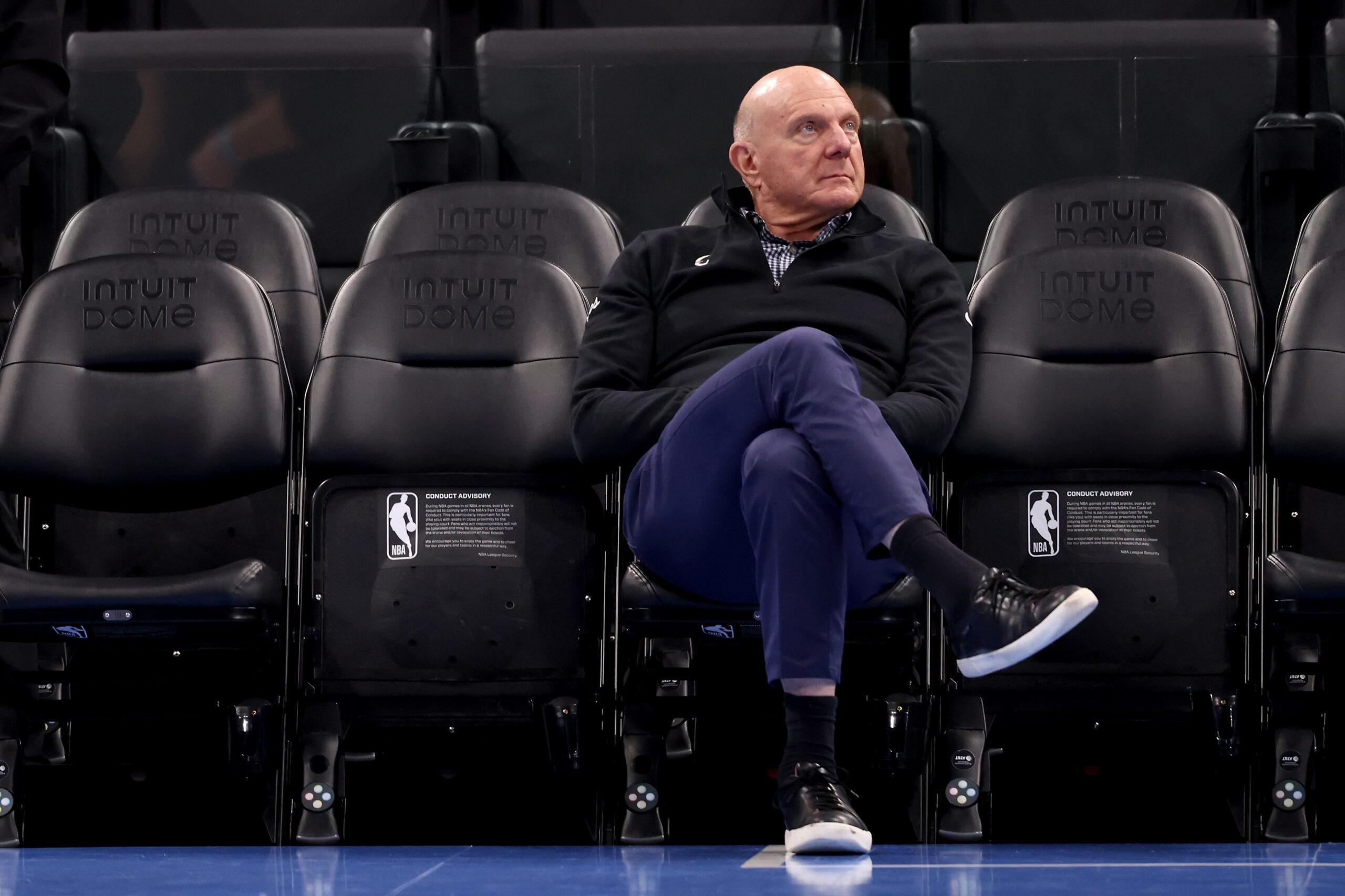
Steve Ballmer before a Clippers game
Since then, we’ve seen another owner—Robert Sarver, who ran the Suns for nearly two decades—driven out over reports of racism and misogyny. And we’ve seen 13 franchise sales in the past seven years alone, an absolutely staggering rate that eclipses anything else in the modern era.
NBA owners are having a moment, as they say, although it’s not entirely clear why or how all of these things are happening at once. What in the name of David J. Stern is happening to this league?
Let’s start with a simple, if unsatisfying, answer: After a survey of sources around the league, there is no neat-and-tidy explanation for all of it, no singular through line connecting all buying and selling and slashing and cheating. Some of this is just an unfortunate cosmic coincidence.
You can explain the flurry of franchise sales as a by-product of rapidly increasing franchise valuations, but this is sort of a snake-eating-its-tail dynamic: The über-wealthy keep driving up valuations with their willingness to pay those valuations, and then the next wave of zillionaires comes along to pay even more.
“It tells you that the NBA is a worldwide brand, and [there’s a] scarcity in owning an NBA team,” said former Suns GM Ryan McDonough, who is now a managing partner of Sports Ownership Group, which is raising a fund to invest in NBA teams. “There are only 30—soon to be 32—NBA teams. So there's a rarity, there's a scarcity. If we're having this conversation in 2036 instead of 2026, the groups that own these teams are going to be robust.”
A rapid increase in extreme wealth is driving some of this. According to Forbes, the number of billionaires worldwide has nearly doubled in the last 10 years, from 1,800 in 2016 to 3,400 today. So there are just a lot more people in position to buy a franchise and keep sending those valuations higher. For long-standing owners who bought their teams in the 1990s or early 2000s—when the going price was merely in the hundreds of millions—this modern-day gold rush means a chance for an insane windfall. League and ownership sources don’t expect the valuation spike to end anytime soon, which means that there’s a good chance the buying and selling and flipping could continue apace.
“In any business where valuations rise at that level, there will be people who are attracted to the price and return,” said another ownership source.
But there are so many other factors at work, too. Sarver sold the Suns (to Ishbia) under duress in 2022 and while facing a fierce backlash from players and sponsors. The Blazers sale was required as a condition of former owner Paul Allen’s will, following his death in 2018. When Wyc Grousbeck sold the Boston Celtics in 2025, he cited estate and family planning considerations. Walter, of course, might need the money to repay billions in loans related to the federal probe. And Glen Taylor’s initial sale to Lore and Rodriguez was mostly driven by the fact that Taylor is in his 80s.
Indeed, age is also driving much of the trend, according to Mark Cuban, who sold his controlling stake in the Dallas Mavericks in 2023 (at a valuation of $3.5 billion) but remains a minority partner.
“I mean, we're getting old,” Cuban said with a laugh in a recent phone conversation. “The owners that are selling, unless they're forced, are getting old. You know, running the team is a whole lot different at 41, when I bought the team, than at 65, when I sold the team. You have a better sense of your kids and whether or not they want to take over. You're dealing with estate planning, like you saw with Wyc, with the Celtics. And on the flip side, there's a lot of money coming in. And if you've held the team for a long time, you're going to make a lot of money. Then there's other issues—like, for me, social media and the fact that I don't want my kids to deal with that, and the fact that so much of the upside and growth comes from non-basketball-specific things, which kills a lot of the fun.”
Nobody feels any differently about Dirk or Cooper or Luka. Everybody still feels the exact same way, and that's what makes the NBA special. That's why the game will go on, because the game's still amazing.Mark Cuban
And then there’s this (and please, read this sitting down): According to Cuban and other owners, many NBA teams aren’t wildly profitable on a year-to-year basis. The real value is in the resale.
“The problem with owning a team,” said another ownership source in a smaller market, “is you have something that’s worth a shitload, and you don’t understand why it is, and it makes you little to no money all the time. And you’ve got to spend money, because if you don’t spend, the fans won’t come.”
Even the example of the Lakers, who operate in one of the world’s largest markets, underscores the warped math of ownership. As one source noted, it costs $12.5 billion to buy a business that turns an annual profit of around $100 million—i.e., less than 1 percent of the purchase price. “You could put it in treasury [bills] and make 5 percent,” the source quipped.
And those profit margins are drastically smaller in other NBA markets. (Not that any non-billionaires will have much sympathy.) The league’s collective bargaining agreement dictates that 51 percent of all “basketball-related income” goes to the players. And in some markets, ownership sources say, that 51 percent spent on player salaries easily exceeds 51 percent of the team’s revenue.
Of course, wealthy people don’t generally buy sports franchises for their short-term profitability as much as for their long-term investment value, along with the fun and prestige that come with them.
But as Cuban alluded to earlier, that enjoyment isn’t quite the same today as it was when he purchased the Mavericks in 2000. In part, it seems, because of those same spiking franchise values.
Unlike in prior eras, few individuals (or families) are wealthy enough to purchase an NBA team or even a true majority stake outright. (It takes only 15 percent to serve as controlling owner.) So wealthy individuals partner with other wealthy individuals, along with private equity firms and sovereign wealth funds, to cobble together all those billions. That’s a lot of partners to keep happy (i.e., with profits), and a lot more emphasis on the bottom line. As Cuban noted, no owner wants to be forced to make a capital call when they suddenly need another $50 million to pay the luxury-tax bill.
“Running a team is a completely different beast [now],” Cuban said. “Like I told Adam [Silver] when I sold, the board of governors meetings went from being all about basketball and me bitching about the officiating to everything being about team valuations.” Cuban added: “It's just different than it was. When I came in, it was like: All I care about is winning.”
Which, of course, raises a question: In an NBA where franchise values keep skyrocketing, where mom-and-pop operations give way to nameless, faceless conglomerates and private equity firms, is the soul of the game at risk? Do the people in the luxury boxes still “care about winning,” as Cuban put it?
“I love the game so much,” said the first ownership source. “Yes, I’m obviously an investor, and I want a good return. But my primary focus is the game, because I love everything about it. I think that is slightly different than some owners.”
But every team must have a controlling partner with at least a 15 percent stake, which means that there will always be at least one identifiable person whose values, priorities, and (one hopes) competitive impulses are driving that team’s agenda.
“As long as you have that [ownership structure], you’ll have somebody who calls the shots, who’s in charge,” the same person said. “The question is, is that person passionate about it? Do they care? Or is it just an investment to them? It’s a reasonable question to ask.”
It wasn’t really a question we needed to ponder in past eras, when every team was easily identified by a single personality. Jerry Buss? Wants to win, badly. Donald Sterling? Just wants to be seen. The Maloofs? Passionate, albeit a little goofy.
And Cuban? Well, whatever his faults may be, no one ever had to question his passion for basketball or whether he’d spend every available dollar to make the Mavericks a contender. Cuban was always out front, literally and figuratively, cheering and screaming from his courtside seat, battling the NBA over one issue or another, alternately chatting up and critiquing the reporters who covered him.
Now we have to wonder, with every franchise sale and every new set of billionaires that comes in: Did they buy my favorite team because they love the game? Or is it just another asset?
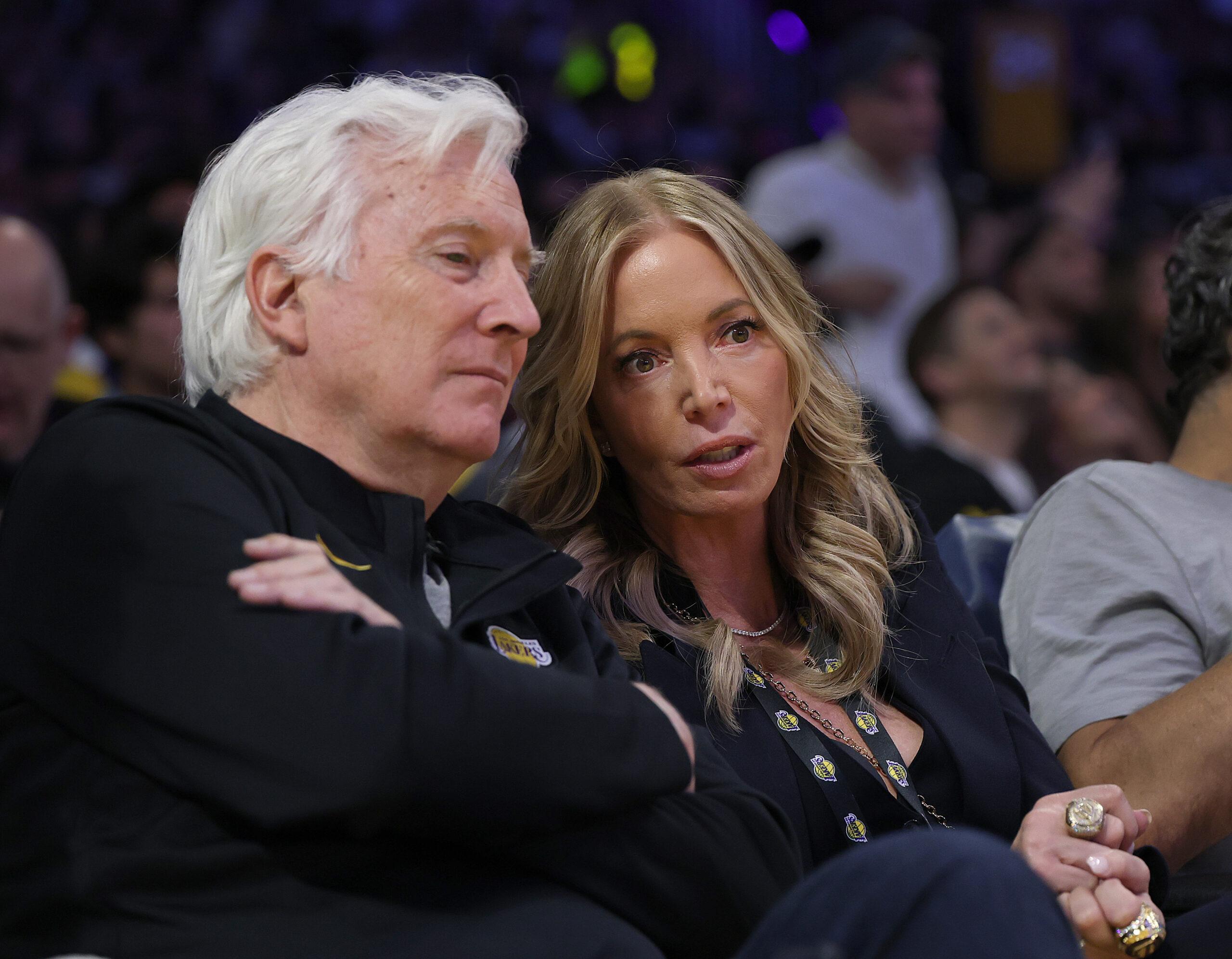
Mark Walter and Jeanie Buss at a Lakers game
Despite the onslaught of conglomerates and private equity, Cuban contends that there are still identifiable, passionate personalities leading the way, pointing to Ryan Smith in Utah and A-Rod in Minnesota as recent examples.
“You got people who love the game,” Cuban said, “and so I don't think there's a deficit there and that the soul will be gone. And really, all the economics don't really impact the fans. You go to a game, and as long as the game is fun and they're selling entertainment and doing everything that they can to make it a unique experience for fans, that's a win.”
So we may wonder and fret and raise our eyebrows at the latest surprise team sale or the brain-breaking franchise valuations, but eventually, our collective attention drifts back to the court, where mesmerizing young superstars like Victor Wembanyama and Cooper Flagg are leading the way for another generation and ensuring that basketball remains the main thing.
“When you bring your kids to a game, they don't care about the salary cap and who's making money and who's sold or not,” Cuban said. “They don't care at all. Nobody feels any differently about Dirk or Cooper or Luka. Everybody still feels the exact same way, and that's what makes the NBA special. That's why the game will go on, because the game's still amazing.”
We don’t know when the next team will be sold, or for how much, or to whom. We can’t be sure which billionaire might act out next. But we do know this much: The Celtics and the Pistons will tip off at 3 p.m. ET on Tuesday, October 20, at Detroit’s Little Caesars Arena, officially kicking off the 2026-27 season, followed by a Sixers-Knicks game in New York and a Thunder-Spurs game in San Antonio. And, basketball gods willing, we won’t spend a single moment of it thinking about the owners.