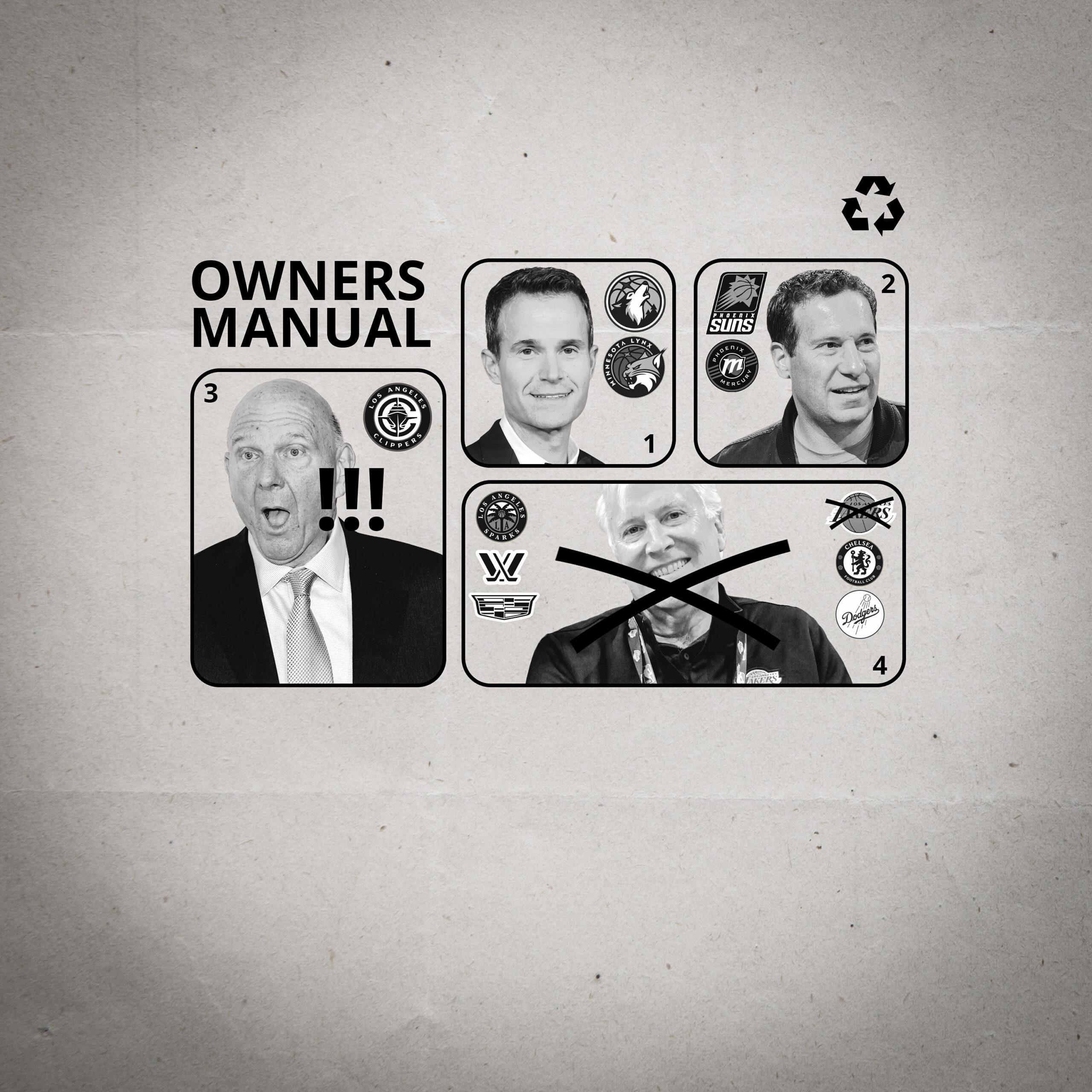
Owners Manual: Steve Ballmer’s Nightmare Is Now Reality
Sports makes an ass(et class) out of all of us. Let’s break down the latest happenings in sports ownership, from Mark Walter’s very bad summer to Jed York’s Ohio misadventures and beyond.Owners Manual: Steve Ballmer’s Nightmare Is Now Reality
Sports makes an ass(et class) out of all of us. Let’s break down the latest happenings in sports ownership, from Mark Walter’s very bad summer to Jed York’s Ohio misadventures and beyond.
Let’s begin, shall we, with a beautiful stroll down memory lane! Back in October 2019, I attended an ocean-view Q&A luncheon between a handful of reporters and Los Angeles Clippers owner Steve “Start Me Up” Ballmer at the Moana Surfrider hotel in Honolulu, where the Clippers were holding their training camp. Just to set the scene: This was the Doc Rivers era; I was there to write a profile on Sixth Man of the Year Lou Williams; during one preseason game at the University of Hawaii, I exchanged pleasantries with Daryl Morey mere hours before he jetted off and tweeted, “Fight for Freedom. Stand with Hong Kong.” Sheesh, were we ever so young?!
Anyway, we had plenty to talk about with Ballmer that balmy afternoon.
A few months earlier, the Clippers had traded for Paul George and won the free agency sweepstakes for reigning NBA champ Kawhi Leonard. Across the league, the summer of 2019’s free agency period had felt so brazenly choreographed that in September the NBA’s board of governors had unanimously approved updates to the league’s tampering and salary-cap circumvention rules. And Ballmer was in the midst of a heated territorial spat with Knicks owner (and L.A. landowner) James Dolan over Ballmer’s ambitious vision for a new Clippers arena. “It’s a weird form of partnership,” Ballmer mused at one point about the unique relationships between himself and his rival/fellow team owners, “when you partner in the NBA.”
He explained to us that when it came to the updated tampering and cap circumvention policies, it wasn’t so much the underlying rules that had changed as it was the enforcement of them. “We’re going to do more to check up on you and fine you and penalize you,” he said. The financial penalties had doubled, for example, from $5 million to $10 million, which was cool by him. “The levels of the fines actually have not kept—the growth has not kept up with inflation, nor the inflation and asset values of the teams,” Ballmer said. “So one can argue it was just perfectly reasonable to increase the fine level.”
While the math checked out, it also got me thinking. “One thing I wonder,” I asked Ballmer, “is do you think there’s a point at which you risk there being almost, like, an arbitrage of ‘It’s worth it to me to pay this fine to get this guy?’”
“As a reminder,” he replied, “the penalties also include losing draft picks and the penalties also include voiding of contracts. I’m not saying the money’s not a big deal. It’s a lot of money. On the other hand, somebody could make a calculation on the money. But if you lose draft picks or get a contract voided? Those are extreme.”
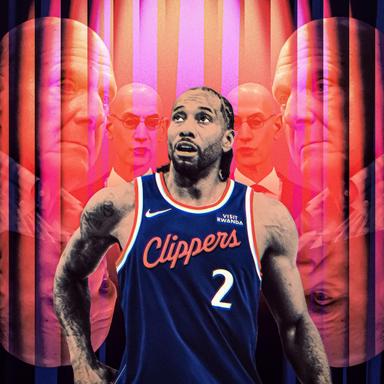
Fast-forward to Wednesday, when the extreme actually happened—to Ballmer himself, and to the Clippers franchise. Following a year’s worth of intrigue that was kicked off by investigative reporter Pablo Torre raising questions last September about tens of millions of dollars of suspicious no-show endorsement deals that the Clippers appeared to have brokered for Leonard, the NBA announced a sweeping punishment for what it found to be, in the words of commish Adam Silver, “flagrant violations of our rules.” (Oh, now they call flagrants!) Among other things, the Clippers were docked five first-round draft picks, and Ballmer was fined $30 million and banned from the league for a season. (Leonard, meanwhile, accepted a $700,000 fine and says he’s heading to Toronto. Unbothered and thriving!) It turns out somebody did make a calculation on the money, after all.
By every measure, it was a historic and rare punishment. The list of pro owners who have done something bad enough to actually get banned for a time is a short one, including Donald Sterling—from whom Ballmer bought the Clippers—and the Suns’ Robert Sarver. (MLB’s Marge Schott, Ted Turner, and George Steinbrenner were also among those on the naughty list, as was the NFL’s Eddie DeBartolo Jr.) And not since the Timberwolves were caught circumventing the salary cap for Joe Smith in 2000 has an NBA team been docked so many first-round picks. (That punishment was later lessened from five picks to four; former owner Glen Taylor had to sit out a season.)
Ballmer’s reckoning was hardly the only ownership drama of this summer.
Around the NBA—despite Giannis taking his talents to South Beach, a new Big Three rising in Philly, and Ja Morant taking in his new Oregonian environs via kayak—it’s the peripatetic owners who have made some of the craziest waves of this offseason, buying and selling and cap-circumventing and insider trading willy-nilly. This isn’t just a hoops phenomenon, either: All around the sporting world, the people pulling the strings just keep on grabbing the spotlight.
Sports is the new asset class, industry observers love to say. But being an asset class means constantly being rebalanced in someone’s investment portfolio. With so much commotion, it can be hard to make sense of the markets. So here, just in time for Labor Day, is an overstuffed Owners Manual: our ludicrously capacious guide to some of the latest happenings among the increasingly conspicuous (and completely chaotic) members of the capital class.
The Ballmer’s in His Court
Even before Wednesday’s Silver hammer dropped on the Clippers, there was a lot going on here. Like Aspiration cofounder Joe Sanberg pleading guilty to a $248 million wire fraud scheme. Or the reveal of an SEC investigation into an undisclosed endorsement deal with Daktronics, the company that built the Intuit Dome’s video board. We had Mark Cuban inserting himself into everything, as ever. We had the stalled trade precluding Leonard from joining the Toronto Raptors until the league finished its investigation. A couple of weeks ago, a group of five ESPN reporters contributed to a piece asserting an 11-month NBA probe had found “no evidence” that Ballmer directly funneled money to Leonard—at which point NBA spokesman Mike Bass issued a remarkable public rebuke, calling ESPN’s report riddled with “numerous and significant inaccuracies.”
Now, all of that has been crushed by an anvil in the form of the (highly readable; narrative longform’s not dead!) NBA-commissioned report from the law firm Watchell, Lipton, Rosen, & Katz. Whew!
Since so much of the conversation is naturally focused on what happens next, I want to instead bring to the table a few more of the things Ballmer had to say back in Waikiki seven years ago. Were his words particularly explosive? Nah. Did that luncheon take place years before Aspiration was even founded? It did. Nevertheless, I think the quotes below do give a glimpse into Ballmer’s perspectives on incentives, guardrails, and loopholes in a way that’s a real trip to see in hindsight.
Ballmer spoke about the distinctive vibes between NBA owners:
It’s a really funny thing where the league office works for the owners and the owners are managed by the league office. I mean, there’s sort of a weird thing that says we’re partners, but we don’t really trust each other when it comes to our basketball teams. We love each other when it comes to making revenue, and yet we compete. So it’s an interesting job.
He also shared what the NBA’s updated tampering and circumvention policies reminded him of:
I mean, the rules didn’t change. Just so it’s clear, nothing changed in the rules. What changed is in the compliance system. How is the league going to monitor whether people are obeying the rules. …
There’s also changes in the compliance procedures. They are more, like, I’d say “corporate,” for better and for worse. No CEO will tell you they like to go through something called Sarbanes-Oxley review. This is a little bit more like a Sarbanes-Oxley review than people probably thought they signed up with. Both in terms of auditing, and random audits, and signing on the bottom line …
(Sarbanes-Oxley is a 2002 federal law passed in the wake of the Enron and WorldCom accounting scandals that requires CEOs and CFOs to personally certify the accuracy of their financial statements.)
And Ballmer also spoke about the importance of staying swole as an organization:
What you have to do is put yourself in position, to then strike when an opportunity presents itself. … We did some things that were, I think, outside what people expected. I think of that as building capability. My business experience is sort of like this. I used to say literally to people, “You always have to be getting in the weight room as a business. You have to have muscle. You may have to have new muscles that you’ve never developed before.”
And despite the fact that this is an NBA franchise that’s been around for lots of, lots of years, 19 whatever it was, ’70, ’71, we didn’t have much muscle. We built that muscle on the basketball side. Frankly, we’ve also built good muscle on the business side.
As for what he sought to do with that muscle? Well, Ballmer at that point got distracted by his annoyance with Dolan (who at that time owned the nearby L.A. Forum and was doing his damnedest to block Ballmer’s quest for a new Clippers arena) and issued, in his Midwestern accent, a half-jolly, half-ominous message to his competition-slash-business-partner:
But it’s another thing, we’re grinders. We’re long-term players and we’re grinders. You want to hit us on the nose? OK. We’ll keep moving. You can’t knock us down. So I’m not sure they understand what they’ve gotten themselves into, from my perspective, in the sense that we’ll just keep going.
Ballmer would eventually just buy the Forum from the Madison Square Garden Company, paying $400 million to make the problem go away. But I couldn’t help but think of that last quote on Wednesday when the Clippers news broke—and especially after Ballmer issued a belligerent statement vowing to “vigorously challenge these findings and penalties through every avenue available to us” (followed by a Clippers lawyer pointing out that, c’mon, everybody’s doin’ it). While smarter legal minds than my own have pointed out that NBA bylaws don’t give Ballmer the right to fight the ruling in arbitration, it remains to be seen whether he’ll choose to escalate matters to some other court of law. Either way, I think it’s safe to say that there will be muscle.
Marc-to-Market! Lore and Stad Swap Wolves
One morning in late July, I found myself distracted by an alarmingly enthusiastic man being interviewed on CNBC. Even with Squawk Box playing on low volume, I couldn’t help but overhear him hawking his latest venture, a sort of slop-bowls-at-scale restaurantech enterprise called Wonder. I spent the next 10 minutes suspended in a sense of wonder of my own as I listened to such remarks as “the infinite sauce machine, which comes out in February, is super exciting”; “you don’t have to tip the drone, which I think, again, is bringing the price point down”; and “thinking first principle, building a fryer, you wouldn’t build a fryer that needed a human to fry it, right? You’d build some sort of frying tunnel.” It was only at the very end of the Q&A, when this guy was asked about his views on NBA expansion, that I realized (a) wait, he didn’t just run robotic ghost kitchens, he also owned a pro hoops team, and (b) omg, lol, this is A-Rod’s moneyman!!
Which is all to say that I sure will miss outgoing Minnesota Timberwolves governor (and Diapers.com kingpin) Marc Lore, a man o’ lore who sold his controlling interest in the T-Wolves and the Minnesota Lynx a week and a half ago. Pour one out for the fella who “in his first season, sat courtside and would take off his shoes as the Timberwolves completed a win, his version of Red Auerbach’s victory cigar.” I hope with his new amounts of free time and capital he can at least resume his lapsed $400 billion vision of building a utopian city called Telosa in an undetermined plot of desert! Though sadly, it’s more likely that both resources will be poured into Wonder’s anticipated IPO.
So, who’s the new guy in Minnesota? Well, the new guy is neither new nor just one guy! “American business leader” Marc Stad graduated from Harvard, worked at McKinsey, trained under “the sages of Santa Barbara,” started Dragoneer Investment Group, and was already part of Lore and A-Rod’s ownership consortium (which finally took over the Wolves free and clear in February 2025 after an awkward arbitration battle with former owner Glen Taylor). Last week’s transaction effectively swapped Stad and Lore’s positions in the hierarchy of the Wolves and Lynx—though it’s Stad’s wife, Elisa, who will reportedly represent the Timberwolves on the NBA’s Board of Governors. A USC grad with a corporate sales and marketing background and the author of the children’s book Mama’s Love Language: Sometimes Love Tastes Like Hainan Chicken Rice, Elisa Stad is expected to work behind the scenes for the time being while A-Rod will be a more public face of the ownership group. (A-Rod will also remain governor of the Lynx.)
This ownership reshuffling came after the Lore/A-Rod group acquired the teams at a $1.5 billion valuation that was first agreed upon in 2021. In the subsequent sports-is-the-new-asset-class frenzy, this would quickly turn out to be a slammin’ enough deal that former owner Taylor, wracked with remorse, tried in vain to undo it. Lore’s latest transaction with Stad, in contrast, was based on a $4.5 billion valuation—and reportedly could have commanded more on the open market if Lore hadn’t prioritized continuity in the ownership ranks.
Did Mat Ishbia Fly Too Close With the Suns?
With all the upheaval happening in the NBA’s ownership ranks, it’s hard not to wonder what other dominoes might be about to fall—and to fixate particularly on Mat Ishbia, the owner of the Phoenix Suns (and one of the United Wholesale Mortgage founder’s sons). It’s nothing personal, just business, when I point out that this man and his various investments have really been going through it!!
The Ishbia story has a little something for everyone. If you’re a real financial markets sicko, you’ll probably enjoy these outrageously comprehensive deep dives by the research firm Hunterbrook that investigate all of his balance sheet moves worth knowing. It’s all there, from ZIRP to the UWM SPAC to the REIT gone wrong to the distressed debt SOS. If you’re a real estate guy, perhaps you just wanna see Ishbia’s Michigan neverland with an indoor trampoline park! Or perhaps you’re fueled by other people’s petty interpersonal drama, in which case you might like:
- Reading about the beef with fellow mortgage lord and NBA owner Dan Gilbert
- Checking out what historians refer to as “the cocksucker voicemail”
- Browsing the 2025 lawsuit that two of Ishbia’s minority owners filed in the Delaware Court of Chancery accusing him of using the Suns as a “personal fiefdom” and “piggy bank”
If you’re an Industryhead like I am, it’s fun to imagine a floor of traders exchanging glances as Ishbia stubbornly blows like $600 million bucks on an interest rate trade. If you’re a Pat McAfee Show bro, I probably don’t even have to remind you of the time that Ishbia went on the show and pledged a million dollars to the winner of the NBA All-Star Weekend slam dunk contest before Cuban well-actually-ed him about how David Stern once declared that to be cap circumvention and tampering. (Shoulda listened to Father Ishbia’s advice that “a spouting whale gets harpooned”!)
Are you a Knicks fan who was scarred by the Isiah Thomas era? Well, you should know that Zeke is not only on the UWM board of directors but also constantly hanging around the Phoenix Suns. Do you love to lurk on LinkedIn? First of all, why? Second of all, you can find Ishbia crashing out there with comments like “I love the noise ... [people] only care about the no. 1 guy.”
And if you’re a hot dog aficionado, you’re in luck! [Extremely “gazpacho for all!” voice] $2 hot dogs for all! Just promise not to look into how the sausage was made.
Wall-to-Wall Mark Walter!
Last month, I examined the life and times of the evanescent L.A. Lakers owner Walter, the Guggenheim Partners cofounder, TWG Global shot-caller, and—still!—Los Angeles Dodgers owner. (And soon after that, I wrote about what looks to be the unplanned bitter end of the late Jerry Buss’s proud, hectic family biz.) Walter shocked the NBA world and spooked the markets on August 13 when he offloaded his majority share of the Lakers to Bob Iger and Josh Kushner amid a federal investigation into whether key swaths of Walter’s investment empire are—to use some high-finance technical language here for a second—one big circle-jerk. Lots has happened since then! Here’s a roundup of some of the latest and/or lingering questions surrounding Walter—and his interconnected web of affiliates, shell companies, and pro sports investments.
Do federal investigators have enough red string and wall space to properly map out the Mark Walter matrix? They’re gonna need a bigger corkboard! While the federal investigation is focused on a handful of Walter’s insurance companies and intermediaries, the greater galaxy of Walter-adjacent people, places, and things is both sprawling and densely interwoven. It spans from Argentina to Abu Dhabi, from Formula One to a former friend o’ Fergie, and from The Cowboy Channel to the president. The holding company containing the Dodgers TV station! The credit rating firm that gave the okey dokey in its assessments of suspect insurance filings! The joint venture with Palantir! All of it is part of Walter’s web, and I bet we don’t even know the half of it yet.
How embroiled is Magic Johnson in this mess? Oh, he’s in it in it! Johnson has been doing business with Walter since 2012, when he joined the Guggenheim-led group that bought the Dodgers. And as a recent Hunterbrook investigation meticulously mapped out, he’s amassed a number of noteworthy entanglements that smack of the classic Walter MO in the decade and a half since. The big one: EquiTrust Life, an Iowan insurance company that Guggenheim sold Johnson a controlling interest in back in 2015—which was used for a supposedly “unaffiliated” $350 million debt acquisition deal with American Media Productions (the Walter-controlled holdco for the Dodgers’ SportsNet LA station) and a $100 million investment in JLC Infrastructure, a fund run by Johnson and his personal business manager, Eric Holoman. (Holoman is also the governor of the Los Angeles Sparks.) In 2025, EquiTrust was sold to Amistad Financial, another Holoman vehicle and one of several entities named in the ongoing DOJ investigation.
Does this mean the Dodgers won’t have the money to pay their deferred contracts? And is it true that Shohei Ohtani could use this situation to leave L.A.? Walter’s sale of the Lakers put many Dodgers fans on edge, wondering what might be coming down the pike for their team. L.A. owes players more than a billion dollars collectively in deferred compensation, for one thing. And more worryingly, Ohtani has a bespoke “key man” clause in his contract that would allow him to opt out if either Walter or baseball operations boss Andrew Friedman were to leave. But fears of the franchise falling apart for either reason are probably overblown. Under MLB’s CBA, the present value of deferred comp must be fully funded into a dedicated, audited escrow account within two years. As for Ohtani, reporting from The Athletic indicates that if Friedman is still around, baseball’s top player isn’t in any rush to go elsewhere. Which is a little bit of a bummer: For those of us always rooting for Team Chaos, that outcome would have been a delight.
What Walter-adjacent little detail is the most surreal? Readers of my previous piece may recall that of all the mind-boggling things about Walter, the one that shook me most was that not only does he own the entire Professional Women’s Hockey League, but he named the league’s championship trophy the Walter Cup. Well, just imagine the level of sputtering I did upon seeing headlines last week that the Walter Cup had been lost in transit!!!! (I guess it’s not a real hockey trophy until it’s gone missing.) The chalice was finally tracked down, and I was able to calm down. But I’m assuming this is some kind of Thomas Crown Affair bowler-hat heist until proved otherwise.
What is the best tweet about Walter’s longtime close associate Todd Boehly?
Are Walter’s many, many other pro sporting properties also up for sale? “TWG is not looking to sell its sports assets at ‘fire sale’ prices to raise capital for its insurance operations,” read a statement issued last week by TWG Global, Walter’s holding company. (My T-shirt is raising a lot of questions already answered by the shirt!) Stan Kasten, the team president of the Dodgers and also a member of the PWHL advisory board, has said that “the Dodgers are not being sold” and “there’s absolutely no expected change to ownership of the PWHL.” And despite rumblings suggesting otherwise, TWG denied that the Cadillac F1 team would be shopped. Still, if reports are true that Walter continues to seek liquidity, it would surprise me if something wasn’t unwound, and I think the most likely candidates are the L.A. Sparks and/or Walter and Boehly’s stake in Chelsea FC. The latter has reportedly been the topic of active conversations with their BlueCo partners—Clearlake Capital’s José E. Feliciano and Behdad Eghbali—who are looking to further consolidate their stake … and cut down on all that bickering!
Padres Purchased by Princeton Power Couple
Beyond the Chelsea stalemate, Feliciano has been busy lately. On August 17, he and his wife, Kwanza Jones, were officially introduced as the newest controlling owners of the San Diego Padres in a deal valuing the franchise at $3.9 billion. (This was, briefly, an MLB record—until it was eclipsed this week by Arte Moreno’s $4 billion sale of the Anaheim Angels to Stan Kroenke. More on that to come!)
The Feliciano and Jones power couple met at Princeton—plan the P-rade!—where he studied mechanical and aerospace engineering (before getting his MBA at Stanford) and she studied public and international affairs while running the 800-meter on the track team (and winning Amateur Night at the Apollo while an undergrad, with a rendition of “And I Am Telling You I’m Not Going” from Dreamgirls). Between then and now, Feliciano cofounded Clearlake Capital, which as of June has some $185 billion in assets under management, and Jones earned a law degree (and released numerous dance songs that hit the genre Billboard charts). In 2020, thanks to a $20 million gift to Princeton, their alma mater named two dorms after the couple.
Now they’re even heavier hitters. At their intro presser on August 24—which Jones kicked off by blasting an original Padres fight song she’d written and recorded herself, inspired in part by Fernando Tatis Jr. robbing the Mets of a Francisco Lindor grand slam, because of course—Feliciano remarked: “Maybe people underestimate us. People don’t think we’re capable of doing what we’ve done—including winning the bid for the Padres. That motivates us.”
Rumored minority stakeholders include the Seidler family (the former owners of the team and descendants of iconic Dodgers owner Walter O’Malley) as well as Drew Brees (sure!) and the Sycuan Band of the Kumeyaay Nation (who also have a stake in San Diego FC). But that’s not all! Last week, the team announced that Jesse and Joey Buss, the two youngest siblings in the Lakers family rivalry who were unceremoniously ousted from their executive roles by their big sister Jeanie following Walter’s takeover in the summer of 2025, had bought a 5 percent stake in the Padres—adding quite the fun new wrinkle to the team’s NL West rivalry with Walter’s Dodgers. Let’s play ball, indeed.
🎵 He’s Choosin’ Texas, NHL … 🎵
One of the prospective owners that Feliciano and Jones outbid for the Padres was Dan Friedkin, a Texan billionaire and father of four with a résumé that wouldn’t be out of place in a Coen brothers script. Gulf States Toyota mega-dealer! Owner of the Serie A squad Roma since 2020 and the Premier League’s Everton FC since 2024! Vintage World War II–era plane stunt pilot! (“When the director of Dunkirk, Christopher Nolan, was casting around for Spitfires to feature in the film,” read a 2024 MoneyWeek profile on Friedkin, “he discovered that Friedkin owned six of them—and went on to secure his services as the pilot of the aeroplane” in the film.) And speaking of films: coproducer of Killers of the Flower Moon! (And Triangle of Sadness! And Landman!)
It didn’t take long for Friedkin to pivot his attention elsewhere when the Padres thing didn’t work out. In June, the NHL executive committee approved an exclusive framework agreement with Friedkin that allows him to bring a 33rd franchise (and second Texas team) into the league via expansion. The terms of the deal have already been largely agreed to: $2 billion for a new NHL team and another $1.5 billion for a new arena. But one little detail remains outstanding: exactly where in Texas this franchise will land.
On the one hand, Houston is the country’s fourth-largest market, and Friedkin lives there. On the other hand, the NHL—thrilled with its previous expansion success in the once-sports-starved Las Vegas—is very into Austin, with its high-growth, tech-money demographics and its lack of competition from other Big Four sporting franchises. Deputy commissioner Bill Daly estimated that a decision ought to be made by year-end. Team Austin Breakfast Tacos: Who says no?!
Stake Bites: A Hearty Romp Around the Owners Club
To wrap up this Owners Manual, let’s see what’s been happening inside some of the other sweet luxury suites around the sports world …
- The next generation is getting its chance: It seems like only yesterday that I was talking shit about Cablevision patriarch Charles Dolan on ’90s Usenet. It also seems like I’ve been making JD & the Straight Shot jokes about his heir, James Dolan, for my entire life! Now, with the news that Quentin Dolan, one of James’s many, many sons, is taking over the day-to-day of the soon-to-be-spun-off New York Rangers, I’m afraid that dealing with a third-gen Dolan might knock me into some kind of temporal dimension. (I’m envisioning this scene, in which “And the Rangers have one more hill to climb!” quickly turns into “Those aren’t mountains!”)
- The next generation is getting its chance, Part 2: According to this Cleveland Magazine feature, operational control over the Haslam Sports Group, which owns the Cleveland Browns, Milwaukee Bucks, and Columbus Crew, has quietly shifted to heiress Whitney Haslam Johnson and her husband, James Wood Johnson III, a former CBS Sports producer. The couple—who met at a 2007 wedding in Savannah, Georgia, per the Cleveland profile, and bonded over having both played soccer goalie in high school—will be busy trying to keep the Browns, in particular, from recording yet another own goal. With Deshaun Watson once again starting at QB, and with a $2.6 billion–plus domed stadium project described by the Haslams as “the largest economic development initiative in Northeast Ohio’s history” (and by the mayor of Cleveland as a “scheme” that “pays for itself on the backs of fans” and relies on “the assumption thousands of people will pay high rent to live in luxury apartments in the shadow of the airport”), they’ll have a lot of diving saves to make.
- The next generation is getting … charged? Back in 1998, after then–San Francisco 49ers owner Eddie DeBartolo Jr. pleaded guilty in a Louisiana riverboat gambling fraud scandal, he was forced to hand control of the team over to his sister, Denise DeBartolo York, who ultimately put her son Jed at the helm. Now, after Jed York’s recent arrest (in a prostitution sting! Outside an Ohio trailer park! At 9:35 a.m.! While repping the New York Yankees!), the team’s 46-year-old owner has stepped back, for a time, from representing the franchise. As Mike Florio reminded everybody, York once told reporters: “I own the 49ers, and you don’t dismiss owners.” However temporary his absence, York did not attend an NFL owners meeting last Wednesday where the sale of the Seattle Seahawks was up for a vote.
- Vinod Khosla will never forget his first: At that meeting, the owners approved the Seahawks sale to venture capitalist and gatekeeper of the shores Vinod Khosla, who acquired the controlling interest in the team at a franchise valuation of $9.6 billion. During an introductory press conference last week, Khosla waxed nostalgic about … his beloved Pittsburgh Steelers, proudly revealing he’s been a die-hard black ’n’ yellow fan ever since he attended Carnegie Mellon during the Steel Curtain dynasty and that he still enjoys every snap. Later, upon being roasted for it by Barstool, Khosla took to social media to complain about the coverage of his chat. All in all, a promising start that has me contentedly following along.
- NBA expansion is on the clock: According to The Athletic’s Mike Vorkunov, the NBA’s long-awaited expansion process in Las Vegas and Seattle continues to develop, with financial adviser PJT Partners seeking bids from $7 billion to $10 billion per franchise. The expectation is that the league will focus on Las Vegas first, where leading bidders range from Walmart heiress Nancy Walton Laurie and her husband, Bill, to Vegas Golden Knights owner Bill Foley to a group headlined by Jerry Colangelo and Vinny Del Negro. (In Seattle, the loudest indication of interest thus far has been from Seattle Kraken owner and chair Samantha Holloway.)
- Don’t trust content from Fast & Furious star Tyrese Gibson. Contrary to the BREAKING news shared on Gibson’s Instagram Monday (?), Allen Iverson is not, in fact, about to be a Philadelphia 76ers owner, as Front Office Sports subsequently confirmed. (Maybe he’s still holding out for that hometown Hampton Roads expansion franchise?! I know I am!) At least Naomi Osaka mimicked Iverson’s lewk at the U.S. Open, and you can’t put a price on that.
- And finally, hot off the presses: Billboards magnate Arte Moreno agreed on Tuesday to sell the Los Angeles Angels, who have not made the playoffs in 12 seasons despite having employed both Ohtani and Mike Trout for half of them. The buyer? Pro sports franchise hoarder Stan Kroenke, who will add the team to a portfolio that already includes (but is not limited to) the L.A. Rams, the Denver Nuggets, the Colorado Avalanche/Rapids/Mammoth, and Arsenal FC. Based on Los Angeles Times headlines like “Anaheim’s long nightmare is over” and quotes like “I feel like it’s my birthday” from Anaheim’s mayor, I think it’s fair to say that Halos fans supported the change! (The ticket sales reps sure hope so.) Moreno may not be popular, but that’s what the money’s for: When he bought the team from Disney in 2003, he paid $183.5 million. Now he’s selling it for a cool $4 bil. I guess sports really is one hell of an asset class!