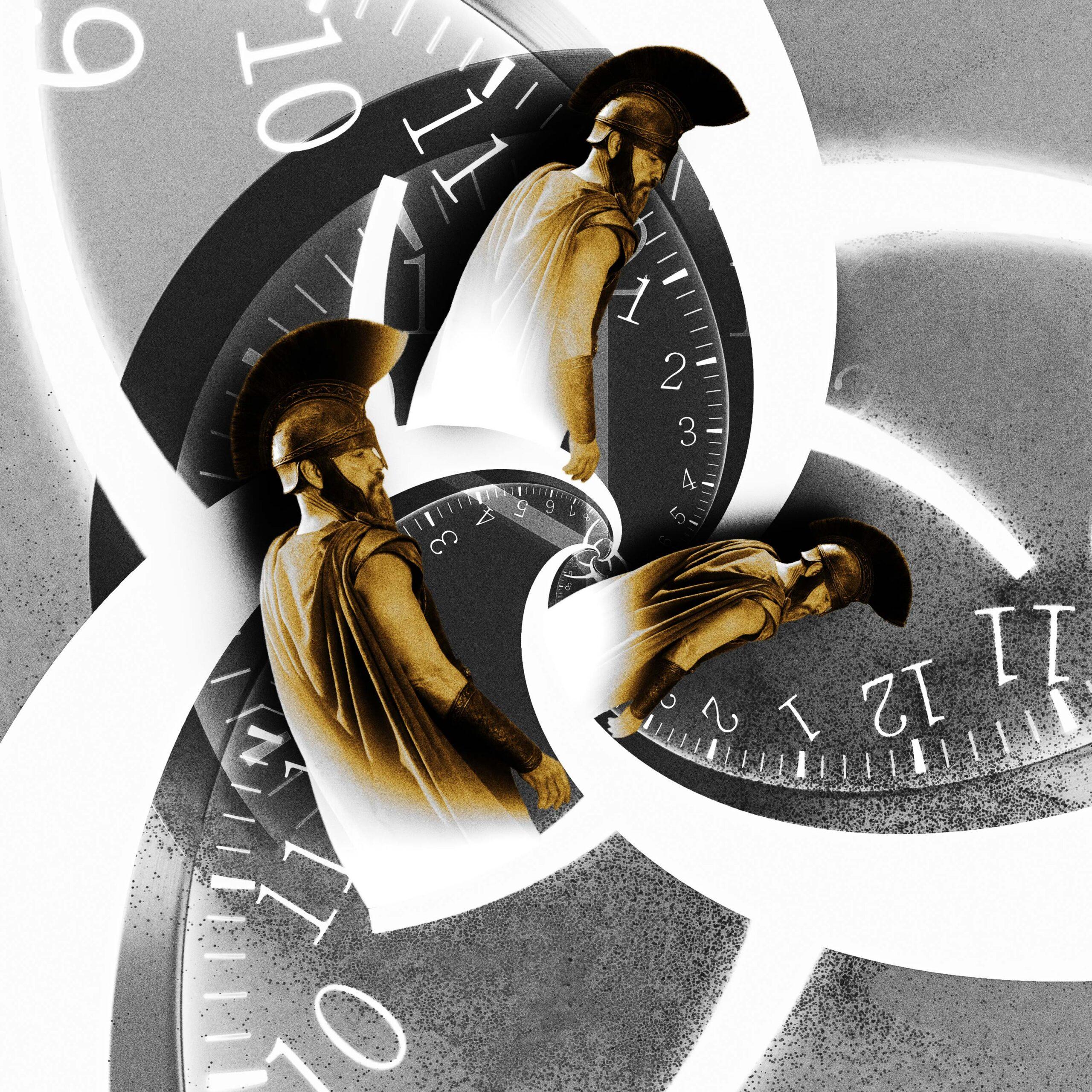

It’s no secret that Christopher Nolan has a distinct fascination with time. Throughout the filmmaker’s illustrious, decades-spanning career, the nature of time has functioned as a central theme and recurring subject in his movies. Nolan’s stories tend to unfold nonlinearly, and time is often vital to the construction of his worlds and their stakes. Naturally, memory comes up as a primary point of interest in Nolan’s works as well, as characters’ experiences—and how they remember them—inform their journeys, along with the audience’s perception of them. In Memento (2000), the film’s fragmented timeline becomes as much of a character as its protagonist: a man with anterograde amnesia who’s hunting down his wife’s murderer despite his inability to form new memories. Interstellar (2014) interrogates Einstein’s theory of general relativity as astronauts leave behind their dying planet in search of a new home in space, where they experience the effects of time dilation firsthand. The mind-boggling enigma that is Tenet (2020) bends the very laws of time itself.
It should come as no surprise, then, that time and memory are essential to Nolan’s latest blockbuster, The Odyssey. These familiar themes and storytelling devices reemerge not only to act as a through line that binds Nolan’s iconic filmography together but also to provide the key to adapting an unwieldy text into an ambitious motion picture.
Few stories are as famous as Homer’s Odyssey. It’s one of the oldest surviving works of literature in the Western tradition, passed down through oral storytelling and eventually written verse. The Odyssey is more than 12,000 lines long, dispersed over 24 books. The story has been told, translated, and reinterpreted more times than anyone could ever count. In many ways, it is the blueprint for all of Western storytelling.


Yet Hollywood studios have never made a big-budget attempt at reproducing Homer’s epic on the big screen, an omission that Nolan calls “an odd gap in movie history.” After the near-billion-dollar, Oscar-winning success of 2023’s Oppenheimer further empowered the filmmaker with rarely seen creative and financial freedom, Nolan also viewed that gap as a unique opportunity.
“There are so many different themes, so many different elements of Homer’s original poem that appear in movies and have been the sort of bedrock of Hollywood for so long,” Nolan explained to MS NOW. “It hasn’t really been told as a modern film for modern audiences. And so, for a director, that's a pretty thrilling opportunity to try and challenge yourself and try to bring something new to the table.”
As influential and well-known as the Odyssey is, there could be any number of reasons behind its apparent absence in modern cinema—but chief among them may be the story’s length and scale. An adaptation like 2024’s The Return, starring Ralph Fiennes and Juliette Binoche, opted to narrow its focus to just the second half of Odysseus’s journey, after the Trojan War hero had already landed back on the shores of his beloved Ithaca. O Brother, Where Art Thou? (2000) takes a different tack, loosely adapting the narrative in a satirical comedy that features musical numbers and shifts the story’s tone and setting. It’s a Herculean task to trim down the entire epic into a palatable theatrical experience and, crucially, to do justice to such a classic. And Nolan achieves this feat by trusting in the strength of the source material yet still being bold enough to apply his own filmmaking sensibilities to make it unmistakably his own.
Nolan’s Odyssey follows the same basic path of Homer’s narrative, first establishing the dire situation in Ithaca—where Odysseus’s son, Telemachus (Tom Holland), and wife, Penelope (Anne Hathaway), are fending off Penelope’s many insatiable suitors—before finding the lost Odysseus (Matt Damon) trapped on Calypso’s (Charlize Theron) island. Like the epic poem before it, the film contains stories within its larger story, as characters trade tales of the Trojan War and, in Odysseus’s case, the ill-fated journey of a hero returning home. It starts in medias res before looking backward to reveal how Odysseus became imprisoned by this goddess for seven years and why he’s been away from Ithaca for so long. The story cuts across time, memories, and perspectives in yet another nonlinear narrative—all of which is done by following Homer’s original designs.
“[Homer’s Odyssey] has a wonderful structure that I was able to be faithful to, and it’s a nonlinear structure,” Nolan said to MS NOW. “That’s one of the fascinating things to me about it. It’s the oldest sort of foundational text of Western literature but has this incredibly adventurous, nonlinear structure. And that lets you include a lot.”


It’s in this framework that Nolan leans into the kind of storytelling that he’s honed over the past several decades of his career. Conversations between characters instantaneously transform into immersive memories that the audience can see and feel. Before we spend any time with Odysseus on Calypso’s island, or within the many trials of the odyssey itself, we join Telemachus in hearing accounts of who his father dad was ahead of the war. As the blind swineherd Eumaeus (John Leguizamo) describes the origins of Odysseus’s faithful hunting dog, Argos, to Telemachus, we suddenly see a younger Eumaeus dropping puppies off a cliff before Odysseus saves one for himself. That triggers another flashback of an older Argos by Odysseus’s side, along with a group of eager boys, who are all ready to witness the great king of Ithaca hunt a boar with honor. Memories cut into the present and bleed into one another, forming ephemeral images of the past that slowly shape where the story is headed.
Early in the film, in particular, these memories intrude fast and often. Telemachus seeks to absorb as much information as he can about the father he’s never known, bringing us along as he tries to learn more about the man Odysseus was before he left for Troy. When we finally meet the present-day Odysseus in a lotus-induced daze, he’s seeking answers about his whereabouts just as much as his son is. He recounts scenes from his doomed travels to Calypso in an effort to piece together his fractured past, not unlike how he spends his days gathering the fragments of a shipwreck he can’t recall. Together, the audience and Odysseus rediscover the events that led him to his precarious situation.
Cross-cutting is a filmmaking staple for Nolan and frequent collaborator Jennifer Lame, who also edited Oppenheimer and Tenet before The Odyssey, and it’s present throughout the film as these disparate timelines and recollections converge to present Odysseus’s story. Fleeting glimpses of Odysseus lying on the steps of a temple in Troy and the decapitated head of a stone statue appear throughout the movie before their significance crystallizes near its conclusion. These images invade the screen the way recovered memories flood the mind: They’re impossible to comprehend before their roots have been traced and processed. Yet a character’s account can also expand into lengthy sequences that imbue the film with an episodic feel, like Odysseus’s retelling of his crew’s harrowing encounter with the Cyclops. Locations and years are never conveyed on-screen as we’re displaced in any given moment, leaving us with only the acute sense that we’re entering the past, somewhere, sometime. By blending this collection of tales from various perspectives, Nolan grows Odysseus’s myth all the while.
It all makes for a rather ornate, disorienting, and very Nolan-esque approach to an adaptation of the Odyssey, yet it feels fitting for the grandiose epic and as a way to illustrate Odysseus’s subjective experience. Like the exiled Dom Cobb yearning to reunite with his children in Inception, or Cooper watching his kids grow up through a screen in Interstellar, Odysseus is a great (family) man who is reckoning with the loss of time. The Odyssey is the prototypical story for this recurring subject in Nolan’s work, and so many elements from it and its hero can be seen in the writer-director’s other films and protagonists. It remains a strange what-if in Hollywood history that Nolan nearly adapted Homer’s Iliad many years ago, when he was hired by Warner Bros. to direct 2004’s Troy. He was ultimately replaced by Wolfgang Petersen, who had developed the blockbuster before almost relinquishing the project to helm a Batman (vs. Superman) movie, of all things. But even though Nolan moved on from ancient Greece to take on Gotham City himself in 2005’s Batman Begins, he didn’t leave its mythology or narrative devices behind as his career progressed.
“At the end of the day, it was a world that I was very interested to explore,” Nolan recently told Empire magazine. “So it’s been at the back of my mind for a very long time. Certain images, particularly. How I wanted to handle the Trojan horse, things like that.”


Although the full story of the Trojan horse appeared in Virgil’s Aeneid and is mentioned only briefly in Homer’s Odyssey (and not at all in the Iliad), it’s the legend that Odysseus is best known for, and the greatest example of his unparalleled cunning. As such, it’s the most important event and the most thrilling set piece in Nolan’s Odyssey. But how the infamous ruse is depicted—in three segments, spread across the movie—is the best example of the film’s use of memory and perspective, and also the heart of Nolan’s interpretation of The Odyssey.
The Odyssey opens with a bard (Travis Scott) spinning the spectacular tale of the ingenious scheme at a feast held in Odysseus’s hall, thrusting the audience directly into the moment Sinon (Elliot Page) delivers the gift horse to the Trojans. It’s the first instance of one of these immersive cross-cut memories supplanting the present. But it turns out to be little more than a tease for the viewers as Penelope pulls us back to Ithaca, weary of hearing the same song of her absent husband’s wartime achievements.
When Telemachus visits Sparta to gather news of his father’s whereabouts an hour into the film, King Menelaus (Jon Bernthal) picks up the story where the bard left it. Except the brother of Agamemnon continues from his unique point of view: inside the belly of the famed wooden horse itself. Through the militant Menelaus’s framing, we get a triumphant account of how the Greeks won the hard-fought, 10-year war thanks to Odysseus’s brilliance and bravery. But before we witness Troy fall, Menelaus cuts his story short. “I think you know the rest,” he tells Telemachus.
The third account comes from Odysseus himself, as he—disguised as a beggar—describes what he remembers most from that night to Penelope toward the end of the film. Unlike the bard or Menelaus, Odysseus doesn’t prop up the ruse as a glorious achievement but rather confesses it as his greatest shame. He propels the story into the ugly aftermath that Menelaus omitted, when an army of Greeks—fueled by a decade of rage—sacked a city of enemies and innocents alike. All of the film’s scattered, nebulous images of Odysseus on those temple steps gain their meaning as he recalls the horrors he witnessed and how he broke an entire civilization’s sacred code of hospitality: Zeus’s law.
The fall of Troy is the final piece to understanding the true nature of Odysseus’s disastrous journey, as well as Nolan’s novel, optimistic take on the character’s evolution after he reckons with his deceitful ploy. Homeric scholars like Odyssey translator Emily Wilson might have some justifiable notes for Nolan, but the filmmaker’s sober reading of a guilt-ridden Odysseus is crucial to an interpretation of the epic that places less weight on the gods than it does on the morality of man. After exploring the horror of war in 2017’s Dunkirk and the destroyer of worlds in Oppenheimer, Nolan uses The Odyssey to examine the human condition on a grander scale—even if he’s turning Odysseus into a tortured figure more like Batman or J. Robert Oppenheimer than a faithful reflection of Homer’s hero in the process.
The Odyssey raked in $264 million worldwide over its opening weekend, the best global debut of Nolan’s remarkable career and a testament to the auteur’s singular box office appeal. Sure, The Odyssey may recycle familiar storytelling conventions and themes the filmmaker has explored in his previous works. But with Nolan returning to ancient Greece in a filmmaking odyssey of his own, more than 20 years after almost directing Troy, The Odyssey feels more like a culmination of an incredible career than it does a mere retreading of his greatest hits. Only time will tell where that’ll lead him from here.