Plain English With Derek Thompson
What Translator Emily Wilson Thinks of Christopher Nolan’s ‘The Odyssey’
Hosts
 Derek Thompson
 Derek Thompson
About the episode
Christopher Nolan’s The Odyssey has brought one of history’s oldest stories back into the spotlight. It’s also sparked a fresh debate about what it means to adapt a classic.
Today, Derek is joined by acclaimed classicist and translator Emily Wilson, whose celebrated translation of The Odyssey helped inspire Nolan’s film. They explore why Homer’s epic has remained the foundation of so much Western storytelling and what gets lost and gained in the act of translating. Then, Wilson gives her take on Nolan’s adaptation. She lets us know what it captures brilliantly, where it departs from Homer, and what those changes reveal about both the ancient world and our own.
Subscribe to our YouTube channel here.
If you have questions, observations, or ideas for future episodes, email us at PlainEnglish@Spotify.com.
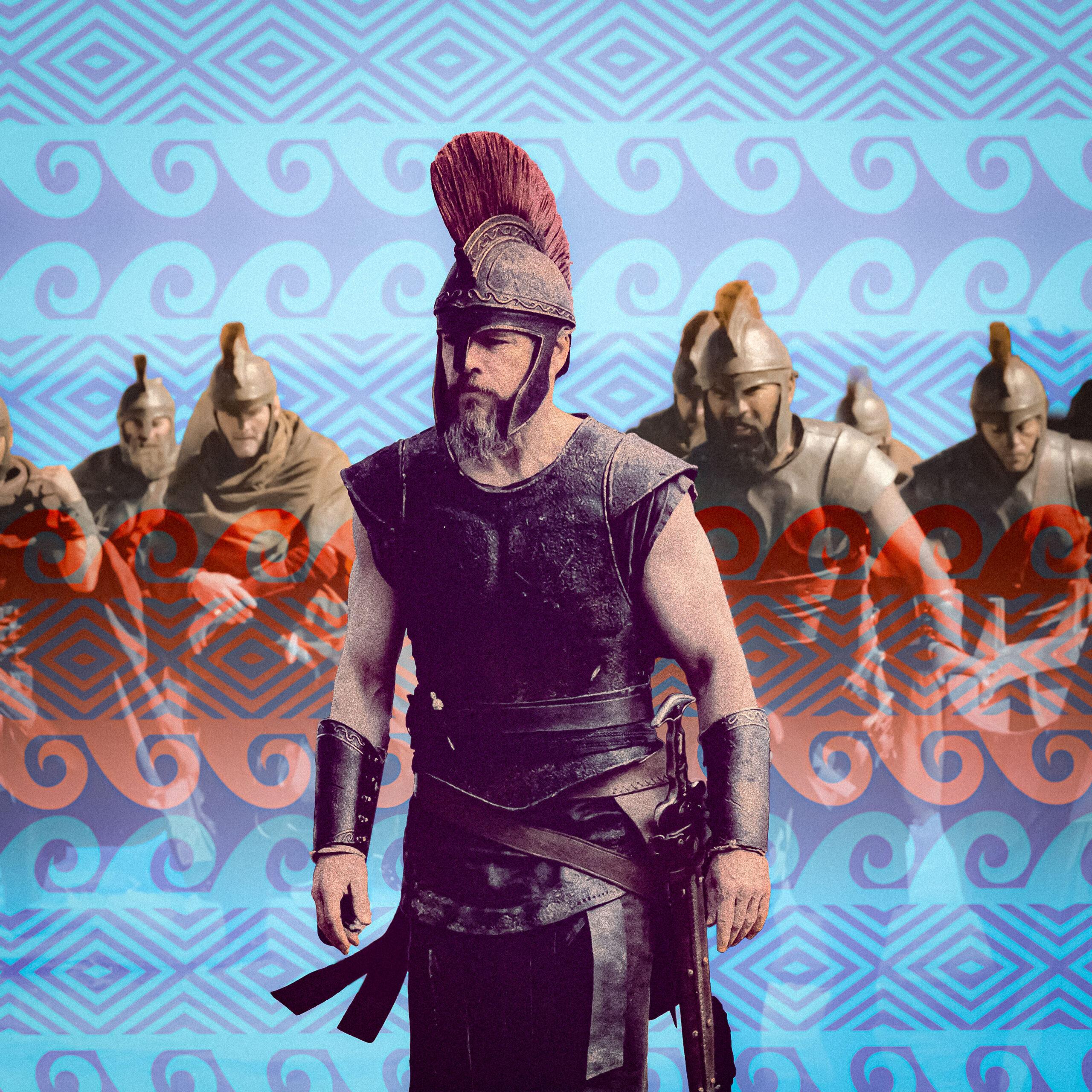
In the following excerpt, Derek and Emily Wilson dive into their thoughts on Matt Damon’s Odysseus.
Derek Thompson: Well, speaking of complicated, let’s talk about your feelings about the Christopher Nolan movie. I want to announce a spoiler alert here: We’re going to talk directly about the film for the next 20 or so minutes. So for those of you who don’t want to hear a word about this film, despite the fact that the story is 3,000 years old, this is the right moment to hit the pause button before you buy a ticket. Let’s start very broadly. Emily, what did you think about Christopher Nolan’s The Odyssey?
Emily Wilson: It is a big spectacle, and it is a fun time with the movies. My teenagers really loved it, and it was fun to go with my teenagers. It’s a fun summer action movie. And it’s also very much a Nolan movie. I mean, I personally really like Nolan. I very much liked his early work. I liked Following. I liked Memento. Since then, he’s got these huge budgets, and I am constantly wrestling with the feeling that he’s a very good short-story writer who’s always writing a 400-page novel because he’s got the budget for it. And that it’s got this actually quite small-scale, clever gimmick about narrative, but then it’s blown up to IMAX-enormous scale. I don’t think it’s a complicated movie. And I don’t think it’s even about a complicated man. I think it’s a quite simple action-hero movie about an action hero who feels bad about being an action hero.
Thompson: Well, let’s talk about the character Odysseus first before we talk about some ways in which I think the film was trying to do some things that your translation was trying to do. Matt Damon’s Odysseus—what is the biggest difference between the Odysseus that you wrestled with on the page and the Matt Damon character that you saw on the screen?
Wilson: So Homer’s Odysseus is a complicated man, polutropos. Whereas Matt Damon in the film, he’s traumatized Jason Bourne. He’s an action hero who feels bad about being an action hero. He’s not that complicated. Unfortunately, he’s not the talented Mr. Ripley in this film. The Odysseus of the Greek poem is complicated. He’s also very smart, very good at problem-solving, very crafty, very good at being in multiple disguises, being a different person depending on who he’s talking to, coming up with clever schemes like telling the Cyclops his name is Noman, such that the Cyclops’s neighbors, the other Cyclopedes, will think, “Oh, if no man‘s hurting you, you’re fine. No problem.”
All of that is erased from the Nolan movie. So there’s no Cyclops trick. There’s no comedy. Matt Damon isn’t required to be intelligent, to be scheming, to be … we don’t even see him building the Trojan horse, which I thought was an interesting choice to have this tech hero, but we don’t see him doing his tech. We see him agonizing about the results of the tech. So I thought there was something in a way quite stylish about doing Odysseus, but don’t make him too smart.
Thompson: My reaction when I saw it yesterday afternoon is that in your book you say, “Odysseus is poly,” this word that comes up over and over again in epithets about Odysseus. It means “many.” He’s a prism of many sides. He is a man of many stratagems, of much wiliness, of much enduring, of much smarts. He’s a city sacker, and he’s a scoundrel, and he’s a family man. There’s all of these parts to him.
And one of the more important parts is his ability to disguise, to be this chameleon, to fit the shape of what is needed for him to get from that island back to the ship or that ship back to the island. And it was interesting to me because there is a role that Matt Damon has very, very famously played which is polutropos, which is many-sided. In 1999, The Talented Mr. Ripley, Matt Damon lied and lied and lied his way toward the upper class, even when it meant having to—spoiler alert—also commit some atrocities on the high seas.
This performance is not that. This is a Matt Damon performance that is a virtuous and, at the end, very guilt-laden warrior who is a classic leader of men from the first minute to the 190th minute or whatever. And that is a representation of The Odyssey, but it is not the Odysseus that I read in the poem. It is Nolan’s Odysseus, not Homer’s. Is that a fair recapitulation of what you’re trying to say?
Wilson: Absolutely. Yes. I mean, I completely agree with you. When the casting was announced, it was Ripley that gave me hope in terms of where might this go with a Matt Damon as Odysseus. But you’re absolutely right that it’s a Nolan reinvention. And of course Nolan is completely within his rights to reinvent in whatever way he sees fit. It’s not like it’s easy to cram the whole Odyssey into three hours and make this amazing, ancient epic poem into a Hollywood spectacle.
You’re inevitably going to leave things out. You’re inevitably going to make choices. And of course, if we look at the longer tradition, Virgil’s version of cruel Ulysses is not the same as Homer’s heroically, gloriously scheming Odysseus. There’ve been reinventions of this character and this story for many, many hundreds of years, and Nolan won’t be the last to do that.
This excerpt has been edited and condensed.
Host: Derek Thompson
Guest: Emily Wilson
Producer: Devon Baroldi
Additional Production Support: Ben Glicksman