
It has to be the fulfillment of some divine will that Christopher Nolan finally got around to making The Odyssey. After so many movies about wife guys who just want to get back home, he’s finally pulled a very Nolan-esque move and made his way back to where it all started. It was never in serious doubt that the reigning king of the thoughtful epic would do justice to Homer’s wine-dark seas, Odysseus’s earnest yearning, and the original’s nested narrative. And while there were plenty of doubters who questioned his fealty to the finer Bronze Age details or the aptness of his dialogue, the only nagging question for the mythology heads among us was whether he’d do justice to the pantheon of conniving, vying gods up on Mount Olympus. From the first pages of The Odyssey, those very human-seeming gods initiate and incite the action; there would be no legend of Odysseus without them. And fears that Nolan would leave out the gods did feel justified: Even when he’s dabbled in superheroes or borderline divine feats of engineering, his protagonists have always been able to chalk up the unknown to some algorithm or explanation they just didn’t have all the variables for yet. In Homer, the gods are those variables, somewhere out past the edges of our understanding: They explain the natural world but also expand it, and it’s hard to wrap your head around a version of The Odyssey that omits them.
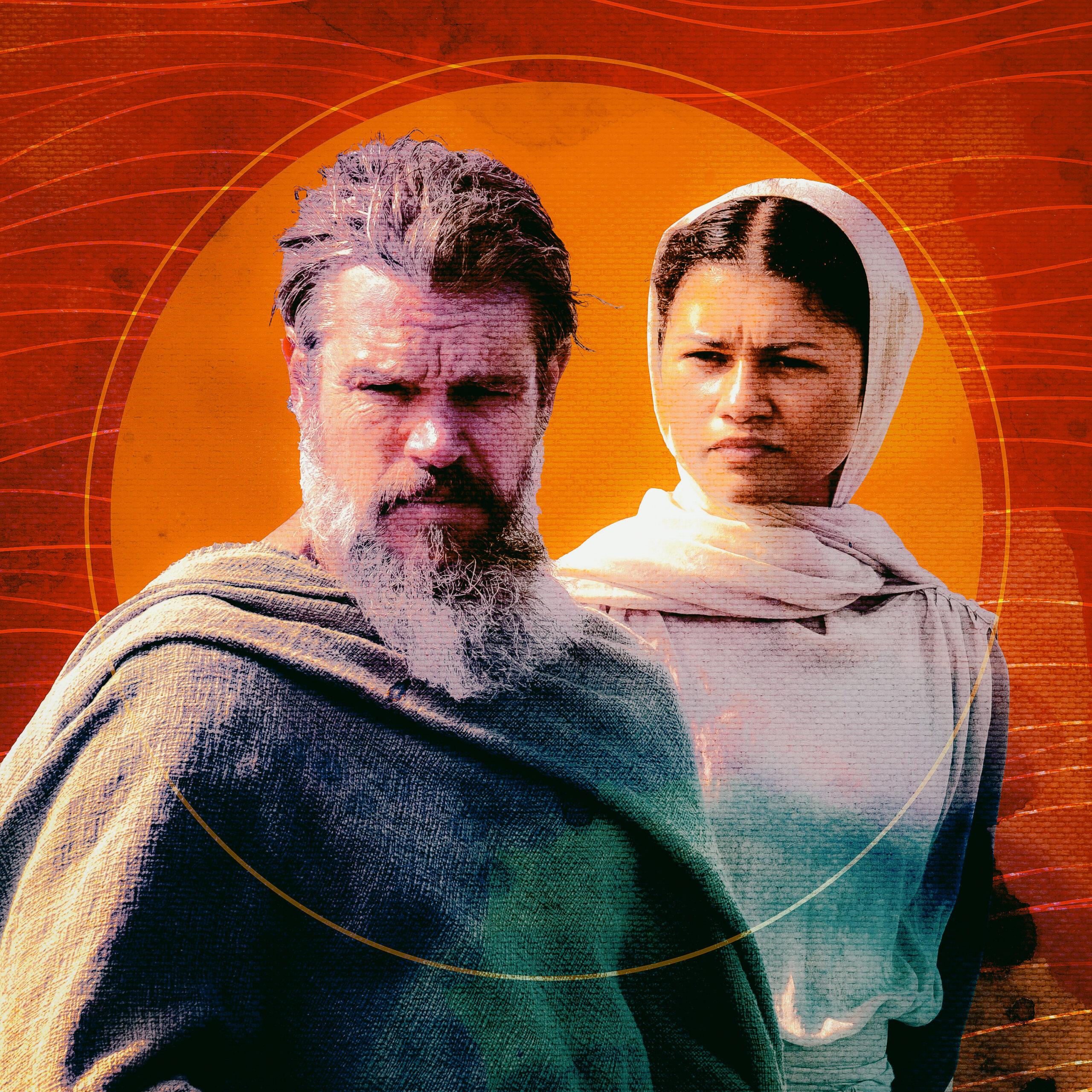
As it turns out, Nolan does pay tribute to the gods in his Odyssey, lest Zeus strike him down, but the straight-faced director excises the carnivalesque lineup of Zeus, Athena, Hera, Aphrodite, Ares, Apollo, et al. and replaces them with a distant deity who manages to show up only in sea storms and thunderbolts and comes with a distinctly modern set of virtues. (Plus, there’s ghost Zendaya.) Homer’s Iliad and Odyssey have their share of woe and divine retribution, sure, but they’re also filled with the bawdy, shifting moods of the gods, who bestow their favor unevenly and pursue their lust and vengeance to extremes. Nolan sands those gods down into a more moral, quasi-Judeo-Christian idea of monolithic power and then puts their divine weight behind some of his chosen themes. The effect is to re-create the gods after our own (or Nolan’s) ideas of remote and irreproachable moral authority, as if we couldn’t believe Odysseus would worship these gods if they didn’t measure up to our standards.



More on ‘The Odyssey’
Because these silent gods take a back seat to the action, Nolan’s Odyssey isn’t just the story of Odysseus’s homecoming, but of his reckoning. Like J. Robert Oppenheimer before/after him, Odysseus is carrying the weight of a war on his back. The movie doesn’t peel back the curtain over Mount Olympus and put the Trojan War at the feet of squabbling Aphrodite, Hera, and Athena, who started the conflict with their fight over Eris’s apple and a pretty-boy prince, and it doesn’t justify it as Menelaus would, as a campaign to get Helen back. In Homer’s version, that Trojan horse really was Athena’s idea; instead of feeling conflicted about it like he is in the movie, the poem’s Odysseus even asks to hear a song about the horse at a banquet. He’s allowed to glory in the war because it was the gods’ fight, too, and the gods battled just as fiercely as the Greeks and Trojans did (and used much dirtier tricks). But without the backing of the gods, there can be no just war—only a petty fight over trade routes that ends with bad karma delivered from parts unknown.
Nolan’s Odysseus, while he wallows in his guilt, has a hard time believing in those distant gods at all, or following their supposed laws. He’s like a modern man who crash-landed into a time of apparent magic but still has a hard time believing in it, even after Circe goes full Hieronymus Bosch on his men. In this version of the story, Odysseus is a skeptic who doubts his men’s entreaties about respecting the gods (“The gods help men who help themselves,” he says) and tells Telemachus that he won’t find Athena in every stranger he meets. He’s like the illusionists in Nolan’s The Prestige: Because he’s clever enough to explain away magic tricks like the Trojan horse, he has a hard time attributing any divinity to a storm at sea. But, in a very Nolan-like turn, he can only come out on the other side by yielding control of his fate to the unknown. By putting his faith in Poseidon, he’s finally delivered from him, as if all the god needed to be satisfied was another true believer.
That notion of belief in Nolan’s Odyssey is similar to a much later, much more Christian idea of faith, “the assurance of things hoped for, the conviction of things not seen”; belief as a tool of appeasement should be familiar to anyone who grew up going to church. But the question in Homer is never about faith at all: Athena isn’t just some vague spirit but a meddling character in the story. Why would Odysseus doubt her and the gods’ fate when he’s already seen her, or some version of her, with his own two eyes? Calypso doesn’t just decide on a whim one day to let Odysseus go; Athena’s the one who secures his release. Athena disguises Odysseus as a beggar so he can infiltrate his home, and she plants the idea for the archery contest in Penelope’s mind so he can take it back. She’s the whirring source of the action, not an unknowable, angry god or a judgy ghost. And there’s no question that Homer’s Odysseus and his comrades in arms believe in Athena or the wrath of Poseidon; unlike the Christian God, these two are very much among us, and submitting to them is a matter of course. (When a Cyclops says he’s the son of Poseidon and then storms follow you everywhere, you tend to believe him.) The real tension in Homer isn’t about belief—it’s whether, despite their followers’ faith, the gods will dig up any mercy for them at all.
As classicist Charles Segal writes, Homer’s Odyssey is a “vision of a world governed ultimately by divine justice,” where the rightful king finally makes his way home and the gods bend the long arc of the story toward justice. The conflict of The Iliad has been resolved, and the gods’ anything-goes wartime logic has mostly been abolished. Zeus reigns supreme, as does his law of hospitality, and he gives Odysseus the justice he deserves on divine time. But in Homer’s Odyssey, chaos is still at the edges because of the uncertain dispositions of the gods: Even though Polyphemus was the one who violated Nolan’s sacrosanct rule of hospitality, Odysseus bears the brunt of the punishment. Zeus’s rule just doesn’t apply equally to all comers; Poseidon punishes the hospitable Phaeacians (conveniently left out of the movie) who bring Odysseus to Ithaca by turning their ship to stone. He doesn’t just brush off Odysseus’s sins against the Cyclops because Odysseus finally did the brave thing and believed in the gods; Homer’s Poseidon is much crueler, and gets his anger out on some innocents because Zeus tells him to lay off of Odysseus for a while. Thus, according to Segal, The Odyssey is “still open to the other, harder, and more painful visions of how men and gods may behave and of why misery, violence, and suffering still continue to define the human condition,” despite the supposed imposition of a divine law. Divine justice doesn’t go around equally, and even in a time of peace, you can’t earn it simply by following the gods’ rules.
Nolan’s Odyssey makes sense as a sequel to Oppenheimer, another war story like The Iliad; Oppenheimer is a firmer condemnation of godless war than Homer’s war story, and Nolan’s Odyssey more emphatically gestures at what peace should look like. Nolan folds together the discordant values of the gods until there’s one message left: Practice hospitality, avoid war, and treat others how you’d like to be treated. That sentiment is nowhere to be found in Homer—it’s basically the opposite of how his selfish gods and heroes operate—but it does show up in a different religious text a few centuries later. It’s a more monotheistic ideal with a more contemporary aspiration: to urge us to welcome strangers into our gates, let up on all that warmongering, seek justice but show mercy, and humble our egos before the unknown powers that be.
The Greeks may have believed that those powers that be are constantly at war with each other and probably with us, too, but Nolan’s outlook on them is more optimistic: His Odyssey shows the world as it could be if bad men were brought to heel and decent men atoned for their greed and honored the deserving. That message may feel as unrealistic now as it did to Homer’s listeners 3,000 years ago, but that’s always been the promise of an epic story: It may not show the world as it is, but it can be a vision of what the writer thinks it should be. Nolan may have taken a lot of the humor and some of the significance out of The Odyssey by banishing the gods, but he also managed to make the story alive to his view of the world and most vital concerns. And, as I’ve always said, the book is still out there for those who’d like to spend time with Homer’s colorful gods instead of Nolan’s joyless ones.