
There is a snapshot tucked away in Victor Wembanyama’s mind. He is just 10 years old and already taller than Fred VanVleet is now. He is playing NBA 2K15 with his uncle and his younger brother, Oscar. It’s only the second edition of the game to include EuroLeague teams. Victor is playing with JSF Nanterre, a French club whose youth team he’d just joined that year—and the club that he would eventually make his professional debut with five years later. His uncle selects a team at random. It lands on Olimpia Milano. The ball is tipped, the game commences, and it doesn’t take long before Wemby’s uncle tries to get in his head by making him laugh. “He was like, mimicking speaking Italian,” Wembanyama tells The Ringer. “It's like trash-talking in Italian.”
Before his rise as a teenage phenom in France, and certainly before his near-exponential rise to elite status in the NBA, Wembanyama was just a kid charmed by the allure of speed and power. He delighted in the monster-truck qualities that a prime Russell Westbrook wielded over 2K’s framework. This is by design. For as long as sports video games have been on the market, explosive athleticism has been the ultimate game breaker—as true in Bo Jackson’s era as it was in Michael Vick’s. As Wembanyama got older, Giannis Antetokounmpo became his favorite player to play with. Same thesis, much larger chassis. But more than a decade after that core memory in 2014, Wembanyama’s otherworldly size and talent have created a glitch in the matrix that neither 2K nor the actual NBA expected would happen so soon.
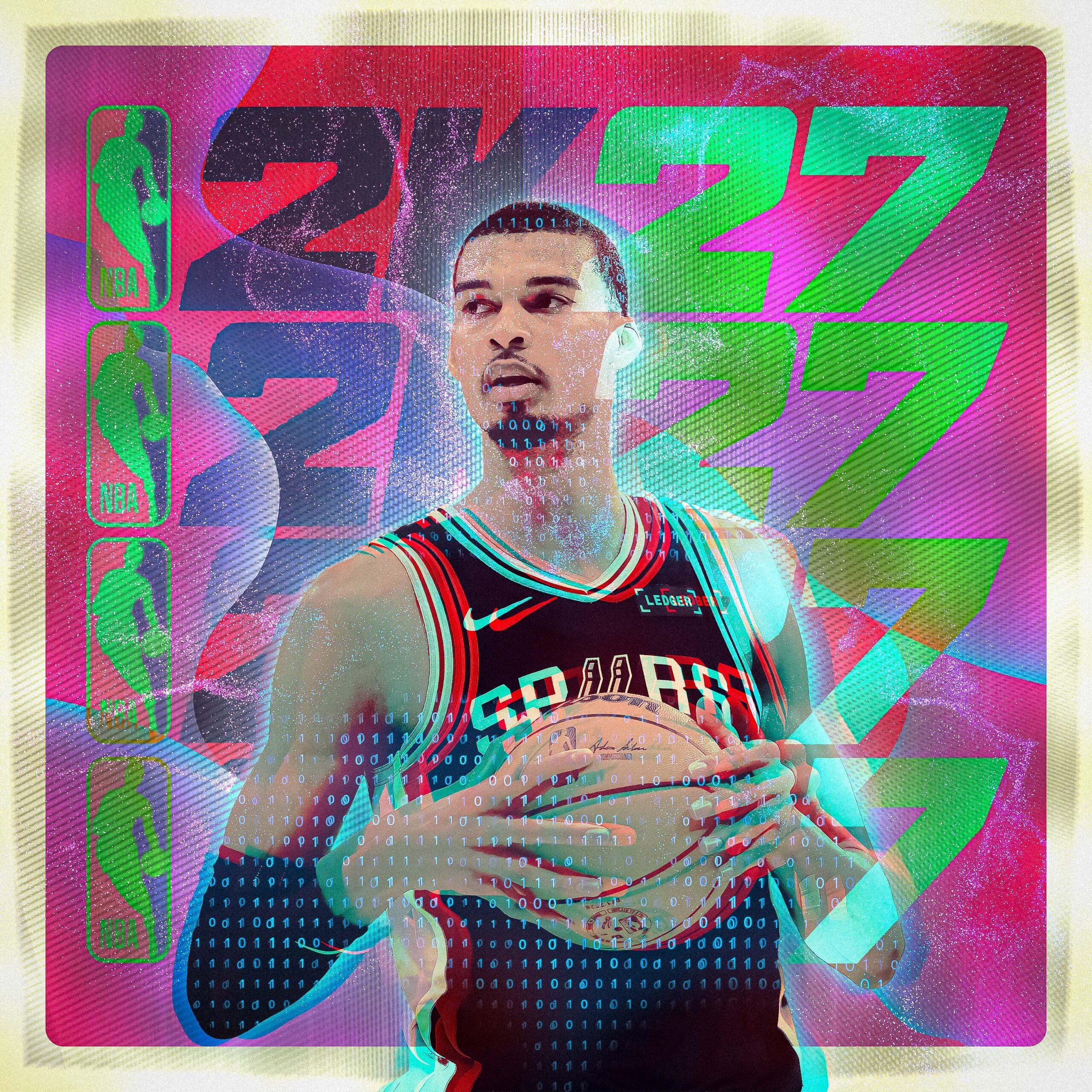
Wembanyama is speaking to me over Zoom from a sterile meeting room straight out of the severed floor of Lumon headquarters; the light beluga-gray walls and metal drawers only serve to accentuate the black San Antonio Spurs away jersey he’s wearing. Wemby’s on set to shoot a commercial for the upcoming NBA 2K27, though the only evidence of that being the case is the thin-rimmed basketball hoop with nylon netting hanging on for dear life in a larger pen area on the other side of a window. Wemby is the headlining cover athlete of 2K’s upcoming release. He’s the logical choice, though that doesn’t make it any less audacious. The franchise has always strived toward realism, but Wembanyama upends conventional notions of what ought to be considered realistic.
In essence, the video game company is choosing to champion its greatest stressor. “Early on, his size triggered glitches,” Mike Wang, NBA 2K’s gameplay director, tells me. “Dunk dismount animations were literally causing the tall models to clip through the floor, and his layup release heights were traveling above the backboard.”
Before Wemby’s arrival, there were built-in limiters that capped the ability to use a created player as tall, long, and skilled as Wembanyama in competitive online play. The game quite literally wasn’t built to accommodate someone like him. But Wemby has forced the game to adjust. It has to acknowledge his ability to flow into a crossover stepback 3-pointer. It has to acknowledge his ability to close out on the perimeter and block 3-pointers with ease. It has to acknowledge his ability to bend and contort in midair with the most preposterous catch radius the game of basketball has ever seen. Wembanyama has never been beholden to the limitations of archetype.
“The reason, in my opinion, that I’ve accomplished what I've accomplished already is because I've always been outside the box and not listened to the conventional advice that applies to everybody,” Wembanyama tells me. “I've never really had the choice to be different. I've always been different, just by nature. And I’ve doubled down on that all my life.”


The idea that Wemby is a video game character putting up video game numbers in real life is reductive and, up to this point, kind of backward. There is not enough latency in the world to make the 2K version of Wemby do what actual Wemby did for his 10th block in Game 1 of the Spurs’ second-round series against the Timberwolves: digging at a Bones Hyland drive as the helper, pivoting to swat at the layup attempt with his left hand before blocking it with his right in a ridiculous no-look flail that resembled the balletic form of a sweeping hook shot.
Insofar as reconstructing the Wembanyama experience goes, art can imitate life only to a degree. “The advantage I would have is that I don't have a limited amount of animations,” Wembanyama says. “I can do anything, when the player in the game can only do what it's been programmed for.”
A 7-foot-4 (7-foot-5? 7-foot-7?) player with an 8-foot wingspan and guard skills is an outlier that threatens to compromise the basic order of the entire game. Wembanyama’s play style necessitates the space for imagination within an engine that is not designed for that. In real life, that break in logic manifests as a teamwide aversion to driving into the lane when Wemby is sitting back in a drop; in 2K, it might look like a blocked shot that happened not because a user pressed triangle at the right time, but because his length and lateral quickness create a sort of unintended, pixel-based force field. How the 2K engine re-creates the psychophysical tension of Wemby’s real-life defensive presence may be one of the most important points of emphasis over the next decade of the game’s existence. For all of the signature moves that 2K has been able to incorporate to give the game a lifelike feel, replicating Wemby’s environmental impact on the floor is a franchise-defining undertaking.
“Capturing Wemby’s defensive gravity meant evolving beyond traditional timed jumps and manual contests,” Wang says. “We had to ensure that Wemby had passive proximity alone to lower an opponent’s shooting percentage. We want the defense engine to accurately reflect his ability to dictate plays without even touching the ball.”
Historically, the franchise has actually done an admirable job of instilling a sense of realism. It’s become realistic enough for a Defensive Player of the Year like Jaren Jackson Jr. to use as an educational tool, figuring out the timing of his real-life shot blocking by studying the launch cadences of players in 2K. We don’t have to imagine what the late sci-fi legend Philip K. Dick would think of all this. “Our environment—and I mean our man-made world of machines, artificial constructs, computers, electronic systems, interlinking homeostatic components—all of this is … becoming alive, or at least quasi-alive, and in ways specifically and fundamentally analogous to ourselves,” Dick said in 1972. “Rather than learning about ourselves by studying our constructs, perhaps we should make the attempt to comprehend what our constructs are up to by looking into what we ourselves are up to.”
In a simulation, style is a mental shortcut to pattern recognition. 2K has gradually gotten more nuanced in replicating Steph Curry’s off-ball gravity over the years or Jayson Tatum’s shrugging feints that flow into his stepback jumpers. In expressing the granularity of a player’s identity, the game can hold its suspension of disbelief for much longer. It’s interesting to think about how Wemby fits in this equation. Wembanyama’s most glaring style marker at this stage still rests on his size and seemingly limitless capacity for experimentation. Even at the highest levels of basketball, the Spurs are steered by the whims and pitfalls of his imagination.
Thus far, Wembanyama has been more intent on testing the NBA’s constraints than refining his own methodology. Is that sustainable? “The point of a signature move is to create a default back to instinctual play, which is essential in a free-flowing sport, but one could also argue that Wemby’s game is all instinct, just in the active voice rather than passive,” I wrote back in May. “Every possession is a prototype that either can be refined or can never be seen again.”
I ask Wemby whether he thinks he has a signature style of play.
“No,” he says. “But I think something that's very important, especially early on in the career, is training with a large width of skills, you know? Because it's something you don't necessarily have the opportunity to do later on in the career. And then you can work on the depth and make everything more and more perfect.”
2K presents Wembanyama as he is: a historic talent still figuring out his place in the game. At the heart of this fascinating relationship between 2K and the idea of Wemby is the tension that lies in rendering a source of awe and imagination within an inherently formulaic construct. It’s the line that divides possibility and probability, knowledge and understanding. That’s the needle that Wembanyama is trying to thread as he bridges what gap is left between the expectation and reality of his career. 2K is banking on Wembanyama leaving no doubt this coming season that he is the best player in the world. And part of that consists of metabolizing his one-of-one creativity into something more replicable.
“I think it's time for me to start getting more in depth,” Wembanyama says.