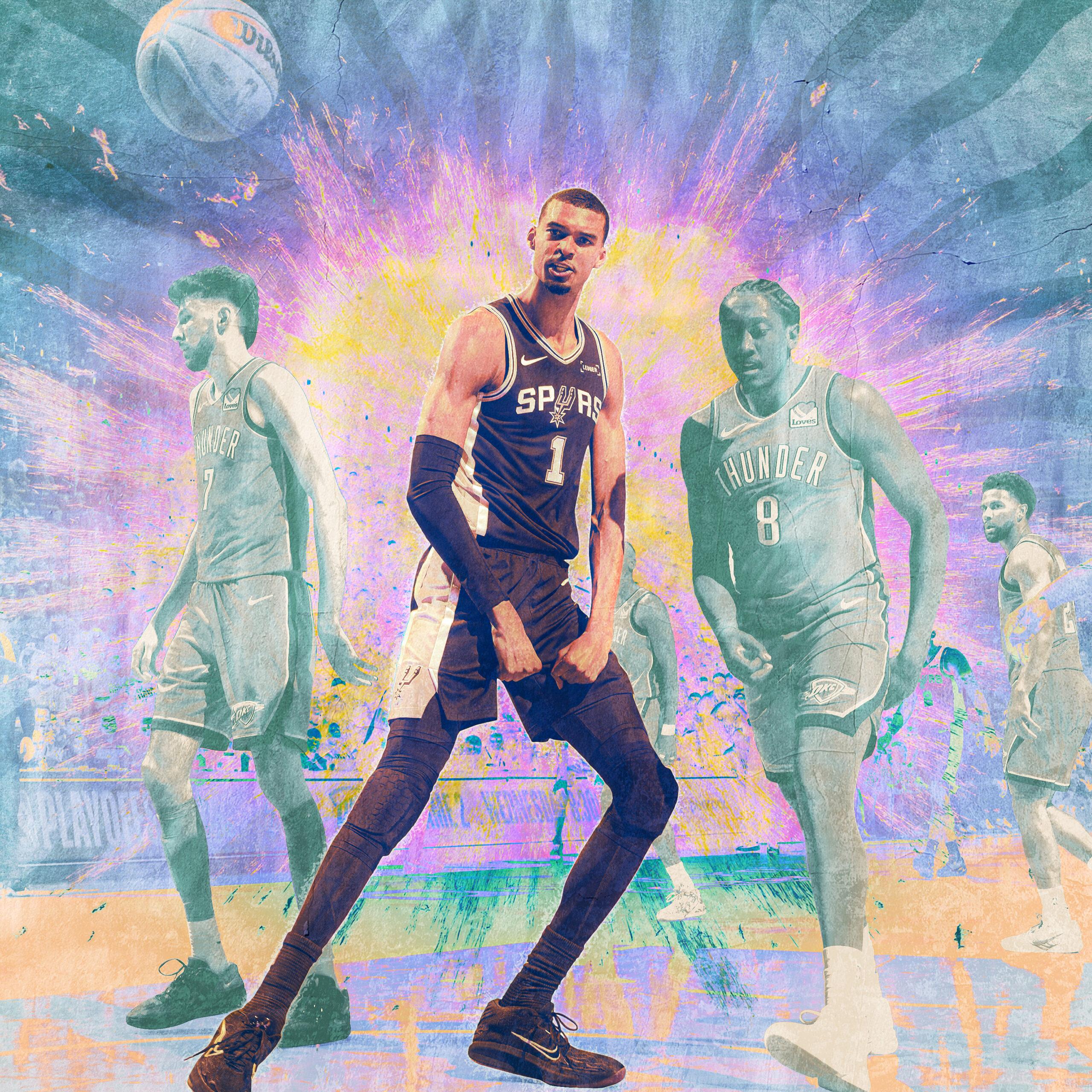

In a cosmic stalemate between the NBA’s two best teams and in one of the most compelling games of basketball you’ll ever see, 22-year-old Victor Wembanyama dictated the final scenes of a hard-fought, double-overtime instant classic against the Oklahoma City Thunder with an awe-inducing resolve. Coming into the postseason, the San Antonio Spurs star faced legitimate questions about how his conditioning and endurance would hold up against the kind of pressure he faced on Monday night. He answered those questions by approaching perfection across two overtime periods. He ended the game by breaking it.
A game-clinching reverse alley-oop dunk and a subsequent block, four seconds apart, punctuated the longest, and best, basketball game of Wembanyama’s life. His 41-point, 24-rebound master class in nearly 49 minutes of Game 1 is one of the great postseason performances in league history. At 22 years old, Wemby became the youngest player ever to record a 40-20 game in the playoffs. And he did it on the road against the reigning champs in the Western Conference finals, in a season series that, after San Antonio’s 122-115 win on Monday night, now sits at 5-1 in favor of the Spurs.
“He has a rare desire to step into every moment that’s in front of him,” Spurs head coach Mitch Johnson said of Wembanyama after the game. “I think he’s showed in his three years in a lot of different situations and a lot of different circumstances that he is going to attack those moments. He has some rare, God-given ability."
The defining moment of Game 1, and perhaps the clearest window into just how unprecedented Wembanyama is, happened with less than 30 seconds remaining in the first overtime period, with the Spurs trailing by three. It was like Wemby knew exactly where it hurt when he delivered a 28-foot trailer 3, from nearly the exact spot of the floor in OKC as the “Double Bang,” the iconic Steph Curry game-winner on a historic shooting night a full decade ago. On Monday night, the roaring sea of blue lining the seats at the Paycom Center went silent in an instant, littered with surrender cobras gasping for the air that had just been sucked out of the arena. In that moment, Wembanyama actualized one of my long-standing fascinations with his skill set: the game-altering potential of his transition 3-point attempts. “What can be done at the point of attack against a center with an 8-foot wingspan comfortably pulling up from 30 feet out?” I wrote back in July. “How do you confront that kind of anomaly when decades of positional orthodoxy are embedded in one’s muscle memory?”

In the biggest game of his life, Wemby cooly, naturally stuck the kind of shot that made legends of point guards more than a foot shorter than him. The Double Bang was a bit of regular-season heroics from Steph against the Thunder that became symbolic, underlining the inevitability of the Warriors dynasty and the ensuing demise of one of its most worthy challengers. Of course, these days, it’s the Thunder that are on the verge of dynasty—that is, unless the Spurs are currently in the process of undoing it. In Wemby’s latest bid toward greatness, he communed with Steph; he also traced the footsteps of Hakeem Olajuwon.
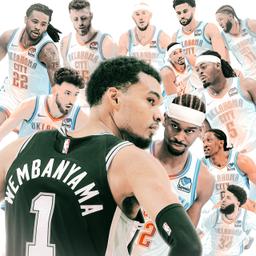
The postseason crucible concentrates these coincidences in time and space into something approaching fate. Game 1 was excellent from a game plan execution standpoint, but it was even more compelling from a storytelling perspective. Wemby’s astonishing performance (and Shai Gilgeous-Alexander’s labored and uncharacteristically inefficient night) immediately commanded a relitigation of the MVP race on the night that SGA was awarded the Michael Jordan Trophy. Alex Caruso’s career night set up an interesting David and Goliath dynamic between him and Wemby. Throughout the broadcast, the matchup between Wembanyama and Chet Holmgren was presented as a sort of full-circle moment after the two faced off as teens in the 2021 FIBA U19 World Championships, with Holmgren landing tournament MVP honors after a close 93-91 Team USA victory over France, wherein Wemby fouled out with less than three minutes remaining. Five years later, they’re here at the apex of the Western Conference. Things have changed. Holmgren is one of the 25 best players in the NBA, and the league’s awards voters uniformly deemed him the second-best defender in the Association; in Game 1, he was little more than a convenient plot device in a much grander myth. Maybe one day they’ll remake Amadeus in Wemby’s image, with Holmgren as the new-age Salieri.
Just about every NBA star has an aesthetic order of operations that, over time, develops into a signature style. It can be a natural pattern of movement, a particular spatial preference on the court, or a maneuver proved to consistently deliver results at the highest level. Donovan Mitchell loves his windmill pick-up getting around traffic in the lane; Karl-Anthony Towns totes the rock like a Heisman finalist on drives; SGA’s frictionless stepback is a hot knife gliding through butter. These are identity markers, hardwood catchphrases, familiar imprints on the game that let you know who owns it. It’s something many of Wemby’s onlookers are waiting for him to find for himself. “I would just break his shit down and be like, get a move that if it’s fourth quarter, you’re gonna go to it,” LaMarcus Aldridge said when diagnosing Wemby’s game on the All the Smoke podcast a few years ago. “It helps you stop thinking so fucking much. … I feel like he’s so skilled, he’s got 18 different moves in his head and he’s playing so fast. Slow yourself down and get two moves to go to.”

It’s sound advice, and perhaps a few years down the line we’ll see Wemby’s style become more concrete. But for now, at the ground floor of his bid as the best in the world, much of the allure of watching Wemby is exactly that potential for novelty every time he touches the ball. He’ll fly in to block a putback dunk attempt. He’ll roll hard in the two-man game, moving laterally the entire time, and then jump out of his sideways shuffle into a dunk rather than square up to the basket. He’ll isolate at the nail, grinding his defender down with spins and pivots like a classic swingman, but instead of a turnaround fade, he’ll elevate and contort in midair into a twirling, one-handed runner.
Wembanyama’s extraordinary frame allows him to do unimaginable things, and he has the coordination and imagination to problem-solve in unprecedented ways. The point of a signature move is to create a default back to instinctual play, which is essential in a free-flowing sport, but one could also argue that Wemby’s game is all instinct, just in the active voice rather than passive. Every possession is a prototype that either can be refined or can never be seen again. At the risk of flattering Wemby’s self-image more than necessary, there is something very Bruce Lee about his approach to basketball as an aesthetic endeavor: He possesses a style of no style. The joy of watching Wemby is not unlike a child watching an unboxing video—there is a broad sense of what you’re in for, but it’s the communal sense of discovery that makes the experience special. There is magic in the reveal. And for Wemby, the reveal seems endless.
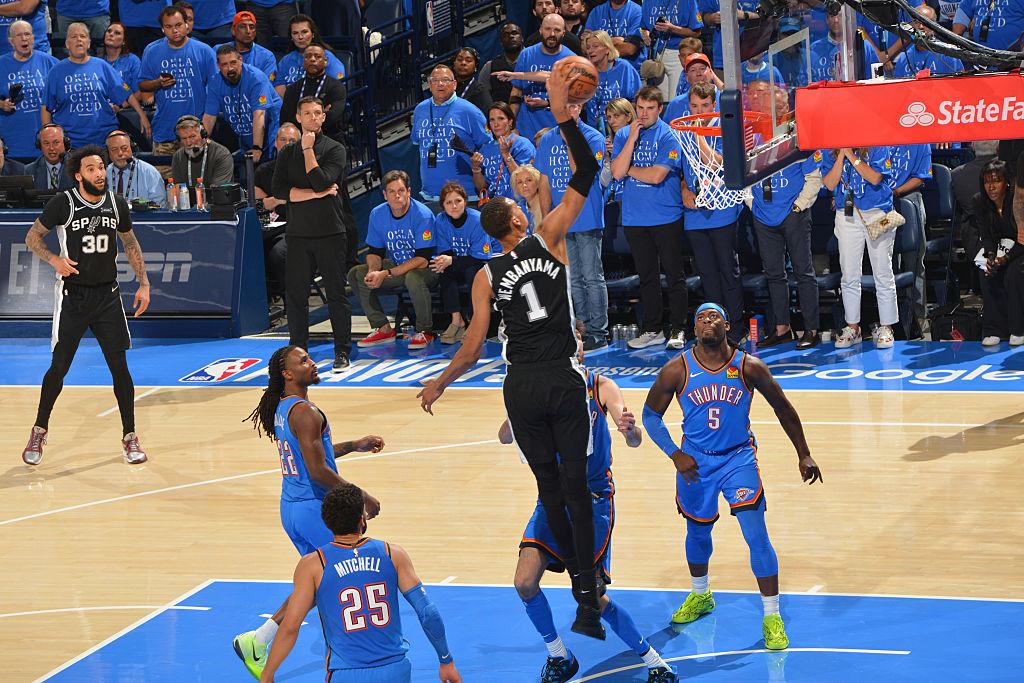
Ultimately, Wemby’s capacious game is anchored by the environmental impact of his defense. It’s typically the murkier, more nebulous half of the game, yet Wemby’s leverage is as clear as day. There is a psychic toll that comes with trying to attack Wemby on defense, sure, but his degree of influence surpasses even the most formidable rim deterrents. He doesn’t just leave drivers second-guessing; he completely alters what they believe in their hearts to be physically possible. (“He’s like 8 feet,” Jalen Williams said after the game—although given Wemby’s wingspan, standing reach, and mobility, that’s somehow underselling his dimensions on defense.) The Wolves were left demoralized by the end of their second-round series against San Antonio, unable to find any reliable way to get around Wembanyama’s dynamic radius. Wemby scored more points against the Wolves’ starting frontcourt of Rudy Gobert and Julius Randle (67) than the entire Minnesota starting lineup scored over Wembanyama (62), according to NBA matchup data compiled by Databallr.
“It’s obviously challenging,” Gilgeous-Alexander said after Game 1 with regard to scoring over Wemby. “He’s very tall, very long, and he deters a lot of things at the rim. You’ve got to be smart when you go in there. Be patient, but also be aggressive and don’t be too timid in there. I think you get caught worrying about it too much and you lose aggression, and that’s when they really get a stranglehold on the game. You’ve got to be able to be aggressive but also be smart.”
As evidenced by Wemby’s 12-block performance in Game 1 of the previous round, his extreme, exaggerated dimensions can create phantasms on the court that not even the most trained eyes in the league can shake. What Wemby is quickly figuring out is how to dominate the space between optical illusions, much like I’ve argued SGA has done in his career. It’s fitting that the representative megastars of the Western Conference finals control the way the game is seen by reaching, bending, twisting, and, yes, falling. In an age when meaning and perspective can so easily be distorted and reshaped to meet a specific end, this series speaks to the times and contemplates the future in more ways than one. But in the end, it all comes back to storytelling, and the winner of this best-of-seven will set the dominant narrative of the NBA’s new era. In Game 1, Wemby made as resounding a case for being the best in the world as a player could possibly make. If the basketball gods allow, the Thunder will have six more cracks at delaying the inevitable.