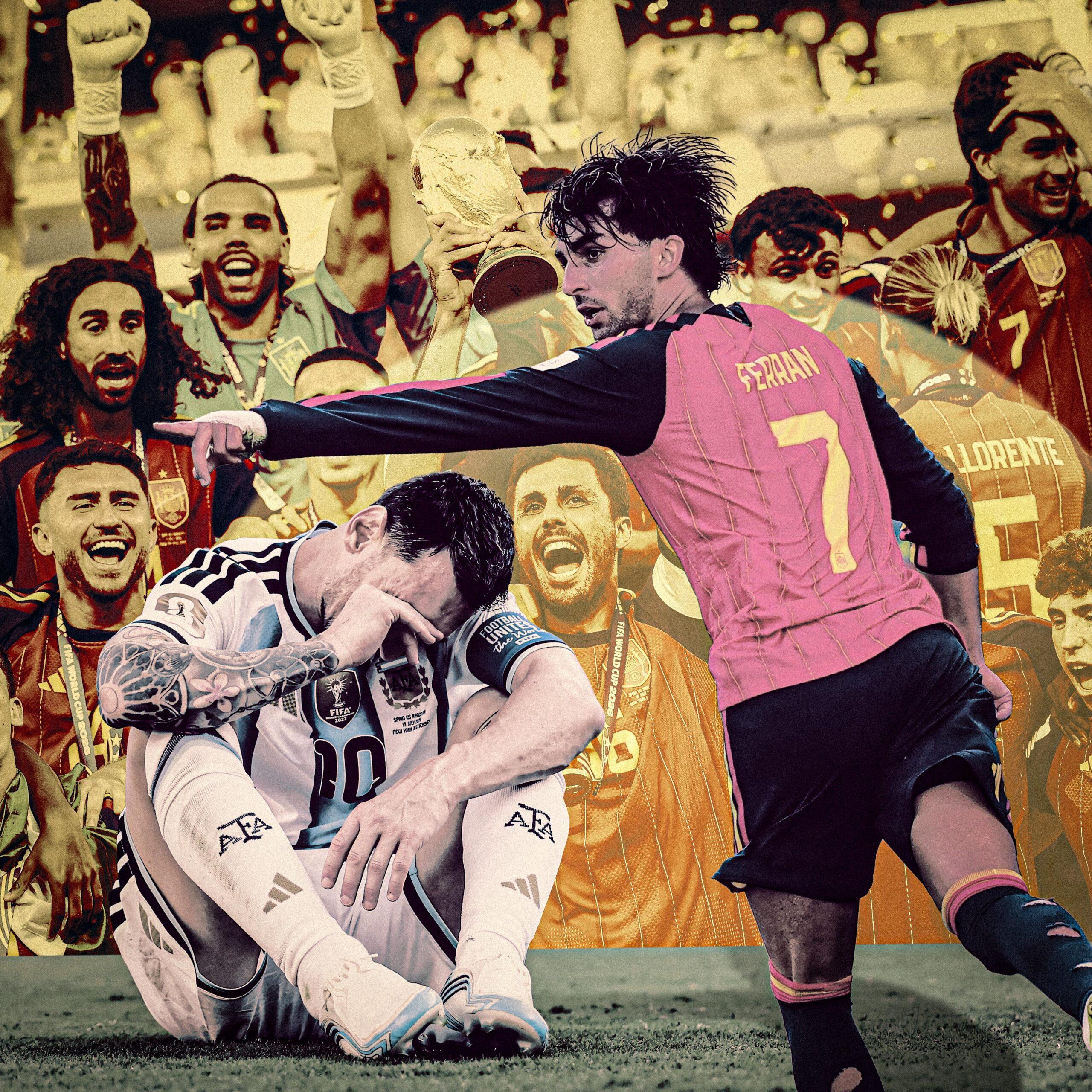

All right, before we say anything else here, let's shoo the elephant out of the room: zero effect on Messi's legacy. Losing a World Cup final no one expected you to reach at the age of 39 is not a diminishes-your-greatness type of scenario, especially not when you hauled your team there in a wheelbarrow, and especially not when the rest of your team is so thoroughly outplayed that you barely get your toe on the ball until stoppage time's dying breath. Lionel Messi's greatness, if it was ever in doubt, was confirmed for once and always four years ago in Qatar; this go-round, probably his last World Cup ever, was all bonus points. This ruling is final and cannot be reviewed by VAR.
Good? OK, let's talk about the match.
It was kinda dull! I would love to gin up a sense of drama to make you read to the end of this piece (please do, my family is starving). But after the many, many bangers this World Cup has given us—even the third-place game, a 10-goal fit of psychedelia between England and France, was riveting—this one was just, like, a soccer game. Oh well. They can't all be classics. It's not against the law for soccer players to play a normal soccer game!
We probably should have seen this coming. Spain has a tendency to dominate possession without scoring all that much, and Argentina has a tendency not to show up for matches till the 78th minute; put those patterns together, and you're likely to get a contest of attrition and late-game nerve. Would Argentina ever touch the ball, even once, even for one second, before extra time? No. Would Spain show any hint of a killer instinct after stringing 87 passes together again and again and again? Also no. Would Argentina be able to make up for their fatal lack of width by shoving Spanish players to the ground every time the referee blinked? No, but they tried so hard! Would Spain be able to shoot the ball without looking like they were trying to loft it gently into the arms of Argentina's goalkeeper, the great Emiliano Martínez? The Death Star tractor beam was a fan of their work.


The match went like this, more or less from the opening whistle: Spain, Spain, Spain, Spain, Spain, Spain, Spain, Spain, missed shot, corner, repeat. None of the corners went anywhere. I'm not sure human language can convey just how utterly Spain dominated every phase of this game, or just how un-dominant it all felt. It was like watching Argentina talk to their therapist for two straight hours. The Argentine players threw tantrums, lashed out, complained, got mad, reenacted their childhoods, cursed, and knocked things over—well, not Messi; he was mostly just anonymous, running around the far side of the pitch like a repressed memory the patient couldn't quite recover—while the Spanish players stayed calm and kept playing their relentless, clinical, weirdly chilly soccer. Six-yard pass after six-yard pass, like And how did that make you feel, Mr. Romero?
Of course a game like this was bound to go to extra time, and this one duly did. It was 0-0; if you squashed those numbers together, you'd get an infinity sign, which felt appropriate. In extra time, Spain—now playing a man up after Enzo Fernández was sent off in the 93rd minute for a foul that sent Pau Cubarsí hurtling into the sky like a firework—finally started looking frustrated. Here's how maddening it must have felt to be Spain: By the end of the first half of extra time, Spain had 19 shots (it felt like more) and Argentina had zero (it felt like less). Yet to the scoresheet, all zeroes are identical.
It wasn't deep frustration, really, but it was palpable. Lamine Yamal, Spain's superstar 19-year-old winger, got visibly irritated after a couple of frankly very irritating Argentine shoves, and around this point, the frame of the match briefly threatened to change. Maybe Argentina's chippy performance had actually been a tactical masterstroke, aimed at getting under Spain's skin? Maybe the best way to win a soccer game is to let your opponents take all the shots? Penalties loomed, and penalties would have been a crushing development for the squad that had enjoyed 687 percent of possession up to that point. You could feel Spain's morale sinking with every second that ticked by, like the mood in the car after you tell your uncle Duane you're driving to a vegan restaurant.
Yeah. That didn't last. In the 106th minute, Spain's Ferran Torres donked a high shot from the center of the area that initially looked like an absolute chimney, but then—I'm using technical language here—sort of clonged past Martínez and into the back of the net: 1-0 Spain, on what was only their 20th shot of the match (sarcasm font). Argentina looked a bit better after that, as teams that go down a goal usually do. Heading into this game, La Albiceleste had scored 12 of their 19 goals after the 75th minute, the most in World Cup history, and if you'd been in a comical frame of mind, you might have argued that Argentina had Spain right where they wanted them. Suddenly, Messi was touching the ball occasionally rather than never. Suddenly, perhaps for the first time in the tournament, Argentina seemed to have fullbacks in their lineup. Several corners threatened to be interesting; in the end, none were. Argentina succumbed after a brutally forgettable performance, finishing with an excruciating statistical combo: 11 saves from Martínez, zero shots on goal.
It was an underwhelming final, as most finals are. (Even 2022, the most thrilling single sporting event I've ever seen, wasn't that good till late in the second half.) But I do want to take a minute to appreciate Spain, a team that dominated this World Cup almost as completely as any team ever has, even if they never quite captured the world's imagination. Spain gave up one goal in this tournament. Let me say that again: Spain played eight matches en route to the title and surrendered a total of one (1) goal. (Congrats, Charles De Ketelaere of Belgium.) Their path to the championship took them through France, the star-studded supergroup picked by most as the tournament favorites. Spain beat Kylian Mbappé and company to pieces; the final score was 2-0, but that doesn't communicate the carnage. (Mild-looking final scores in matches that were absolute bloodbaths are a hallmark of this team.) They didn't lose a single match. The only nation that held them to a draw was Cape Verde, the darlings of the early rounds, whose World Cup story now looks even more amazing.
Like the last Spanish team to win the World Cup, in 2010, Spain play in a style that can be mesmerizingly skillful but that's seldom really thrilling. Prioritizing possession over everything means most of the team's daring comes when they don't have the ball, as they press with speed and aggression to try to win it back. Having won it, they can look cautious, rolling it around in short triangular passes that risk nothing and go nowhere. "They want to pass the ball into the back of the net," people used to say about Arsène Wenger's old Arsenal squads; Spain's strategy is predicated on the idea that defensive gaps will be exposed by patience, but they sometimes play as if they're mildly offended by the need to put the ball in the net at all. Shooting—so inelegant! It's not ugly soccer by a long shot, but it's not beautiful in the free-flowing, ears-pinned-back style of the classic Brazil and Dutch teams. It's murderously effective—Spain, don't forget, won the European Championship two years ago and are currently in the midst of the longest undefeated streak in international soccer history, at 38 games and counting. But if you're an adrenaline junkie like me, it can feel a little abstract and over-refined. A little boring.
I'm trying to find it in my heart, though, to appreciate competence. Spain may not stir you in the poetic-artistic sense, but they're really, really fucking good at their jobs. Rodri? Just a towering pillar of competence. Marc Cucurella? You have to be competent to be that good with that hair. Pau Cubarsí? So competent I spent the whole final imagining him muttering to himself, "This game could have been an email." We are living through an era in which it seems that many things are getting worse, perhaps irreversibly and certainly with a dismaying quickness. To see a squad this in sync, this capable of bringing a plan to fruition, is inspiring, if only as a reminder that human beings are capable of doing difficult and complex work together without totally screwing it up. At a time when international soccer teams look more similar than different thanks to the wide geographic distribution of players and the prevalence of foreign coaches, Spain play in a distinctive, coherent style that most of their players have been drilled in since their youth. They were built carefully and systematically to succeed, and they do.
It may not have been the face-melting exhilaration inferno of 2022. But I look at the world right now, and it's so grim. The air's full of smoke from runaway wildfires. We're all getting explosive diarrhea thanks to Trump's CDC cuts. AI doesn't do almost any of the stuff they say it does, but you still have to use it all the time, because a CEO said so. Everyone in power seems to be so bad at doing the exact thing they've been empowered to do. I mean, my God—we can't even do photo ops correctly in this country.
So I don't know—maybe it's a stretch, but to me, Spain's World Cup win feels like a small act of vengeance for every lost FedEx package, every health-insurance snafu that cost us three hours on the phone, every time we had to work harder at our jobs because our bosses insisted we'd be more productive using some broken tool they never even tried to understand. It's a reprisal for all the gadget designs that made the tech harder to use, all the legal reforms that made life more difficult, all the city roadwork that created more problems than it fixed.
It may not feel cinematic or epic, and it may not make you leap out of your seat. But Spain do what works, and they do it better than anyone else. And what works has its own romance, at a moment when so few things do.