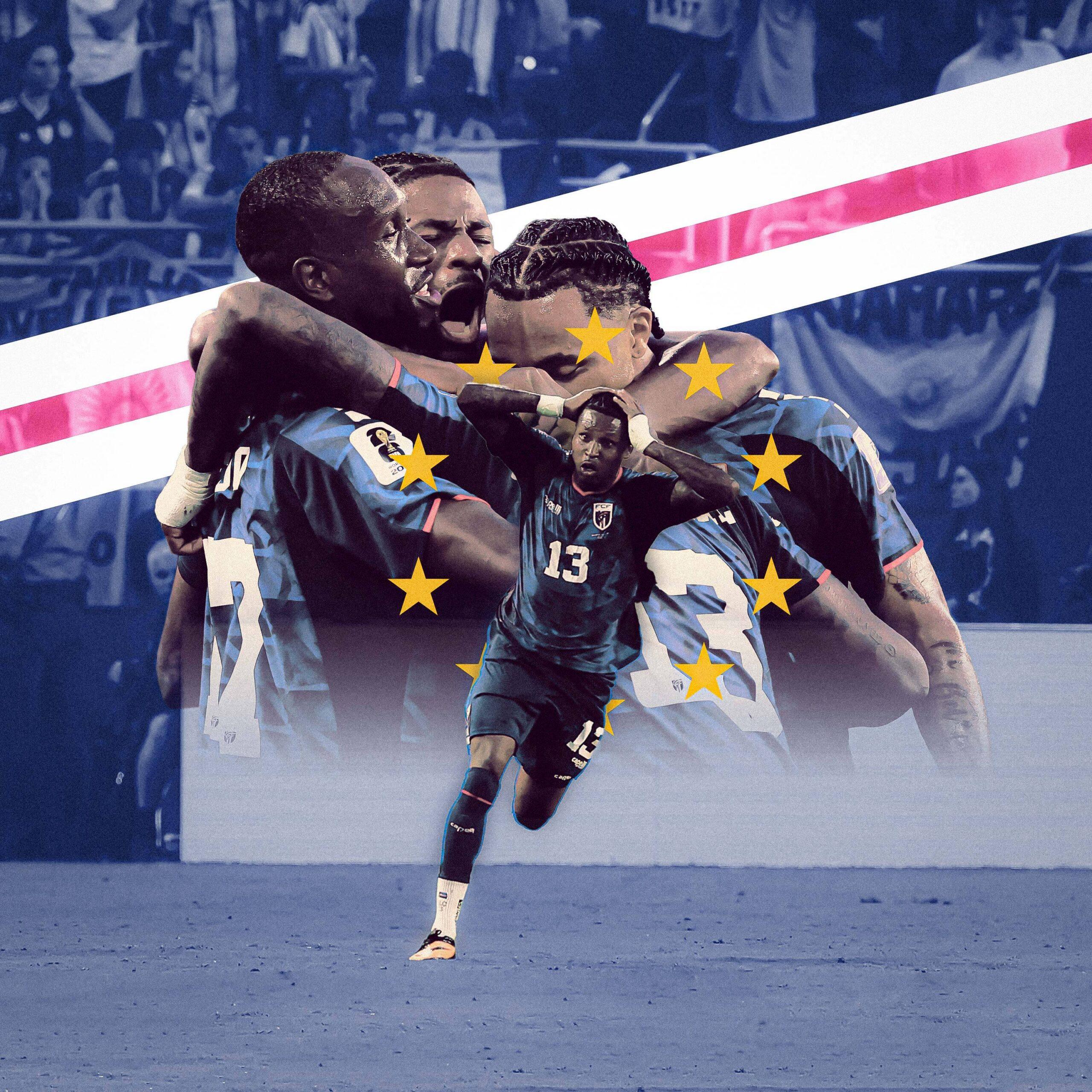

What does it feel like to watch one of the greatest sports stories ever unfold in real time? There is awe. There is wonder. The brain starts racing in search of a historical comparison: the Miracle on Ice? UMBC becoming the first 16-seed to topple a 1-seed in March Madness? Buster Douglas knocking out Mike Tyson? For 120 unforgettable minutes on Friday night, the epic match between Cape Verde and Argentina seemed poised to enter that conversation.
Had Cape Verde actually pulled off the victory, it might have been the greatest upset in sports history. A small island country with a population of 530,000 against a soccer-obsessed nation with over 46 million people. One country making its World Cup debut vs. the defending world champions and the best player in the sport. The no. 67-ranked team in FIFA against no. 1.
Argentina went up 1-0, then 2-1, and finally 3-2—and even then, Cape Verde kept pushing. But the upset never came. When the final whistle blew, Argentina was through to the round of 16 and Cape Verde’s World Cup dream was over.
It hardly mattered. Cape Verde didn’t need to beat the defending champions to cement itself as the defining story of the tournament. Its players became international heroes. Vozinha's performances in goal will be passed down in Cape Verdean soccer (and World Cup) lore. Sidny Lopes Cabral's extra-time goal to tie the score at 2-2 will live forever alongside some of the greatest goals in World Cup history. The team played with a persistence and togetherness that highlighted the very best of this kind of international competition. They won over everyone from diehard fans to casuals across the U.S. who are experiencing the World Cup for the first time. As for me, I am proud to say I am one of Vozinha’s now-22.2 million Instagram followers.
Cape Verde’s golden generation just delivered everything to its people. Children in Praia will grow up replaying these matches, wearing the jerseys of Vozinha and Cabral, and believing that the world's biggest stage is within reach. They won’t return home with the World Cup trophy, but they will always carry the memory of standing toe-to-toe with some of the most decorated soccer nations in history, and proving they belonged on the same field.
Only eight countries have ever won the World Cup. Maybe a dozen enter a given tournament believing they realistically have a shot. Everyone else comes with a different intention. They want one upset, one unforgettable night, or one moment that becomes part of a nation's identity forever.
Cape Verde had several. In its opening game, it forced a 0-0 draw with Spain, one of the two pre-tournament favorites. In its second, it drew with Uruguay, 2-2. A third draw, 0-0, with Saudi Arabia clinched Cape Verde’s spot as the most unlikely entrant into the knockout stage.
This captures the true essence of the World Cup. In a departure from the silverware-driven metrics of club football, glory here is defined by more than just trophies. Morocco’s seminal run in 2022 shifted the soccer world’s perception of an entire continent. Costa Rica’s 2014 quarterfinal journey provided a generation of sporting nostalgia. Iceland transformed into a worldwide sensation at the Euros with its win against England in 2016, despite never hoisting a trophy. Cape Verde now enters that lineage of shooting stars who shined so brightly that they blocked out the elite teams that we’ll hear more from later in the tournament.
When Cape Verde was penned into its own penalty area against Spain and battling a seemingly never-ending clock, its defense never faltered. When they fell behind 2-1 against a desperate Uruguay team in need of three points, Cape Verde not only equalized but showed an ability to stop the Uruguay attack completely after halftime. And they didn’t just settle for a draw against Saudi Arabia, even when that would have guaranteed their advancement: They kept attacking and playing for a winning goal.
In the round of 32, this group of players—managed by a man named Bubista who has never coached professionally outside of his home country—legitimately had the defending champions on the ropes. It wasn’t a classic example of an underdog parking the bus and barely holding on. Instead, Bubista may have pulled off the best managerial job at this tournament, getting this group to both defend effectively and look consistently dangerous on the attack. They came from behind on multiple occasions against South American powers and took every punch still standing.
It’s why Argentina’s fans applauded Cape Verde’s players off the pitch on Friday night, after both teams endured the Miami heat for two hours in some of the most grueling and intense minutes of the entire tournament. Cape Verde could have treated Lionel Messi’s opening goal as a knockout blow. Instead, they lurked and scored a second-half equalizer. Lisandro Martínez’s extra-time thunderbolt to put Argentina up 2-1 felt like the dam breaking. Instead, Lopes Cabral’s goal was the equalizer that shook the match to its core. Argentina’s final goal could have finally broken Cape Verde’s spirit. And yet, the final 10 minutes of this match featured an exhausted Argentina barely holding on against wave after wave of Cape Verde attacks. Like Congo on Tuesday against England, Cape Verde proved that a well-coached and well-organized group can fight to overcome a seismic talent gap. Bubista engineered a tactical approach that not only allowed Cape Verde to live out its dreams on the pitch, but also provided a blueprint to every other David around the world.
“We did the hardest part, which was finding the first goal and then from there we would find our game,” Messi said post-match. “And it was the complete opposite.”
When Cape Verde's fairy tale finally ended, many players collapsed to the turf in exhaustion and heartbreak. Vozinha walked from player to player and lifted each of his teammates back onto their feet. It was not the time for mourning. First came appreciation and recognition. Under the previous World Cup format, in which Africa only had five teams, Cape Verde likely never would have qualified for the knockouts. With the expansion to 48 nations, Africa now gets 10 teams in, and nine of them reached the knockouts.
Cape Verde reflects the image of exactly what FIFA’s critics missed when analyzing the expansion.
Plenty of critics claimed that expansion would diminish the group stage, water down the first knockout round, and lead to too many global minnows getting outclassed on the world’s biggest stage. But while there were certainly a few uncompetitive teams at this tournament, Cape Verde reflects the image of exactly what FIFA’s critics missed when analyzing the expansion.
Critics viewed expansion as a talent and math problem. More teams meant more mismatches. But those critics missed a key piece of what makes the World Cup a unique event. Every additional place in the World Cup is another chance for a nation that has never mattered on this stage to suddenly matter to everyone. If you create more soccer and allow for more nontraditional soccer nations to make the field, you are increasing the surface area for one or two surprises. In a sport as variable and low-scoring as soccer, it doesn’t take much to get a result or two that change the course of a nation’s soccer trajectory.
The new World Cup format does lessen the jeopardy for the elite teams. The group stage isn’t really about the top-tier squads anymore. It’s now about Congo, South Africa, Cape Verde, and other nations who have unique opportunities to showcase their talent on the world’s biggest stage.
Inside Hard Rock Stadium on Friday night, the scoreboard read one thing. Everyone who had witnessed Cape Verde for the past few weeks knew another. It’s why the celebrations among Cape Verde supporters continued after the match and into the Miami night.
In an era when modern sports often feel increasingly predictable, meticulously optimized, and dominated by financial superpowers, Cape Verde offered us something new and genuine to believe in. The greatest sports stories aren't always about the winners. It's the dream, and even more importantly the fight, that people remember.