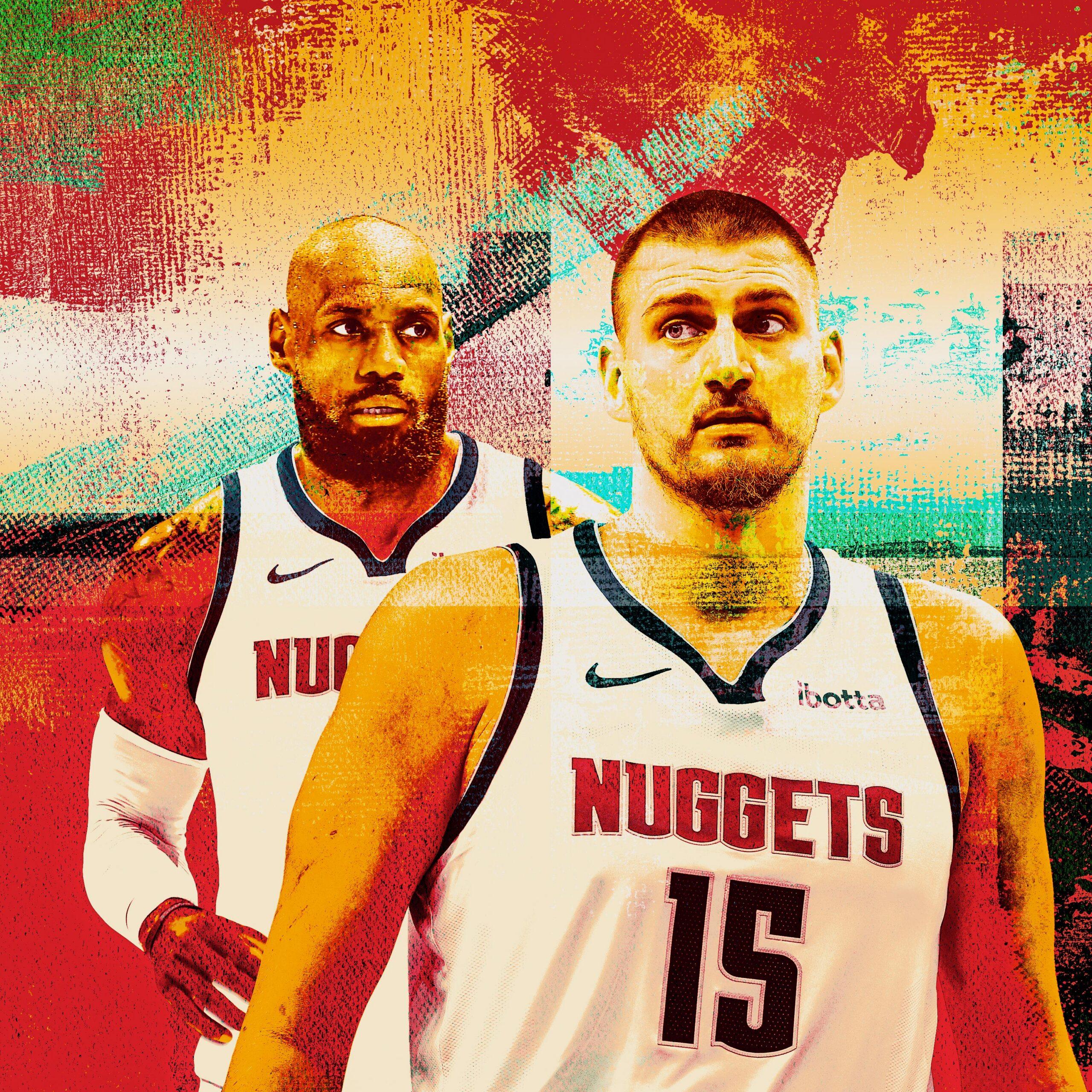

With no end in sight and every realistic suitor currently stuck in the mud until his final decision is revealed, LeBron James, once again, has the NBA offseason wrapped around his finger. Most of the anticipation is just. We’re talking about a peerless icon who defied Father Time once again by averaging 20.9 points, 7.2 assists, and 6.1 rebounds per game in his 23rd NBA season.
James is singular and awesome, still able to carry a team by the scruff of its neck through a playoff series. When he was on the court without Luka Doncic and Austin Reaves last season, the Los Angeles Lakers still outscored opponents by 7.2 points per 100 possessions. Whoever lands LeBron will be better.
The actual significance of his signing is to be determined, though. James will turn 42 years old in December and averaged the fewest minutes of his career last season. Whether he can move the needle at this stage largely depends on how much talent sits above him in his next team’s pecking order. Pretty much every impact metric model reflects the obvious and understandable: This cosmically impressive athlete is in decline.
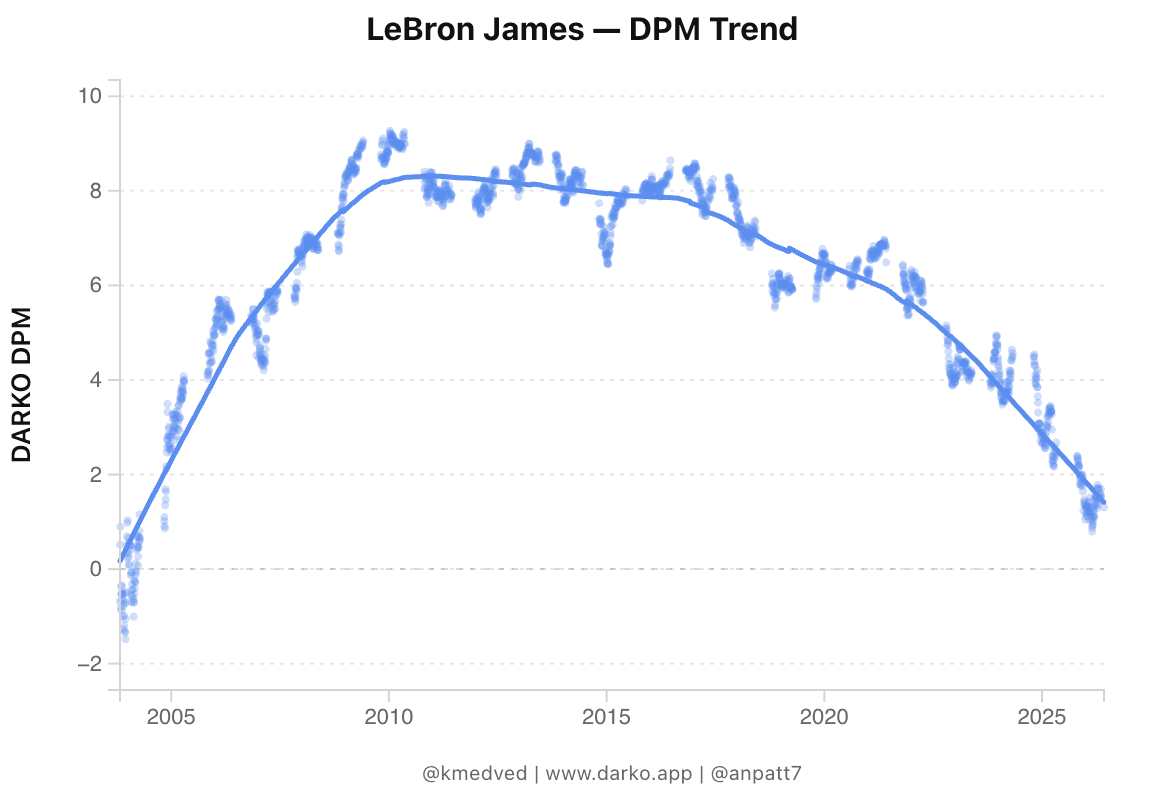
Can he be the third fiddle on a championship contender? Sure. The copilot? Probably not. This is admittedly a reductive analysis, a sweeping judgment that lacks meaningful context and might come across as disrespectful to one of the greatest basketball players who ever lived. But the NBA is increasingly a young man’s game; while LeBron’s ceiling remains that of a top-20 player, his ability to produce in a high-usage role for the entirety of a grueling nine-month season is suspect. But put him on a team where on-ball dominance and the need to generate quality shots for himself and others aren’t prerequisites for success, and you’re cooking with gas. It’s why, purely from a basketball perspective, I don’t think any team in the hunt for James would yield a more entertaining, captivating, or satisfying return than the Denver Nuggets.
It’s hard to speculate about LeBron’s fit on an incomplete team that’s staring down the barrel of a nine-figure repeater tax penalty with Peyton Watson still a restricted free agent. In a crowded field that includes more fully formed options like Cleveland, Philadelphia, Miami, Golden State, and wherever else he may want to go, I know Denver isn’t the most realistic possibility. It can likely offer only the veteran’s minimum because using the taxpayer mid-level exception—which could be a two-year, $12.4 million contract—would hard-cap the Nuggets at the second apron, where they pretty much already are.
But before we dive into the logistics and rationale, can we fantasize about how profound it would be to witness LeBron James and Nikola Jokic wearing the same jersey? Two kindred spirits who, when all is said and done, will sit at the top of any reputable list that ranks the most exceptional offensive players the NBA has ever seen. “There has not been a more dominant complete player that I’ve played against,” James said about Jokic earlier this year on Mind the Game. “There’s nothing he cannot do on the offensive end. Like, nothing at all.”


The union would have no historical parallel. You can build an entire roster out of household names who once called LeBron a teammate. Some of the most technically majestic, physically dominant, high-achieving stars the NBA has ever seen. He also, at times, has had true basketball brilliance in his ear: Rajon Rondo, Shane Battier, J.R. Smith, etc. None of them, though, ever combined IQ, skill, and accolades like Jokic does. They don’t seem like basketball soulmates but should absolutely be viewed that way.
OK, with that settled, how would this all work? Even if only two of Watson, Cam Johnson, and Christian Braun are back to serve as Denver’s fifth and sixth men next season, the bulk of Denver’s championship odds in this daydream would hinge on the synergy and health of four starters who’d immediately form the most accomplished, powerful, and selfless quartet in the NBA: James, Jokic, Jamal Murray, and Aaron Gordon.
There’s positional elasticity, plenty of shooting, indomitable size, and encyclopedic brainpower. All four can bring the ball up the court and initiate highly efficient offense. James could run a mean two-man game with Murray or operate from the post against compromised defenses that would, in all likelihood, struggle to find a matchup for him and Gordon without putting two on the ball. LeBron would also add a dimension to the Nuggets’ attack that hasn’t really existed before, rumbling downhill from the perimeter to put pressure on the rim. It’s pick your poison all over the court, with a ceiling somewhere in the realm of “best offense in NBA history”—one powered by problem-solving sleuths who’d flow through the action with unprecedented competence.
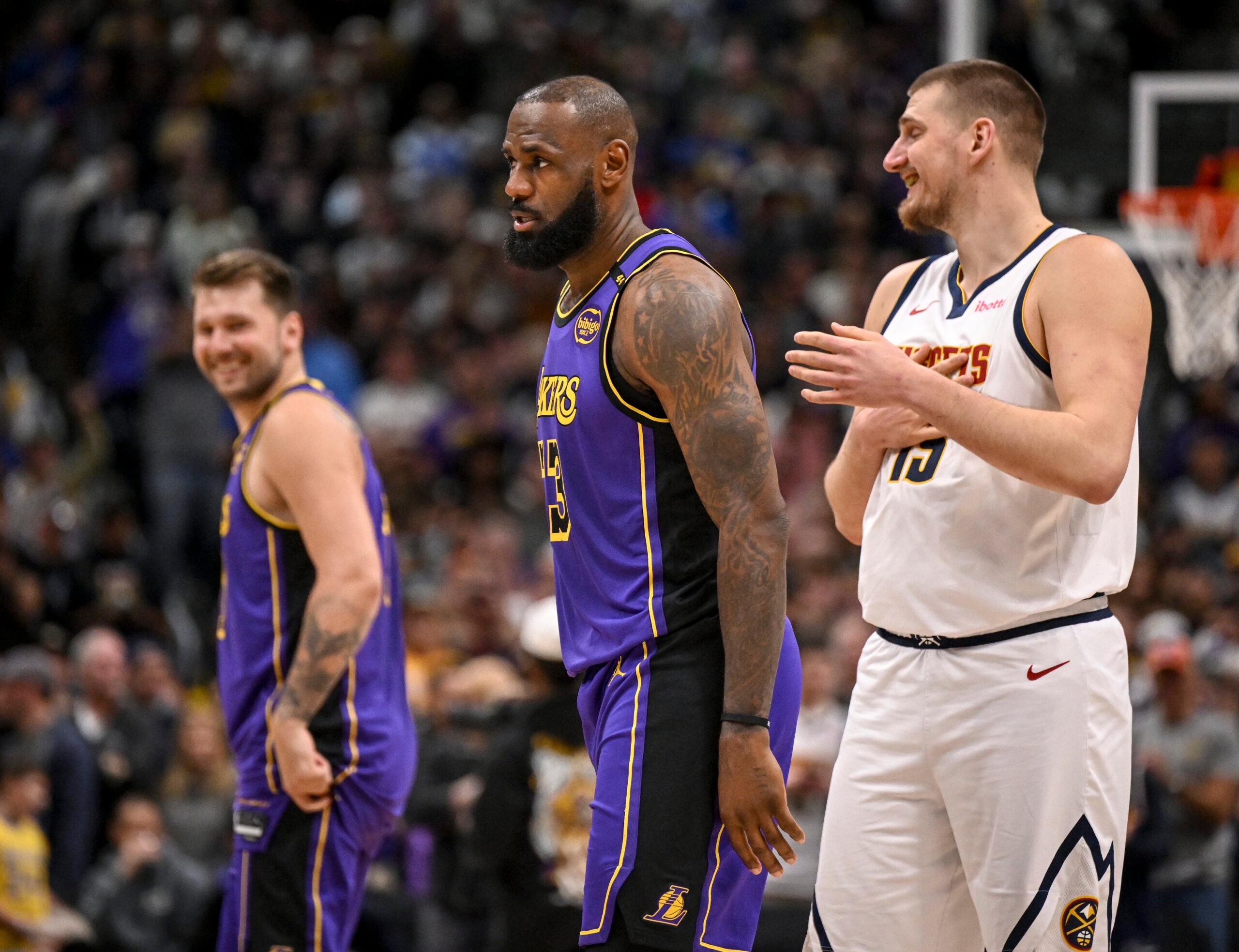
At the heart of everything, of course, would be a symbiotic collaboration for the ages. Over the past six years, Jokic has inherited LeBron’s greatest attribute: the intuitive willingness to connect all the dots on a basketball team with force and creativity, efficiently maximizing imperfect rosters. Together, even with James no longer operating at the peak of his athletic powers, the two would breathe ethereal air—cracking trigonometric equations while everybody else struggles to hold a protractor.
Jokic’s genius can enhance just about anyone in the league. He touches the ball a ton but doesn’t dominate it unless the defense leaves him no choice (and is willing to get torched one-on-one). That would keep LeBron engaged at all times, unlike when he played with Luka Doncic. There’d be no on-court conflict or awkward redundancies. They’d spot cracks in the opposition, thrust a crowbar in to pry every advantage loose, and feast in the open floor.
LeBron can’t solve defensive woes that became bad enough for Denver to need a crisis PR team during last year’s playoff debacle against the Timberwolves, but he does bring some size, savvy, and muscle. (As another über-reliable ball handler, James could also stanch some of the turnovers that crippled Denver’s transition defense.) The Nuggets would still look a step slow on occasion, but their ability to get stops and flip them into immediate scoring opportunities heading the other way would dramatically improve.
James averaged the most fast-break points per game last season, and 22.5 percent of his points were scored in transition, which ranked second. These are small data points in a grander scheme, but they help illustrate why James would be the peanut butter to Jokic’s jelly. No player is more eager and able to take advantage of a quick strike than Denver’s three-time MVP; the moment he grabs a defensive rebound, the Nuggets are a threat to score.
More broadly speaking, this duo lacks the sort of on-court hubris that could spell their undoing. They appreciate the value of the pass and would find new ways to optimize each other on a weekly basis. There’d be no confusion in crunch time. No ego-driven fallout in the face of a tough loss. Whoever is open gets to shoot. Read, react, and live with the results.

There’d be something historic about watching them as a pair: two mononymous fable makers who nearly overlapped in their claim to the “best player on Earth” title teaming up, with a healthy mix of confidence and skepticism surrounding their effort to reach the Finals. In Denver, LeBron and Jokic would enter the season knowing they could win a championship while also telling themselves (accurately) that they’re underdogs.
The vast majority of the league couldn't even detect the frequency at which they’d feed off one another. There would be sequences where the collective insight held by everyone else on the court might as well fit inside a teacup. You can already picture a highlight reel of no-look passes that reward instinctual cuts to the basket. Hail Marys that are so precise they look choreographed. Two 5D chess masters attending a Tiddlywinks convention.
Jokic is singular, a burly ballerina who can anticipate what’s going to happen a second before it does. He’s also the only player alive whose skill set could extend LeBron’s career without diluting everything the all-time scoring leader has left. It’d be an invigorating, frictionless partnership inside a tried-and-true system. Everybody wins. Everybody has fun. Everybody would watch. LeBron probably won’t choose the Nuggets, but for all the reasons laid out in this pitch, he should! Cleveland is tiresome. Miami is nonsensical. Golden State is hopeless. Minnesota is weird. If basketball were literally the only factor driving his approach to this process, there wouldn’t be an alternative.