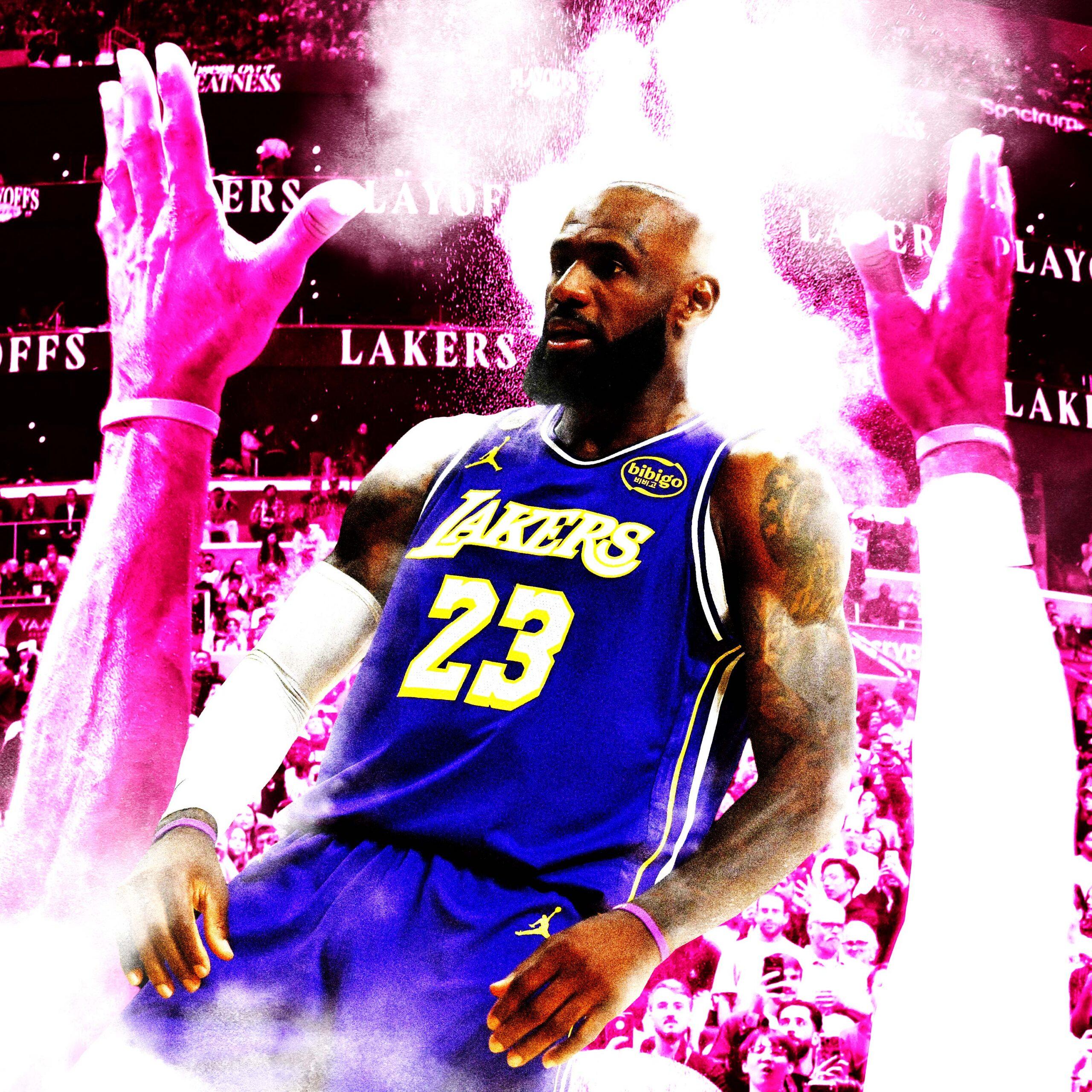

There is a serenity in LeBron James’s game these days that feels absolute. Even his most ardent haters have begrudgingly given him props amid one of the most meaningful playoff runs of his career—meaningful in ways that ought to be impossible given the realities of athletic mortality. Since he turned 40, LeBron has played 56 games in which he’s logged at least 35 minutes—more than Michael Jordan (26) and Kareem Abdul-Jabbar (25) combined.
James’s first-round dissection of the Houston Rockets was a display of command and ease that was both familiar and unprecedented. James has been memefied ad infinitum in the past, but the lasting images from the Los Angeles Lakers’ first-round victory seem to center just how comfortable LeBron looks out there as a graybeard: He can change the course of a game just by nodding his head a few times; he can air his grievances with anyone at any time, even with a little kid sitting behind the Lakers’ bench. Truly, only LeBron could turn a series in which the Lakers were clear underdogs into an opportunity to play a game of catch with his son for the world to see.
“As you get older, you appreciate the moment more than anything. When you’re younger, you think about what you’ve done in the past, or what’s to come in the future,” LeBron reflected back in March. “But the only thing that we know for sure is happening is the moment.”
James was a step ahead of the Rockets at every point in the series, consistently beating younger and (at this point in his career) more athletic players to the punch in transition, serving as a downhill conduit on drives and hitting the open corner, and timing his digs down in the post to muck up an already-hapless Houston offense. LeBron used to play the game at a terrifying velocity, trying to outrun his present; he just couldn’t wait to be king. In year 23, he’s slowed down considerably. His frame is broader, bulkier; his capacity for flight is nowhere near what it used to be. But his synapses still fire faster than those of any other player on the court, any other player, period. He is the NBA’s ultimate fount of accumulated knowledge.

“This fuckery” is old enough to be learning about the Sumerian irrigation systems in Mesopotamia and the FOIL method of binomial multiplication. James has done this long enough to not only recognize every play in the book but also understand the patterns of basketball to a higher degree than everyone else. He’s done this long enough to see the narratives around him fold and reverse course several times over. The apex of Game 3 arrived with LeBron’s calm late steal and game-tying 3 in regulation, all from a superstar who was maligned in his youth as a choke artist. His performance in the first round was imbued with a sense of sentimentality for the game itself—it wasn’t a spaceship, it was a time machine.
Sure enough, LeBron’s career has become one giant creative exercise in telling time. Part of the joy in sports fandom is popping icons of different generations into each other’s worlds, an act of imagination that might be the clearest display of one’s attitudes toward certain eras. What if Magic Johnson could have played against Kobe Bryant? What if Michael Jordan could have played against LeBron James? I think about what drove Jordan to return to basketball the second time around, in the early aughts. “I don’t want to sound bitter or old or whatever,” Jordan told Michael Leahy, the author of When Nothing Else Matters, a chronicle of MJ’s forgettable run with the Washington Wizards. “I read something about Kobe or Vince Carter and it gets the competitor in me going, you know. … And you hear things that bother you. Somebody has a big game, Vince, Kobe, and people on television talk about them the way they would’ve talked about Michael Jordan. And that gets the competitor in me going because what they don’t understand is Michael Jordan did all these things.”
Perhaps the most impressive thing about LeBron’s longevity is how he renders those cross-generational thought experiments void, if only because he’s allowed them to be played out in reality. The gap between Jordan’s first season and Carter’s first season was 14 years. The gap between LeBron and Anthony Edwards—a similar Air Apparent—is 17 years.
James grew up on the mythology of Jordan the way many of us did. For decades, the stars of tomorrow were compared to Jordan, or, more accurately, a simplified memory of Jordan’s greatest qualities. It is an impossible standard to live up to. “I never thought that I could be him, but I dreamed of the opportunity to live in the shoes that he lived in,” James said recently. “I dreamed of being able to be in a big game and hit a game-winner as the clock went down. I dreamed of having my own sneaker. I dreamed of flying through the air like him. I dreamed of people screaming my name. Everything that he did.”


Myths reflect both the persistence and fallibility of memory, and how our powerful imaginations tend to fill gaps in time. One could argue that there is no true mythology in LeBron’s career—there has never been any airspace over the past quarter century that he hasn’t taken up concretely. His career is less the stuff of myths and more of an obelisk: a structure that points toward eternity. Myths conform to the vessels they’re contained in; they are stories that become universal. You watch Mike, and you want to be like him. It’s the opposite with LeBron—not that you wouldn’t want to be like him, but there’s an innate understanding that you could never be.
“His game? I never really liked his game,” Shai Gilgeous-Alexander said of LeBron back in 2023. “To me, when I was younger, he was just super athletic—I wasn’t that. He was 6-foot-8 and super strong, and I wasn’t that, either. So I never related.”


James will face the Oklahoma City Thunder in the postseason for the first time since the 2012 Finals, when the Miami Heat prematurely dismantled one of the greatest assemblages of young talent the league has ever seen. James has lasted long enough to give it another go against the latest Sam Presti chimera, more than a decade later. And in SGA—arguably the best player in the league—LeBron is confronted by an avatar whose game remixes the Platonic mold set by Jordan and Bryant. On an episode of Mind the Game last month, James marveled at Gilgeous-Alexander, praising his monster efficiency as “Jordanesque.” For all of the moral panic that SGA’s game inspires, James recognizes its historic quality, and the lineage that it follows.
In a way, this matchup serves as the inverse of Jordan’s run in the 2000s. Where MJ dragged himself into the future in an effort to reaffirm his all-time primacy, LeBron’s run-in with SGA in the present might be the closest thing to rectifying the biggest missed opportunity in his past. We’ll never get the LeBron vs. Kobe postseason series we were promised back in 2009 and 2010, and there are still many who will never forgive James for losing before it came to fruition. But this second-round matchup, lopsided as it may be on paper, feels like a sort of cosmic alignment. LeBron at 41 versus Kobe’s greatest acolyte. LeBron versus a new-age monolith in OKC that is the product of late-stage superteamism—an era-defining trend that might not have existed if James had faced off against Kobe in those Finals in the first place.
There is a sense that everything LeBron has left to confront in his epic career is right in front of him. If the Lakers can pull off the impossible by moving past the Thunder, it’s likely that the San Antonio Spurs would be waiting in the Western Conference finals—a matchup that would feature two paradigm-shifting talents at opposite ends of their careers. And that matchup would truly demonstrate how LeBron’s staying power has created a sort of time dilation in our perception of NBA history.
It seems impossible, but there is a larger gap between LeBron’s first year in the league and Victor Wembanyama’s (20) than there is between Jordan’s and LeBron’s (19). MJ retired twice before LeBron even declared for the draft; LeBron averaged 20-6-7 in Wemby’s third season.
“My game is really played above time,” James said in 2005, when he was just 20 years old. He had no idea just how accurate he’d be. Then again, maybe he did.