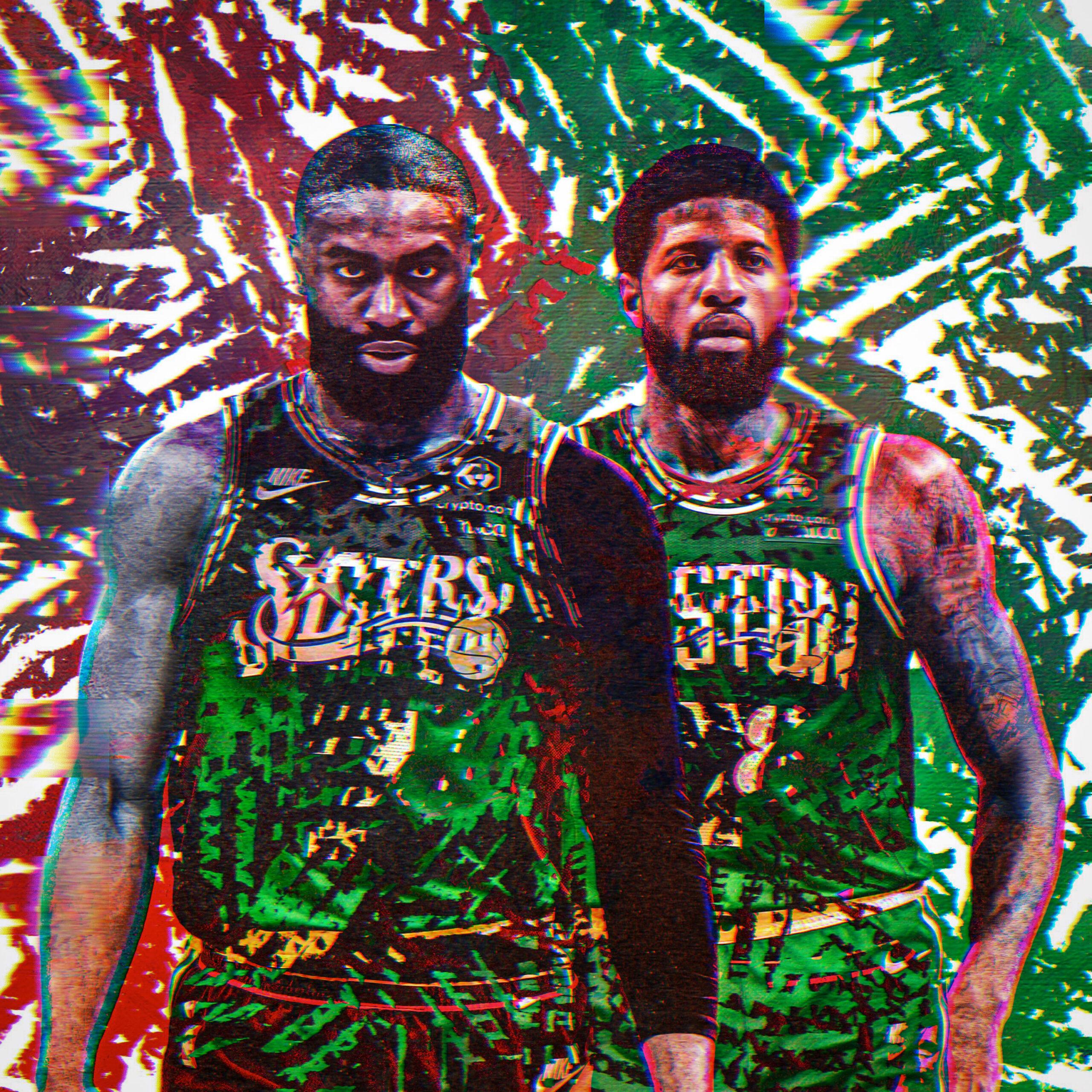

In the confusing aftermath of a trade that should be recognized as one of the most unnecessary transactions in recent NBA history, one question sits above the rest: Why did the Boston Celtics have to trade Jaylen Brown?
Not even two weeks ago, this team was a finalist to acquire Giannis Antetokounmpo. Brown was the headliner in Boston’s offer, but the rest of the admittedly thin proposal contained just two first-round picks. This was fine and made sense. Giannis is better than Brown but comes with his own set of risks—not wanting to mortgage your future to get him is perfectly understandable. But after the Milwaukee Bucks went in a different direction, the Celtics believed, for some reason, that a bridge was burned. Boston apparently couldn’t repair a relationship that had already been through years of trade rumors; this was, a bit too conspicuously, the straw that broke the camel’s back. Brad Stevens responded by canvassing the league, scrambling to find an acceptable package before ultimately settling on an astonishing deal that will send Brown to the Philadelphia 76ers for Paul George, two first-round picks, and two second-round picks.
This is a deeply strange turn of events for myriad reasons. To put it in context: The haul is objectively worse than what the Los Angeles Clippers just received for Kawhi Leonard, a frequently injured 35-year-old currently under investigation for allegedly taking part in a cap circumvention scheme. I say this not to chastise Leonard but to point out how absurdly low the return was for a younger, more dependable forward who just averaged career highs in points, rebounds, and assists for a 56-win team that … was eliminated in the first round by Philadelphia. Yes, for those counting at home, Boston might have gone out of its way to enhance the division rival who knocked it out of the playoffs in shocking, humiliating fashion a few months ago.
Now, it’s technically possible that we’ll see the Celtics land a top pick in the 2028 draft or, sooner than later, package that valuable asset with others they currently own to grab a talent who can nudge them closer to another Finals appearance. But it still feels like the Celtics negotiated from a position of weakness, desperate to divorce themselves from one of the 10-ish best players in the world. Why? What motivated Boston to move on from a beloved 29-year-old Finals MVP and franchise mainstay whose jersey will one day hang in TD Garden’s rafters?


Let’s allow speculation to run wild for a moment. Did Jayson Tatum give Boston’s front office an ultimatum? Was Brown’s personality that corrosive on a daily basis? Did new Celtics owner Bill Chisholm tell Stevens to save even more money than he already has? Brown has roughly $70 million more left on his contract than George does. Back in September, Chisholm said, “My goal and my high-level direction to Brad and the team is let’s do whatever we can to win championships and raise banners and raise as many as we can, both in the near term and also in the medium to the long term as well.” Cool, cool, cool.
Or, using Occam’s razor, is this trade as simple as Boston thinking it can still be a contender without Brown and choosing to add a couple of draft picks rather than pay him a ton of money to function as its second-best player? We all know what the advanced impact metrics say, and it’s common knowledge that Boston was better on both ends when Brown sat on the bench last season. I have a hard time believing that’s it, though.
Brown and Tatum have excelled together on the biggest stage. Why break them up on the hunch that (a healthy) George should be able to fulfill the same responsibilities with a more agreeable disposition? Why not trade Brown last summer, tank, and hope for some luck at the lottery in a draft that was loaded with franchise-altering prospects?

Flexibility is a fair enough objective, and, based on everything we saw Joe Mazzulla squeeze out of his club last year, this trade won’t necessarily keep the Celtics from competing for a championship next season. If Tatum is at full strength, they will be a large and physical defensive menace that may have the best offense in the NBA. Internal growth from untouchable pieces like Hugo Gonzalez and Baylor Scheierman will be helpful. Derrick White, Payton Pritchard, and Sam Hauser know what it takes to win it all. Prying Mitchell Robinson away from the New York Knicks with the mid-level exception is the type of move made by an organization that wants to win it all and believes it can.
Glass half full: George is available, fits with Boston’s existing core, and continues to be a better 3-point shooter than Brown ever was. The nine-time All-Star drilled 45.4 percent of his spot-up attempts in his final year with the Clippers, 38 percent in his first year with the Sixers, and 41.7 percent last season. On a Celtics team that is built to fire away from the outside and loaded with very good outside shooters, he’ll have the greenest light of his career and, arguably, the most space to operate inside the arc.
All of this is true, but light-years away from the point. George is almost seven years older than Brown. This decade, Jaylen has played 111 more games than PG. Last year, he generated 16 more points per game with a slightly higher true shooting percentage. After a couple of disappointing postseasons that were partially caused by poorly timed cold spells behind the 3-point line, the Celtics ostensibly entered this summer looking to diversify their attack and become an offense that can put more pressure on the rim. This trade, in a vacuum, makes that goal significantly harder to achieve. (Last year, George attempted only 2.9 shots at the rim per 100 possessions and shot 55.9 percent from there. Brown finished at 6.9 attempts and shot 69.1 percent.)


Now, it must be said that George outplayed Brown head-to-head in meaningful stretches of Boston’s most recent playoff meltdown. He isn’t that far removed from his last All-Star appearance and could conceivably turn back the clock on a team that won’t demand too much from him on either side of the ball. George’s contract has become an abomination, but he’s still a very good NBA player.
The Celtics have sturdy infrastructure, championship experience, exceptional coaching, depth at every position, shooting, and talent. They won’t enter next season with talk of a gap year hanging over their heads. Expectations will be a lot higher, with movable assets and a giant trade exception to build upon what’s already there. But would Boston be closer to the title right now if, um, Jaylen Brown were still on the team? In the near future, at least, it’s a question that will follow this franchise every single day.