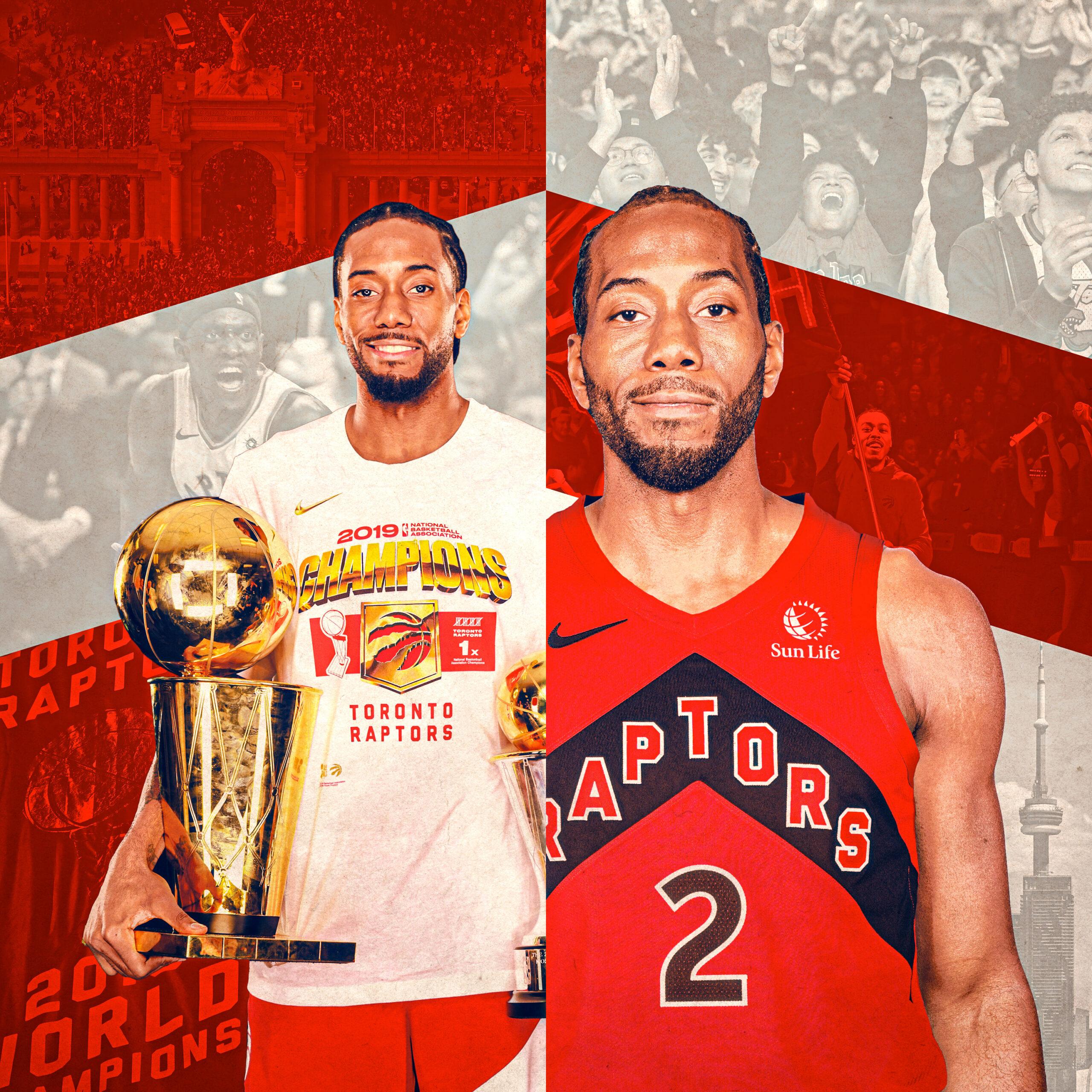

On a Saturday morning in January, Kawhi Leonard took advantage of a break in the Clippers’ schedule to host a basketball skills clinic in the Toronto district of Scarborough, roughly 12 miles east of Scotiabank Arena, where Leonard, for one transformative season seven years ago, bent the game to his will.
“Toronto is still in my heart,” Leonard told the families in attendance at the newly dedicated Kawhi Leonard Court at TAT Stadium, a multisport indoor facility. How could it not be? This was the city he played for when he staked his claim as the best player in the world in 2019 after winning his second championship and second Finals MVP; this was where his own family expanded, when his second child was born two weeks before the playoff run that would change the perception of Canadian basketball forever. His kid is a Canadian citizen, now old enough to be attending one of these clinics, old enough to process what his dad did for an entire nation of fans, old enough to now learn an important lesson: You can come home again. For years, Kawhi was likened to a T-800—the stoicism of his public persona was of one piece with his cold, brutally efficient two-way game—but maybe Kawhi has been a sentimentalist all along.
On Tuesday, seven years after bringing glory upon the Toronto Raptors, Kawhi is back. The Raptors have once again pulled off a stunning trade for Leonard, sending Brandon Ingram, Gradey Dick, two future first-round picks, a first-round pick swap, and two future second-rounders to the Clippers, according to ESPN’s Shams Charania. It’s more draft capital than the Raptors had sent out in 2018 the first time around, but no one needs to be reminded about what inflation hath wrought over the past seven years. Imagine if he’d stayed, one might ask. Well, no point in dwelling on the past when the present suddenly becomes so exciting.
This is the second time that the Raptors have acquired Leonard while the overall market was fearful, with Toronto making the ultimate bet on an otherworldly two-way talent. Kawhi, of course, is the player at the center of the still unresolved Aspiration cap-circumvention scandal. The Clippers’ insistence on additional draft capital may have something to do with lingering concerns about any future punishment handed down from the league office. Scandal aside, Toronto was also willing to deal with maybe the more pressing concern about Kawhi. The Raptors are evidently confident that they can navigate one of the most precarious realities in professional sports: the age cliff at the tail end of stardom. A look across the league offers hope. William Faulkner would be impressed by the run-on sentence that this vaunted era has generated: Players like Steph Curry and Kevin Durant are still massively productive efficiency monsters well into their late 30s; LeBron James was emphatically the best player in a playoff series at the overripe age of 41.
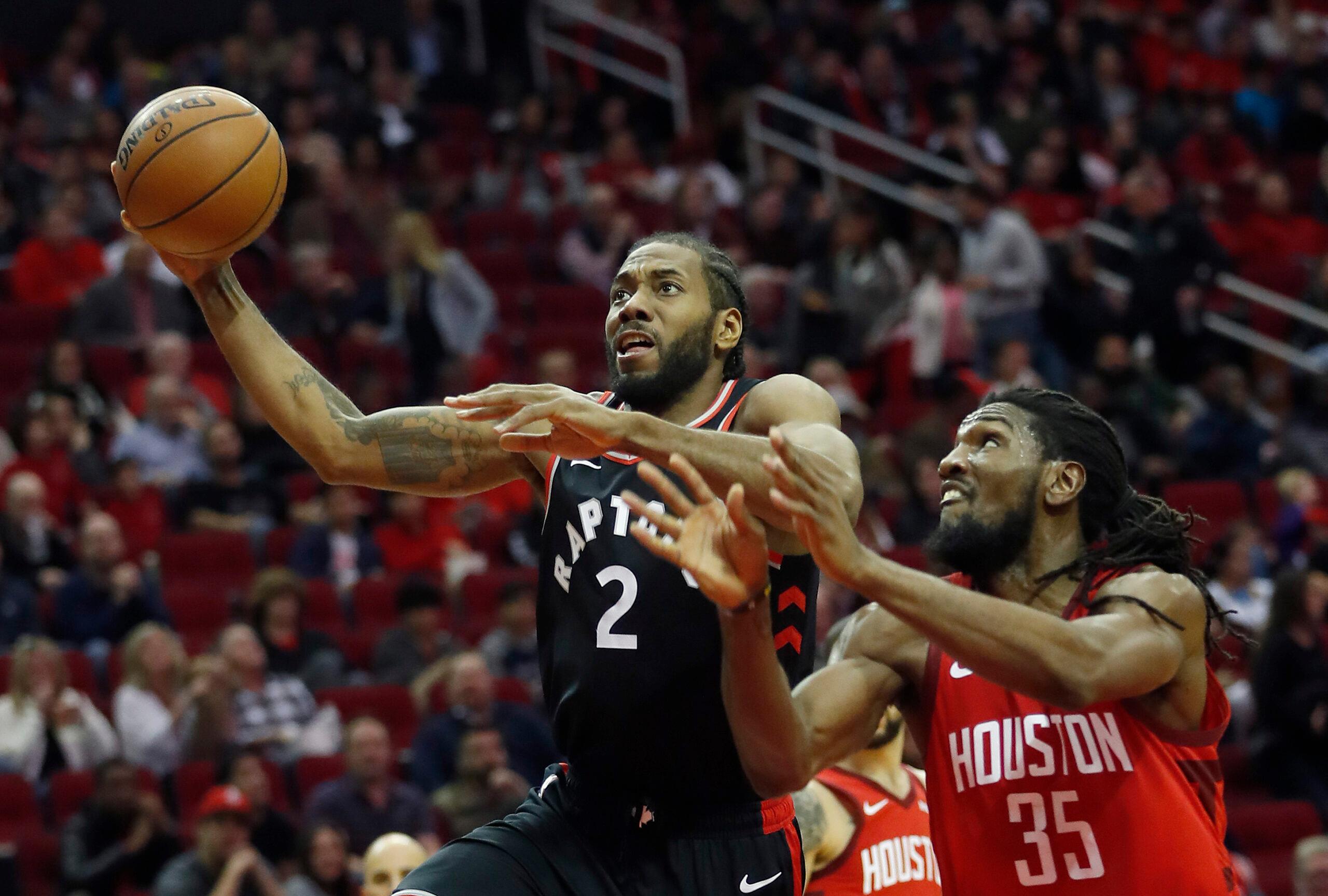
Kawhi averaged 26.6 points in his lone season with Toronto.
If those legendary careers can serve as any precedent, Kawhi, who just turned 35, might have enough quality years to make this trade an absolute heist for Toronto. Leonard had the best scoring season of his career this past year; his age-34 season looked awfully similar to Michael Jordan’s last dance with the Bulls at the same age. What straight-line speed and open-floor athleticism that Leonard may have lost through several knee injuries have been redirected into his setup: His power dribbles are still as explosive and literally stunning as ever, freezing his defender momentarily by conveying intensity without betraying intent. His stampede dribble flows seamlessly into turnaround fades and hesitation stepbacks. His game is self-possessed on a physical and mental level; he is always in control; he is still always one step ahead.
Toronto’s ultimate trade packages for Kawhi across time aren’t all that dissimilar, and it almost points to a fatedness about this particular union. It became all too obvious in the Raptors’ first-round loss against the Cavaliers this past spring that Ingram—brought in to be the kind of dynamic bucket getter the team had largely lacked since Leonard’s departure—was simply reheating the samsara of Toronto’s DeRozan years, championing a player who was good but not the level of star the team truly needed in the moment. Who could have known that Kawhi would be the light at the end of the tunnel for both cycles? Players of Kawhi’s magnitude aren’t just the sum of their gaudy numbers. Their presence alone becomes an almost metaphysical property of order. They fill voids that you didn’t know existed before their arrival, and in their wake they leave voids that echo for years onward. It’s a phenomenon perhaps best explained by the great Canadian thought leader Carly Rae Jepsen: Before you came into my life, I missed you so bad.
The Raptors didn’t just trade for Kawhi again; they reclaimed the generative effect of his influence. The shared history baked into the trade makes it impossible not to project the past upon the present. With Kawhi back in tow, I found myself thinking about Pascal Siakam, who blazed one of the most impressive and improbable player-development paths of all time during his stint with the Raptors. The opportunity to play within the slipstream of Leonard’s load-bearing two-way foundation surely expedited that process. Kawhi’s unflappable poise and stability as a shot creator allowed for Siakam’s whirling freak flag to fly freely in the frontcourt. A relative unknown after two seasons in the league, Siakam was the best player on the court in an NBA Finals game in his third year, absolutely flooding Draymond Green’s supercomputational mind in saltwater with his unorthodoxy as a scorer and playmaker. He took the mantle upon Leonard’s exit and continued to refine his game, turning himself into one of the league’s most reliable (and scalable) two-way players.



More on the Kawhi Trade
It’s an intoxicating thought exercise to wonder just what kind of effect Leonard will now have on Scottie Barnes, whose breakout this past season has made him a clear top-20 player knocking on the door of top-15 status after a revelatory series against the Cavaliers. The heightened competition brought out an actualized version of what the 24-year-old had shown flashes of during his first five seasons in the league. He was a terrorizing weakside rim protector, a dogged pressure defender, an irrepressible force in transition. His offensive initiation had an instant metamorphosis under the bright lights—scaling up his number of drives per game from 7.8 in the regular season to 16.7—and he was second behind only Nikola Jokic in postseason assists per game.
Barnes credited Ingram’s on-court gravity for his success in getting into the paint. “Just the way they’re guarding him, it opens up driving lanes,” Barnes said in April. “It opens up me being able to drive, and they’re trying to not allow him to get to the ball.” The upgrade from Ingram to Leonard in that regard will be exponential. It’s clear that the vision behind the deal isn’t just for Kawhi to step into the building as the be-all, end-all; it’s to expand the range of possibility and expedite the journey that Barnes had already embarked on.
It’s fair to wonder whether Kawhi might’ve seen an alternate version of his younger self in Scottie’s seven-game series against the Cavs. In 2014, when he was with the Spurs, Kawhi transformed from the platonic-ideal role player during the regular season into a two-way archangel by the end of the Finals, when he brought home his first championship and Finals MVP award. There was no putting that version of Leonard back in the box. But Kawhi is now much closer to Tim Duncan’s age during that run than he is the 22-year-old version of himself. He’s spent the past seven years trying to make it work with peers. But his formative years in San Antonio gave him a better understanding than most of how these cycles work. At 35, perhaps he understands it’s time to become a shield for the next generation.
For the Raptors—and for Kawhi himself—the impetus behind this trade and his impending extension is a mutual feeling that what’s past is prologue. Something really special happened in Toronto then. It can happen again. The front office never quite let go of the idea of building an army of defensive-minded, playmaking forwards who overlap and interlock. It was Siakam and OG Anunoby before; it’s Barnes, Collin Murray-Boyles, and newly drafted Allen Graves today. Now with the benefit of hindsight, the possibility—and proven formula—of landing a difference-making self-creator through a trade to complete the vision was the reason why. Leonard’s almost exclusive desire to join the Raptors is a massive endorsement of the young players whom Toronto has developed in this transitional period.
Kawhi is the archetype. He is the inspiration, the shape, and the form.
In the Raptors draft room, as the team selected Graves with the no. 19 pick last week, president Bobby Webster repeatedly emphasized the word “hands.” If there is a through line that links Toronto’s most successful prospects over the years, it’s been a level of hand-eye coordination so advanced that it blurs the line between defensive reactivity and proactivity—precisely the gift that made Leonard an indispensable championship player from the very beginning of his career. Murray-Boyles is Toronto’s poster child for that particular skill, and in terms of hand strength, he might be second only to Kawhi himself. After a standout postseason performance, CMB is trending toward becoming the league’s new archetypal 1-through-5 defender: He can hold his own against players as disparate as Donovan Mitchell and Victor Wembanyama. The sell on Graves as a prospect is that he offers similarly aggressive defensive playmaking instincts, but with the allure of also becoming a 40 percent 3-point shooter. Key role players Jamal Shead and Ja’Kobe Walter both have excellent steal rates in college and the pros thus far. Opponents will need a whole lot of discipline to outwork the procession of similarly wired defenders.
The Raptors’ overwhelming defensive activity—a franchise hallmark that coach Darko Rajakovic inherited and pushed forward—creates a sort of strategic paradox for the opposing offenses. Ball movement is generally the safest way to extend a defense beyond its breaking point, but every pass, every dribble is also another opportunity for Toronto’s many handsy defenders to create potential turnovers. Toronto had the highest points-off-turnover average in these past playoffs and were top four in the regular season, while also ranking top four in deflections. Those numbers will likely climb even higher next season. Initiating a dribble handoff is asking for trouble with Kawhi’s claws in the vicinity. There is no dislodging CMB on a bump-and-drive, and no accounting for Barnes springing out of nowhere to swat the shot away. The best defenses create tension and anxiety, forcing the opposition to second-guess its decisions often enough to create moments of fracture. A team like San Antonio accomplishes that with the single-most outlandish physical specimen that basketball has ever seen; Toronto’s doing it with a defense modeled after the rows and series of teeth in the gaping maw of a shark—waves of defenders at every level on the court, ready to tear, strip away, and blot out possessions at a moment’s notice.
It’s all in line with the league’s current defining metagame. Teams are stacking advantages, rather than diversifying, wherever they exist on their respective rosters. We’re seeing it among the elites. The Spurs have three star-level initiators at the guard position; the Thunder have used the draft practically like Steve Jobs going wardrobe shopping: doubling and tripling down on shooters with playmaking equity and rim-protecting bigs with passing chops, which ensures that every lineup they place on the court is of a template with interchangeable parts. It’s showing up early in the offseason, too: After buying low on Ja Morant, the Blazers (currently) have four starting-caliber point guards on their roster, and reports seem to claim that they’re confident they can coexist.
Toronto is following a similar ethic, but with a very particular mold. They have assembled a team built around Kawhi and his numerous stylistic and spiritual variants. Outside of the defending champions, the East is in flux: So much remains to be seen with how Boston, Cleveland, Detroit, and Miami handle the rest of free agency. The Pacers and Hornets will rise; the Sixers, Magic, and Hawks aren’t going anywhere. The Wizards are the ultimate question mark. But the promise of a healthy Kawhi Leonard immediately vaults the Raptors back into legitimate championship contention, just as it did last time.
So much has changed since 2019, but not Toronto’s vision for how basketball ought to be played. Kawhi is the archetype. He is the inspiration, the shape, and the form. He is the template for what success looks like in Toronto. And he has been for a long time, if, for a time, only in memory, only as a ghost of what was.
There was legitimate hope in the city that—in the afterglow of a championship that ushered in this era of parity with eight different NBA champions in eight years—Kawhi might have found what he needed in Toronto. I was one of those dreamers. I made multiple trips to Toronto from Los Angeles during the Raptors’ championship season—I was there during the polar vortex of 2019; I was there for the championship celebrations at Jurassic Park West in Mississauga. I fell in love with the city, fell in love with a girl, and not long after chose to make a life in Canada. I’d hoped that Kawhi would have fallen under a similar romance. I took a one-way flight to Toronto just a few months after Leonard left for L.A. He was 27, at the peak of his powers, with an opportunity to build a team back home in his image—a completely understandable reason to leave. Never mind that, all the while, Toronto had already built the perfect nest for him here. But it’s OK to take the long way round—the hope is that we all land where we’re meant to be. On the eve of my first Canada Day as a Canadian citizen, I don’t take for granted this opportunity to write about the player who changed my life. All this to say: Kawhi’s back. Not to undo the past seven years, but to rekindle the magic in a place he should have called home a long time ago.