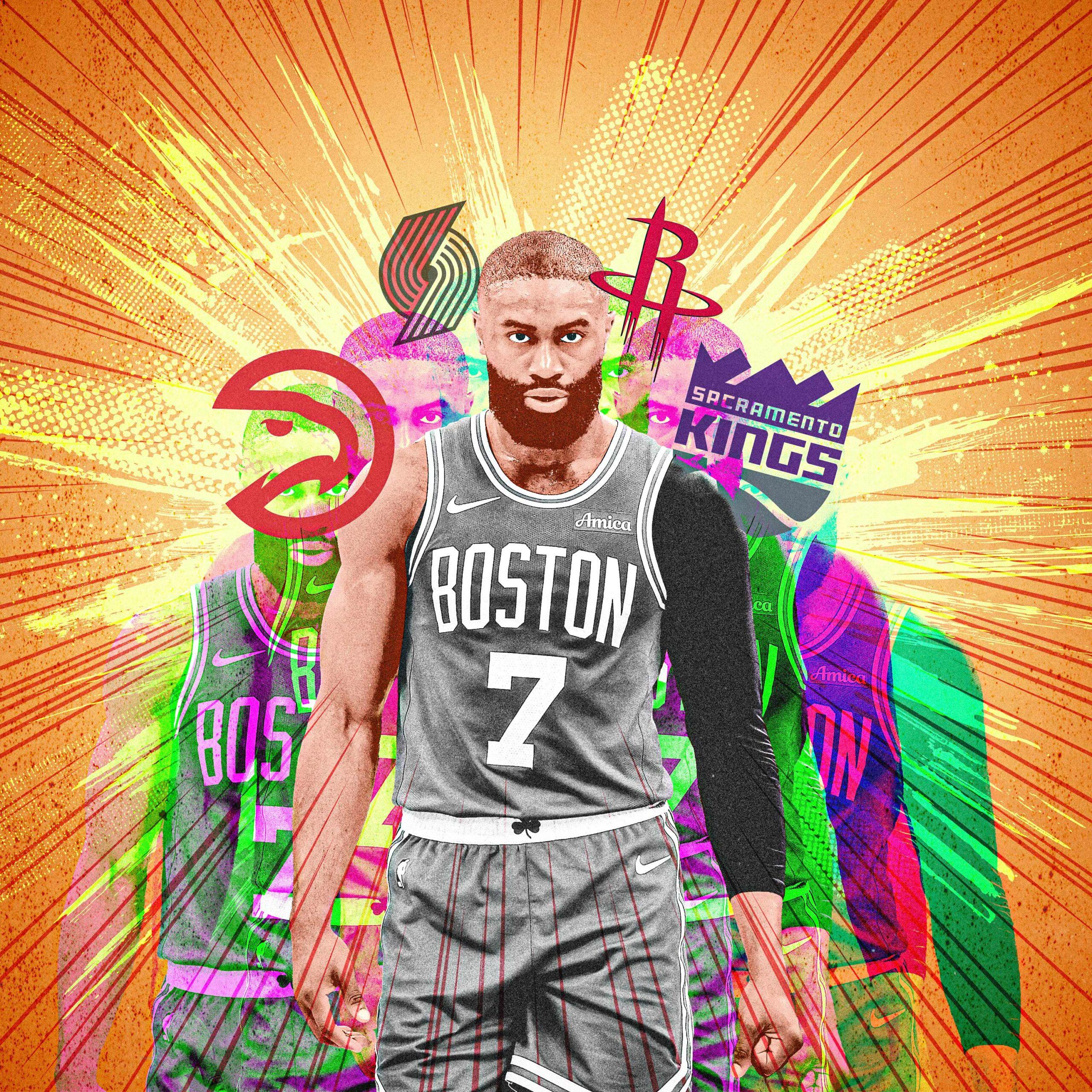

How did we get here, 742 days removed from the night Jaylen Brown cradled the Larry O’Brien and Finals MVP trophies in his arms? Only 11 months before that, the Boston Celtics had locked him into a supermax extension, temporarily silencing the trade rumors that nearly drove a wedge between franchise and star. Brown was paid to win, and he did, placing himself on the path to one day retire as a Celtics legend.
But today, somewhat surprisingly, that relationship appears to be hanging on by a thread. After Brown was reportedly (and fruitlessly) offered to the Milwaukee Bucks for Giannis Antetokounmpo earlier this month, he remains on the trade market. On its face, this development is downright bewildering. Locally beloved multiple-time All-Stars aren’t usually shopped during their prime, particularly coming off an All-NBA season that resulted, deservedly, with a spot on dozens of MVP ballots.
The Celtics value Brown and know what he can do, but other factors are at play here. This organization is well aware of how difficult it is to sustain title contention in the apron era and appreciates the long-term benefits that could come from selling high on a player who, in all likelihood, has peaked. Brown has three years and over $180 million left on a contract that soaks up 35 percent of Boston’s cap sheet through 2029. He turns 30 in October and, steadily impressive production aside, might already not be worth what he’s being paid.
That alone isn’t a good enough reason to trade him. Brown is awesome. But he also comes with undeniable deficiencies on both sides of the ball. His playmaking fluctuates, his defense is overrated, and his shot diet doesn’t regularly generate the most efficient looks for him or his teammates.
If an offer comes along that allows the Celtics to diversify their attack, get a little bigger, cut costs, and add draft capital without taking a competitive step back from where they were last year, they should, and probably will, pull the trigger. If they don’t, they will probably enter next season as a championship contender. In some ways, it’s a win-win for Boston. In others, it’s perilous.
With Brown as the hottest name on the market, the Ringer NBA team assembled to examine his seven most interesting suitors and why they should and should not trade for him. —Michael Pina
The Suitors
Portland Trail Blazers
Why they should trade for Brown: The Trail Blazers are ready to level up. They proved that they had moved past asset-accumulation mode last regular season, overcoming injuries up and down the roster to claim the West’s 7-seed. But a first-round gentleman’s sweep at the hands of the Spurs showed that there’s still a ways to go before they can compete with the conference’s highest echelon. And if they weren’t motivated enough already, new ownership will give them the shove they need to make a splash, in part to make good on promises that their cost-cutting measures don’t extend to the product on the court.
Why they should not trade for Brown: The fit between Brown and Deni Avdija isn’t ideal. They’re both good, not great shooters who want the ball in their hands to power their way downhill. And if Brown is set on having his “own team,” he might be a year late, as Avdija vaulted to All-Star status (and would’ve made All-NBA if not for a second-half back injury) as Portland’s offensive engine last season. So while Brown’s size, edge, and defensive reputation fit the identity the Blazers have carved out the past two seasons, and getting any creative juice in the building would help an offense that went bone-dry without Avdija, Portland would probably be better off targeting a volume shooter like Trey Murphy III if it wants to bring out the best in the star it already has.
The most intriguing (and fair) trade: Brown and Sam Hauser for Donovan Clingan, Shaedon Sharpe, Jerami Grant, swap rights to the Bucks’ 2028 first, and the rights to the most favorable between Boston’s and Milwaukee’s firsts in 2029. Clingan feels like a sticking point on both sides—the gargantuan center made great strides last season, in both staying on the court and stretching his game out to the 3-point line. But the Celtics seem dead set on solving their size disadvantage at the 5. So in this scenario, Boston doesn’t get control of all three of the Bucks’ future picks and has to take on Grant’s remaining $71 million. I hate it for both sides—the Celtics would be noticeably worse, and the Blazers would be forced to cross their fingers and hope that Robert Williams III will re-sign and stay healthy—but that’s showbiz, baby. —Justin Verrier
Houston Rockets
Why they should trade for Brown: The Rockets have never quite figured out an easy button on offense in the post-Harden era. At 37, Kevin Durant still sleepwalks to 26 points per game on 50/40/85 shooting splits, but age has worn away at his ability to move as dynamically as he did in his prime, which affects the way he and the team can collapse a defense. Brown has really honed his patience as a strength-based driver when he’s playing off two feet over the past few seasons, and his ability to create his own shot on all three levels of offense (and draw fouls at by far the highest rate of his career) would bring a new dimension to Houston’s scoring without sacrificing the imposing perimeter defense that it’s staked its identity on.
Why they should not trade for Brown: Two reasons, really: (1) Because there is an anonymous league source who apparently thinks that Brown is no better than, like, Tristan Da Silva. (2) Because the Celtics’ asking price is deservedly steep. The Rockets are in a precarious position given how much they needed a 37-year-old to bail them out of their droughts and the limited progress the team got from its young core last season. But while Brown is easily a top-15 player, he wouldn’t cure all that ails Houston—especially not if it has to give up all future flexibility to land his services.
The most intriguing (and fair) trade: Brown for Alperen Sengun, Tari Eason (sign-and-trade), the Rockets’ 2027 first-round pick swap (which will likely yield the Brooklyn Nets’ 2027 first-rounder), and a 2030 first-round pick. Sengun would be unlike any big man the Celtics have had in a while, and it’s rare to see a young star traded before his age-24 season. We saw Sengun hold his own as an anchor for an elite defense two seasons ago; what might he look like playing off someone like Jayson Tatum, who’s arguably a top-five player when healthy? Eason is an oft-injured agent of chaos whose shot completely abandoned him last season, but he’d bring another layer of versatile and disruptive defense to the Celtics squad—those types of players have been the team’s lifeblood. Boston probably doesn’t have to trade Brown, but if tensions should ever become untenable, a Rockets package like this would create a level of value insulation through youth and multiple movable assets. The Celtics could do a lot worse. —Danny Chau

Atlanta Hawks
Why they should trade for Brown: Because the Hawks’ breakthrough season—46 wins and a first-round playoff exit—might also be their ceiling. The Jalen the Hawks have (Johnson) is a multiskilled star who can stuff the box score, but as we saw in Atlanta’s first-round debacle against New York, he’s not a go-to, get-a-bucket-anytime-anywhere brand of scorer. It’s a little concerning that 34-year-old C.J. McCollum was the Hawks’ leading scorer—and their best crunch-time scorer—for critical parts of that first-round series. Brown would solve all those issues and allow the younger Jalen to be a high-level second option. Added bonus: Brown is from Marietta, and who doesn’t love a good homecoming? (Added bonus no. 2: We know that Brown can thrive in a two-Jays combo.)
Why they should not trade for Brown: Because the Hawks just broke through with a fun, young, still evolving group, and it might be too soon to go all in on a nearly 30-year-old star who’s averaging $60 million a year for the next three seasons. And it’s probably too soon to decide that Johnson—who just made third-team All-NBA at age 24—can’t evolve into the crunch-time alpha scorer the Hawks need. Could the Hawks even get Jaylen without giving up Jalen? Any proposal from Boston would certainly start there. And if the younger Jalen isn’t part of the package, then the Hawks would probably have to give up two-way star (and 2025-26 Most Improved Player) Nickeil Alexander-Walker and/or defensive ace Dyson Daniels, which would severely cramp the lineup around Brown.
The most intriguing (and fair) trade: Brown for Alexander-Walker, Jonathan Kuminga, Zaccharie Risacher, and four first-round picks. The picks: a 2027 first (the less favorable between Milwaukee’s and New Orleans’s, protected 1-4), a 2028 first (the less favorable between Cleveland’s and Utah’s), and Atlanta’s firsts in 2029 and 2031. If the Hawks are keeping Johnson in this deal, they’d have to surrender their next best piece in Alexander-Walker. Kuminga (who turns 24 in October) and Risacher (age 21) would provide both cap filler and upside potential for the Celtics. If neither blossoms, the Celtics would still gain plenty of draft capital. The Hawks would retain enough talent—Daniels, McCollum, Onyeka Okongwu, Asa Newell, and rookie Kingston Flemings—to put a solid cast around their Ja(y)lens. —Howard Beck
Sacramento Kings
Why they should trade for Brown: This is a tough question to answer from a commonsense point of view, but if Sacramento sees this as its best chance to add a genuine top-15 player and give its fan base an entertaining three or four years, terrific. Brown is someone who doesn’t miss games. He can lend the league’s most dysfunctional organization some credibility and championship experience while helping to keep it from toiling at the bottom of the standings for the foreseeable future. Being relevant isn’t everything, but if Sacramento wants that, it should absolutely throw its hat in the ring.
Why they should not trade for Brown: A rational team that sits where the Kings are would not even consider trading for someone who turns 30 in October and has three years and $183 million left on his contract. This is one of the worst teams in the league, miles from anything close to a playoff run. Said rational team would also consult its analytics department and be skeptical of Brown’s dour impact metrics, history of inefficient shooting, and meh assist-to-turnover ratio. What Sacramento should do is build around its young core, slowly, steadily, organically, and hope that someone emerges as a tentpole. Stay lean, hoard picks, and pounce when a better opportunity strikes.
The most intriguing (and fair) trade: Brown for Domantas Sabonis, DeMar DeRozan, and three first-round picks. The particulars here are fluid. The Celtics might be able to squeeze more draft capital from Sacramento or add another small contract (like Luka Garza’s) to decrease their payroll and make ducking the tax that much easier. DeRozan’s contract is expiring, and only $10 million of it is guaranteed.
But, fundamentally, the appeal for Boston is twofold. First, I don’t really care how dramatically reformed the lottery gets; owning Kings picks is smart business. Second, Sabonis is kinda what Boston needs: an interior low-post bruiser who’s comfortable handling the ball on the perimeter and could seamlessly fit into its preexisting offensive system. Sabonis is miscast as any team’s best player. As a beneficiary of all the attention defenses will show Tatum and Boston’s cadre of 3-point shooters, he’s ideal. If Joe Mazzulla could work a serviceable defense when Sabonis and Neemias Queta share the floor, all the better. —Pina


Denver Nuggets
Why they should trade for Brown: The Kroenkes love to go to the bathroom when the bill arrives. Unfortunately for them, Nikola Jokic has figured this out, so he’s asking the waiter to bring the check before their table is even seated. Marc Stein is reporting that Jokic is considering delaying extension talks until next summer. If that doesn’t wake you up as an NBA owner, nothing will. Jokic is still in his prime, and it would feel like a letdown if he wins only one career title (shout-out Calvin Booth). Jamal Murray will forever be a Nuggets legend, but trading him also might be their most realistic path to salvation. The West is loaded. It’s time to make a move. And not for fucking cap purposes.
Why they should not trade for Brown: It won’t help with Denver’s ongoing depth issues. It also wouldn’t help with Brown’s desire to be a bona fide no. 1 option. How would Jokic and Brown mesh? On paper, Brown’s talents would pair perfectly with Jokic's; he is one of the NBA’s best scorers and isn't a huntable defender in the playoffs. But playing with such a ball-dominant scorer would be an adjustment for Joker. Then again, maybe an adjustment is needed after three straight disappointing playoff exits.
The most intriguing (and fair) trade: Brown and Hauser for Murray and Cam Johnson. Bill Simmons (hmm, name sounds familiar) is reporting that the Nuggets and Celtics have discussed this blockbuster. Needless to say, it would be a huge boon for the stagnant Nuggets and would dramatically diversify the Celtics’ offensive attack. But Brad Stevens would have to truly covet Murray for this deal to materialize. My Spidey senses say that’s a reach. If a trade goes down, the Nuggets would have to fork over someone else valuable or a lot of draft capital, which wouldn’t feel great if that extension remains unsigned. —Matt Dollinger
Los Angeles Clippers
Why they should trade for Brown: Well, contrary to what some analytics nerds would have you believe, Brown is one of the top two-way wings in the league, capable of taking an undermanned team to near the top of a conference (even if he has a little selfish streak and a propensity to settle scores on a livestream). Alongside (the oft-injured but talented) Darius Garland, Brown could give the Clippers a foundation to build on in the vaunted Western Conference. Brown is one of the most confounding players of his era. His game can carry a franchise to heights all teams strive toward, even if his quotes, perceived personality, and advanced numbers disappoint the pundits. If the Clippers want to win, they must acquire winning players, which Brown has been since he arrived in the league.
Why they should not trade for Brown: Even if the Clippers pull off a Brown trade, his salary and the price to get him could ruin their chance to build a competitive team out West. Last season, Brown’s impressive exploits were inflated by the historically weak Eastern Conference, and his disappointing postseason showing last spring left questions about whether he can be a successful lead player at the highest stage.
The most intriguing (and fair) trade: Brown for Kawhi Leonard, Isaiah Jackson, and Keaton Wagler. This trade would deliver the Clippers a bona fide star and give the Celtics the fresh coat of paint they’ve suddenly and somewhat strangely coveted over the past few weeks (smh). —Logan Murdock

Cleveland Cavaliers
Why they should trade for Brown: Because now is the time to sell high on Evan Mobley. Five years into his career, Mobley is a very effective player, but the sheen of his upside is starting to wear off. And positionally, the Cavs are stuck between a rock and a hard place: Mobley’s offense hasn’t popped enough to make him a viable 4, and his physicality hasn’t progressed enough to make him a full-time 5. Exhibit A is the 2026 playoffs: Mobley’s performance was fine overall, but Cleveland’s lineups got destroyed when he was the lone big. During those stints, opponents feasted on the offensive glass, which isn’t totally surprising. But the Cavs also struggled mightily on offense, and that’s the side of the ball where Mobley’s versatility should in theory be able to open things up for the entire team. The Cavs are attempting to follow a Knicks-esque blueprint by building depth and well-fitting players around a top-10 guard. Mobley is owed $223 million over the next four seasons; if the Cavs don’t believe that he will turn into a top-10-ish player, they’d be wise to cut bait now—especially if they could land just the sort of big wing they’ve spent years looking for.
Why they should not trade for Brown: Because the Cavs shouldn’t trade Mobley; they should trade Donovan Mitchell instead. I’m not foolish enough to believe that Cleveland doesn’t need sweeping changes this offseason, but swapping Mobley for Brown—really the only way to make a deal happen—would mean doubling down on the worst aspect of the team’s ill-fated Garland-for-Harden trade, which replaced a 26-year-old with a 36-year-old. Mobley is just 25; Brown is 29. Cleveland needs to reset around its youngest, most promising talent—not cut bait and push even more chips into the middle for the sake of a title window that will be open for only a couple of seasons, if it’s even open at all.
The most intriguing (and fair) trade: Brown and Jordan Walsh for Mobley and Max Strus. The most fascinating version of this trade would be Brown for Mobley straight up, but we’re forced to include Walsh and Strus for salary-matching purposes. The Celtics would add two players who fit like a glove next to Tatum, while the Cavs would be able to roll out a starting lineup of Mitchell, Harden, Brown, Jaylon Tyson, and Jarrett Allen. I’m not sure which team would win that seven-game series, but I wouldn’t mind finding out. —Isaac Levy-Rubinett