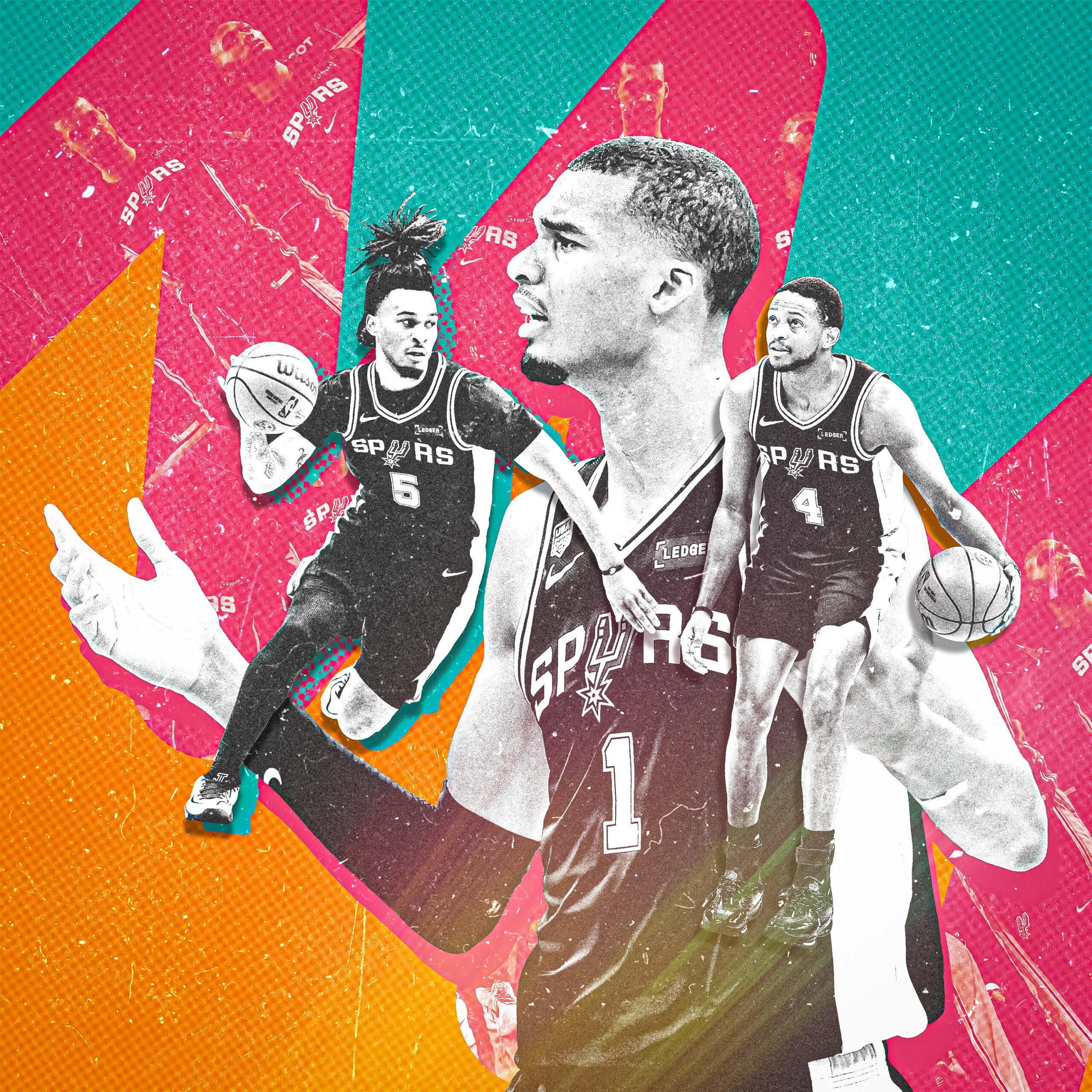

The San Antonio Spurs are down 0-2 in the NBA Finals even though they had the lead with about two minutes left in both games, which makes sense. Coming in, this was a coin-flip series between two mentally tough, incredibly talented, well-connected teams that deserve to be where they are.
Margins are slim. If Victor Wembanyama made one of his last two jumpers and didn’t commit the worst unforced error of his career, the series might be tied. Instead, San Antonio has one foot in the grave and the other about to step on a banana peel.
There are plenty of reasons the New York Knicks are two wins away from their first championship since The Exorcist was released. The most consequential and surprising one, though, has been San Antonio’s inability to score. Two of the Spurs’ three least efficient performances in these playoffs have been in the Finals, where their offensive rating is a middling 100.5. Put in perspective, they generated 117.9 points per 100 possessions against the Minnesota Timberwolves in Round 2 and 112.4 points per 100 possessions against the Oklahoma City Thunder (one of the greatest defenses in NBA history) in the conference finals.
Wembanyama is shooting only 40.7 percent from the floor and has yet to harness the type of rhythm that convinced many he was already the best player alive before the Finals began. In the first half of Friday’s Game 2, he attempted only four shots, an output deemed “not acceptable” by Spurs head coach Mitch Johnson. But the struggles extend beyond Victor. New York’s defense deserves a ton of credit for stifling the entire team, executing a disciplined pick-and-roll scheme, being physical, closing out on shooters, and getting back in transition.
The Spurs can do a much better job of breaking down their opponent, though—and they’ll need to if they want to win four of the next five games. Whether it’s altering their rotation, making a strategic adjustment, or doubling down on something that’s already working, San Antonio has tangible options.
“Pace” isn’t just a buzzword in the Spurs’ locker room. They want to play fast and create advantages before New York can get organized in the half court. As the postseason leaders in transition frequency, it’s fundamental to who they are. But that doesn’t mean the Spurs should throw caution to the wind and permanently keep their foot on the gas. There’s a push and pull here that necessitates a little more patience. As seen below, the first shot is not always the best shot:
In this series, San Antonio is averaging 90 points per 100 transition plays, which is an uncharacteristic abomination. Against the Thunder, it averaged 157 points per 100 transition plays.
“Sometimes the result cannot be as consistent as you want,” Johnson said on Sunday. “What I mean by that is we’ve had a few turnovers in transition that are not as common throughout the season. It really hasn’t been a real clear theme of why that is, other than not making the right play or not finishing those advantages out as we have throughout the season. It is a huge part of the game for us when we are at our best. We have to take advantage of those.”
Every possession is precious. If there’s no clear advantage, pull the ball back out (as Devin Vassell implores Keldon Johnson to do after he loses the ball out of bounds in one of the examples above). Running is a prerequisite for success, but the Spurs need better results when they press the gas. “For us, we got to try to find a way to get easy baskets,” De’Aaron Fox said after Game 2. “I’m not sure what our transition points were, but we got to figure out a way to play fast, off of misses, off of makes, get the ball out quick.”
There were several sequences in Game 2 when Stephon Castle simply missed a layup, tried to force a shot through defenders who had already hustled back, or committed a backbreaking turnover that killed San Antonio’s momentum. “Going from looking like we’re probably getting a bucket to giving up a bucket,” Mitch Johnson said. “Those are big swings in this game when you start talking about the margin of error at this level.”
Sometimes this team needs to take a deep breath and find more consistent scoring avenues at a slower tempo. New York won’t lose this series in the open floor, but San Antonio might.
Zooming out, so much of this is tied to Wemby and the Spurs’ need for him to be more aggressive in advantageous spots. When San Antonio runs a pick-and-roll—high or staggered—with Wemby as the screener, there’s almost always a third Knick rotating over to physically impede his progress. If you’re wondering why lobs are few and far between right now, watch Jose Alvarado abandon Castle to blow everything up in the play below:
But when an opportunity presents itself, San Antonio’s guards also have to take advantage. Even if the window for a pass is narrow and closing, Wembanyama can rise above the fray, which is a big reason this team is here in the first place. “There are times I think when he was open on rolls or around the paint, and his teammates got to give him the ball,” Johnson said after Game 2. In the two plays below, Vassell and Castle decided to go in a different direction:
OG Anunoby is everywhere in this series, as shown on that first play, where he tags Wemby’s initial roll and then sprints back to run Vassell off the 3-point line. Karl-Anthony Towns plays a perfect cat-and-mouse game guarding two Spurs at the same time, but in this spot, Vassell can either take what New York is giving him (a wide-open 12-footer) or realize Wemby is positioned to catch a pass high above everyone else’s heads.
The Spurs can also do a better job of anticipating and taking advantage of New York’s game plan by leveraging all the attention Wembanyama receives when he’s shuffling toward the basket. Here, Fox recognizes that Mitchell Robinson won’t fully commit to stopping the ball, so he slithers to the rim for a layup:
For San Antonio, it’s a matter of continuing to flow out of that initial action. When New York takes away Wemby’s first roll, either make the open 3 on a kick-out or drive into the paint and collapse the defense. It’s how Victor scored his first basket in Game 2:
The Spurs can also mix things up by having Wemby set his ball screen higher on one side of the floor. Either let him catch it on a short roll with more space to operate or give the ball handler a longer runway into the 7-footer-free paint. Wemby can also slip more screens instead of taking an extra beat to make contact, which gives defenders enough time to meet him on the release.
On occasion, the Spurs can utilize Wembanyama’s gravity in other areas of the floor, on and off the ball. He can set more flare screens and—when guarded by a big, as he typically has been—space himself out on the perimeter and help create pathways for his teammates to attack the paint. (This doubles as a good way to fortify San Antonio’s transition defense.)
After registering only 16 assists in Game 1—their fewest of the entire season—the Spurs trusted the pass a little more in Game 2 (22 assists) and did a good job of getting to their drive-and-kick offense with Wemby at the top of the arc. One of the first plays of the game felt immediately instructive. It was a simple ball reversal to Julian Champagnie, who curled off Fox’s pindown and drew a foul at the rim:
What really stands out here is the fact that San Antonio immediately and intentionally went at Jalen Brunson. Before the series started, I wrote a piece in which I wondered how often the Spurs would use Brunson’s man to set a wide pindown for Wembanyama. During the regular season, they had a bunch of success with that action. But it has been mothballed in these Finals.
Related to all this is San Antonio’s rotation. Not only should the Spurs be attacking Brunson more, but they should be doing so with lineups that prevent him from hiding. Translation: Play Dylan Harper more. The rookie sensation logged 28 minutes in Game 1 and 32 minutes in Game 2, and there’s a cogent case for inserting him into the starting five for Champagnie. According to ESPN’s net points, no Spur in these Finals has had a larger impact on winning than Harper.
We’re talking about a 20-year-old who already might be the most dynamic player in the entire series. The Knicks certainly treat him that way. When Harper isn’t cannonballing himself into the paint, he’s making quick decisions to compromise the defense. In the play below, Harper makes two passes that force New York to think and give Vassell the step he needs to beat Miles McBride off the dribble:
Moving Harper into the starting lineup would have ripple effects. Some are good. San Antonio’s net rating when he shares the court with Wembanyama is plus-28.6, which is both small-sample-size silliness and more verifiable than 2+2=4. Playing Harper from the jump would also remove any safe place for Brunson on defense and take away the target (Champagnie) he’s repeatedly gone after in this series. It’d diminish San Antonio’s spacing a little bit while creating some natural overlap at the guard position.
Champagnie is a quick-release marksman who is shooting 46.7 percent behind the arc in this series. He drilled 11 3s in a game against New York earlier this season. I recognize his value and am not 100 percent committed to endorsing a demotion, but playing Fox, Castle, and Harper together for extended minutes might be the alchemy San Antonio needs to take down this particular opponent. “Love the look,” Johnson said about playing those three guards together. “We’ve done it sporadically throughout the season. … They’re three dynamic, talented, unselfish guys that can dribble, pass, shoot, guard. It’s a good formula.”
By “sporadically,” Johnson means 51 total minutes this season, with very meh results.
A change this dramatic would remix a bench that’s given San Antonio nothing this series. Harrison Barnes, Carter Bryant, Keldon Johnson, and Luke Kornet have all struggled on both ends. The Spurs need to figure out how to score when Wembanyama is off the court—their offensive rating is a team-low 87.8 without him—and starting Harper would further complicate their rotation.
(A quick related tangent: The Spurs can’t have both Kornet and Barnes in the game when Brunson is on the floor, which happened for a couple of minutes in Game 2. That doesn’t seem like a big deal, but San Antonio was minus-1 in that stretch and lost the game by a point. This is the Finals. Every detail matters.)
Despite how things may feel, the Spurs are close. “Those were very winnable games,” Castle said. “I think the next two are very winnable games, too.” Their defense can be tighter—I wouldn’t mind seeing them stay home on the 3-point line and (as wild as this sounds) let Brunson take as many tough shots as he wants—but it has done enough to prevail. Wembanyama has been pretty good but still hasn’t completely dominated the way we’ve seen all year.
Before the series started, I wrote about how the Knicks would go down as one of the greatest playoff teams in NBA history if they won their next four games. Unless the Spurs figure out a way to generate more efficient offense, that’s exactly what will happen.
“We did a lot of things wrong, but we also were relentless and kept pushing, but kind of, like, wasted that effort,” Wembanyama said on Sunday. “Even though I know it’s not wasted because our lessons are learned. I know we’re not going to make the mistakes of the past again.”