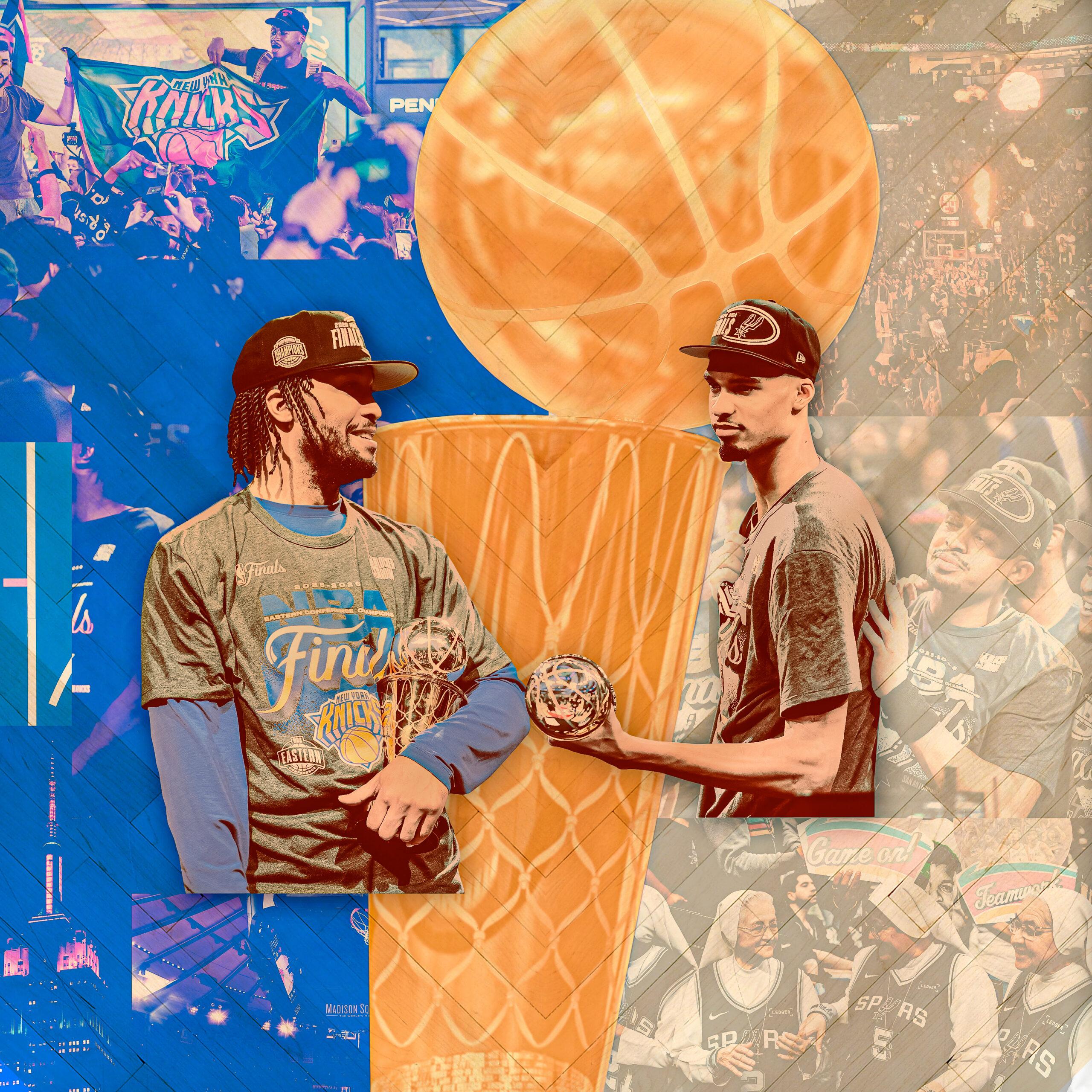

Before we preview the 2026 NBA Finals, let’s first acknowledge that some—but not all!—of what transpired between New York and San Antonio during the regular season now feels a little dated. The Knicks beat the Spurs two out of three times under some unique circumstances, in games that might as well have happened several years ago.
One was played on a neutral court for the NBA Cup championship. One was a Sunday matinee at Madison Square Garden (and San Antonio’s first loss in a month). And the other happened on New Year’s Eve and saw Julian Champagnie drill 11 3s. Victor Wembanyama got hurt in the second half of the Spurs’ only win against the Knicks, and logged just 25 minutes off the bench in Las Vegas. Unique circumstances, indeed.
More importantly, so much about both teams is obviously different since they last saw each other in early March. The Spurs have accelerated through the time-honored rite of passage that every young team endures during its first postseason go-around, confidently winning humongous road games with (and one without) their unprecedented 22-year-old MVP candidate.
Meanwhile, New York has suddenly become an aesthetically pleasing steamroller that could literally go down as one of the greatest playoff teams in history if it wins its next four games. That scenario is obviously much easier said than done, but shouldn’t be dismissed out of hand. The Knicks are cohesive, deep, red-hot behind the 3-point line, and riding a serendipitous wave for the ages.
Hopefully, what we’re about to witness is a little more competitive than the 1999 Finals, when San Antonio vanquished New York in five games. Things are a little more evenly matched this time around. Let’s cross our fingers for a coin-flip series that’s decided in its final moments, with superstars on both sides rising to the occasion. On that note, here are four questions we’ll be minding over the next couple of weeks about a matchup that should be a lot more competitive than pretty much everyone originally thought it would be.
How will the Knicks defend Victor Wembanyama?
Let’s start with a massive yet tiny problem: Mitchell Robinson’s mysteriously broken pinky finger. After having surgery last week, Robinson will reportedly be available for Game 1 with a cast on his hand. Not a doomsday scenario, but far from ideal. If Robinson can’t have his usual impact on the glass or finishing around the rim, can the Knicks even afford to play him?
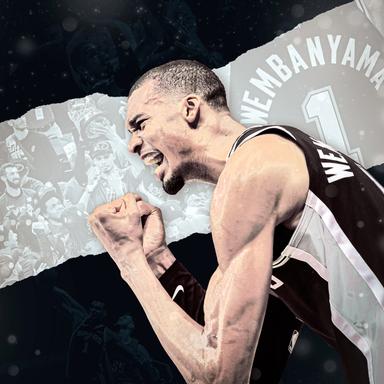
New York’s only loss to San Antonio this season was also the one meeting Robinson missed. In it, Wembanyama needed just 12 shots to score 31 points in 24 minutes. In the NBA Cup final, Robinson pulled down 10 offensive rebounds and spent more time guarding Wembanyama than any other Knick. Again, this injury matters.
Two paragraphs about a backup center might seem excessive, but you truly can’t have enough muscle, length, and size against San Antonio. Robinson’s free throw shooting was already bad enough when healthy. Will the Spurs simply hack him out of the series altogether? And if that happens, does New York go small when Wemby is off the floor or protect Karl-Anthony Towns to keep him out of foul trouble (i.e., send more help in one-on-one situations than it’d prefer)? From there, does Luke Kornet have a place in this series? Will we be blessed with an Ariel Hukporti sighting or a Jeremy Sochan revenge game?
The theoretical ripple effects from this one injury are never-ending, but before we fall too far down this rabbit hole, let’s pivot to the two starters who are expected to be Wembanyama’s primary defenders: Towns and OG Anunoby. Keeping Wemby away from the basket will be the Knicks' main objective. Regardless of which Spurs guard is running a pick-and-roll, whenever Wemby sets a ball screen, the Knicks will mostly drop, go under, and pack the paint.
When Wembanyama dives to the rim off a rip screen, two Knicks will stay on him step-for-step. It’ll look like a mistake, but it’s not. Early on in the series, at least, taking away lobs and putbacks should be the priority on every play; there might as well always be a third defender overhelping off the perimeter, willing to let pretty good 3-point shooters take advantage of some pretty clean looks. The alternative is a wave of soul-snatching alley-oops and/or a devastatingly quick trip into the penalty.
When Towns is on him, Wembanyama will do stuff normal big men do not do. He’ll run inverted pick-and-rolls, draw Towns outside the paint and force tricky decisions. If Towns switches, there will be a mismatch. If the Knicks put two on the ball, whoever sets the pick can slip into the paint, catch a pass, and make a play. If Towns tries to fight over/under the screen, there’s a decent chance Wemby will just get downhill with a man advantage.
All bets are off when San Antonio decides to have its 7-foot-4 center come off a wide pindown or flare screen. New York’s centers simply aren’t used to guarding off-ball actions that are designed to create a shot for their assignment. By itself this is worrisome, but the Spurs can somehow make the situation even more horrifying by using whoever Jalen Brunson, Jose Alvarado, or another small guard is on to set the pick:
These moments will be less dangerous and frequent when Anunoby (or Josh Hart) is tracking Wemby off the ball. Both are significantly more comfortable navigating screens and guarding in space. If Victor fades out for a long 2 or 3-pointer, so be it. The Knicks will have to live with his jumper. What they can’t afford is to die from his dunks.
The big question from there (at least when both starting lineups are on the court) is who will Towns guard, if not Wemby? Sticking him on Stephon Castle to neutralize Area 51 and (theoretically) force a so-so outside shooter to settle for a bunch of outside shots sounds convenient enough on paper, but it’s been a disaster in practice. Just ask Trail Blazers center Donovan Clingan how that went. Castle can’t be ignored. He’s already too canny and physical, and currently 12-for-24 behind the 3-point line when guarded by a center in these playoffs.
If not Castle, does Towns stay attached to Champagnie or Devin Vassell? These are San Antonio’s two best shooters, so the answer is absolutely not. Dylan Harper isn’t a spot-up threat, but good luck giving him a reason to attack off the bounce. Over the course of each game, there will be more convenient places for Towns to “hide,” be it on Keldon Johnson, Carter Bryant, or Harrison Barnes, but Mitch Johnson’s simple counter will eventually be to not play those guys when Towns is in the game (or, for the latter two, at all).
New York’s most obvious alternative is a brickhouse who just made an All-Defensive team. Anunoby has built-in-a-lab qualities to defend Wemby. He can deny the ball, push him off his spots, and switch on to any other Spur in a pinch. But the Knicks’ best bet may still be in hoping Towns can hold up on his own. Don’t foul, keep San Antonio off the offensive glass, and limit any need for a costly double-team.
There’s no stopping Wembanyama, but, when healthy, New York’s options to slow him down are a tick above solid.


Who will win the second-chance battle?
It’s fun to speculate about half-court matchups, strategies, and adjustments in the playoffs. But if one team is able to consistently grab its own missed shots and give itself another chance to score, all that analysis kinda goes out the window.
New York enters the Finals ranked first in second-chance points on both ends of the court: It has scored 18.2 points per 100 possessions and held its three playoff opponents to 12.4 points per 100 possessions. These numbers help explain why the Knicks have looked like a monster truck mashing through a junkyard for the past six weeks.
Now, the Spurs were excellent during the regular season at limiting putback points. (New York and San Antonio both ranked in the top three in this category.) But that hasn’t held in the playoffs. Only two teams have allowed more second-chance points per 100 possessions than the Spurs: Atlanta and Phoenix (quite possibly the two smallest teams in the field). They’re particularly susceptible with Wemby on the court, which makes sense when you consider how many times he’s gone to block a shot that is immediately rebounded by his own man. Robinson’s injury is relevant here, too.
The Knicks were at their best manufacturing second looks when he was on the court this year. When he sat, they were at their worst. That doesn’t mean they need him to generate the backbreaking chances that will cripple San Antonio’s spirit. But it’s all worth keeping an eye on. These are the front lines, where plans are dashed and competition works as a centrifuge. When bodies clash below an airborne ball. There’s no telling which side will have their way a majority of the time, but it’s these moments that may ultimately decide who wins the whole damn thing.
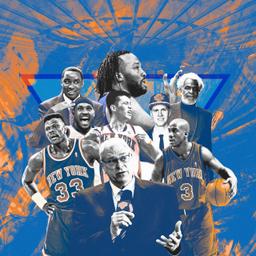
Can Karl-Anthony Towns be Wemby’s kryptonite?
Towns is the exact type of player you need to score against San Antonio. He’s a 7-footer who can space the floor, drill contested 3s, drive closeouts, dominate the defensive glass, and pulverize mismatches in the post. This doesn’t mean Wembanyama can’t or won’t spend time guarding KAT, especially if/when the Knicks play a five-out lineup that offers no other clear choice to roam off of. But the Spurs, understandably, do not want their starting center guarding him. In addition to foul trouble becoming a possibility, it opens the door for stuff like this to happen:
Often, when the NBA’s unanimous 2026 Defensive Player of the Year guards a traditional big, the Spurs will zone up on the back side and pre-switch if his man goes up to set a ball screen. The main objective is to keep Wemby near the basket. New York is built to complicate that plan, though. Its offense is comfortable playing through Towns at the high post, where he can find cutters, put the ball on the floor, or, when all else fails, shoot. Leaving him alone isn’t an option, which means someone else will take that assignment and let the greatest help defender in human history wreck shit how only he can:
For the Spurs, it’s a matter of deciding what they’re willing to live with. If we see an initial game plan similar to what they deployed against Oklahoma City, then Josh Hart (standing in for Alex Caruso) will need to make his open 3s, speed up the game in transition, crash the offensive glass, and sow chaos into the action any other way he can: set lots of ball screens and back screens, flow into dribble handoffs, be a delightful maniac.
Hart is a barometer in this series. If he punishes the Spurs for “ignoring” him—as he eventually did to Jarrett Allen, Evan Mobley, and the Cleveland Cavaliers—it may force Johnson to tinker with his matchups and stick Wemby back on to Towns. Before that happens, though, smaller defenders like Castle and Keldon Johnson will get their chance to guard the All-Star big, an effort to neutralize his two-man game with Brunson and make drives to the basket a bit more adventurous.
New York’s response should be to see whether Towns can obliterate those defenders in the post. If the answer is yes, it forces San Antonio to either double-team him or, once again, change the matchup. Nothing is obvious, which isn’t what the Spurs are used to.
It’s all connected to the big picture rock vs. hard place confrontation that will decide who has their hands on the steering wheel. In these playoffs, the Spurs are allowing just 40.9 points in the paint per 100 possessions (which ranks first). Meanwhile, the Knicks are scoring 54.8 points in the paint per 100 possessions (which also ranks first). Something has to give.
Can Jalen Brunson do what Shai Gilgeous-Alexander could not?
I sound like a broken record, but if you’re going to beat the Spurs, you need to be able to knock down 3s and pull-up jump shots. Translation: Brunson will eventually need to summon the most efficient and aggressive version of himself if the Knicks want to win, particularly when he catches Wemby in a drop:
None of this is breaking news or qualifies as particularly insightful analysis, but it’s the truth! San Antonio is 60-19 this season when its opponent doesn’t shoot above 40 percent behind the 3-point line. (For the record, the Spurs are also 17-7 when opponents do make at least 40 percent of their 3s, which is the highest winning percentage in the league; only two other teams are even above .500.)
Brunson has to play fast without losing control. Not easy. It doesn’t matter how methodical any offense is against a team with Wembanyama: San Antonio is allowing 86.0 points per 100 plays in the half court, which is a mark that renders one speechless. Opponents are shooting a heinous 56 percent at the rim and 38 percent from the midrange.
Brunson has made only 29.8 percent of his pull-up 3s in the playoffs but is lights out between 8 and 16 feet, owning an area of the floor that’s typically unguardable against defenses that don’t employ Wembanyama. The Spurs do in fact employ that man, though. Entire regions of the court are suddenly off limits when he’s even remotely nearby. If Brunson isn’t his relaxed self because the other team’s paint protector has an 8-foot wingspan and the reflexes of a house fly, New York’s offense may, understandably, sputter. Trips to the free throw line won’t be as frequent, either.
But the matchups here will be captivating. If Castle is preoccupied with Towns, who covers Brunson? De’Aaron Fox and his lingering high ankle sprain? I’d suggest Vassell, but if he can instead be the Spur primarily responsible for KAT (as someone who just helped remove Chet Holmgren from the conference finals), Castle can then focus on making Brunson’s life a living hell.
These micro battles are as fluid as they are fascinating, and exist on a long list of variables that will help decide this series. If either team goes cold behind the 3-point line, the other one will feast. If Mikal Bridges can assume some ballhandling responsibilities and cut down Brunson’s usage, the Knicks will be that much harder to slow down. If Harper can defy common sense and continue to have one of the most impressive rookie-season playoff runs we’ve ever seen, San Antonio will be doing backflips.
This is going to be a great series between two absolutely incredible basketball teams, and whoever emerges victorious on the other side should be allowed to raise an extra banner.
Prediction: Spurs in 7