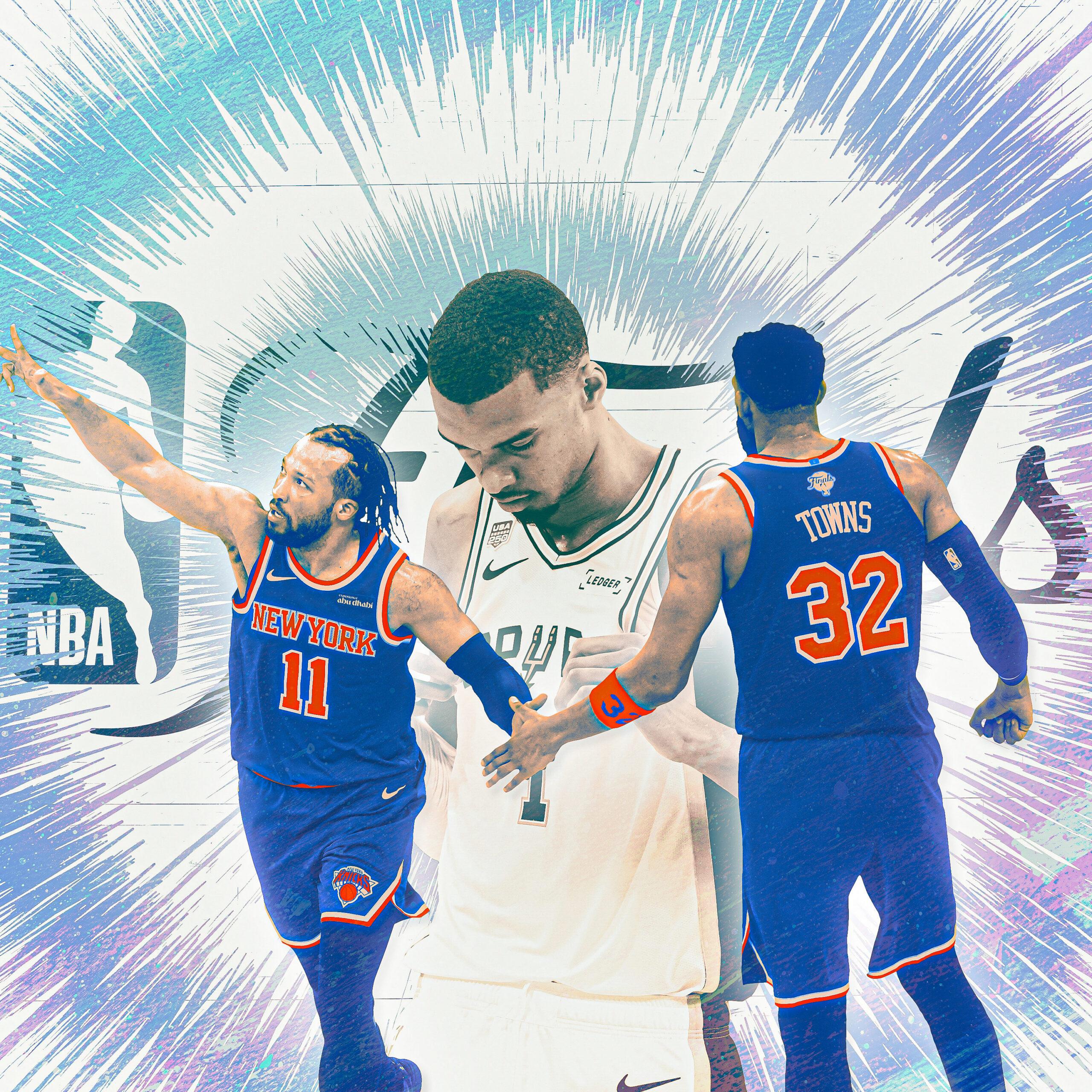

In less than 48 hours, Madison Square Garden will host an NBA Finals game for the first time in nearly three decades, and the Knicks will enter the arena as championship favorites for the first time since before the Rubik’s Cube was invented. How a team could possibly bear the weight of a half-century’s worth of disappointment is how a team can find itself winning two road games en route to the Mecca of basketball: Distribute the weight equally, and march relentlessly forward.
New York’s dramatic 105-104 victory in San Antonio on Friday night sets the stage for the iconic MSG theatre lighting that will frame the next two games. Game 2 felt like a baroque composition: Three different movements stitched together by string theory. The Knicks were in complete command of the game until they weren’t. They were on the brink of an epic collapse until they weren’t. The Knicks weathered the storm in the end because, in a way, it must have felt familiar. They’d inhabited these choppy waters all season long, struggling to find their identity and any semblance of rhythm with a new head coach and system. A run of inspired play would be met by an ugly regression, rinse, repeat. Hindsight may be omniscient, but little did we realize that those struggles were the point.
It was a different struggle than what these Knicks had been used to. Under Tom Thibodeau, rotations were unbearably tight, and the entire offensive architecture rested on Jalen Brunson to do his best 2002 Allen Iverson impression, bumps and bruises included. Mike Brown introduced a more balanced rotation this season to ensure that pivotal supporting players like Landry Shamet, Deuce McBride, and Mitchell Robinson would be ready to answer the call on the biggest stage of their respective careers. Karl-Anthony Towns was haphazardly positioned all across the chess board during and was in a prolonged funk due to the sacrifices he’d made in minutes and touches, forcing him to hone in on the kind of defensive instincts that have become a revelation in these Finals. And Brown’s spirit of collaboration amongst his coaches emboldened assistant coach Jordan Brink to challenge a late-game call, turning what was called an OG Anunoby turnover into three made Anunoby free throws. “You work on connectivity throughout the year for moments like these,” Brown told reporters after Game 2.
Brown waxed about the team’s resilience all season. Two of the game’s heroes know something about that. Mikal Bridges has largely been oppressed by the shadow of the massive trade that brought him to the Knicks two offseasons ago, shrinking under the pressure encased within the Knicks universe; on Friday, he hit eight straight field goals across the second and third quarters, forever justifying the fee. KAT has spent most of his career trying to live up to the standard that his enormous talent had set for him, only to redefine his game, and the functionality of the modern big man writ large. Towns is now an overwhelming favorite to be Finals MVP in the series, and the resolve he’s shown at the pinnacle of basketball has echoes of Pau Gasol circa 2010, when the Spaniard’s steadying presence on the perennially contending Lakers brought him into the circle of trust as one of the greatest big men of his generation.
Brunson, as ever, was instrumental in the clutch. Anunoby had some of the most spectacular plays of the game, including a dunk over Victor Wembanyama and the kind of chasedown block that defines the tension and desperation of championship basketball. Brown made a point to commend Robinson in the postgame presser for his efforts in defending Wemby in the Spurs’ final two possessions, though it was equally commendable that the Knicks survived an early bout of Hack-a-Mitch in the first half. "It means a lot when I ruin that strategy,” Robinson said after the game. “It seems like they just want me off the court, so in my eyes I feel like I'm a threat." One has to wonder if the Knicks might have fared better in 1999 if Chris Dudley had that same mentality.
This switch-flip to end all switch-flips—which has basically been six and a half weeks of straight-up ass-kicking—has led to one of the most stunning postseason runs in NBA history. The Knicks have now won 13 straight postseason games, second behind only the 2016-17 Warriors winning its first 15 playoff games en route to what might’ve been the most dominant championship run of all time. Those Warriors outscored their opponents by 12.9 per 100 possessions across its 17 games; the Knicks currently have an astronomical net rating of 18.1 in its 16 games thus far. They’ve built something sustainable amidst all the pressure that comes with the Knicks organization and surrounding culture. No one’s been able to capture that lightning in a bottle for more than 53 years. The Knicks found their equilibrium in those final moments of Game 2, where the Spurs, who had fought so valiantly to wrest control at the end, were suddenly reeling from the undertow.
The most lasting visual of the game—and perhaps the most iconic failure of Wembanyama’s young career to this point—occurred with 10 seconds remaining and the game tied. Wemby pushed the ball up the floor after successfully contesting and rebounding Brunson’s midrange pullup, only to throw a hit-ahead pass off the back of an unaware Stephon Castle, leading to a game-swinging turnover. Blame doesn’t diffuse like energy does. It doesn’t move from a point of high concentration to low—it tends toward a singular scapegoat. But it’s hard to pin the potentially series-defining turnover on any one party when it was its own triangle of sadness. Spurs head coach Mitch Johnson should have called a timeout as soon as Wemby secured possession; Castle should have been ready to receive the ball given how much transition play factors into the team’s style; Wemby, having already thrown a few anxious, sped-up passes in the first half, should have brought the ball up himself if the plan was to cross into the frontcourt.
The Spurs have embraced their inexperience at every step of the postseason, and it’s led to positive results all the way up to the Finals. Their accelerated timeline created the ultimate imaginative exercise for a basketball consciousness so eager to find the next league-defining phenomenon. But part of being young is not knowing what you don’t know—and not always having the framework to adapt and overcome situations where the mind or body is calling for surrender. There are some things that can only come with time and repetition, if they come at all. Two games in, youth is getting served across the board.
Castle’s headstrong forays into the paint are reaching dead ends; Dylan Harper’s balletic game on offense and persistence on defense are visual wonders, but he can be a bit one-note in his delivery at this stage in his career. Johnson’s timeout management and lineup decisions are fraying under the pressure (Johnson is as new to the Finals experience as any of his players). On the other end, Brown appears to be coaching the series of a lifetime, rectifying what was a career-defining Finals loss with the Cavaliers to this same San Antonio Spurs organization back in 2007. No one could possibly understand the pressure that Johnson is feeling more than Brown, who reached the Finals in his second season as a head coach, in the exact position Johnson finds himself now, tasked with trying to help fulfill the prophecy that a legendary talent like LeBron James or Wembanyama innately foretells. Easier said than done.
It’s a sort of romantic cognitive bias, but the mark of a great team is how resolute a victory feels in the aftermath: The final seconds of Game 2 felt like a fight for the fate of the series, and the Spurs lost. The Knicks are up 2-0 heading back home to an arena and fanbase teeming with a nervous energy that hasn’t had an outlet since the previous millennium, hoping to accomplish something that hasn't been done in 53 years. How can the Spurs possibly come back from this, losing the first two games at home in the Finals? Brown has been making all the right adjustments, but perhaps this has been within the Knicks all along. Willis Reed has been immortalized in basketball lore as a reminder of the lengths to which a player can sacrifice for the ultimate prize. But there is a far more recent reminder. Last season’s Eastern Conference Finals loss to the Pacers was both a deeply rich cultural palimpsest and a colossal missed opportunity—if this is indeed where San Antonio’s flux-capacitor run ends, let the Knicks be the ultimate example of how a deep wound can become a galvanizing memento.
Of course, the series isn’t over. There is still a lot left for both teams to prove. Ultimately, the margin of victory in Game 2 was one point. The free-throw made differential between the two teams was three, in favor of the Knicks, and Wembanyama missed three. Each game has come down to the waning minutes of the fourth, as they should. But there is a wealth of accumulated knowledge and experience guiding New York in this particular timeline. Basketball will always be a five-on-five game. Wembanyama might be the chosen one, but the Knicks sure look like the team of destiny.