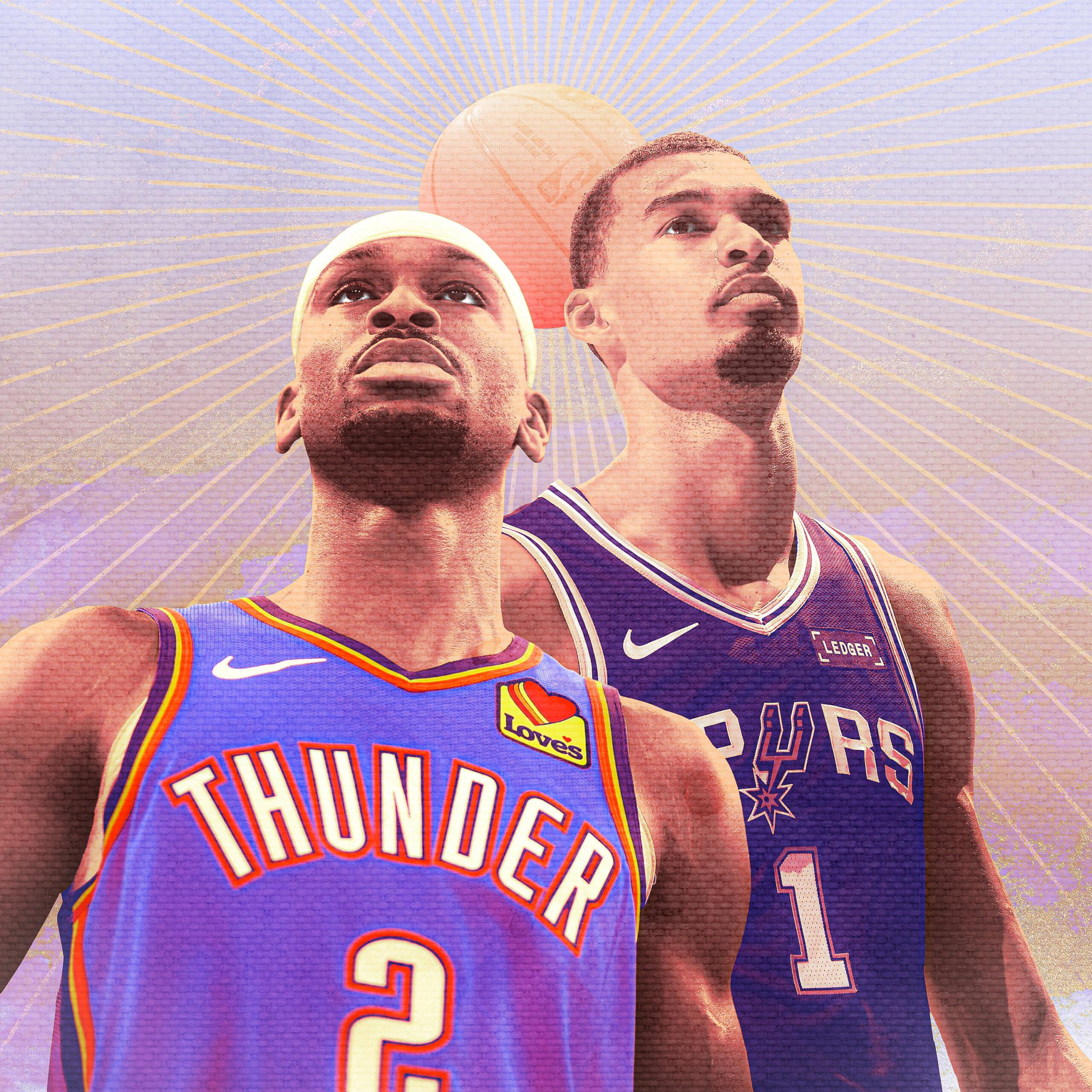

There are moments, during this epic clash between the San Antonio Spurs and Oklahoma City Thunder, when it feels like we’re all watching basketball on psychedelics.
Moments when Victor Wembanyama looks 10 feet tall, with a 20-foot wingspan—swatting every shot, swishing every 3 from the logo, dunking from half court with those Mr. Fantastic arms. Moments when Shai Gilgeous-Alexander seems to hover above the hardwood, virtually weightless, effortlessly sinking jumpers while absorbing a random assortment of elbows, forearms, and knees. Moments when the Thunder’s starting five seem impossibly in sync and the Spurs’ sprightly stars look like 10-year vets.
There are moments, in these deadlocked 2026 Western Conference finals, when even a certified NBA legend can only gasp at the staggering wealth of talent, youth, and depth and proclaim, with a fair degree of certainty: No one else stands a chance. Not now. Not next year. Not for years to come.
“I hate to break the news to the rest of the Western Conference, but they may not have a chance to win the Western Conference finals for the next 5-7 years. The Oklahoma City Thunder and San Antonio Spurs are just that good!”
That was Magic Johnson, he of the five NBA championships, in a tweet posted a short time after Wemby’s Spurs completed a riveting 122-115 double-overtime victory over SGA’s Thunder in Game 1 of the series. And Johnson was hardly alone. Across social media, fans and pundits and former ballers all joined in the gasping and proclaiming (and, in some cases, despairing) as they processed the collective dominance of Wembanyama (age 22), Stephon Castle (21), and Dylan Harper (20) on one side, and the brilliance of Gilgeous-Alexander (27), Chet Holmgren (24), and Jalen Williams (25) on the other.
The Thunder already have a championship in hand, a back-to-back MVP (SGA), the deepest roster in the league, and a massive cache of draft picks to keep replenishing as they go. The Spurs—the second-youngest team to make the conference finals this century—have the reigning Defensive Player of the Year (Wemby), an MVP finalist (also Wemby), two other rising stars, and an equally enviable stash of draft picks.
You can almost feel the existential angst spreading across the NBA map.
These aren’t just the two best teams in the West—and arguably the entire NBA—this season. No, the Spurs and Thunder are positioned to be elite for many, many, many years to come. This would be remarkable in any decade, but even more so now, in an era of unprecedented parity. Last June, the Thunder became the NBA’s seventh different champion in seven years. No team has won back-to-back titles, or even made back-to-back Finals, since the Golden State Warriors in 2017 and 2018.




The NBA’s collective bargaining agreement is engineered to thwart superteams, to render dynasties virtually extinct. But the Spurs and Thunder are threatening to break the system.
So if you’re a fan of any other team and find yourself shuddering and fretting and muttering about the hopelessness of it all … well, you have our sympathy and support. You’re right to be freaked out. But history suggests that things won’t be quite so predictable. That visions of a Spurs-Thunder hegemony will prove faulty. And, critically, that the other 28 franchises will not cower in fear.
Yes, the conversation among rival GMs and coaches right now is much like the public conversation—filled with awe and respect for Wemby and Shai and for what the Spurs and Thunder have built. But it’s tinged with defiance. No one is conceding the next half decade.
“The notion that everyone is just gonna accept it is insane,” said an executive from an Eastern Conference playoff team. “Everybody that are in these jobs are competitive. They’re not just gonna accept it. A team like San Antonio, who have gotten lucky to get generational talent multiple times [in the lottery], people take that shit personally, and they have a drive to beat those guys. They’re not gonna sit back and take a beating for the next 10 years.”
Both the message and the tone were consistent among a half dozen executives and coaches who spoke to The Ringer. No one can say exactly how they’ll dethrone the two Western Conference powers—just that they’re committed to finding a way.
“When I watch the game, I’m not watching it with any fear; I’m not watching it with a level of like, ‘We’re in a lot of trouble,’” said a coach with a Western Conference playoff team. “I'm watching it going: This is the standard. We're going to have to find ways to compete against these guys.”
Or, as one NBA team exec put it: “There’s no time spent like, ‘Oh, fuck.’”
It’s a daunting challenge but not a unique one. NBA coaches, players, and fans have been hand-wringing over one impervious force or another for decades. In the 1980s, it was the twin dynasties in Boston and L.A. In the ’90s, it was Michael Jordan’s Bulls. In the early 2000s, it was the Shaq-and-Kobe Lakers. And in the 2010s, it was Stephen Curry’s Warriors and whichever team had LeBron James.
But someone always breaks through. Moses Malone and the Philadelphia 76ers seized the title in 1983, temporarily interrupting the Lakers-Celtics stranglehold. Age and attrition eventually took down both powers. Isiah Thomas and the Detroit Pistons ended the Lakers’ reign in 1989. Hakeem Olajuwon and the Rockets sneaked in for two titles in the mid-’90s, between Bulls three-peats. Tim Duncan’s Spurs prevented a Shaq-and-Kobe four-peat in 2003.
The last time the NBA was this angsty about a single team was in 2016, when the Warriors—already champions and two-time Finalists—signed Kevin Durant to play alongside Curry, Klay Thompson, and Draymond Green. And that angst was justified. The Warriors put together a modern-day record of five straight Finals appearances, facing James’s Cavaliers in four of them. For a full half decade, it felt like no one else had a chance.
But it didn’t stop rivals from trying. The Spurs signed LaMarcus Aldridge in 2015, just after the first Warriors title, to flank Kawhi Leonard. Two years later, the Rockets acquired Chris Paul to play alongside James Harden and unleashed a playing style that stressed out the Warriors for seven games of the 2018 conference finals.
The Warriors, of course, repelled that challenge and won their third championship that June. A month later, the Toronto Raptors—clearly undaunted—acquired Kawhi Leonard to make their own Finals run. Eleven months later, Toronto took down the battered and broken Warriors to claim its own championship.
The specter of a prolonged Spurs-Thunder era might induce some bad teams to stay bad longer, or at least to build more methodically, in the hopes of rising when those teams fall, league executives said. But any team with immediate playoff aspirations has to at least consider San Antonio and OKC in its roster construction.
And any current team with a top-10 talent is almost obligated to follow the Raptors’ and Rockets’ example from a decade ago and go all in. The Lakers, now built around an in-his-prime Luka Doncic, can’t afford to stand idle. Ditto the Denver Nuggets and Nikola Jokic. The Minnesota Timberwolves, powered by 24-year-old Anthony Edwards, have been consistently aggressive in recent years, regardless of whom they’re chasing.
“We know our competition is not gonna sit still—nor will we,” Tim Connelly, the Wolves’ president of basketball operations, told reporters last week. But he also acknowledged the unique challenge posed by the Spurs and Thunder. “I think the equation changes when you see the two teams playing in the Western Conference [finals] right now and how good they are,” he said. “We got smacked by Oklahoma City last year, we got smacked by San Antonio. We know they’re … the gold standard.”
How will rivals actually respond? Will they load up on 7-footers to rough up Wembanyama? Will they splurge on rangy defenders to try to contain Gilgeous-Alexander (and Castle and Harper)? Will challengers be even more aggressive in pursuing a trade for Giannis Antetokounmpo? Or Kawhi Leonard? Or Jaylen Brown? This offseason will provide the first real glimpse into how other GMs view their chances of pulling an upset.
The wiser path, said the Western Conference coach, is to build patiently, “just be really good and focus on yourself, and then make sure you feel like you have a game plan that you'd be able to compete against them.” But, he quickly noted, “I do think some teams are going to make some mistakes this summer” in their zeal to defeat Wembanyama or Gilgeous-Alexander.
One strategy you should not expect: anyone trying to build a roster in the Spurs’ or Thunder’s image. And it’s not just because you’re unlikely to find another 7-foot-4 center with an 8-foot wingspan, with the shooting range of Damian Lillard and the shot-blocking instincts of Dikembe Mutombo. The map the Spurs followed—a multiyear commitment to losing in pursuit of high draft picks—will soon be erased by the NBA’s coming lottery reforms. It will soon be extremely difficult (if not impossible) to acquire three young talents like Wembanyama (the no. 1 pick in 2023), Castle (no. 4 in 2024), and Harper (no. 2 in 2025).
“You’re not going to replicate Wemby,” said a Western Conference GM. “Generational talents like him come along once every quarter of a century. But I think our job as competitors, and I think the majority of the league would say it, is, ‘OK, they’re special, they’re great, but it’s our job to figure out: How can we put up a team that can compete against that and give us at least a fighting chance to unseat them?’”
Nor is the Thunder’s model easily replicable. They landed Gilgeous-Alexander via trade, before he blossomed into a star. They acquired the future pick that turned into Williams (no. 12 in 2022) in that same deal. And they tanked the year they landed Holmgren (no. 2 in 2022)—a gambit the NBA hopes to eradicate with flatter lottery odds.
“We would never try to build a roster specific to an Oklahoma City or a San Antonio,” Connelly said. “You can’t match up with everybody.”
Still, as one talent evaluator for an Eastern Conference team noted, there are lessons to be gleaned from both powerhouses. Both teams scout, draft, and develop young talent at an elite level. Both teams invest smartly in analytics and sports science.
“You try to find an advantage in the margins,” he said. “We’re not gonna be able to stop Wemby, but if we can manage to not let them get 25 points from a rookie in Dylan Harper, maybe we have a chance to win. It’s not gonna be easy, obviously, but people found a way to win around LeBron’s dominance, they found ways to win around KD and Steph Curry’s dominance. There’s always going to be somebody that’s going to challenge them.”
Failing any other solution, rivals can hope that a string of deep playoff runs will wear down the wunderkinds and leave an opening for someone else. No one is rooting for injuries to marquee stars, but the recent surge in soft-tissue injuries (especially Achilles ruptures) is an ever-present factor in the championship race. The NBA’s current economic system—featuring punitive luxury taxes and “aprons” that punish the highest spenders—could also theoretically force the Thunder and Spurs to break up their cores at some point, or at least shed some key role players.
“People are gonna figure it out, how to beat them,” said the first Eastern Conference executive. “With the rules the way they are, San Antonio may not be able to keep all those guys. So a window opens up again. You have to be prepared for when that window is there.”
Yet, barring injuries or salary-cap issues, it’s hard to see how the Spurs or Thunder will falter anytime soon. But we’re reminded of another leaguewide freakout, some 16 years ago, when a once-in-a-generation player left Cleveland for South Beach to play alongside two other stars in their primes and threaten to win every title for the next decade. “Not one, not two, not three, not four, not five, not six, not seven,” James proclaimed on that Miami stage in July 2010.
The history books show that the Heat made four straight Finals, winning two of them, before James returned to Cleveland. Which merely proves once more that nothing in the NBA is forever and, well, none of us know anything.
“We can all try to predict the future,” said a team executive. “No one is going to be right about it.”