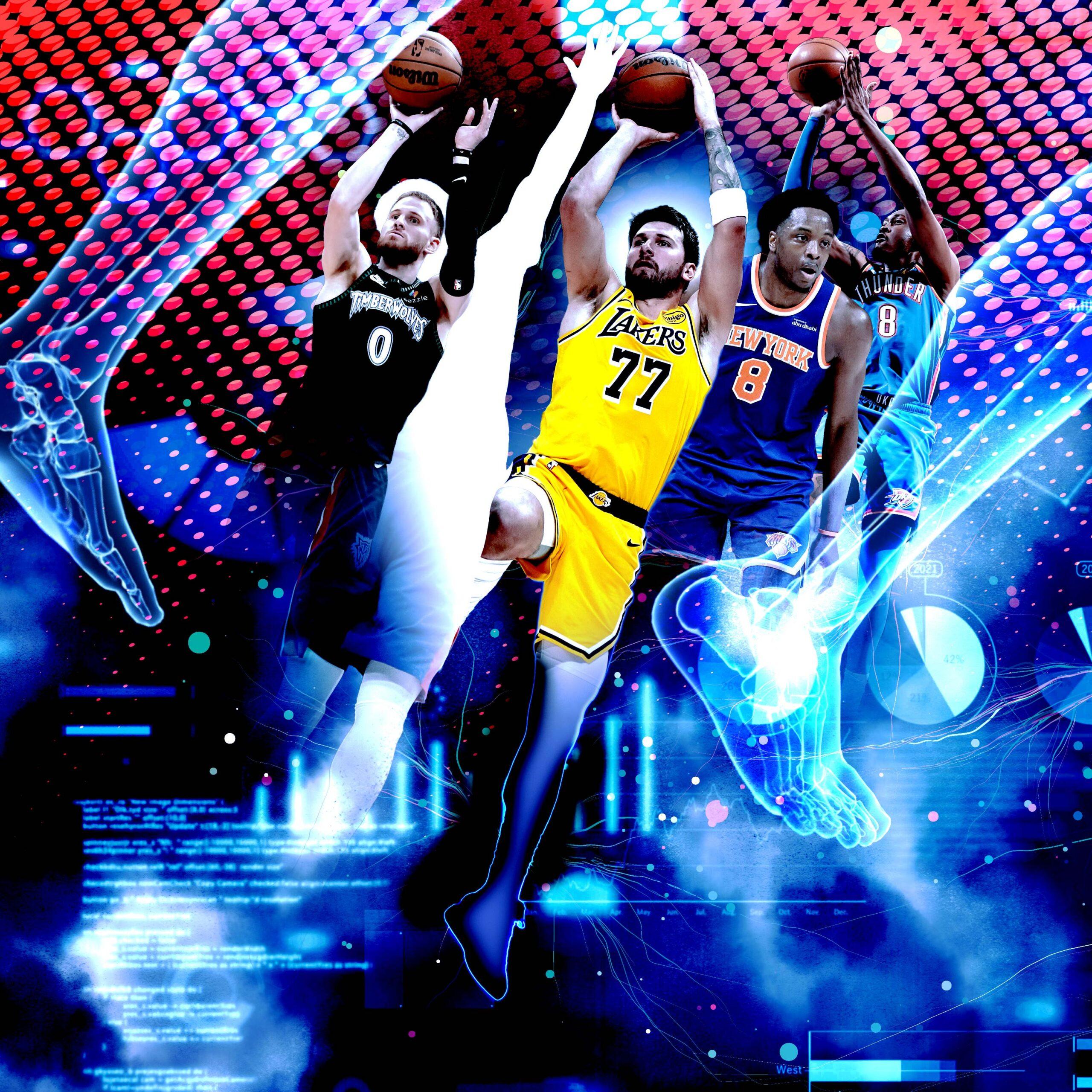
Is the Modern NBA Breaking Its Stars?
An increasing number of players are missing a growing share of games with soft-tissue leg injuries. Why is this happening? And what can the league do about it?Is the Modern NBA Breaking Its Stars?
An increasing number of players are missing a growing share of games with soft-tissue leg injuries. Why is this happening? And what can the league do about it?
Two moments. Sixteen months apart. Same player. And a giant new red flag for the NBA.
It’s Christmas in Dallas in 2024, and the hometown Mavericks are facing the Timberwolves in a massive showcase on national TV. Late in the second quarter, Luka Doncic catches the ball on the left wing, attacks the elbow, splits his stance wide for the stepback, and, at the instant he usually gathers and rises, aborts. Instead of his patented shot, he throws a flat, listless pass to Kyrie Irving at the logo. Doncic doubles over on the wing, with both hands on his left calf. He wouldn’t play another game in a Mavericks uniform. Six weeks later, he’s traded to the Lakers, and the explanation the front office gives the public is clear: They don’t trust his body.
The second moment is on April 2, 2026, in Oklahoma City. Doncic again finds himself on the left wing, again attacking the left elbow, and again he comes up hobbling. This time he grabs his left hamstring. It’s a Grade 2 partial tear.
The calf strain on Christmas ended his time in Dallas. The hamstring tear ended his first full season in L.A. Doncic missed the final five games of the regular season and the entire Lakers playoff run. That is the story. And the story is not unique to him. Consider the rash of other injuries so far in the 2026 playoffs:
- Jalen Williams missed all but two of the Thunder’s eight playoff games due to a hamstring strain.
- Aaron Gordon missed most of the Nuggets’ first-round series with a calf strain.
- Peyton Watson missed all of the Nuggets’ first-round series with a hamstring strain.
- Franz Wagner missed the final three games of Orlando’s first-round loss to Detroit due to a calf strain.
- Ayo Dosunmu missed two games with calf soreness.
- Donte DiVincenzo has missed all but three postseason games after rupturing his Achilles.
- Anthony Edwards missed two games with a knee injury and has been limited since his return.
- Jayson Tatum missed Boston’s Game 7 loss to Philadelphia in the first round due to “left knee stiffness,” but he was seen with an ice pack on his left calf, and reporters on the scene described the injury as a calf issue.
- OG Anunoby missed the final two games of the Knicks’ second-round series against the 76ers with a hamstring strain.
This postseason is turning into a war of attrition, with soft-tissue leg injuries in particular playing an outsize role. And it doesn’t just seem that way; the data supports it. The league has been trending this way for years. In 2010-11, there were 18 documented calf injuries across the entire season. Last season, there were 60. This season, 86.
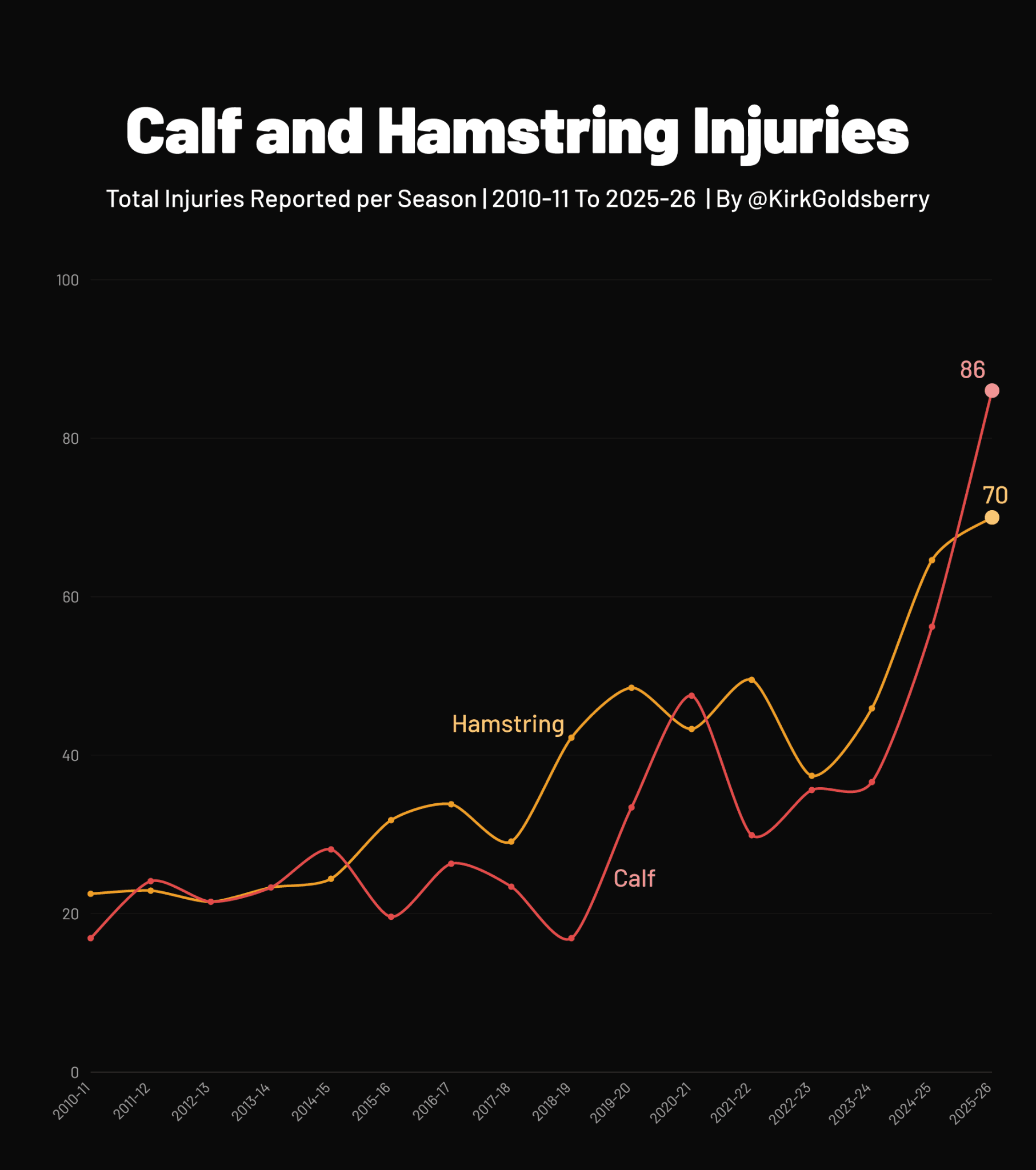
I collected the data in the graph above with the help of Michael Rees, a student researcher at the University of Texas at Austin. We spent the past several weeks tracking down historical NBA injury data, stitching it together, and cleaning it up so that we could study it. The resulting dataset includes more than 13,000 injuries and over 1,500 players, spanning 16 NBA seasons and all 30 teams.
Public injury data is notoriously messy. Reporting guidelines have shifted over the years, the information we have about individual injuries is often vague or inconsistent, and teams may be more cautious with treating soft-tissue injuries than they were in the past.
But the trends in this dataset are loud enough to cut through the noise and reveal a signal that is unmistakable and important: The NBA is in the midst of a leg plague, and a growing number of players are missing a growing number of games with lower-body soft-tissue injuries.
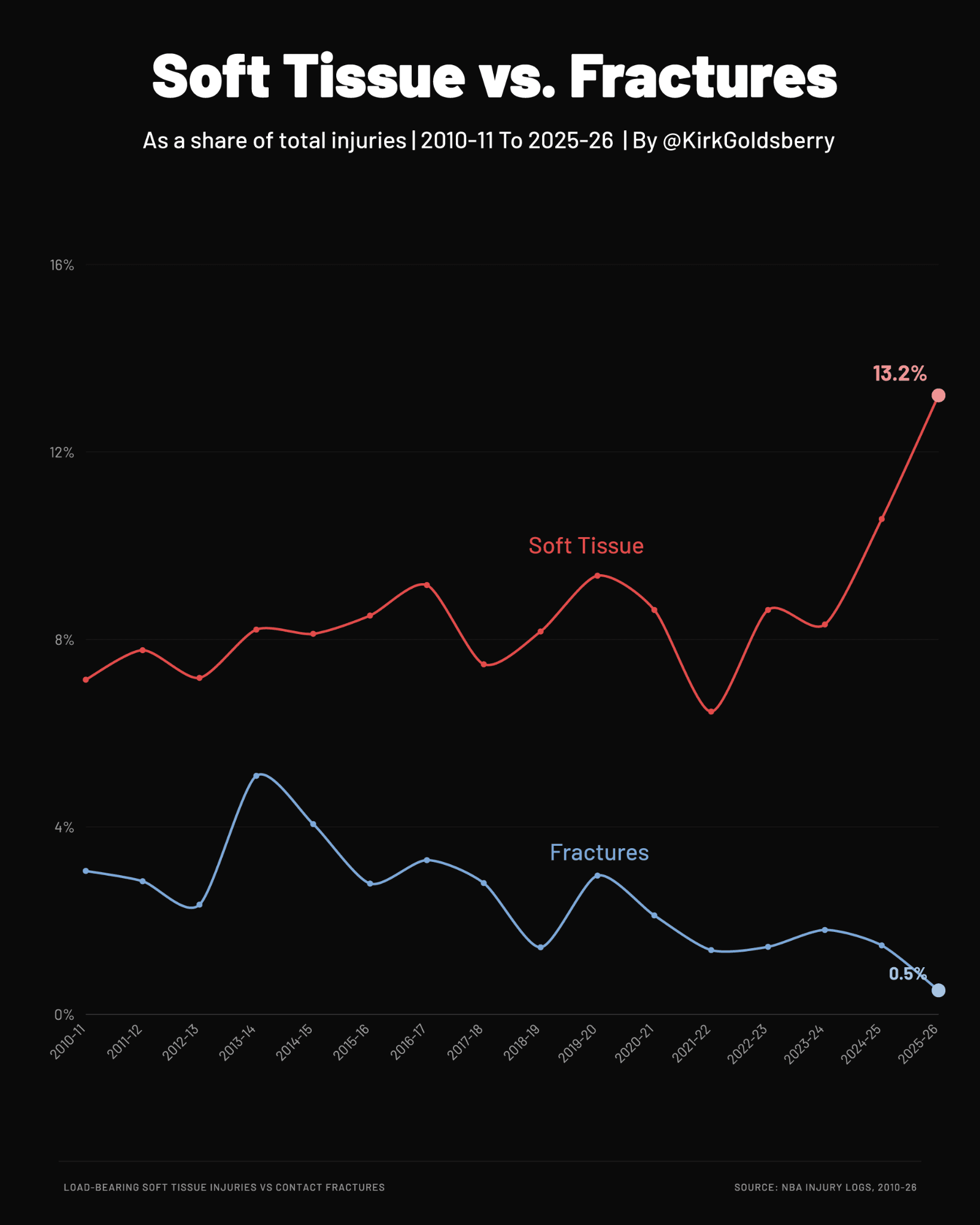
These soft-tissue injuries are dangerous for players, disappointing for fans, and destructive for the league. So why are they occurring so often? And what, if anything, can be done about them?
The first clue occurred to me several years ago in a conference room at the Warriors practice facility in San Francisco, during a technical discussion about biomechanics and basketball. At the time, Klay Thompson was still rehabbing from a brutal one-two punch of traumatic lower-body injuries that upended his prime and likely shortened the team’s dynasty. When our meeting wrapped up and the room fell into that unique silence that signals that a group is ready to disperse, Ron Adams, the longtime assistant coach and elder statesman of the Warriors, spoke up for the first time all afternoon.
"Basketball used to be a two-footed sport," Adams said. The room locked in. "If you ever watched a John Wooden practice, it was always the same: get to the paint and play off of two feet. Nowadays, the game is a one-footed sport. Most players are making every move off of one foot."
Adams’s observation was basic but profound. He was exactly right. The footwork in basketball is drastically different now than it was a few decades ago.
Cast your mind back to the NBA of the late 1990s. Post-up basketball. Isolation sets. Hand checks stopping drives before they could even begin. Games unfolding at a glacial pace. The bodies on the floor were doing hard things, but they were largely bilateral things—like a center backing down his man, a wing squaring up off a catch, or a guard running off a screen to spot up from the corner. When players drove, they drove in straight lines.
That game is gone. It didn’t happen overnight, but since Allen Iverson made the crossover famous, Manu Ginobili popularized the Euro-step, and Stephen Curry made the stepback 3 into a fundamental skill, today’s best players have exhibited a completely different choreography than their basketball ancestors. The modern NBA is a pace-and-space machine—100-plus possessions a night, built on rapid ball movement, floor spacing, and the core principle that any player must be able to create offense off the dribble from anywhere. The epicenter of NBA offense has migrated from the low block to the perimeter, where endless drive-and-kick sequences stack on top of one another. Twenty-five years ago, if you were 6-foot-9 and 260 pounds, you lived in the post; now you live on the edge, like everyone else.
Today’s game of relentless one-on-one creation; guards, wings, and increasingly centers attacking closeouts; and transition offense requires a different kind of movement. It requires rapid changes of speed and direction. And almost all of it happens off one foot.
I remember writing in my notes: “Ron Adams … are modern moves hurting players?”


Richard Lieber has spent decades literally removing muscles from patients during surgery and measuring what those muscles can do. He is the chief scientific officer of the Shirley Ryan AbilityLab in Chicago, where he runs the muscle physiology lab. Lieber wrote the definitive textbook on skeletal muscle and is, according to several sports scientists I spoke with, the closest thing the field has to a unified theorist of soft-tissue injury.
Lieber’s core finding, built over a career, is simple: Muscle damage isn't caused by how hard a muscle works, but rather by how far it stretches while it's working. "The muscle almost always has to be activated to really be injured," Lieber tells me. "And it almost always has to be stretched." When both of those things happen at once, that's when injuries can happen.
The calf, he explains, is particularly vulnerable to that combination because of our anatomy. "The calf muscle has pretty short fibers, all things considered,” Lieber says. When the ankle rotates and the knee extends at the same time, it puts immense strain on the muscle.
That strain is amplified for bigger players. "My calf and Shaq's calf have about the same length of fibers," Lieber says, "but he just has maybe 10 times what I have." The fibers don't scale with the body. The bones—the levers—do. "So a bigger person, when they rotate their knee joint or their ankle joint 20 degrees, they stretch their muscles relatively more."
The same move, performed by a larger body, is more dangerous. Not because the player is weaker, but because the geometry is worse. That’s bad news for a league that’s demanding that larger and longer players increasingly add false steps, stepback 3s, and Euro-steps to their repertoires.
When I describe the stepback 3—in which the plant foot lands with the knee extended and the ankle flexing simultaneously—to Lieber, he doesn't hesitate. "You step back and then take a giant push off with your legs and calf. You countermove to activate and stretch the calf, and then you pile a big activation on top of it." Stretch, activate, explode—in that order, faster than the nervous system can protect against it.
Kinetically, the Euro-step is two high-magnitude single-leg decelerations stitched together by a lateral weight transfer. The plant leg absorbs forward momentum, the trail leg then swings laterally across the body's midline, and then an additional plant of the trail leg requires another absorption of force, this time with the body already off its axis. In other words, these are three of the highest-risk loading patterns in basketball—eccentric calf braking, valgus knee deceleration, and unilateral pelvic stabilization—compressed into roughly 0.6 seconds.
The rise of the stepback 3 and the Euro-step is not a random trend. As the NBA learned that the smartest shots on the floor happen at the rim and from beyond the arc, creative players have developed and iterated on moves that generate those opportunities. Being able to create and convert their own shots from 3 or at the basket is what makes someone a superstar. But is the way they’re going about it risky?
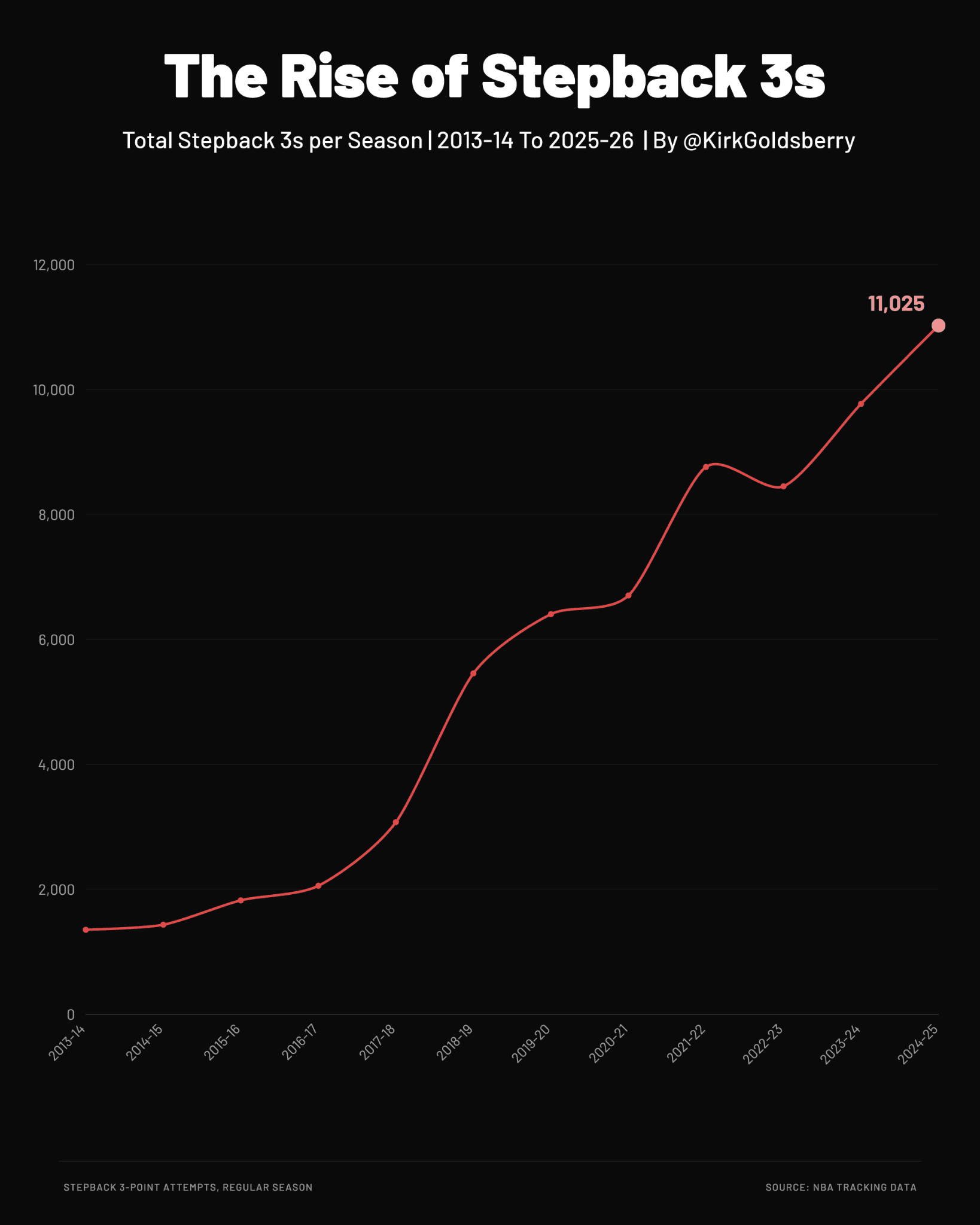
You can trace the development of the NBA’s one-footed moves through its star players. In his rookie season, in 2017-18, Jayson Tatum attempted 11 total stepback 3s. In 2024-25, he attempted 251. That’s a 23-times increase, but that’s just the beginning.
Since the player tracking era started in 2013-14, only five players have attempted more than 1,000 total stepback 3s: James Harden, Doncic, Curry, Tatum, and Damian Lillard.
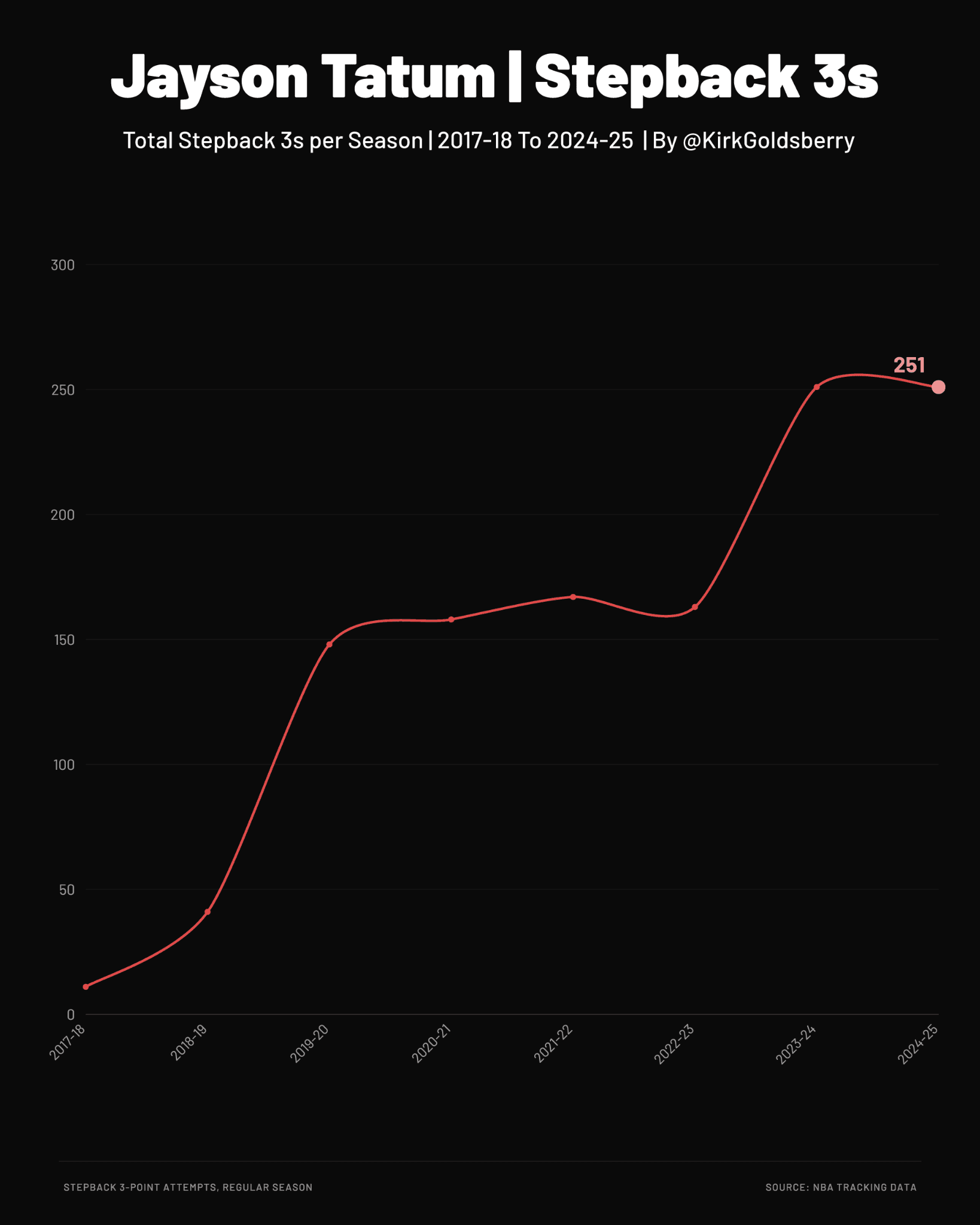
Lillard and Tatum have both endured traumatic Achilles tears. (Injuries to the Achilles, which is anatomically connected to the calf, are also on the rise. Last year, six players tore their Achilles, the most in any season in our data.) Doncic has had three calf strains and just missed the Lakers’ entire postseason with that hamstring injury. Harden has largely been spared, but even he missed time with Achilles soreness in 2023. Curry, who takes better care of his body than just about anyone, suffered the first muscle strain of his 17-year career in last year’s playoffs.
Correlation is not causation, and these stars are hardly the only players suffering soft-tissue injuries in their legs. But it’s really starting to seem like the modern game might be breaking down its own superstar class.
The NBA isn’t the only professional sports league dealing with a rash of lower-body injuries. In the NFL, Achilles injuries have increased by 300 to 500 percent since the turn of the century. In tennis, match retirements due to injury have increased by 25 to 50 percent over that same time period. Across the sports world, athletes are bigger and stronger, competition is more dynamic and physical, and the scheduling demands have ballooned.
Earlier this spring, I ran into Jimmy Buffi at a conference at MIT. Buffi runs Reboot Motion, a biomechanics consultancy company that works with a bunch of teams in MLB and the NBA. Buffi earned his PhD and his reputation in Major League Baseball by obsessing over pitching mechanics and the rise of the so-called Tommy John injury, which has plagued that league for the past decade or more.
“In baseball, there is now such a strong incentive for throwing the ball harder and harder. Velocity has become everything, and strikeouts have become super important. Now, pitchers are training toward that reality. They need to be more explosive,” Buffi says. “They used to want to be long and loose; now they crush the weight room and throw weighted baseballs to chase increased velocity. And everybody is getting hurt.”
Over the past decade or so, MLB has endured a data-driven velocity revolution that has changed everything from how pitchers practice to how many strikeouts and home runs occur in an average ball game. Training regimens have changed, and pitchers are more explosive than ever. But the unfortunate truth is that the human elbow didn’t update its firmware. The ulnar collateral ligament used to be a term known only to health care providers; now it’s part of basic baseball discourse.
It’s not perfectly analogous to what’s happening in the NBA, but Buffi tells me in no uncertain terms that there is a clear relationship between the evolution of gameplay and the evolution of injuries. When I ask him whether the rise of modern moves like the stepback and the Euro-step could be causing this spike in calf and hamstring issues in the NBA, Buffi quickly replies, “It’s definitely possible.”
There’s no smoking gun—experts like Buffi and Lieber didn’t earn their reputations by jumping to conclusions. But clearly something is happening, and it’s time for real research.
Lieber says that the single biggest predictor of a calf strain injury is a previous calf strain. We like to believe that once an athlete is healed, they’re as good as new. Lieber cautions us. So does the data: This season, 13 different NBA players suffered multiple calf injuries.
Six players suffered three or more calf injuries this season alone: Coby White, Rui Hachimura, Isaiah Hartenstein, Giannis Antetokounmpo, Evan Mobley, and Ty Jerome.
For context: From 2010 to 2024, the instances of a player having three calf reports in a single season were vanishingly rare; it happened a total of five times across 14 seasons. Again—it happened six times this year.
That’s a massive red flag. Yes, reporting standards have changed in that window—that's the responsible and necessary disclaimer—but calf injuries now make up nearly one in four lower-leg injuries in the league, up from fewer than one in 10 a decade ago.
The data is clear. If the league insists on stacking 82 48-minute regular-season games on top of a grueling two-month playoff gauntlet on top of a movement vocabulary that asks 240-pound men to absorb five times their body weight on one leg, dozens of times a night, then we can expect present trends to increase.
The NBA has a choice here. It could cut down on the number of games, make games shorter, and/or add more rest in between them. But all of these solutions pit revenue against player wellness, and in a league increasingly driven by billionaires and tycoons, that’s probably not great news for hamstrings and calves.
NBA owners can keep pretending that load management is a player character issue rather than a cry for relief. It showed its hand in 2023 when, instead of adopting a shorter schedule, it added a new in-season tournament that compressed it even more and inserted a 65-game rule that punishes athletes whose bodies break down amid the relentless grind of the most demanding basketball season on earth.
There is an alternate version of this incredible league. One in which the regular season is shorter and the playoffs are spaced more humanely. One informed by basic sports science, where the average game has a higher rate of superstar participation, where rest and recovery are respected, where stars like Doncic can properly recover from a calf strain without worrying about losing out on awards and millions of dollars. That version of the league would be smaller, but it would also have more superstars on the floor this time of year.
In the spring of 2026, the NBA is Euro-stepping its way to a tipping point, and unless it decelerates and pivots soon, it’s going to get hurt.
A previous version of this piece misstated details about recent injuries to Jalen Williams and Franz Wagner. Williams played two playoff games for the Thunder before suffering a hamstring strain, rather than missing the entire playoffs so far; Wagner injured his calf, not his hamstring.