

In spite of the NBA’s irritating 65-game benchmark that has agents hysterical, fans annoyed, voters confused, and stars playing hurt just to qualify, this is one of the closest MVP races in recent memory. Everyone on this ballot has been inevitable; when they’re locked in, it feels like every frame of action is under their control. Every shot will go in. Every decision will be correct. Every opponent will be relieved when the final buzzer goes off.
In trying to precisely compare and contrast the nominees, there are no right answers. There are no wrong answers, either. Here’s what went into my ballot: countless hours watching games and poring over (too many) statistics that help confirm what my eyes can see and illuminate some of what they can’t.
I’ve also absorbed a ton of NBA analysis on myriad platforms and have had countless debates with colleagues, team employees, fans, and random strangers who don’t understand why Payton Pritchard isn’t taken more seriously in the race.
At the time of this writing, with six days left in the regular season, it’s still unclear who will be eligible to win MVP. I did my best with the information that’s available, but my official vote may be tweaked after the 2025-26 regular season is officially in our rearview mirror. (Apologies ahead of time to Luka Doncic and Cade Cunningham. Both would’ve appeared on this list if they qualified.) Without further ado, here’s my five-man ballot.
1. Nikola Jokic
As someone who believes Jokic should have won the past five MVP awards, this is the first time since 2021 that the race for basketball’s most prestigious individual award has felt like a crapshoot.
I get why Jokic’s status as the best player alive has slid from an exclamation point to a question mark over the last couple of months. I know the odds of him holding up the Michael Jordan Trophy for a fourth time this spring are paper-thin. I understand voter fatigue, genuinely care about defense, and realize the power of a captivating narrative. Nobody wants to be late to the party, and a revelation is easier to appreciate. More tangibly, victory is better than defeat. The Denver Nuggets are riding an eight-game winning streak after downing the San Antonio Spurs in an overtime thriller on Saturday, but they have persistently wobbled along the thin line that separates euphoria from crippling disappointment. The two leading MVP candidates, Shai Gilgeous-Alexander and Victor Wembanyama, play for more stable powerhouses that are expected to square off in the conference finals.
But I also think—from almost everything I’ve read and heard that’s related to the never-ending MVP discourse—that Jokic has been taken for granted. Whether we’re measuring value, skill, or production, Denver’s center (still) stands alone. One game does not make an MVP campaign, but he showed why he’s worthy throughout Saturday’s instant classic against San Antonio: 40 points, 13 assists, eight rebounds, three blocks, zero turnovers, and one breathtaking floater or Sombor Shuffle after another down the stretch.
Wemby is by far the most intimidating defender in the world, but Jokic had an answer over and over and over again to questions that have baffled the rest of the league for months:
The entire performance encapsulates why Jokic belongs at the top of this list. He consistently reaches heights that have him levitating above everybody else. Very soon, the eight-time All-Star will become the first player in NBA history to lead the league in assists and rebounds per game in a single season. It’s an unthinkable feat that’s somehow been glossed over, so allow me to repeat it: Jokic is about to become the first player in NBA history to lead the league in assists and rebounds.
And then there’s the fact that he also ranks sixth in scoring with unconscionable efficiency. Jokic almost begrudgingly logs 27.9 points per game, he has the third-highest true shooting percentage in the league on field goal attempts that often come with an incredibly high degree of difficulty, and when he misses, he can self-rebound for a putback. (Jokic’s field goal percentage above what’s expected also ranks first by, like, a lot.) To boot, no one has a more positive impact on their team’s transition offense. All those defensive rebounds? Many of them preceded a fly route:
There was a spell this season when his flaws were exacerbated and his strengths didn’t have the same edge. Pick-and-roll defense and rim protection are important parts of the job and, obviously, not Jokic’s strong suit. Opponents are shooting 71.3 percent at the basket when he’s on the floor; for several games after he returned from the knee injury that sidelined him for all of January, Jokic resembled a folding chair. His 3-point shooting fell off a cliff, and some of the (many) turnovers he committed were inexplicably careless. Denver is 13-17 in crunch time when Jokic plays, which is the exact opposite of a feather in his cap.
But the bar Jokic has set for himself makes any slip feel more consequential than it actually is; even when he doesn’t look like himself, Jokic still looks like the best player on the planet. His February was, for him, not ideal. But since the All-Star break, only Luka Doncic and Kevin Durant have scored more points, and nobody has recorded more assists or rebounds. He had nine triple-doubles in March, which is more than all but two players have logged this year. (Jokic has 32 triple-doubles overall, or, put another way, over a third of the total recorded this season.)
Seasons are long, but I’m old enough to remember his Christmas Day massacre of the Minnesota Timberwolves: 56 points, 16 rebounds, 15 assists, 15-for-21 shooting from the floor, and 22-for-23 shooting at the free throw line. A month before that, he plopped 55 points, 12 rebounds, and six assists on the Los Angeles Clippers, making 18 of his 23 shots and going 14-for-16 at the line. Both performances have a top-25 all-time game score. Mind-boggling stuff.
To me, lost in the conversation about two-way players—defense being 50 percent of the game, etc.—is the rudimentary fact that outscoring your opponent by a ton when you’re on the floor, regardless of how it looks or happens, is kind of the whole idea. Jokic generates the most points in the league (53.7 per game) for an offense that continues to be the sport’s golden standard. When he’s on the court, Denver yields an NBA-best 125.8 points per 100 possessions. This is largely thanks to an anti-solipsistic approach that directly enhances all of his teammates, nearly all of whom are considerably more efficient when they share the floor with him. Jokic is first in passes and touches while ranking 38th in on-ball percentage among players who’ve logged at least 1,500 minutes. Life at his side is the basketball equivalent of a beach vacation.
Winning matters, but so does context. In this day and age, there are several reasons why it doesn’t make a ton of sense to use the standings as a pivotal criterion. We’re evaluating individuals who don’t handpick their teammates or control their injuries. What’s more meaningful, to me, is what each superstar does with the people around them. This is the first time in years that Jokic doesn’t have a choke hold on pretty much every catchall impact metric, but he still leads several of them and ranks no worse than second in most.
He’s also the only player who is the hardware and software for his team—both motherboard and operating system. The Nuggets have to reinvent almost their entire identity when the three-time MVP sits. Regardless of what lineup combination Nuggets head coach David Adelman settles on, their fast-break opportunities completely dry up, the ball sticks, and they can’t rebound. Unlike Gilgeous-Alexander, Jokic can’t rely on the most dominant defense in at least 25 years to strap clamps on his team’s opponent while he’s resting. And when you remove garbage time from the equation, nobody’s on/off differential is wider.
Throw in all the games that Aaron Gordon, Cam Johnson, Peyton Watson, Christian Braun, and Jonas Valanciunas have missed with various health issues, and it’s fair to wonder whether anyone else in the league could have endured what Jokic has without seeing their team fall into the play-in or worse. Altogether, his value, production, and skills still rest, ever so slightly, on their own level.



More on the NBA
2. Shai Gilgeous-Alexander
Has there ever been a more resounding combination of consistency, elegance, and art in a scorer? Dropping at least 20 points in a million straight games is kind of a big deal. Doing it with a top-10 effective field goal percentage is ruthless. Gilgeous-Alexander is slippery, technically precise, and able to raise his game higher than anybody else can in the moments that matter most.
This man could average 25 points per game wearing a bathrobe and slippers. In a Thunder jersey and SHAI 001s, he’s up at 31.6, converting 60.1 percent of his 2-point shots. Just look at his shot chart. Don’t stare too long, though. It might burn a hole in your retinas.
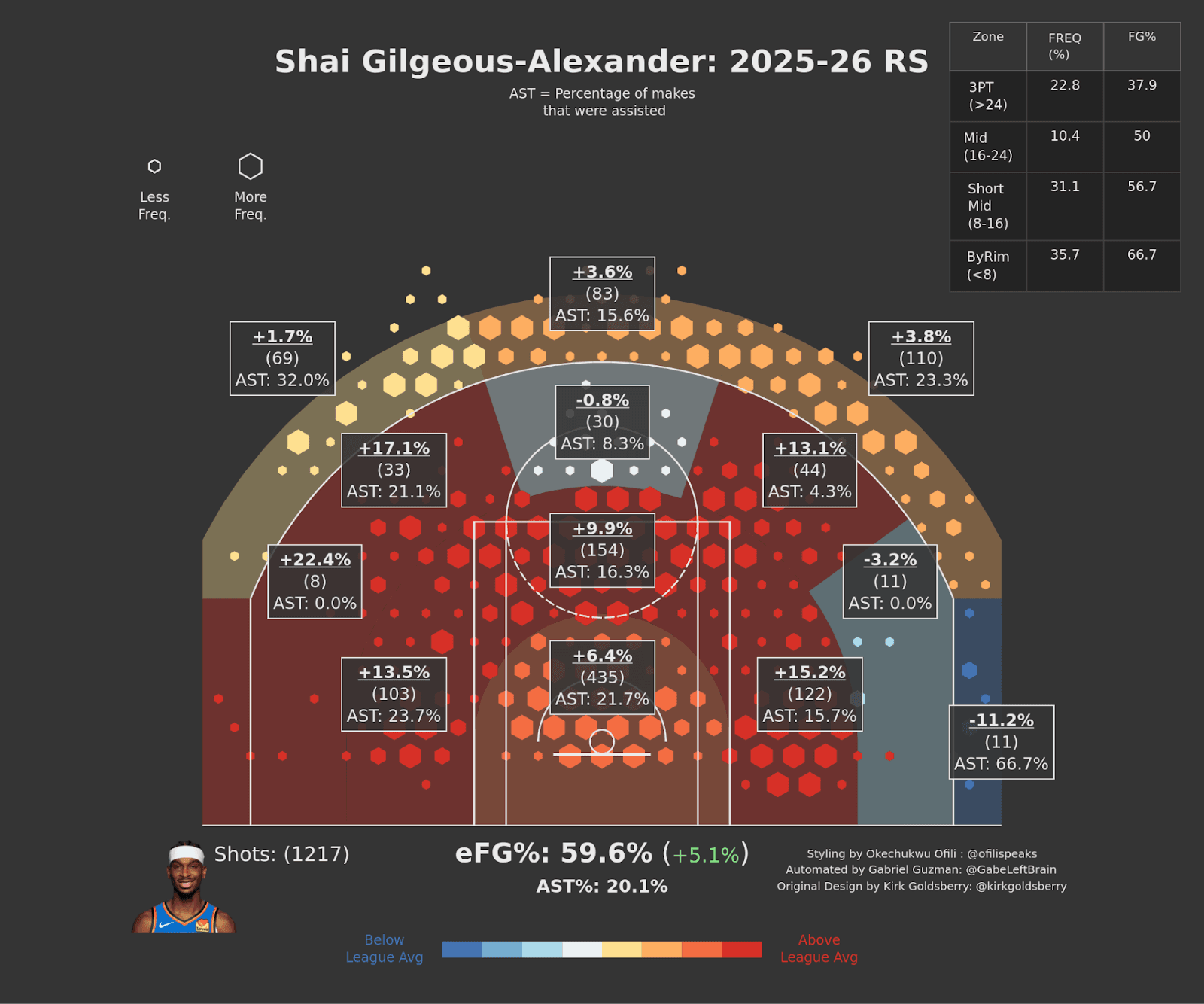
Shai flutters around the court like a butterfly with fangs. Only two players who’ve attempted at least 200 layups have a higher field goal percentage (Jokic and Austin Reaves), and the only person who’s converted shots at a lower unassisted rate is James Harden. Shai is an assassin in crunch time, too. While leading all players in clutch points per game, Gilgeous-Alexander also has a 43.8 usage rate and a 66.8 true shooting percentage. These numbers look fake but, in fact, are real. Shai’s mark in win shares per 48 minutes not only leads the league, but it’s also good enough to rank second all time among MVP winners.
The Thunder’s offense dies when he’s on the bench, and it sizzles with him leading the way. They outscore opponents by 15.3 points per 100 possessions when he’s on the court; among all players who’ve appeared in at least 60 games, only Wemby makes more of an impact. And while I won’t nominate the seventh-best defender on Oklahoma City’s roster to an All-Defensive team—the Thunder deploy what is essentially the best defense of the modern era with or without Gilgeous-Alexander on the floor—he’s still a hawk on the weak side and cagey enough to stand his ground when targeted with a ball screen. (Sometimes I forget that SGA's defense is what initially made him so appealing way back when he was a rookie on the Los Angeles Clippers.)
He’s first in a bunch of catchall metrics, like estimated plus-minus and xRAPM, on a first-place team that’s won 81.5 percent of its games that Gilgeous-Alexander plays in. Right now, when you type “MVP” into Thesaurus.com, his winking headshot very well may appear.
The inescapable criticism tied to his power—debates about ethical basketball and rule book manipulation—wouldn’t be so loud if he weren’t this great. To all that criticism, I say: Don’t hate the player; hate the game. Until referees interpret personal fouls differently, the NBA will be littered with hyperintelligent scorers who are eager to take advantage. (Sidebar: We really need to do something about the act of creating space with a push-off. Please, NBA, disincentivize it with a rule change, à la the rip-through. Probably the most frustrating thing about this entire conversation is the fact that the foul-baiting is nowhere near a prerequisite for SGA’s success.)
If/when he wins his second straight MVP—Gilgeous-Alexander is the prohibitive favorite—it will be well-earned.
3. Victor Wembanyama
Wembanyama entered his third year facing massive expectations and a smidge of skepticism. When will he stop shooting 3s? Can he stay healthy? Were the San Antonio Spurs a bit hasty in accelerating their timeline and trading for De’Aaron Fox?
In hindsight, every shred of doubt that was cast during the preseason now feels extremely foolish. Even the people who predicted he would make first-team All-NBA, win Defensive Player of the Year, and crack a few MVP ballots didn’t believe he would transform the Spurs into a genuine title contender this quickly. San Antonio’s over/under win total heading into this year was 44.5. It has already won 59 games, has punked the defending champion Oklahoma City Thunder multiple times, and is the only team with a top-five offense and defense against opponents with a top-10 net rating.
The Spurs’ rise from “how cute” to “uh-oh” to “If the NBA doesn’t change several rules immediately, we might as well cancel the season” is primarily thanks to a 7-foot-4 22-year-old who also might be the most confident player in the league. The totality of Wembanyama’s impact can’t be measured statistically. Even catchall metrics that reflect his dominance feel inadequate.
What San Antonio’s hallucinatory tentpole has done over the past five months fundamentally transcends what it means to control a basketball game. No game plan comes close to working, and when we think back on the 2025-26 regular season, this ascendance is what will be remembered most. The jaw-dropping highlights that suspiciously coincide with the invasion of artificial intelligence. The way he peer-pressured the NBA’s best and brightest to try hard in the All-Star Game. Remember those “face of the league” debates that were backdropped by a looming concern over LeBron James’s and Steph Curry’s battles against Father Time? It’s not a coincidence that they’ve completely disappeared.
Wemby’s existence as both a defensive powerhouse and unstoppable scorer with incomparable off-ball gravity is a new form of poor sportsmanship. He can shoot 3s. He can drive closeouts. He can sense where a double-team is coming from when his back is to the basket. He can drive to the rim, collapse the defense, and dunk a lob that might as well graze the shot clock. He can flex out of a triple-threat position at the nail. He can run a one-man fast break. He can come off a wide pin-down and freeze half the floor’s attention. He can induce panic with an inverted pick-and-roll. He can do it all:
Stick a wing on him (as several teams have), and he’ll either knock them into the basket or unleash a post move you didn’t think he knew how to do.
The Spurs appreciate all of it. Wembanyama leads the league in on-court net rating and net on/off differential. Put another way, when he’s in the game, San Antonio boasts a point differential that equates to a 73-win team. So, yes, in more ways than one, Wemby is history unfolding before our very eyes.
He’s second in estimated plus-minus, second in xRAPM, and second in daily plus-minus. Decent enough. He’s also first in moments that make you wonder if Barack Obama watched a Spurs game the night before he went on a podcast to reveal that aliens do, in fact, exist.
4. Kawhi Leonard
How did someone who’s headed for the play-in crack this list? Whether I’m whittling down my MVP ballot or assembling All-NBA teams, I care about each individual’s impact more than whatever his team’s record happens to be. These separate criteria often align, but whenever there’s a disparity, it isn’t that difficult to disentangle them. The process should be more surgical and emphasize variables that capture the net effect each player has on his surroundings.
In Leonard’s case, putting him here wasn’t that hard. He’s been one of this season’s best players for several months, an irrepressible three-level scorer who also still happens to be one of the most disruptive defenders in the league.
The Clippers are .500 and have lost a crap ton more games than just about every other team that’s led by a verifiable MVP candidate. Very little of this is on Leonard, though. They’re 35-26 in games he’s appeared in—a 47-win pace that’s remarkable considering the amount of injuries, trades, and general dysfunction L.A. has endured. (Leonard has been slightly more efficient and his plus-minus has doubled since James Harden was traded.)
More precisely, Kawhi is an analytics god. He ranks third in daily plus-minus, sixth in estimated plus-minus, fourth in net points, third in Neil Paine’s LAKER, and fifth in PER.
And in more elementary terms, when he’s on the floor, the Clippers outscore opponents by 8.5 points per 100 possessions. Without him, they’re a disastrous 14 points per 100 possessions worse (a net differential that trails only Wemby’s). Some of that’s thanks to 3-point luck, but most of it’s because he serenely handles an immense offensive load with a jump shot that cuts like a serrated blade.
Below is a chart, per Cleaning the Glass, that identifies every player this season with a usage rate above 28 percent who’s also averaging at least 1.25 points per shot. Pretty good company!
My favorite word to describe Kawhi is “unbothered.” There’s nothing you can do to speed him up, slow him down, steer him in a direction he doesn’t want to go, or keep him off his spot. He’s either going around you, plowing through you, or—as someone who draws the most defensive attention in the league with the ball in his hands—finding the open man.
Of course, there are also plenty of examples where Leonard sees a double-team coming and decides to make it look like no double-team is coming:
It doesn’t matter if there’s eight minutes left in the first quarter or the Clippers are down by one with five seconds left in regulation; Kawhi is going to get whatever shot he wants.
His leisurely takeover of the All-Star Game isn’t technically relevant to this exercise, but watching him stand head and shoulders above a premier group of basketball talent underscored the ever-imminent doom he’s treated NBA teams to for the past four months. How many first-ballot Hall of Famers can say their most impressive season happened in year 14? Show of hands? Anyone?
He’s averaging a career-best 28 points per game and shooting a career-best 52 percent from the midrange with, somehow, the third-most fast-break points. Back in December, he painted his own Mona Lisa: a 55-point, 11-rebound, five-steal, three-block performance against the first-place (and fully healthy) Detroit Pistons. Besides Shai, no player can say they’ve been steadier than Leonard this season. CraftedNBA measures every player’s consistency by looking at their game scores and then categorizing each one as great, good, fair, or poor. That last bucket is what separates superduperstars from everyone else. Respectively, 4.8 percent, 6.5 percent, and 4.6 percent of Jokic’s, Wembanyama’s, and Gilgeous-Alexander’s games fall into the “poor” category. In the top spot, at 1.6 percent, is Leonard.
None of it comes without a clean bill of health. For a player who’s primarily known for not often playing but always issuing his team a passport to respectability when he does, this season is a reminder that had injuries not stolen a few thousand minutes from Leonard’s career, we could’ve been looking at one of the 12 best players ever.
5. Donovan Mitchell
You couldn’t go wrong putting Jaylen Brown or Tyrese Maxey here. Both have been excellent in their own context. I selected Mitchell, by a brush bristle, for two reasons: One, his impact metrics are undeniably superior, and two, with fairly even counting stats among these candidates, he was clearly the most efficient.
For stretches of the season, all the talk about Cleveland was shrouded by concern that bordered on panic. Rightfully so. The aftermath of last year’s humiliating second-round beatdown by the Indiana Pacers hung over a roster that was rolled over with some trepidation. Evan Mobley didn’t take the step on offense many (myself included) expected, Darius Garland’s body waffled between bandaged and broken, key supporting pieces like Lonzo Ball and De’Andre Hunter forgot how to shoot, and their front office completed a desperate backcourt shake-up at the deadline that would not have happened if Mitchell weren’t so capable.
His numbers have been the bedrock for the Cavaliers: 27.7 points, 5.7 assists, and 4.5 rebounds per game with a true shooting number that’s 3.3 percentage points above league average. These numbers would be more robust if he didn’t share the floor with James Harden—whose own true shooting percentage is 15 points higher beside Mitchell—for a not-insignificant amount of time. But the 29-year-old still ranks 10th in estimated plus-minus, sixth in daily plus-minus, and sixth in ESPN’s net points.
Mitchell’s game does not mince words. He’s first in fourth-quarter points despite being just 26th in fourth-quarter minutes. His swim move is a gorgeous paroxysm that, after all these years, still can’t be anticipated. And despite all the worry that preceded its near implosion, Cleveland will have home-court advantage in the playoffs. None of it would be close to possible without Mitchell.