

The Denver Nuggets arrived to the Bay Area on Saturday afternoon hoping that their season had turned a corner. One night before, in Portland, the team had delivered its most convincing victory of the year, beating the Blazers by 54 points. That eye-popping score and the all-around team performance that delivered it seemed like a message to the league that Denver, although battered and bruised, was beginning to round into form for the NBA’s stretch run.
Instead, a Sunday matinee against Golden State devolved into one of Denver’s most disappointing results of the season. Without Steph Curry, Draymond Green, and Kristaps Porzingis, the skeleton-crew Warriors outscored the Nuggets 33-16 in the fourth quarter to hand them another concerning loss. Granted, it was Denver’s third game in four days, and yes, it tipped off at 12:30 p.m. local time. But it also should have been a cakewalk for Denver, which has now dropped to 4-6 since Nikola Jokic’s return from injury almost a month ago.
“It wasn't good enough tonight,” said Nuggets head coach David Adelman following Sunday’s defeat. “It was one of those losses during the season where you're going to look back and really wish you had a different approach to start the game.”
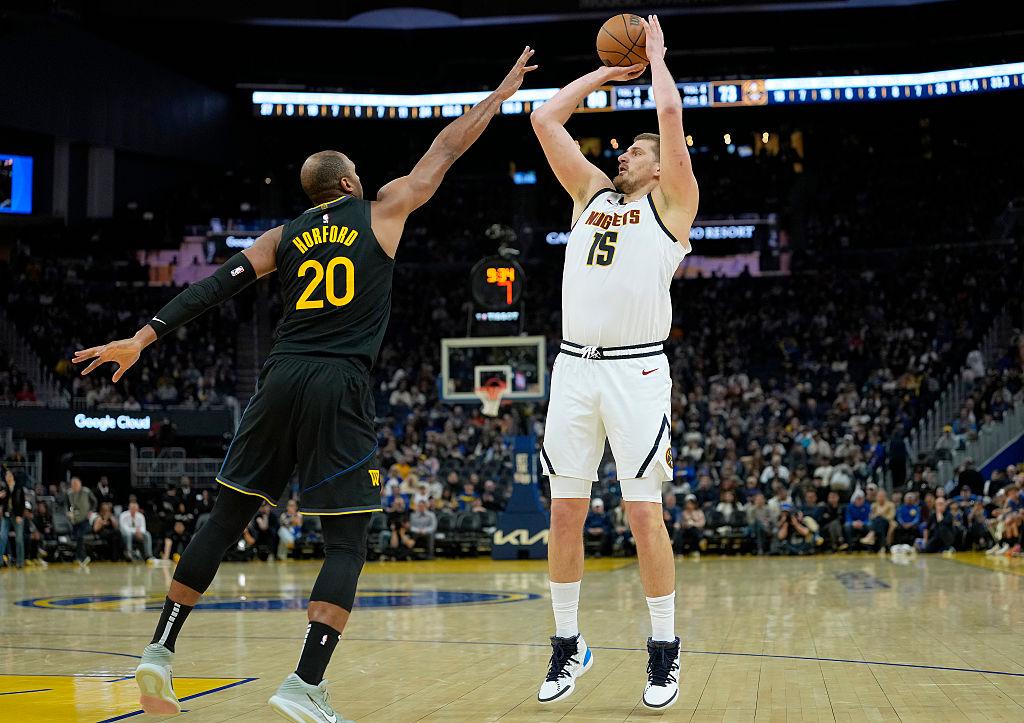
Nikola Jokic shoots over Al Horford in the second half of the game on February 22
The performance lacked the urgency befitting a team with so much riding on the 2025-26 season. Last spring, the Nuggets fired head coach Michael Malone and general manager Calvin Booth mere days before the end of the regular season. Over the summer, they traded longtime contributor Michael Porter Jr. and an unprotected 2032 first-rounder for Cam Johnson. Then they rounded out the roster with veterans Bruce Brown and Tim Hardaway Jr. in savvy moves to replenish the depth they had lost in the years since the team's 2023 title run.
During the first month of this season, the Nuggets raced to a 12-3 start. The additional shooting and depth snapped into place like puzzle pieces around Jokic and Jamal Murray. By mid-November, the Nuggets were the most formidable challenger to Oklahoma City’s throne.
But those ambitions have been delayed by a brutal string of injuries. Aaron Gordon pulled his hamstring in November. Two weeks later, Jokic hyperextended his left knee in the final seconds of a loss to the Heat, prompting the longest absence (16 games) of the Serbian’s career. Gordon would return shortly after, only to re-strain his hamstring in January, which will keep him out for at least another couple of weeks. Additionally, Johnson, Christian Braun, Peyton Watson, and Jonas Valanciunas have all spent extended time on the injury report.
The battle of attrition has created a unique set of obstacles for Adelman, who has had to throw everything at the wall to find answers. In one game, he went with a starting lineup of backup point guard Jalen Pickett and four forwards. In the first few minutes of another, the Nuggets started the game playing a 2-3 zone in an attempt to neutralize Anthony Edwards. Last month against the Sixers, the Nuggets won a game without a single opening-night starter in the lineup.
Adelman and his player development staff have managed to find some golden nuggets in muddy waters. “I think we did a good job of just saying, instead of talking about who's out, talk about who's in,” Adelman says.
Other players have stepped up, and the resilient Nuggets have learned more about the talent and potential on the fringes of their roster. With Jokic in street clothes, for example, Watson parlayed the increased opportunity into 22 points per game, including three contests with 30 points or more. The search has also thrust Spencer Jones, an undrafted forward on a two-way contract, into a central role. As the injury report filled to capacity, Jones was brought first into the rotation and then into the starting lineup, where he was asked to learn his role on the fly, playing next to the most creative player of his generation.
“It's knowing where [Jokic] wants you,” Jones says when asked how he has found his role in the Nuggets offense. “A lot of it is learning how the defense is covering him. A lot of teams will double punch from the baseline. … If they keep straight up, space it out. It's a lot of knowing how the defense wants to guard him and then where he expects you to be from there. A lot of that is just looking at the games, talking to him, and then just reps.”




More on the NBA
While Adelman and his staff have attempted to milk every ounce of production out of unproven talent, Murray has turned in the best campaign of his career. Long respected as a premier playoff riser and big-shot maker, Murray has a more uneven regular-season track record. Before the season, Nuggets executive vice president of player personnel Jon Wallace challenged Murray with a question: “Why aren’t you an All-Star?” Wallace pushed him to take a more holistic approach to leadership. Murray responded by organizing summer runs and team dinners—and stepped on the gas from the jump, posting career highs of 25.5 points, 4.4 rebounds, and 7.5 assists thus far.
“I think Jamal took that Etch A Sketch type of approach,” Wallace says. “Shook it all up, came back with a clean slate, and said, ‘All right, let's focus on the fundamentals. Make sure I'm in shape, my endurance [is] good, and reps. Reps, reps, reps.’ And he's done that, and it's paid off.” In Jokic’s absence, Murray averaged 28 points and seven assists, keeping Denver in the Western Conference playoff hunt and earning his first All-Star nod.
But getting Jokic back into the lineup hasn’t been the panacea the Nuggets might have envisioned. Against a tough slate of opponents, the Nuggets have been unable to string together wins at a time in the season when establishing cohesion is paramount. After clawing their way to a 10-6 record while Jokic was out, the Nuggets have dropped six of their past 10 with him, and their defense has slipped to 22nd in the league.
“It's hard just because we had a lot of injuries,” Jokic says. “I feel like everybody was injured a little bit and it's been the whole season trying to get guys back and then try to find the rhythm at the same time.”
Against the Warriors on Sunday afternoon, Jokic’s usual brilliance was undercut by curious bouts of carelessness. In the first quarter, he executed a brilliant no-look touch pass to Braun in transition, one of his 12 assists in the game. But he finished with five turnovers, including an errant pass with 5:30 left in the fourth quarter, as Brandin Podziemski and the ageless Al Horford led the Warriors on a 19-8 run to clinch the upset.
“Fuck!” yelled Hardaway after the game as he walked back to the visitors locker room, kicking a door as he took off his jersey. Addressing the media minutes later, Adelman pulled no punches as he derided his team for letting such a winnable game slip through its fingers.
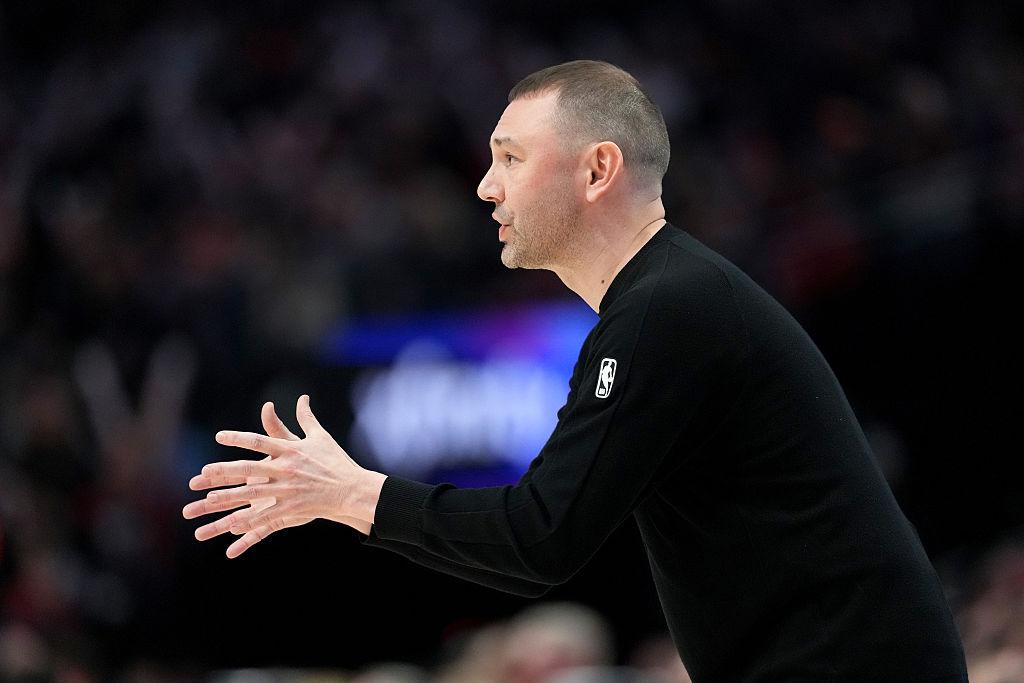
David Adelman during the first half of a game against the Trail Blazers on February 20
“We were not ready to play,” he said. “This has been a tough weekend for us with the back-to-back and all that, but that has nothing to do with your approach to the game. … Their energy surpassed ours.”
As the team hopes to get healthier, the schedule will only get harder. Next, the Nuggets will host the Celtics in a nationally televised game on Wednesday evening. That will be followed by tiffs with the Thunder and Wolves. According to Tankathon, the Nuggets have the hardest remaining schedule in the NBA.
The team is hopeful that positive news is on the horizon. Gordon is currently participating in on-court workouts and is reportedly targeting a return to action soon, hoping to reintegrate with a group that needs his defense and motor. Watson is also nearing a return, and the Nuggets are eager to see how his newfound offensive leap will mesh with Jokic and the team’s entire complement of players.
On paper, this may be the best team of the Jokic era. Murray is playing incredibly, and the roster is deeper and has more shooting than last year’s team—and maybe even than the squad that hoisted the trophy three seasons ago. But with just six weeks left in the regular season, they’re running out of time to put all the pieces together.
“My hope is that we get the full group back [with] 20 games to go,” Adelman told reporters after practice on Tuesday. “That’d be what I pray for nightly, just so we can actually see what it is we have.”
Until then, the Nuggets will continue to search for a rhythm while the pressure mounts. “I'm definitely concerned, because we are losing the games,” Jokic said on Sunday. “So that's something that we need to change. ... I don't know what it is, but we need to figure it out.”