

The chasm between regular-season indifference and playoff intensity can be treacherous for any contender that hopes to flip a switch when the games start to really matter. Right now, no team is struggling to navigate those straits more than the Denver Nuggets. A large gap currently exists between how they actually look and the theoretically sky-high ceiling they still hope to reach.
The Nuggets are just 15-14 over their past 29 games and 6-8 since Nikola Jokic returned from a scary knee injury that sidelined him for about a month. Nearly all of these losses have come against contenders, but they’ve still endured painfully close defeats and crunch-time meltdowns; their leaky, 21st-ranked defense doesn’t look particularly close to championship ready.
At the center of this rough patch stands Jokic, who simultaneously exists as the primary reason Denver can go all the way and the sudden cause for some doubt. He’s still incredibly valuable—over their past 14 games, the Nuggets have a plus-9.3 net rating with Jokic on the court and a minus-9.4 net rating when he sits—regularly flirts with monstrous triple-doubles, makes absurd plays that nobody else can, and gives Denver a belief that it can beat any team in the league. (The avalanche Jokic summoned without Jamal Murray in the third quarter of last week’s win against the Boston Celtics would drop your jaw if it wasn’t so typical.)
But since he came back from that knee injury on Jan. 30, Jokic has not looked like the player he was before it happened. His shooting efficiency, in particular, hasn’t been up to snuff. Compared to his first 30 games of the season, Jokic’s past 14 have seen a 12.5 percent drop from inside the arc and an 11.6 percent drop from behind it. He’s making only 31.3 percent of his catch-and-shoot 3s while converting just 49 percent of his attempts from the floater zone—his sweet spot. (Jokic was at 61 percent there pre-injury.)
Despite playing fewer minutes, Jokic’s committed more turnovers, too. He's throwing uncharacteristically bad passes at an alarming rate, at least in part because defenders are anticipating his trickery:
You wonder how much hitting the 65-game threshold (and allowing a run at a fourth MVP) is in consideration, and whether he would have come back so early if that rule didn’t exist. Not to make any nefarious accusations, but the timing of Jokic’s return—which provided a one-game cushion to qualify for end-of-season awards—probably wasn’t a coincidence!
Zooming out, there’s also an unsettling shift that’s happened to Denver’s offense this season. The fundamental numbers are still beyond encouraging: The Nuggets lead the NBA in offensive rating, and when Jokic is on the court it’s a league-best 12.1 points per 100 possessions above league average. In other words, Jokic is still the best player alive and is fueling the NBA’s most unstoppable attack.
But when you take a look under the hood and watch them play, everything feels a little harder than it used to be. Threes are up under Nuggets head coach David Adelman in his first full season on the job, which is generally fine. Denver has attempted at least 34 of them in 34 games this season, a number it hit just 26 times last season and 23 times in 2023, when the Nuggets won the title. (This is the first season since 2020 in which the Nuggets’ 3-point rate is higher with Jokic on the court than off.) They’re also first in 3-point percentage, which isn’t nothing.

The catch? When all those attempts replace shots at the rim, it’s a problem. Last year, the Nuggets gorged in the paint more than any other team. This year they rank 19th in at-rim frequency. Some of that’s because of Jokic’s injury, but Denver’s percentage of shots at the rim is as low as it’s been since 2021 even when he’s in the game. The lobs to Aaron Gordon and Peyton Watson have been missed; more often than not, Jokic is surrounded by jump shooters who don’t put pressure on the basket.
Another factor is how defenses are guarding the Nuggets. They pack the paint and live with the results. Watch Clippers wing Derrick Jones Jr. on this empty corner Murray-Jokic pick-and-roll. Threes are up because, sometimes, Denver has nowhere else to go:
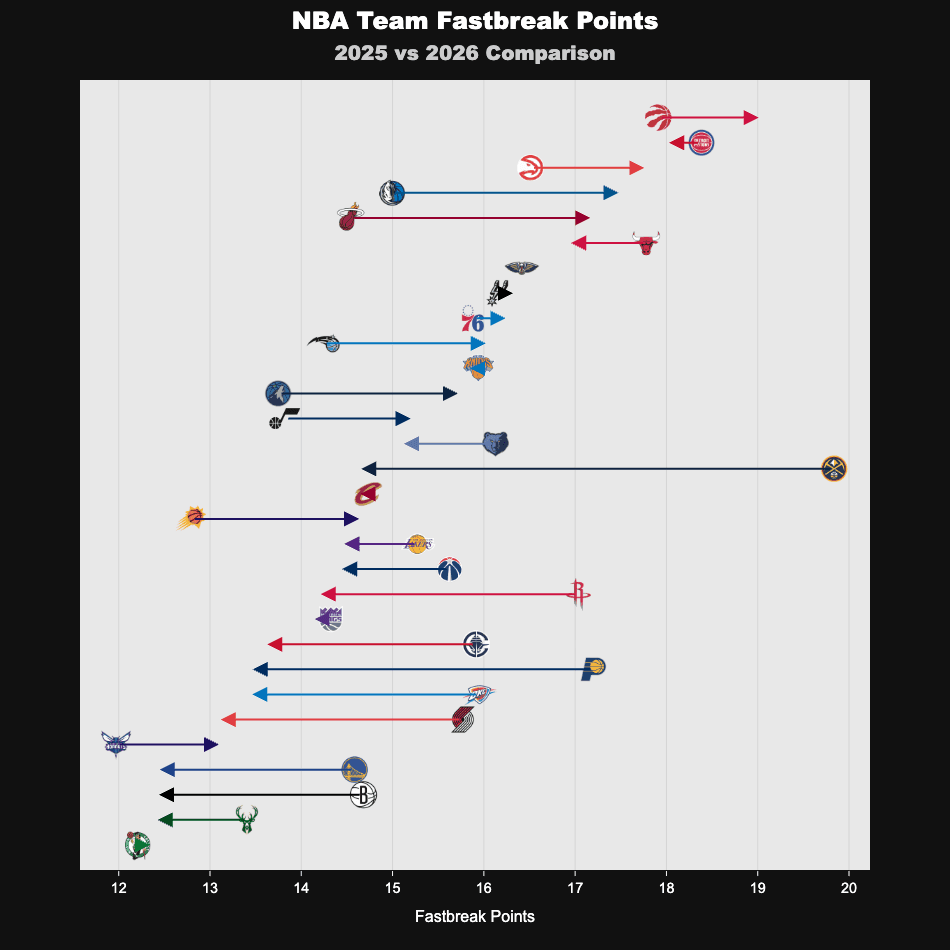
Denver’s offensive rebound rate is way down, too, and it’s gone from a transition dynamo to one of the slowest teams in the league. Easy buckets have been harder to come by:
All not great, but almost every cause for concern that’s cited above can be twisted into a simple case for optimism by acknowledging who hasn’t been on the court. Jokic missed all of January, a month when the Nuggets’ offense fell to 10th and their defense dropped to 24th. (It’s the only full month this season when Denver had a negative net rating.)
Gordon, Watson, Christian Braun, Cam Johnson, and Jonas Valanciunas have been sidelined for approximately 8,000 games at different points in the season. Gordon and Watson are currently out with hamstring strains and Johnson missed Denver’s last game—an unnecessarily tight escape act in Utah—with a sore ankle.
Injuries have prevented Adelman from leaning on a dependable starting five. Gordon, Jokic, Braun, Johnson, and Murray have appeared together in only 10 games this season, while the Nuggets have deployed 23 different starting lineups. (Last year it was 22. The year before it was 14.) To boot, only 26 percent of all Denver’s minutes have come with its starters on the court (currently the seventh-highest frequency in the league). Their average over the previous five years was 37.1 percent, which ranked first.
Functionally, these injuries have eaten away at Denver’s size, too. Once a strength—Michael Porter Jr. is not walking through that door—the Nuggets are struggling with some tiny five-man units that can’t attack or protect the paint. Jokic is an underrated defender who can make up for his physical limitations with quick hands and a PhD in basketball geometry. But right now he isn’t moving well enough to offer even the tiniest bit of resistance guarding a pick-and-roll. Far too often he’s caught in no-man’s-land, teetering between apathy and aggression, in desperate need of the insulation Denver’s depleted supporting cast can’t provide.
When your low man is Julian Strawther, Tim Hardaway Jr., or Bruce Brown, it’s hard to consistently deter ball handlers once they blow past the first line of defense:
There is one stat hiding in all this morass that should draw a sigh of relief from Nuggets fans, though: Opponents are shooting 71.1 percent at the rim when Jokic is on the court. This number is god awful. It’s also a smidge better than how Denver finished the 2022-23 season, which ended in a championship.
There are recent examples of Denver’s defense going out of its way to protect Jokic. Against certain matchups, he’ll show on a ball screen and then hustle back to the opposite corner as his teammates rotate over to provide some cover. As seen below, it’s a tightwire act that forces all five defenders to be on the exact same page. But it looks good when executed properly:
Barring poor health, another reason to believe the Nuggets will look better in the playoffs is optionality. How good on both ends can a Jokic-Murray-Gordon-Watson-Johnson lineup be? That group has played a grand total of 25 minutes (!) together this season, but has enough defensive versatility, shooting, and size to dominate in the playoffs. Elsewhere, if a matchup calls for it, how about slotting Gordon at the 5 when Jokic needs a breather? Broadly speaking, how about never letting a moment pass with Murray and Jokic both on the bench, which still happens at the start of the second and fourth quarter.
The Nuggets were my preseason pick to win it all and I still believe they can. Jokic was my preseason pick to win MVP and I still believe he’s the most deserving candidate. Among qualified players, he’s first in rebounds, first in assists, first in true shooting percentage, first in PER, and first in on-off point differential. (Is that good?) Regular-season swoons are not unfamiliar to the Nuggets, and I don’t worry too much about a roster this deep, experienced, and familiar.
Of course, health is an inescapable variable that can derail even the best-laid plans. Gordon, especially, has dealt with a hamstring injury that effectively ended the Nuggets’ championship hopes last year and threatens to do the same this spring. Jokic clearly isn’t close to full strength. Murray, who deserves strong consideration for All-NBA, is a perennial risk to miss time. Lineups featuring all three players have obliterated pretty much everything in their path this year.
Combined, all these questions ultimately create two very different scenarios: The Nuggets are either dead in the water or a juggernaut hiding in plain sight. Time and luck will ultimately decide which one is real.