Who (or What) Killed ‘Highguard,’ Gaming’s Latest Live-Service Flop?
And can the industry learn any lessons from its high-profile failure?

If you’ve been meaning to try Highguard, hurry. One of the most discussed video games of 2026—though not one of the most played—is going to gaming’s graveyard on Thursday, 45 days after its January 26 launch on Windows, PlayStation 5, and Xbox Series X/S. Highguard, a hero shooter (or if you prefer, a player-versus-player raid shooter), was prominently announced at the Game Awards last December, after more than three years in development. The free-to-play title’s rapid demise—which was widely predicted, and in some quarters eagerly anticipated and celebrated—has reignited one of gaming’s most heated debates: Is the pursuit of live-service success an industry dead end? And, relatedly, are game funding, development, and discovery broken?
Highguard is (was?) the debut work of Wildlight Entertainment, an independent studio formed largely by veterans of Electronic Arts–owned hit factory Respawn Entertainment, makers of well-received online shooters Titanfall (2014) and Apex Legends (2019). The developers’ track records augured well for the new game, which garnered nearly 100,000 concurrent players on Steam immediately after it launched. But those player counts cratered in days, despite patches and new modes, and a little more than two weeks post-launch, most of Highguard’s designers were laid off. After a few more weeks of drain-circling, the studio bowed to the inevitable and announced that the game would shut down. Like the Titanic’s band playing as the ship went down, a skeleton staff soldiered on and pushed out a final update last week, as concurrent player counts fell below 400.
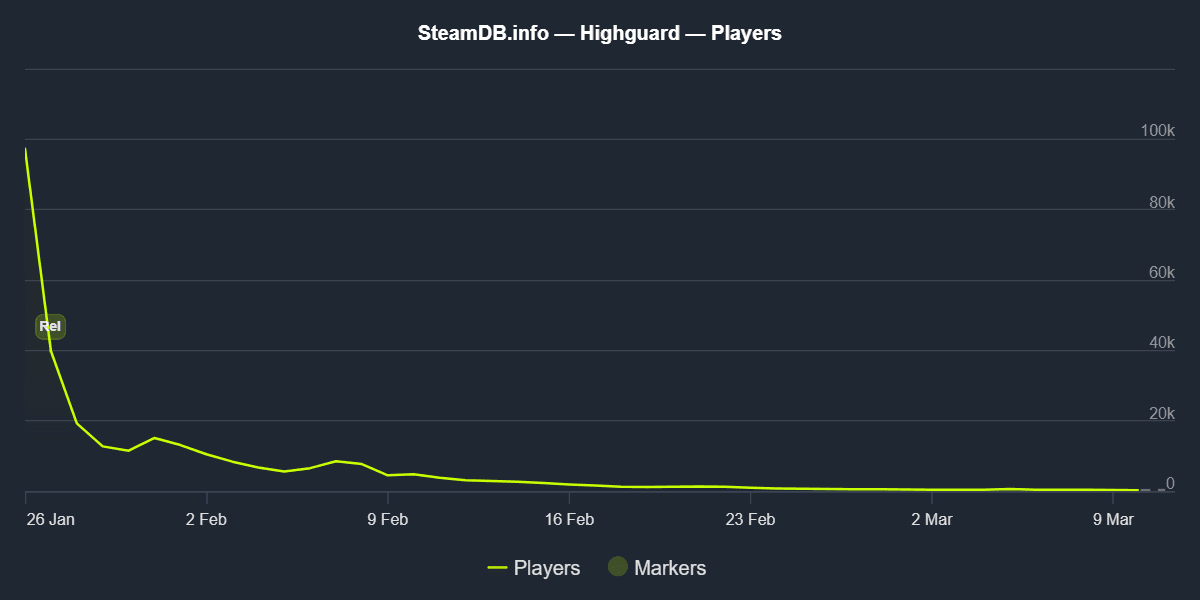
Highguard lasted nearly three times as long as Concord, the 2024 hero shooter whose shutdown and refunds after only 14 days made it a costly fiasco for publisher Sony (and first-time developer Firewalk Studios, which soon closed). Outlasting Concord isn’t much to brag about, though, so Highguard has earned its own ignominious place on the live-service lowlight reel. The game’s corpse is still warm, but let’s enter spectator mode and conduct a preliminary postmortem, in hopes of learning lessons that might help other studios avert future failures. We’ll scrutinize the suspects one by one, Obra Dinn/Golden Idol/Blake Manor–style, and deliver verdicts to determine who, or what, killed Highguard.
Geoff Keighley
Industry hype man Geoff Keighley, the face of Summer Game Fest and the Game Awards, surely didn’t mean to hurt Highguard’s chances by giving it the highest-profile slot at the December ceremony. On the contrary, he hoped to give the game a big boost. And perhaps he did, in terms of name recognition—but also, less happily for Highguard, in terms of notoriety, too.
In recent years, unveilings of the likes of Capcom’s Monster Hunter Wilds and Naughty Dog’s Intergalactic: The Heretic Prophet—big games from legendary developers—served as stunning finishers in a cavalcade of announcements leading up to the unveiling of the Game of the Year. Highguard, the product of a largely unknown studio and the latest in a long line of free-to-play hero shooters, was the most miscast closer since Ambiorix Burgos. Keighley—who has one mode as a presenter, gung ho—did his best to sell it. “Sometimes our last reveal at the Game Awards is a teaser for something years and years away,” he said, delighting in the suspense. “Not tonight.” After briefly familiarizing viewers with Wildlight’s story and secret project, Keighley continued: “I’ve played it, and after you see this trailer, I think you’re gonna want to as well.”
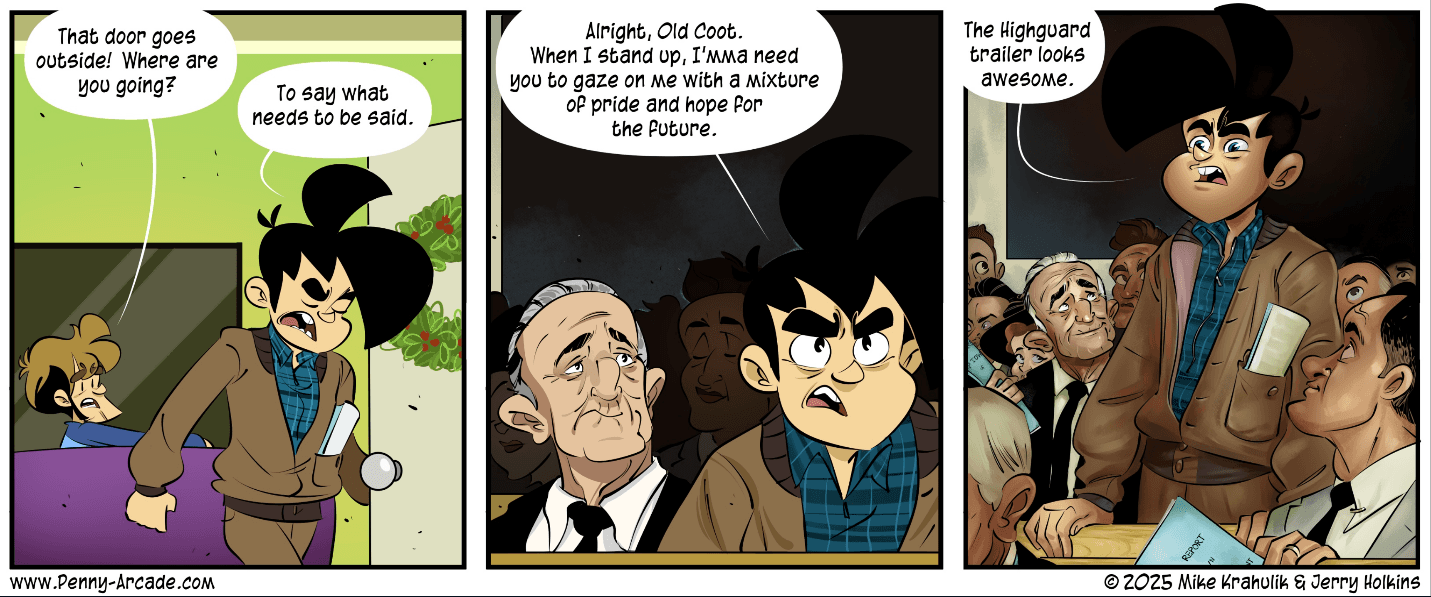
Keighley thought wrong. “Pretty crazy!” he crowed after the footage was finished, which more or less summed up spectators’ response to his programming decision. Much of the internet was unimpressed or incensed by its first glimpse of Highguard, and the dislike counts on the YouTube trailer climbed like Maverick’s F-14 outrunning missiles in the sequel to Top Gun. The backlash was such that it took guts to suggest that the game might be good, as the webcomic Penny Arcade documented.
Although Keighley repeatedly plugged and GIF’ed about the game in the days preceding and following its launch, the public vindication he seemed to expect never arrived. We can tell the story of Highguard’s accelerated life cycle in a series of several Keighley tweets:
Keighley denied that he had any financial stake in Highguard, and he reportedly gave the game its high-profile position in the pricey show for free. He simply fell for it, and miscalculated its appeal to his enormous audience. Of course, Keighley didn’t force Wildlight to accept his offer. Highguard’s developers had planned to stealth-drop the game with no prerelease fanfare, following the blueprint that had paid off for Apex Legends years earlier. Instead, the studio was seduced by the promise of publicity.
As Wildlight cofounder and CEO Dusty Welch later recounted to PC Gamer, “He came in and he played the game a couple of times, and he loved it. So when he said ‘Look, I’d love to do something different and put an indie studio and a free-to-play game up here and put it in the show,’ I mean, as an indie who was unknown by choice, who wouldn’t jump at the chance to do that? Here’s the biggest platform [in gaming], right?” Speaking to Polygon, Welch characterized the reveal as “unique and maybe a little risky in hindsight” but stood by the decision on the grounds that it would’ve been “foolish to ... turn down the Game Awards and what was the last spot and all the awareness that would come from that.”
As we’ll cover below, getting gamers to notice a new release from a startup studio is prohibitively difficult, so Welch wasn’t wrong to seize what seemed to be a lifeline that plenty of studios would’ve paid a fortune for. I’m inclined to think the maxim about there being no such thing as bad publicity applies even to Highguard. Without the TGA-imposed pressure, the game might well have sunk equally quickly. It just would have happened more quietly. We could describe most live-service games’ burials like Eleanor Rigby’s: Nobody came.
Guilty or innocent: Keighley, whom Welch has called “a friend of the studio,” clearly had Highguard’s best interests at heart, so he’s guilty, at most, of manslaughter. (Gameslaughter?) But even that charge is probably excessive. By training such a bright spotlight on Highguard, Keighley inadvertently put a target on the game and set it up to be regarded as a disappointment. Had other conditions been different, though, that exposure could’ve been a springboard to success. The culprit(s) lies elsewhere. Keighley was guilty of loving Highguard too much, but when it comes to killing it, our verdict is: innocent. It wasn’t Keighley killed the beast.
The Trailer
“It is insanely fun to play, as you saw in that trailer,” Keighley enthused right after the 2.5-minute teaser for Highguard aired. A lot of viewers saw something different: yet another hero shooter, with what appeared to be a fairly generic fantasy setting and character design. The trailer promised people “a new breed of shooter,” but the action didn’t do much to back up that claim. What was Highguard’s differentiator? How would it stand out in a crowded online landscape and entice people to put their playtime into Highguard instead of one of the many shooters that preceded it, Apex Legends included? I thought the game’s horseback blasting and ax-throwing looked kinda cool, but the trailer soon dispensed with mounts in favor of more run-of-the-mill gunplay.
Wildlight blamed itself for the reception. “I wish the feedback had been better,” Welch told PC Gamer. “Part of that’s on us, right? … Ultimately, we could have made a different trailer—a better trailer that wasn’t about entertaining, which is what we think [the Game Awards] was about. We could have made something that did a better job of highlighting the unique loop of the game. So that’s on us.”
PC Gamer’s Morgan Park agreed with Welch’s assessment, writing that Highguard’s trailer “did a terrible job of communicating what it actually is. Yes, it’s a hero shooter, but like Apex Legends’ battle royale focus, Highguard is really defined by its unique format: a multi-phase, 3v3 tug of war where teams fight over the right to raid each other’s bases and blow up generators. It’s got a bit of Rainbow Six Siege defensive tactics, a smidge of battle royale looting, and a whole lot of Apex Legends teamfighting.” Little of that was apparent in the trailer.
Guilty or innocent: To invoke another maxim, you never get a chance to make a second impression, especially in front of millions of viewers. And at TGA, Highguard made the wrong impression, to the extent that it made any impression at all. Keighley gave Wildlight an ideal scoring opportunity, and Wildlight couldn’t convert. Thus, the verdict is guilty—though the trailer bears only partial blame for the game’s poor reception. After all, a trailer can do only so much to make a so-so game seem extraordinary. We’ll get to the game in a moment.
Live-Service Obsession/Fatigue
Although Highguard’s trailer didn’t do the game any favors, Wildlight’s devs essentially strolled into a chaotic conflagration after having their heads down for a few years. Long before the game debuted, gamers had had it up to Highguard with companies pushing live-service games in general, and hero shooters specifically, in pursuit of a hit that could mint money indefinitely. This ground wasn’t just saturated; it was salted.
Gamers didn’t just lose interest when suits tried to sell them on yet another microtransaction-ridden, never-ending experience; they actively resented the ways in which corporate mandates to chase live-service dollars derailed development on what could’ve been good games. Sony, a publisher known for single-player games with epic campaigns, had misfired on more than one multiplayer project (which recently led to the dissolution of beloved remake/remaster masters Bluepoint Games). Rocksteady Studios, best known for its brilliant Batman: Arkham trilogy, fell flat with live-service looter shooter Suicide Squad: Kill the Justice League. BioWare bombed with Anthem, as did Ubisoft with the oft-delayed, lackluster Skull and Bones, which it had promoted as a “quadruple-A” game.
In short, gamers had no tolerance for additional games in that vein, and they voiced their opposition to being force-fed more. For the month and a half between the Game Awards and Highguard’s debut, a toxic stew brewed: a blend of sincere dismay about industry trend-chasing, opportunistic, clout-chasing pile-ons and the usual smattering of complaints that the game was too “woke” from a small subset of Gamergate types who danced on the game’s grave. Some number of gamers were rooting for Highguard to fail, less out of personal animus for its makers than in hopes that its failure would send a message to the CEOs and investors who’ve been trying to cram every concept into a live-service-shaped mold.
In a since-deleted (and downplayed) post, Josh Sobel, a technical artist on Highguard, called out the hate he said was directed at Highguard. “In discussions online about Highguard, Concord, 2XKO, and such,” Sobel wrote, “it is often pointed out by gamers that devs like to blame gamers for their failures, and that that’s silly. As if gamers have no power. But they do. A lot of it. I’m not saying our failure is purely the fault of gamer culture and that the game would have thrived without the negative discourse, but it absolutely played a role. All products are at the whims of the consumers, and the consumers put absurd amounts of effort into slandering Highguard. And it worked."
Highguard had other problems, but Sobel was probably right that Wildlight was weighed down by baggage that had little to do with its game. As CNET’s David Lumb said after Highguard’s end date was announced, “Negative press is a hard stink to clean off. When gamers decide to hate a game, they’ll sink it, especially if it doesn’t have years of runway.” Many gamers were so convinced that Highguard was “the next Concord” that their forecasts became a self-fulfilling prophecy.
Guilty or innocent: Guilty—but more of an accomplice to the crime than the real ringleader. Many gamers prejudged Highguard, sight (almost) unseen. But just because they leapt to conclusions doesn’t mean all of their conclusions were incorrect.
The silver lining is that the cautionary tale of Highguard, and other live-service titles with declining player counts, may accelerate an industry reckoning. Enough games have been sacrificed at the live-service altar that investors will be less likely to give green lights to imitators. However, games take so long to make that strategic shifts of that kind aren’t really reflected in the current release calendar. As Wildlight cofounder and Highguard director Chad Grenier wrote on LinkedIn, “Sometimes the biggest challenge is trying to hit a moving target. When you take investment under certain criteria and lock in a high-level vision 4.5 years before release, the market you launch into can look very different from the one you started building for. Trends shift, player expectations evolve, and there are many investor realities behind the scenes that the public will never fully see.”
According to a newly released report by the architects of game engine Unity, 52 percent of responding studios said they’re now “focusing on smaller, more manageable projects.” On the other hand, 26 percent said they’re “doubling down on live-service games.” The latter group’s deliberations probably went a little like this:
The Game
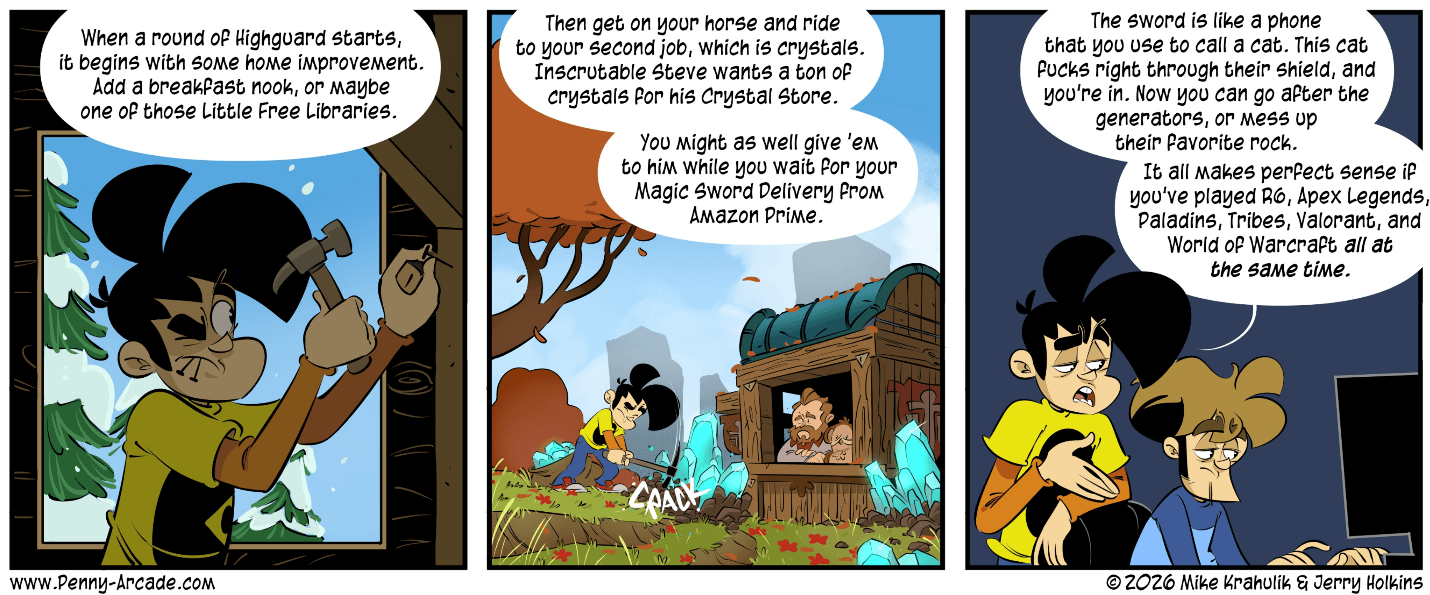
In contrast to the case of $40 Concord, which maxed out at 697 concurrent players on Steam, plenty of people were willing to pay $0 to see what the Highguard hype and backlash were about. This actually was a sort of second chance to make a first impression. Unfortunately for Wildlight, Highguard didn’t hold the lookie-loos’ interest. The game wasn’t visually distinctive or cohesive. The maps were too big for three-on-three matches. The pacing was slow, the resource farming was tedious, and the mechanics were overly complicated. Even Penny Arcade conceded that Highguard didn’t have the juice.
Although some hands-on impressions published on launch day, based on a Wildlight-hosted preview for press, were surprisingly positive, the comeback buzz didn’t build. Review-bombing campaigns make Highguard’s user ratings at some sites unreliable, but Metacritic and OpenCritic report critic ratings of 63—not much better than the mixed reviews on Steam—and almost perfectly in line with Concord’s pedestrian scores. Per OpenCritic, only 36 percent of critics recommended the game. Like Concord, Highguard wasn’t a bad game. But not being bad wasn’t good enough, and neither game had time to get better.
Guilty or innocent: Guilty. Plenty of great games fail to find a sizable audience, but we can’t count Highguard as one of them. We can reasonably list a lot of extenuating circumstances—this isn’t a “no one to blame but itself” situation—but itself is the no. 1 suspect.
Hubris
Why did Highguard, the game, not quite come together? Well, most games in development don’t. Knowing that, though, a bit more humility may have served Wildlight well.
After the disastrous response to the trailer, Wildlight returned to its original rollout plan and went radio silent for several weeks, confident that players’ doubts would be assuaged when they had their hands on Highguard. In the interim, though, the public’s skepticism proliferated, and Wildlight’s refusal to counter the criticism or make a proactive case for the game was widely interpreted as indecision, disarray, or a prelude to a delay. Even so, the studio stuck by its belief that what had worked for Apex seven years earlier—in a less crowded, jaded market—would work again. Wildlight’s overconfidence was its weakness—one of its weaknesses, at least. That hubris, a word several laid-off Wildlight developers used in conversations with Bloomberg, also bit the game before the final stages of development.
Although Wildlight sought some feedback from internal and external testers in the year leading up to launch, the mostly positive responses it received were skewed by the studio’s reliance on ideal conditions. “Highguard was a complicated game to learn and was more fun when using voice chat to communicate with other players,” Bloomberg explained. “When they tested it with the microphones off, it made for a much worse experience, former Wildlight employees said. Having developers on hand to answer questions and explain mechanics also led to different conditions than players would ultimately face when the game was released into the wild.”
As Wildlight level developer Alex Graner put it on a podcast, “It’s all designed to be a team-based shooter. I think that was the biggest thing. People just kind of turned it off because they didn’t have the team.”
Wildlight could have anticipated this problem by holding alpha/beta tests with a wider cross section of players whose hands weren’t being held by developers. If all went well, those tests could have created good word of mouth, as was the case with Battlefield 6 and ARC Raiders last year. And if the feedback was negative, Wildlight could have identified and fixed trouble spots, as Bungie did with Marathon, which was savaged in a close alpha last year and subsequently delayed to make time for tuning. But “whenever that notion came up at Wildlight,” Bloomberg shared, “leadership nixed it.” It wasn’t what Apex had done.
Guilty or innocent: Guilty as sin. In the desperate scramble to salvage Highguard during its first month on the market, Wildlight made major, welcome changes to the game, incorporating five-on-five modes that made maps feel less empty, a new character, and streamlined (or eliminated) looting phases. All of those revamps came too late to affect the fate of the game, but if they’d been implemented prior to release, they might’ve made a difference.

Tencent
Although Wildlight was cagey about the source of its funding, Game File reported last month that the studio had been backed by Tencent, the massive Chinese gaming conglomerate (which is facing the prospect of a ByteDance-esque, Trump-driven divestment of its U.S. assets). Bloomberg broke the news that Tencent had precipitated Wildlight’s layoffs by pulling funding for the game shortly after release, which left staff—who’d assumed that they had months to win players over—with the impression that “their financing was contingent upon hitting certain metrics, such as retention rate, which they’d failed to even come close to achieving.”
Tencent’s call was cutthroat, and possibly premature. But while some single-player-centric games (Cyberpunk 2077, No Man’s Sky), and even some online-oriented ones (Final Fantasy XIV, Fallout 76), have overcome lousy launches, live-service resurgences are few and far between. Meanwhile, flops are frequent, from Ubisoft’s XDefiant to Riot’s 2XKO to King of Meat (one of many misfires from Amazon Game Studios) to many more you’ve never heard of or forgot because they fizzled so fast. Some aspiring live-service staples whiff twice, such as Splitgate 2, which face-planted last summer, went back to beta, and returned several months later but never developed a pulse. This pattern has repeated itself for years. In 2018, I chronicled the demise of free-to-play shooter Gigantic, which went live in 2017 and shut down roughly a year later. The game relaunched in 2024 as Gigantic: Rampage Edition, only to quickly collapse again.
Once the player-count death spiral sets in, players perch like vultures and wait for the last gasp. From Tencent’s perspective, Highguard may have seemed like a sunk cost, and human considerations aside—we’re talking about dozens of developers’ livelihoods—giving the game a longer leash may have been throwing good money after bad. The odds that Highguard would bounce back to follow in the fresh footsteps of successful live-service exceptions such as Marvel Rivals (which drafted off well-known IP) or ARC Raiders (which refined and popularized the formerly forbidding “extraction shooter” subgenre) were minuscule. Which was seemingly sufficient for Tencent to decide it had seen enough.
“Whether it gets a thousand people or a hundred million people, it doesn’t matter,” Grenier said at a press event. “What matters most is that the game is loved by the people who played it.” His sentiment echoed an earlier comment by lead designer Mohammad Alavi: “Honestly, we don’t need [player counts] to be super huge in order to be successful.” Clearly, the quantity mattered to Tencent. A single-player game with a small audience but no upkeep cost doesn’t disappear from the face of the earth. But a live-service game with a small or modest following might, because an investor who’s looking for a 100x unicorn may treat it like one of the unpromising infants Plutarch claimed the Spartans snuffed out.
Guilty or innocent: We can’t convict on all counts, but guilty on lesser charges, in that Tencent cut off any possible path to rehabilitation. Maybe the money people pulled the plug too early; Wildlight was trying to course correct. But Highguard had a huge hill to climb to change gamers’ minds.
Every Other Game
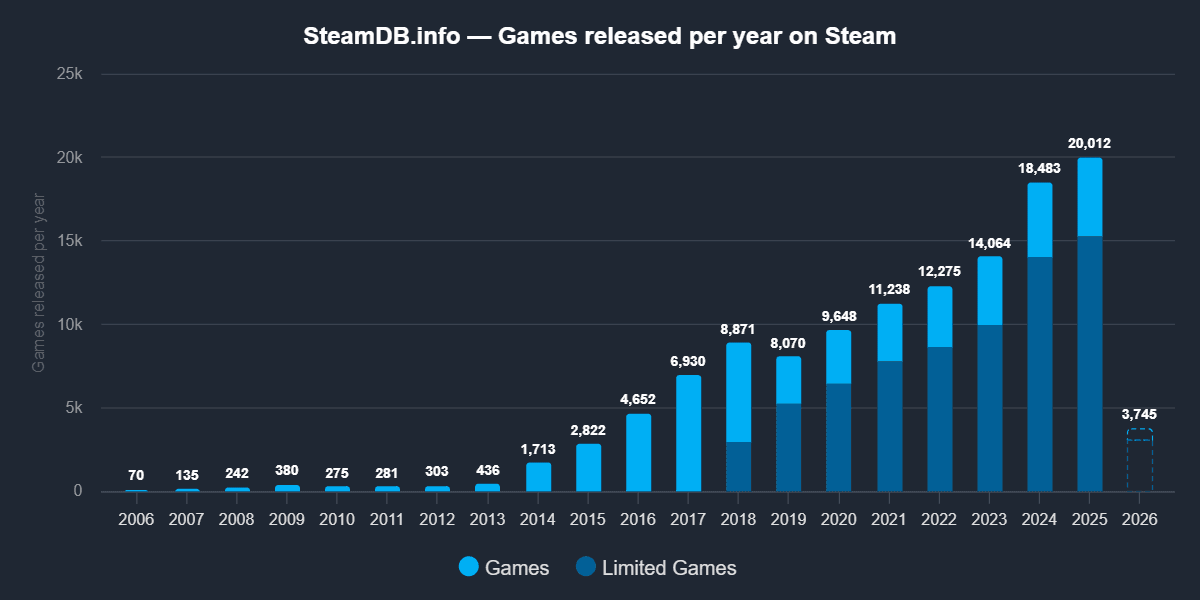
One of the stiffest challenges confronting Highguard—and, for that matter, any new video game—is that there are so many other games. More than 20,000 were released on Steam alone last year. To make matters worse for new arrivals, most consumers are content to keep playing the hits of previous years. On PlayStation and Xbox, the five most played games of 2025 were unchanged from 2024. Only 14 percent of total playtime on Steam in 2025 was devoted to titles released last year, and 40 percent went to games released eight or more years earlier.
Highguard wasn’t just competing with contemporaries such as ARC Raiders and Battlefield 6 (the latter of which had a huge launch but still sustained layoffs). It was also squaring off (on Steam or rival services) with the likes of Overwatch (2016), PUBG: Battlegrounds (2017), Fortnite (2017), and the latest incarnation of even longer-running series Counter-Strike, not to mention perennially popular non-shooters like League of Legends (2009) and Dota 2 (2013), and pervasive platforms Roblox and Minecraft, which date back to the 2000s. To claim mindshare and market share, Highguard had to stand out, and not solely for looking like an industry plant at the Game Awards.
In the end, Highguard did stand out, albeit for the wrong reason: It joined Suicide Squad and Concord in an unholy trinity of live-service follies. No one on the inside sabotaged it on purpose; as Michael “Cromwelp” Douse, publishing director of Baldur’s Gate 3 maker Larian Studios, posted, “There are genuine villains in this industry but I don’t see them here.” But there’s ample blame for this debacle to go around. If I had to rank the culpability of all the candidates above, I’d go: the game, hubris, live-service obsession/fatigue, every other game, Tencent, Keighley. Each suspect played a part in the tragedy of a collective labor of love that left Steam too soon, but in this scenario, both blaming and pitying the victim isn’t totally off base. After fulfilling its predicted destiny as “the next Concord,” Wildlight’s game, gone but not forgotten, will live on through the goal it gives to future developers: Don’t be “the next Highguard.”