The Best Video Games of 2025
The games were good this year. These were the best of them.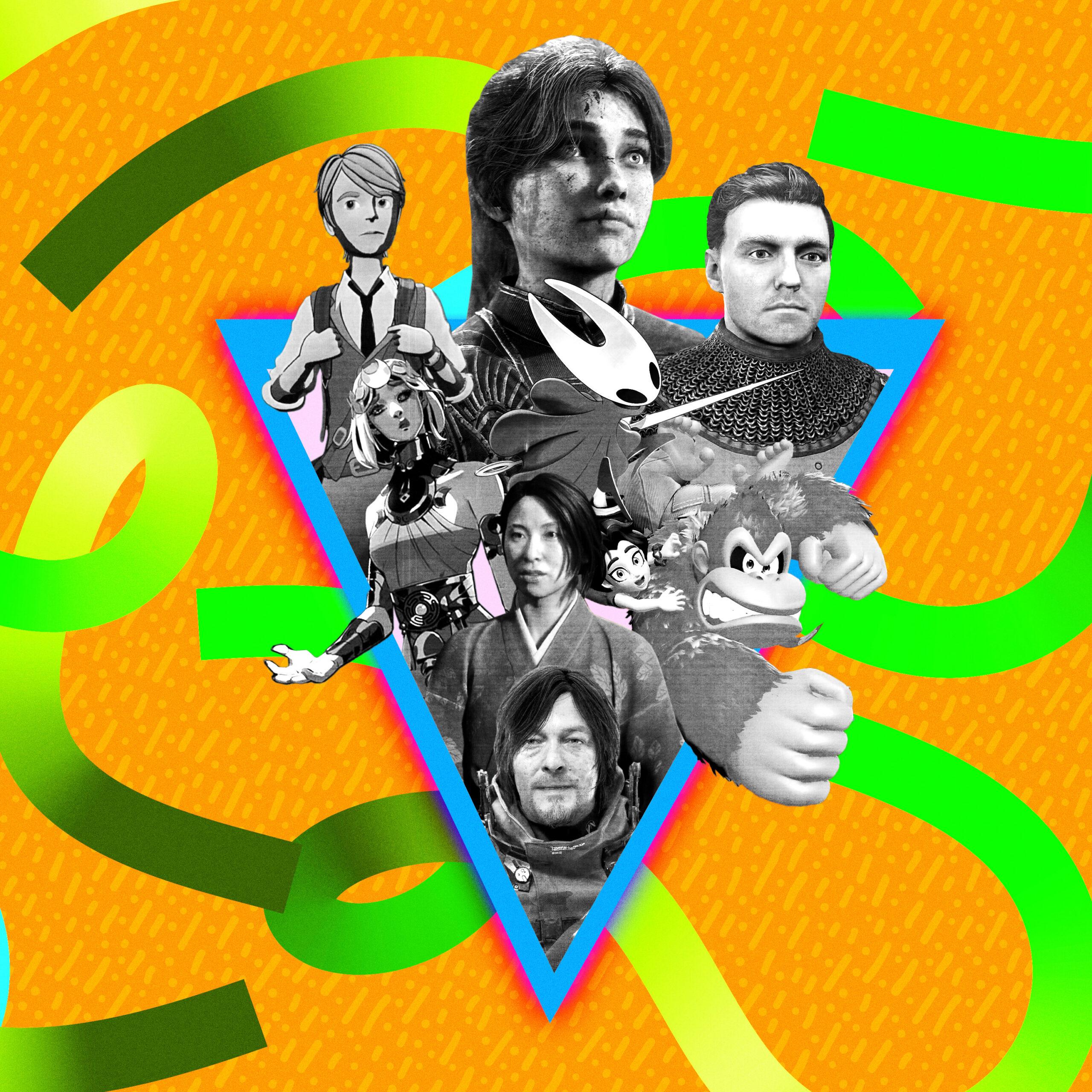


Stop us if we’ve said this before, but it’s been a great year for video games. No GTA? No problem. There were, once again, more games released than ever—far more than any one person, or two people, could play (although we tried). Although the vigil for Grand Theft Auto VI stretched on, Hollow Knight: Silksong and Metroid Prime 4: Beyond actually came out, retiring two punchlines about much-anticipated, long-in-development titles. (One of them was even worth the wait!) Both were playable on a new console, Nintendo’s Switch 2, which picked up where its massively successful predecessor left off and became the fastest-selling system ever. Call of Duty was, at least temporarily, dethroned as the perennial ruler of online shooters. And when would-be Triple-A blockbusters fizzled or failed to materialize, indie games and Steam sensations picked up the slack so firmly and refreshingly that the release slate rarely slowed or suffered.
The Steam Machine, a new Super Mario movie, and, maybe, a certain Rockstar release loom on the hype horizon, but those are topics for 2026. Below, we lay out our tandem top games of this year—alongside a lengthy list of honorable mentions, to assuage our remorse about being unable to squeeze more 2025 highlights into a 10-game ranking. (One caveat: With apologies to the likes of Dragon Quest I & II HD-2D Remake, Final Fantasy Tactics: The Ivalice Chronicles, Metal Gear Solid Delta: Snake Eater, The Elder Scrolls IV: Oblivion Remastered, Tony Hawk's Pro Skater 3 + 4, and many more quality titles, we’re excluding remakes, remasters, and rereleases from consideration and limiting the list to originals only—including DLC, if it deserves a spot on its own merits.) —Ben Lindbergh
10
ARC Raiders

By Ben Lindbergh
A lot of phenomenal games came out this year, but few had a credible claim to being breakouts for their genre. ARC Raiders was one of them. The Embark Studios hit, which was announced in 2021 as a co-op experience before being rebooted mid-development, didn’t invent the extraction shooter—credit for that pioneering feat typically goes to some blend of DayZ, The Division, Infestation: Survivor Stories, and Escape From Tarkov—but it was the first to perfect the formula and unlock the genre’s latent mass appeal. (Although Escape From Duckov, of all games, was waddling hot on its heels.) Raiders is almost too intense, at times. But if you played it, it probably produced some of the most memorable moments you spent in front of a screen this year. ARC Raiders doesn’t tell scripted stories—although its arresting, if ill-explained, postapocalyptic setting begs for more lore—but its gameplay loop, pervasive pressure, and unpredictable interactions among players create the conditions for chaotic victories and defeats that organically make players legends in their own minds.
By bottling the extraction shooter’s prickly appeal in a somewhat accessible, endlessly replayable package, ARC Raiders—with a big assist from Battlefield 6—put a deep dent in Call of Duty. I wouldn’t count on any upstart keeping Call of Duty down. But ARC Raiders seems to possess some staying power, and it’s as safe a bet as any game released this year to crack the ranks of perennial multiplayer powerhouses.
9
The Séance of Blake Manor

By Matt James
The Séance of Blake Manor, from small studio Spooky Doorway, is a supernatural mystery game set in an old Irish manor in 1897. You are detective Declan Ward, tasked with investigating the disappearance of Miss Evelyn Deane. You arrive on a Friday night to find the manor filled with guests who are planning to attend a séance on Sunday. You have until then to solve the mystery of Deane’s disappearance.
Perhaps the biggest challenge in designing a mystery game is ensuring that the player has the means to put together all the pieces of the puzzle. Commonly, mystery games will leave you to your own devices, expecting you to break out pen and paper IRL. Blue Prince and last year’s Lorelei and the Laser Eyes are two excellent examples that demand that their players journal like wellness influencers. I don’t have a problem with that, and I love looking back at my notebooks for those games. But it would be nice not to have to scribble, right?
Creating an in-game organizational system for all the facts and discoveries in a mystery game is a tall order. When a game attempts to track everything itself, the player will often spend more time trying to solve the interface than the game’s mystery; the story is liable to be dumbed down, lest the player get overwhelmed. The outstanding triumph of The Séance of Blake Manor is that it cracks the code in regard to the in-game tracking of mysteries, leads, characters, and evidence. Everything is automatically recorded and easily revisited in a series of easy-to-access, intuitive journal pages. The story of The Séance of Blake Manor is a beautifully complex confluence of character actions and motivations, and the game’s interface actually aids you in putting it all together rather than getting in your way. Each sub-mystery I solved supplied a bit more of the bigger picture, until eventually my revelations began beautifully cascading into a pool of answers to questions I’d been desperate to resolve. All of that makes The Séance of Blake Manor easy to recommend, not only to fans of mystery games, but also to fans of mysteries in general.


8
Ghost of Yōtei
By Matt James
Sure, Ghost of Yōtei is the result of developer Sucker Punch playing it safe. As a sequel to 2020’s brilliant and commercially successful Ghost of Tsushima, Yōtei doesn’t attempt to fix what ain’t broke. Just like Tsushima, Yōtei elegantly points you to your objective by way of gusts of wind. There’s no way to improve on that system, so Sucker Punch doesn’t try. Thus, the biggest knock on Yōtei is that it’s too similar to one of the best games of the past decade.
There could be worse things than that. But Yōtei does improve on its predecessor in some respects. While Yōtei’s revenge story is no more original or gripping than the plot of Ghost of Tsushima, the new protagonist, Atsu, is far more memorable than Tsushima’s Jin Sakai. Voiced in English by Erika Ishii, Atsu is constantly pulled in different directions as she ruminates on revenge, family, womanhood, and honor. Ishii’s nuanced performance, which earned her a nomination for Best Performance at this year’s Game Awards, elevates Yōtei’s story into something much more impactful than Tsushima’s.
Ghost of Yōtei has also pared back some of Tsushima’s map bloat. There are fewer foxes to chase and hot springs to soak in, and when you do encounter recurring activities, Yōtei does its best to make each instance unique. Oh, another bamboo strike, you’ll think, just as a giant bear gets the drop on you seemingly out of nowhere. Combat has evolved from different sword stances to entirely different weapons, making encounters more varied and strategic. And finally, Ghost of Yōtei happens to be one of the best-looking games I’ve ever seen. Its natural environments and their gorgeous lighting effects foster a near-spiritual experience. I took more photos in Yōtei than I did on my most recent real-life vacation.
Shame on you, Sucker Punch. You made another truly fantastic video game.
7
Death Stranding 2: On the Beach
By Ben Lindbergh
Death Stranding 2 wasn’t the only good game this year about how hard it is to walk, but it was the one that made the greatest strides. Hideo Kojima and Co.’s latest weird-ass opus hung together as a game better than the 2019 series originator: I went from bouncing off the original Death Stranding to getting glued to 2. By one account, Kojima worried during development that the game’s play testers “like[d] it too much” because of his belief that widespread palatability to players (as opposed to more polarization) is a sign that a game has become conventional. To be clear, you can always count on Kojima for some hot nonsense, but Death Stranding 2’s nonsense … sort of makes sense? More importantly, the game is more fun than frustrating, thanks to more streamlined mechanics and combat that isn’t a chore. It’s also eerily beautiful: Some of my most lasting memories of gaming this year will be teetering over Death Stranding 2’s photorealistic landscapes, without another soul in sight, while a haunting Woodkid composition played.
Death Stranding 2 wasn’t free of friction or challenge, but its quality-of-life tweaks and easier onboarding paid dividends. Only 79 percent of critics recommended Death Stranding, but 95 percent of critics vouched for Death Stranding 2. That may not be what the game’s creator intended, but I’m sorry, Kojima-san: I have to give the sequel my seal of approval, too.


6
Hades II
By Ben Lindbergh
A sequel from Supergiant? The studio that so resolutely launched fresh IP from scratch every three years, from Bastion to Transistor to Pyre to the original Hades, and produced a singular, unforgettable game each time out? Weren’t those visionaries squandering their creative potential by doubling down on a huge hit and taking five years to finish it? Were they trapped by their own past success?
Well, we can’t prove that they weren’t; we’ll never know what masterpiece Supergiant’s designers could have cooked up had they left the underworld and its coterie of gorgeous Greek gods and goddesses behind. But Hades II is the furthest thing from a phoned-in cash grab. It’s less original than any other Supergiant joint, but no less inspired. Somehow, it’s both bigger and, probably, better than its predecessor, arguably the best game of 2020. Always deep and detailed but never overwhelming, Hades II is a nearly flawless refinement of an oft-imitated but rarely replicated formula that remains as intoxicating in 2025 as it did in the depths of the pandemic.
The first of three straight games on our list about journeying up or down in pursuit of some nemesis, Hades II taught me not to doubt the magicians at Supergiant unless and until something spoils their perfect track record. Which isn’t to say that I now have a hankering for Hades III. Unless …?
5
Donkey Kong Bananza
By Ben Lindbergh
The Switch 2 launched without even a whisper of a new Super Mario or The Legend of Zelda game. There also wasn’t word of a new Animal Crossing, or a new Super Smash Bros., or even a new Splatoon or Pikmin. So once the hubbub about day one system seller Mario Kart World died down, it fell to slightly miscast mascots and franchises to carry the Nintendo torch from summer through the holidays. The headliners would have to be the B team (historical scores- and sales-wise, at least): the likes of Kirby Air Riders, Hyrule Warriors: Age of Imprisonment, Metroid Prime 4, and … Bananza.
Donkey Kong’s history goes back as far as Mario’s, but his pedigree, in terms of quantity and quality of games, can’t come close to rivaling the plucky plumber’s. But the broad back of the gorilla proved capable of bearing not only Pauline but also the Switch, from a first-party perspective, for months, as players literally and figuratively delved into Bananza’s delights. From Odyssey and Bowser’s Fury to Breath of the Wild, Tears of the Kingdom, and Echoes of Wisdom to Pikmin 4 to Mario Kart World, Nintendo has increasingly created sandbox-style games in which it provides players with the tools to play as they see fit, then sets them loose to explore malleable open environments. Bananza, which was made by some of the same designers who worked on Odyssey, extends that trend and demonstrates the Switch sequel’s souped-up processing power. Tears let players shape vehicles and gadgets; by bringing back destructible environments, Bananza lets players reshape levels down to the bedrock, one punch or ground pound at a time. It’s incredible, kinetic fun, and it tests your brain, too.
That the Switch 2’s first six months have been such a sales success sans Super Mario or Zelda bodes well for the platform’s future. And when Mario, Luigi, and Link inevitably arrive, they’ll owe a debt to DK and Bananza for buying Nintendo time.
4
Hollow Knight: Silksong
By Matt James
Much of the conversation surrounding Hollow Knight: Silksong has concerned whether the game’s brutal difficulty is excessive. But let’s not get pulled into that black hole of a debate just yet. After all, the inescapable vehemence of the arguments on each side illustrates how much people care about what Silksong unequivocally gets right.
Silksong excels in virtually every way a game can, introducing a painstakingly realized, gorgeous world full of quirky characters, mysterious lore, and haunting music. Bopping about the kingdom of Pharloom, which harbors surprises around every corner, feels exhilarating thanks to tight controls and snappy movement mechanics. Each of the visually arresting biomes is distinct but similarly grounded in the game world. The game’s collectible crests and the trinkets that slot into them offer an enticing level of creativity and customization. There are a dozen or so absolutely unforgettable bosses in Silksong, only two of which I recall weeks later with unbridled, seething rage. Fuck you, Groal the Great. Not so great now that you’re dead, are you?
I have never spent more time being angry at a game I claim to fervently love. I still have waking nightmares about some of the interminable gauntlet rooms full of waves of enemies and the runbacks from save points to bosses. I suppose a game about perseverance and having faith in trying times can’t effectively teach its lessons without a hearty heaping of challenge. Can that lesson be learned without reaching Silksong's true ending? To some degree, absolutely. Is the message more potent after conquering the final final boss? It must be, right? Is it OK for a game to, in some measure, dispirit the vast majority of its players? Can the positive impact on the few justify the frustrations of the many? At present, 27.6 percent of Silksong players on Steam have finished the game’s third act and unlocked the Sister of the Void achievement. That means that 72.4 percent of Steam players have yet to see the end of the game’s third act.
As someone who has beaten the actual end boss of Silksong, I think that the game is too hard. I have learned and greatly appreciated its message: Fear of failure is the greatest enemy of progress. We must strip out our emotional reaction to failure. The cries of our ego only impede us. All we need is unwavering faith that we will eventually succeed through willpower, analysis, and learning. We succeed by not quitting and by remaining as calm and confident as our protagonist, Hornet. All of this would feel just as memorable and hard-earned, and would reach a much wider audience, with the difficulty toned down 20 percent. Yet rather than nerf the stiffest obstacles in Silksong, Team Cherry decided to let players roll credits on an incomplete and unresolved story after its second act, allowing them to feel some hollow sense of accomplishment if they’re inclined to bow out early. It was the developer’s prerogative to make Silksong this punishing. And it’s our prerogative to drop it down a few slots in our Game of the Year rankings.
3
Kingdom Come: Deliverance II
By Matt James
My PlayStation tells me that I’ve put 99 hours into Kingdom Come: Deliverance II. That’s not enough for me to have completed my playthrough, and when you factor in the game’s three DLCs, I’m not particularly close. But KCD2 is such a wonderful canvas to visit and explore that I’m in no rush to reach the end. I dread the day that I finish it. The game’s lush landscapes are rivaled in beauty only by Ghost of Yōtei’s. Its voice acting and storytelling are comparable to Clair Obscur: Expedition 33’s. Its combat is … good enough. Hey, no game is perfect.
I’ll remember KCD2 much as I do The Elder Scrolls V: Skyrim and The Witcher 3: Wild Hunt. These are all role-playing games in the best, most literal sense. When you interact with KCD2’s Bohemia, it will ripple in reaction. Entire cities can burn to the ground based on your decisions. Commit enough crimes in a town, and as punishment, you’ll be branded on the neck for the rest of your days. There’s an entire world here to live in, filled with surprises, consequences, compelling people, and fascinating places. At times you’ll be dead set on advancing the main story, and then you’ll suddenly find yourself two hours into a subplot that involves stacking bones in a basement for someone you’ll later learn has been dead for years. There are so many tales to be told and to tell.
And you can’t make me leave. I refuse to stop playing until I can see KCD3 cresting over the beautiful hills of Kuttenberg.
2
Blue Prince
By Matt James
If you were at least 10 years old in 1994 and had a shared family computer with one of those new CD-ROM drives, you probably remember what it felt like to play Myst for the first time. How do an empty place’s stories seep out of its silent walls like this? What happened here? How can I think about anything in my real life while this atmospheric game’s mysteries remain unsolved?
Much like Clair Obscur: Expedition 33, Blue Prince is deeply rooted in nostalgia while simultaneously being a very modern game. There was no shortage of roguelikes this year, but Blue Prince is the best and most distinctive of all of them. It could have just been about laying down rooms within a mansion to try to reach an end point; that's enough of a concept to build a game around. But the mysteries and puzzles under the surface are the foundation that this clever roguelike rests on. There are hidden meanings laced into every room you step inside. There are things in plain sight you simply don’t see.
If you had the pleasure of falling headfirst into Blue Prince this year, you’re well aware that without any context, the notebook you kept could likely get you committed to a psych ward. If you haven’t yet walked through the ever-shifting halls of Mt. Holly, you should bring a friend or a loved one, and you shouldn’t look up anything online. Don’t rob yourself of the joy of discovery. The mysteries spiral deeper than you can imagine, and it’s an unforgettable ride all the way down.
Congratulations to publisher Raw Fury for getting two of its manor-based mystery games onto this year’s top 10 list.
1
Clair Obscur: Expedition 33
By Ben Lindbergh
Yes, it’s a predictable no. 1 now—it’s been the leader in the clubhouse ever since its late-April release—but Expedition 33 was far from a consensus GotY-in-waiting when 2025 started. From its fairly humble origins (one might even say obscurity), Clair Obscur rose to the pinnacle of the pastime and, for both better and worse, has dominated discussion of prestige games for the last eight months of the year.
Sandfall Interactive’s inaugural effort was so central to the story of video games in 2025 that the discourse came in waves. At first, Clair Obscur was seen as a savior of sorts—an antidote to all that ailed the industry and thus, as we wrote in July, “a game that makes you feel great about gaming.” But as the praise piled up, Clair Obscur fatigue started to set in. Was it wonderful in its own right or merely a well-executed homage? Was it really the gaming gods’ gift to turn-based RPGs, or were we sleeping on plenty of predecessors? Was it indie enough to be nominated for indie awards, or did the size of its creative team, its graphical glories, and its impressive polish make it more of a Double-A game? Did it deserve a record 12—scratch that, 13—nominations at the Game Awards? It wasn’t the year’s only great game.
Well, allow this blurb to be the backlash to the backlash. Put aside its totemic status for a second, and try to appreciate this title on its own terms: its unforgettable art, voice work, characters, story, strategy, and quick-twitch tactics. Regardless of what it’s come to symbolize to its supporters and detractors, Clair Obscur is simply a really great game. In fact, it’s the greatest game of the year. However else we assess its significance, let’s remember it that way.
Honorable Mentions
Absolum, Assassin’s Creed Shadows, Atomfall, Avowed, Ball x Pit, Despelote, Dispatch, Doom: The Dark Ages, Elden Ring Nightreign, Ender Magnolia: Bloom in the Mist, Fantasy Life i: The Girl Who Steals Time, Keep Driving, Mario Kart World, Ninja Gaiden: Ragebound, Öoo, Peak, Pipistrello and the Cursed Yoyo, Sektori, Shinobi: Art of Vengeance, Silent Hill f, Skate Story, South of Midnight, Split Fiction, Sword of the Sea, The Drifter, The Outer Worlds 2, The Alters, The Roottrees Are Dead, Where Winds Meet