
Before we move to a packed Thanksgiving slate, it’s time for Week 11 of the Ball Knower’s Notebook. As usual, we’ll be covering the best and worst plays and schemes of the week and breaking down the film to explain why plays work or fail.
This week, we’re giving some well-deserved credit to the Chiefs for their dynamic passing game, applauding the 49ers for solving Brian Flores’s Minnesota defense, and highlighting a stellar game from a budding defensive star in New York. In our All-22 Spotlight, we’ll also take on a crunch-time pick-six from Fernando Mendoza, evaluate a bad interception from a former MVP, and dissect how one of the best offensive play callers designed an easy score for his team by calling a red zone shovel pass. Let’s talk some ’ball.
What Went Well: Patrick Mahomes’s Under-Center Passing
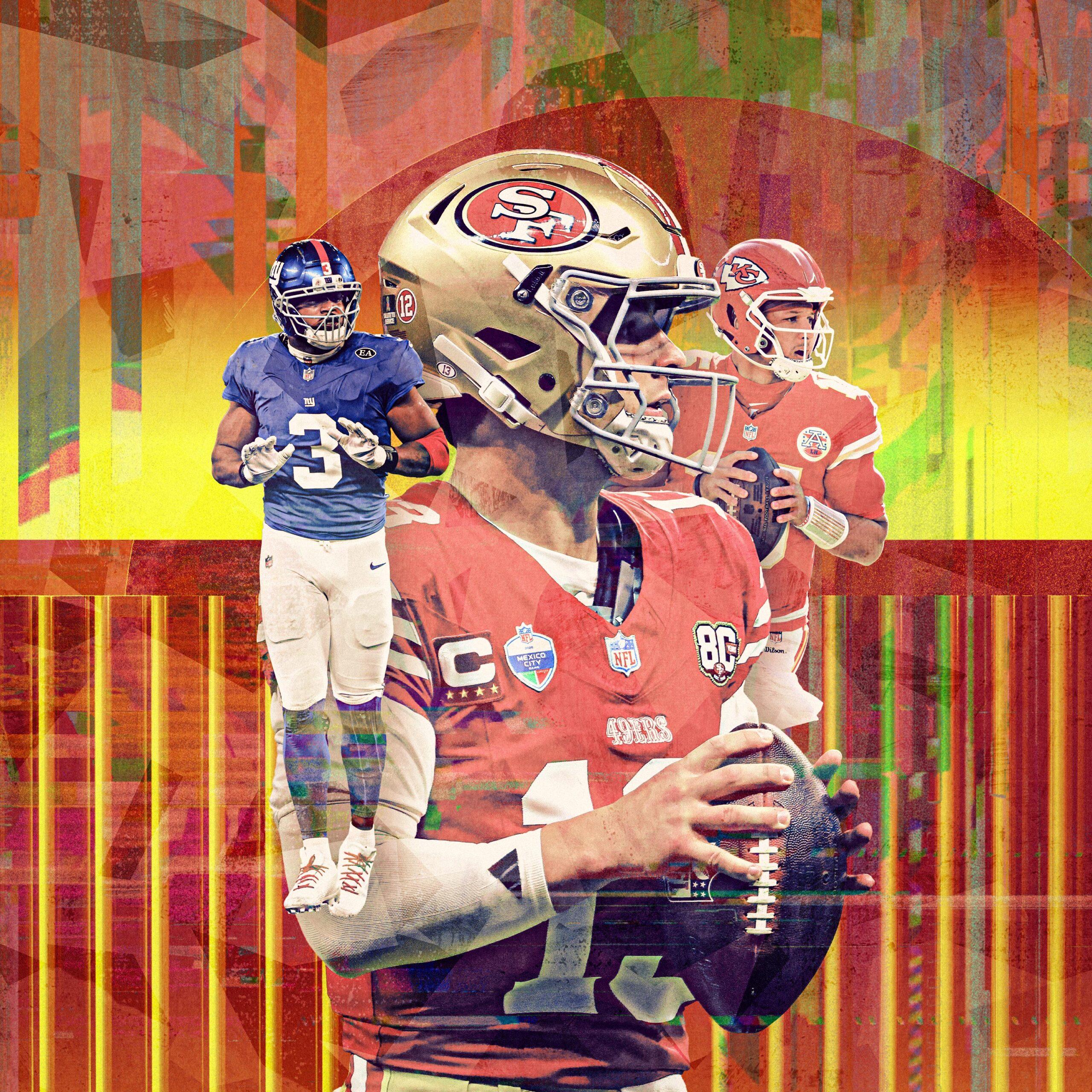
I was fascinated to watch how Kansas City’s offense would operate without its most important player not named Patrick Mahomes. Through Week 9, the Chiefs led the league in rushing yards per attempt and ranked seventh in total rushing yards, making life easy for the two-time MVP quarterback. But with running back Kenneth Walker III—whose arrival in Kansas City rejuvenated the Chiefs offense early this season—sidelined for their last two games with a groin injury, Mahomes has gone 49-of-77 passing with eight touchdowns and no interceptions while averaging 9 yards per attempt. Mahomes’s current passer rating of 108.3 is his highest since 2018, his first MVP season, and he’s on pace to throw for 37 touchdowns and more than 4,600 yards. Mahomes is quietly (as quietly as he can, anyway) putting up an MVP-caliber season and giving the Chiefs a legitimate chance to earn the AFC’s top seed.
The current surge we’re seeing in Kansas City’s passing game isn’t because Mahomes has changed as a passer from the first half of the season (or from the past couple of years); it’s because Kansas City is building a different style of offense around him. Through 11 weeks, Mahomes is averaging nine under-center dropbacks per game, which is the sixth most in the league and almost double Mahomes’s previous career high, from 2024. He currently ranks second in passing yards and is fifth in passer rating this season when he lines up under center. And while Mahomes is taking about the same number of dropbacks per game whether Walker plays or not, his air yards per attempt have jumped from 5.3 in Kansas City’s first eight games to 7.5 in the past two weeks. This newfound downfield passing game is a driving reason the Chiefs look like one of the NFL’s elite teams—even without Walker. On Sunday against Arizona, Mahomes completed eight of his 10 under-center pass attempts, and his efficiency in the passing game led the Chiefs to a 34-7 rout.
After getting accustomed to the Chiefs’ spread-out, RPO-heavy approach in years past, it’s jarring at times to see Mahomes playing in this style. In a lot of ways, it feels like Mahomes is running an offense that was built for Josh Allen or Jared Goff (who rank first and third in under-center dropbacks per game, respectively) because of all the play-action passing into the middle of the field.
In the clip below, Kansas City is running a play-action pass, and Mahomes finds receiver Rashee Rice open in the middle of the field for a chain-moving completion. This play is designed to use both a run fake and routes by two tight ends: Noah Gray sprints across the field into the flat, and Travis Kelce serves as a checkdown option underneath the linebackers to open up a passing window for Mahomes. This play simply wasn’t a part of this offense’s approach in years past.
To start the year, the Chiefs established an identity based on their explosive rushing attack, with Walker rushing for 1,044 yards in just eight games. Even though he’s been out for the past two weeks, the Chiefs are still second in the league in yards per carry this season. But in his absence, we’ve seen that Kansas City can quickly shift into an offense that is based on under-center play-action and leans on Mahomes to create chunk gains with his arm.
And because the Chiefs get into heavier personnel groupings when under center—ninth in the league in snaps per game with one back and two or more tight ends—defenses have to honor the run and crowd the line of scrimmage (Kansas City ranks 12th in stacked box rate on the season). That keeps the middle of the field wide open on play-action passes. In the next clip, Kelce sits in a void behind Arizona’s linebackers after the run fake. Arizona’s safeties aren’t anywhere close because they were anticipating Kelce running a deep crossing route. Mahomes has a clean pocket, and Kansas City moves the chains with ease once again.
In this last clip, we saw how Kansas City can adapt some of its best spread passing concepts to its new under-center offense—particularly plays designed to feed the ball to Kelce. In the next clip, the Chiefs are running a “stick nod” out of a three-tight-end set near the red zone. Gray and Kelce fake underneath out routes before sprinting up the seams. Arizona is in a five-down front to try to stop the run, and it leaves a ton of space for Kelce to set up his double move. Cardinals safety Budda Baker has to honor Kelce’s fake, and there’s no one in the middle of the field to contest Mahomes’s touchdown throw.
Not only is this play excellently designed and executed, but it’s the kind of play that defensive coordinators will have to worry about when Walker returns to the lineup and the run game is at peak capacity again. Will teams continue to load up the line of scrimmage, or will they focus on keeping safeties deep and over the top? Whichever approach a defense tries, Kansas City’s offense is now built to exploit it. That makes it impossible to ignore the Chiefs as Super Bowl contenders.
What Went Well: Kyle Shanahan vs. Minnesota’s Blitzes
After the 49ers’ beatdown of the Vikings on Sunday night, I gave head coach Kyle Shanahan credit for devising a game plan good enough to expose some of Minnesota’s defensive vulnerabilities. Now let’s take a deeper look at that plan and how quarterback Brock Purdy executed it so well.
We’ve talked about the Vikings’ approach to defense on a few occasions in our notebook, so ball knowers should be familiar with how defensive coordinator Brian Flores designs his blitzes to frequently attack the running back or tight end in pass protection. Shanahan’s response was essentially an intricate game of offensive three-card monte, with the goal of disguising which players would be in pass protection and which ones would release for routes. In the first clip, running back Kaelon Black is in a “pistol” alignment (directly behind Purdy), and tight end George Kittle is aligned next to fullback Kyle Juszczyk. There’s no telling before the snap what the pass protection might be. When Kittle motions across the formation, the Vikings still don’t have a clue where the weakness in the pass protection is. Ultimately, none of those players stay in to block, and all five eligible receivers release on routes. This forces the Vikings defense to widen out, opening passing windows for Purdy, who finds receiver Keenan Allen wide open on an in-breaking route to move the chains, a rare occurrence against Minnesota’s defense. On throws in the middle of the field (essentially between the numbers), Minnesota allowed the fewest completions (68) in the league through the first 10 weeks. On Sunday, it allowed 15 completions of that nature, tied for the second most this week.
Throughout the game, the 49ers used several formations and motions to keep Minnesota guessing. In the next clip, San Francisco is in a split-back formation with running back Christian McCaffrey and receiver Deebo Samuel. Minnesota is trying to overload McCaffrey’s side with potential rushers. Flores’s intent here is to try to force McCaffrey to stay in pass protection. But the running back motions out into the slot, and Kittle motions out wide too. This motion put the 49ers into an unorthodox formation—and left the Vikings in a nightmare coverage scenario, with cornerbacks aligned across from McCaffrey and Kittle and safeties left to deal with Allen and receiver Mike Evans. This is a creative way for Shanahan to get his best receivers in space against the Vikings’ worst coverage players. Evans was wide open in the middle of the field, and Purdy hit him for a quick completion before the blitz had a chance to affect the quarterback in the pocket.
I can only imagine how frustrating it must have been for Flores to try to crack the code, no matter what personnel group Shanahan used. In our final clip, McCaffrey isn’t even on the field. Juszczyk is the lone back in the backfield, and the 49ers have Samuel, Allen, and Kittle in a bunched formation. This time, the 49ers don’t have to use confusing motions to mess with the Vikings in coverage; they simply use Juszczyk to pick up an extra rusher. After the snap, San Francisco’s offensive line slides to the offense’s left, and Juszczyk crosses the quarterback to pick up linebacker Andrew Van Ginkel. Minnesota’s blitz actually does get a rusher through, but the bunched receivers occupy Minnesota’s defenders just long enough for Allen to get open for a first-down catch.
The 49ers didn’t try to match the Vikings’ extreme aggression with aggression of their own; they just worked as hard as possible to hide their intentions in pass protection. And Shanahan trusted that Purdy would find the open receivers underneath quickly and consistently. San Francisco completed nine of 12 passes against the blitz on Sunday, and between Purdy and backup Mac Jones, who came in for the last eight minutes of garbage time, the Niners averaged over 10 yards per attempt with a passer rating of 144.4 in those situations. In Minnesota’s previous nine games, opposing quarterbacks completed just 62 percent of their passes and had an average passer rating of 75.6 against the blitz. The 49ers cut the Vikings to pieces, established themselves as the NFC’s best team, and looked, to me, like the best offense that Shanahan’s ever coached.


What Went Wrong: Jacksonville’s Offensive Line vs. Abdul Carter
When an edge rusher is in a flow state, it’s the closest thing we see to basketball on grass for a defensive football player. He’s on an island, using his unique athletic gifts to get past the offensive lineman in front of him. That’s what it was like watching Giants defensive end Abdul Carter find a special groove during New York’s 23-18 win over Jacksonville on Sunday. Carter finished with two sacks, five quarterback hits, and eight pressures and looked like the best player on the field the entire way. And while it’s easy to be wowed by his raw physical traits, what’s most impressive about this performance was that he showed nuance and technical refinement.
While Carter did not officially run a 40-yard dash at the NFL combine or his pro day, his elite speed and burst were no secret during the predraft process in 2024. His average get-off time this season (how quickly he reacts to the snap) is 0.83 seconds, which is faster than Houston edge rusher Will Anderson Jr. and Jets rookie David Bailey, two of the most productive pass rushers in the league this year. Carter uses his great first step to get an advantage, and this helps him turn the corner and bend around the edge before quarterbacks can get the ball out of their hands. In the clip below, Carter flies by Jacksonville left tackle Walker Little and is taking down quarterback Trevor Lawrence before any of Jacksonville’s receivers are even done running their routes.
Having this sort of speed sets up endless possibilities for countermoves, and Carter is learning how to sequence them to keep tackles guessing. In the next clip, Carter is matched up against right tackle Cole Van Lanen, who tries to get hands on Carter quickly (called a “quick set”) in the hope that he can keep Carter from bending around the edge. But again, Carter’s speed destroys the lineman’s plan. Van Lanen loses balance trying to cut Carter off, and Carter plants his outside foot and uses a spin move to fly by him. Lawrence feels the pressure and gets the ball out of his hands quickly enough to avoid a sack here, but the spin was so effective that it’s sure to stick in the minds of Jacksonville’s offensive linemen (and future Giants opponents).
A good edge rusher has a go-to move; a great edge rusher has a counter built off that move. A truly special edge rusher develops a third move in order to be as unpredictable as possible. In just his second year, Carter has that with his jab step, which he uses in this next clip to stop tackle Wyatt Milum’s feet. Carter then delivers a perfectly timed hand swipe to knock Milum off-balance and get around him for another hit on Lawrence.
When a pass rusher can beat an offensive line in this many ways, it draws the play caller’s attention to him and away from his teammates. Eventually, opposing offenses will have to dedicate running backs and tight ends to chipping Carter, and quarterbacks will have to get the ball out quickly to avoid him. That is the mark of an elite edge rusher, and that’s where Carter’s headed if he keeps building on performances like the one he had Sunday.


All-22 Spotlight: Ja’Quan McMillian’s One-Handed Pick-Six
Rookie quarterback Fernando Mendoza is receiving a fast education in what he can’t get away with in the NFL. With the Raiders down 31-24 in the final two minutes of Sunday’s game against the Broncos, Mendoza threw a game-sealing interception to Broncos slot cornerback Ja’Quan McMillian, who returned it 35 yards for a touchdown. And before we even get into the particulars of how Mendoza made the game-ending mistake, you all deserve to marvel at the impressive focus McMillian showed in order to reel in this pass as all his momentum was taking him in the opposite direction.
This is one of the best defensive plays of the season. Now let's break down how it happened. The Raiders are in an empty formation, with running back Ashton Jeanty in the slot. Denver’s defense is in dime personnel (six defensive backs), and before the snap, it shows a single-high safety look. With extra cornerbacks on the field and that deep safety, Mendoza likely assumed he was getting man coverage on this play—and he wouldn’t have been totally wrong. The Broncos are running man-to-man coverage with corners Patrick Surtain II and Jahdae Barron, but they’re still playing Cover 3 on the other half of the field, with McMillian intending to drop into the flat. I’m assuming that when Mendoza saw Surtain in press coverage against receiver Jalen Nailor and Barron locking in on Jeanty pre-snap, he predetermined that his best throw would be to receiver Tre Tucker on a slant.
Mendoza’s mistake was assuming man coverage across the field; he never sees McMillian dropping into coverage. McMillian is so focused on reading Mendoza’s eyes that he almost runs himself right past Tucker and has to reach back to pick off the pass. This was an excellent play from McMillian and a teachable moment for Mendoza. NFL coverages are more complex than meets the eye, and predetermining throws costs quarterbacks games at this level. Mendoza had plenty of encouraging moments in his 267-yard, three-touchdown performance, but I’d bet that this mistake will stick in Mendoza’s memory much longer than his touchdown passes will.


All-22 Spotlight: Miami’s Defense Fools Josh Allen
While we’re on the topic of interceptions, maybe Raiders fans can take solace in the fact that even elite veteran quarterbacks get fooled sometimes. Bills quarterback Josh Allen had a pedestrian game against the Dolphins on Sunday, throwing for 304 yards on 45 attempts, with two disappointing interceptions right before halftime. Buffalo ultimately won by a comfortable 17-point margin, but the Bills probably left that game feeling annoyed that it took all four quarters to put the game away against one of the league’s worst teams.
Allen’s first interception was an unfortunate but forgivable error. The ball was batted at the line of scrimmage before landing in the hands of rookie linebacker Jacob Rodriguez. His second pick was more surprising and inexplicable. Allen threw the ball directly to safety Zayne Anderson in the middle of the field. As you can see in the clip below, the Bills motion tight end Dawson Knox out of the backfield to go from a split-back formation into a spread-out four-receiver set. But when Knox motions, Miami’s defensive look doesn’t change, an indication that Anderson is going to be in coverage patrolling the middle of the field. Indeed, after the snap, Anderson is playing in the “hook” area (an area about 10-12 yards deep and around the hash marks) of Miami’s Cover 3 zone, yet Allen never sees him as he tries to throw the ball to receiver Khalil Shakir on a crosser.
Maybe Miami’s teal uniforms momentarily blended into the grass, or maybe Allen just said “fuck it” and took an aggressive but unwarranted risk because Buffalo had a comfortable lead. But this is the type of boneheaded turnover that used to make people doubt Allen. He’s mostly eliminated these kinds of mistakes from his game. But even from the end zone camera angle, you can see that Allen determined that he’d be throwing the ball to Shakir no matter what, and it bit him the same way those types of choices bite young, inexperienced passers.
All-22 Spotlight: Caleb Williams’s Touchdown Shovel Pass
I can’t get enough of well-designed plays in the red zone. These are the moments that often separate the best play callers from the rest of the field. On Sunday, Chicago had one of my favorite red zone touchdown plays of Week 11: a shovel pass from quarterback Caleb Williams to running back D’Andre Swift.
It’s hard to get receivers open in space once an offense gets the ball inside the 5-yard line, so Chicago needed a creative way to manufacture openings. The Bears accomplish this with misdirection in the clip below. Williams rolls out to his right, and tight ends Colston Loveland and Cole Kmet run close enough to each other to make the Saints believe the Bears are running some kind of pick/rub route concept. New Orleans’s defensive ends widen out to account for Williams’s rollout, which opens just enough space for Swift to sneak underneath for the shovel pass. The fake rub route from Kmet and Loveland sets up their blocks, and Swift runs unimpeded into the end zone.
Every layer of this play’s design makes the shovel pass easier. I wouldn’t be surprised if we see Chicago use this same formation in the near future to set up a pick route, a designed run for Williams, or another creative way to get Swift in the end zone. Head coach and play caller Ben Johnson has been cooking all year, and this play was just the latest example of how easily he can set up scores with his calls.