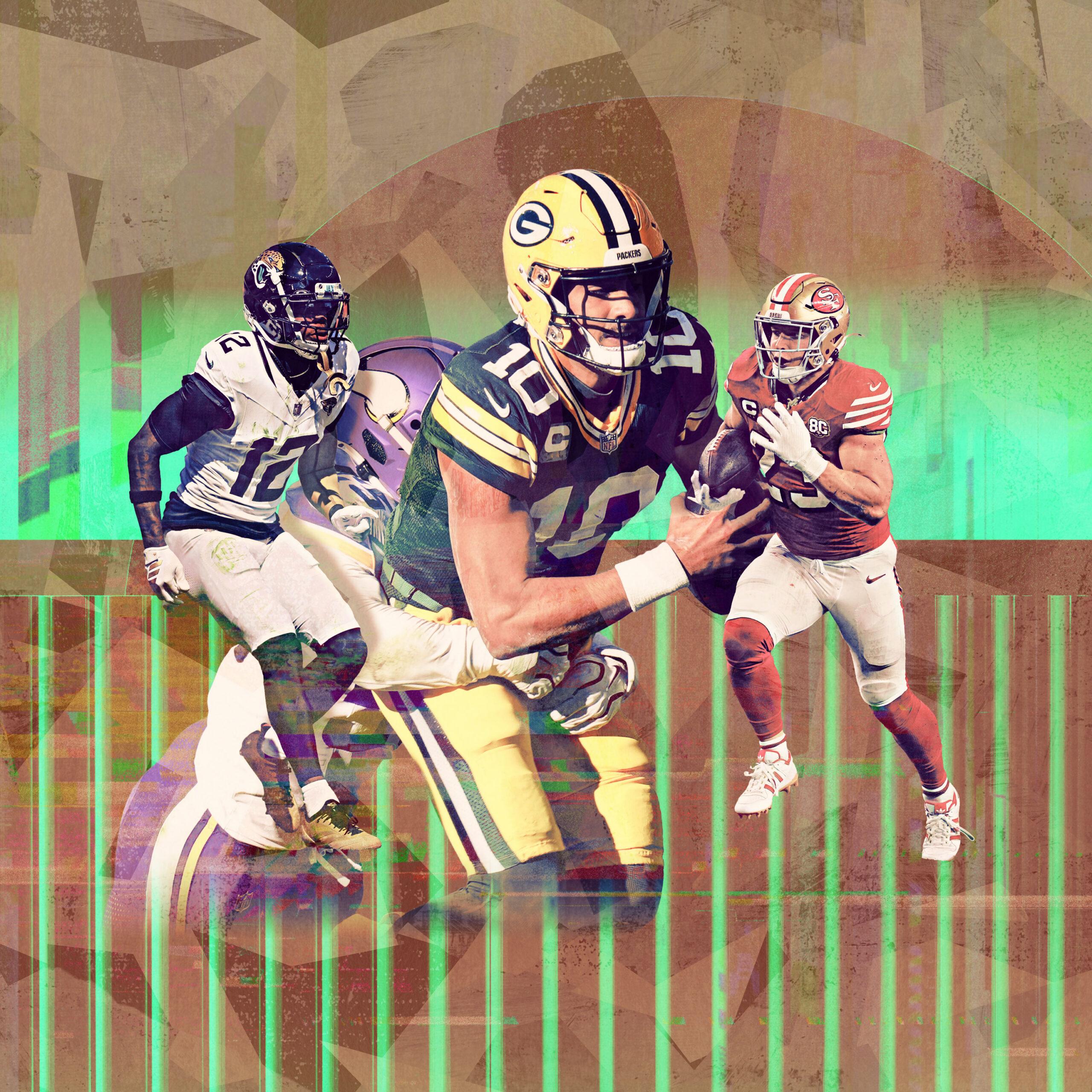

Week 10 of the NFL season is finished, so it’s time for the latest edition of the Ball Knower’s Notebook. The trade deadline is behind us, the holiday season is approaching, and the playoff picture is starting to take shape.
There were several explosive offensive performances this weekend, so we responded with one of our biggest notebook dumps of the season. We’re covering San Francisco’s 46-point output and Detroit’s overseas beatdown of New England. And we also took a look at rookie quarterback Fernando Mendoza’s debut, one of the best plays of Travis Hunter’s young career, and more. Let’s talk some ’ball.
What Went Well: San Francisco’s Unstoppable Offense
Blitzing is a defensive term, but I don’t know how else to describe what San Francisco’s offense did to the Cowboys defense on Sunday. Dallas’s offense staged a late-game rally to make the final few possessions of its 46-40 loss interesting, but before that San Francisco built a 38-19 lead and ended up finishing the game with an unconscionable 584 yards of offense. Quarterback Brock Purdy had 389 passing yards and a 154.5 passer rating on just 28 attempts, and the 49ers ran for 214 yards and three touchdowns as a team. This is the most yards a 49ers offense has ever gained under head coach Kyle Shanahan, and it’s the first regular-season game he’s had with 500 or more yards since a 28-16 win over the Seahawks in 2023.
So much of this team’s efficiency is thanks to Purdy’s playmaking. I’ve grown accustomed to Shanahan’s quarterbacks having a rigid adherence to the system, and Purdy does play within structure often. But what makes things special is when he gets out of the pocket, extends plays, and turns what could’ve been a routine completion into something that’ll go on his career-highlight film. That was Purdy’s 74-yard connection to running back Christian McCaffrey, where he evaded an unblocked blitzer, rolled to the sideline, and attacked the line of scrimmage—only to flip the ball upfield to McCaffrey with no defender in the vicinity. Dallas’s defense is bad, but this could’ve happened to any team given the groove Purdy’s in right now. He ranks second in the league in expected points added when he’s out of the pocket, behind only Josh Allen.
When Shanahan has a quarterback that can handle the playmaking load, he can focus on what I know he loves most—designing the coolest run game in football. Wide receiver Deebo Samuel’s 70-yard touchdown might not have been the longest play of the game, but I’d bet it's the one Shanahan’s patting himself on the back for most. In the clip below, the play looks like a typical Shanahan outside zone run. Fullback Kyle Juszczyk is flying around in motion before the snap, and he and tight end George Kittle are working in tandem to secure the edge. Dallas is reacting to the run and attacking the line of scrimmage—so none of the defenders in the box even seem to notice when the reverse to Samuel happens. There are more 49ers offensive linemen in Samuel’s vicinity than there are Cowboys defenders, and Samuel has to make only one defender miss before his score.
When Shanahan has a defense figured out, every 8-yard run and 15-yard completion comes with a kind of sophisticated brutality—but right now we’re in a place where literally any 49ers play can be a score.
And with Purdy playing at an MVP level, Shanahan doesn’t even need to make the perfect play call anymore. He can trust his quarterback to run his offense in a way he hasn’t been able to since he coached Matt Ryan in 2016. I don’t know whether San Francisco can overcome its injuries to seriously contend this year, but I know this offense could be the hardest to deal with in the league.
What Went Wrong: Dallas’s Recklessness
I had to double up on Sunday’s game because San Francisco got plenty of help from the Cowboys’ awful defense on Sunday. Dallas’s defense has been on the wrong end of a few track meets this year, but this one tops the list. The Cowboys have gone looking for any and every schematic answer they can find this season, but none have worked—and in the process they’ve lost any semblance of an identity.
Look at this 16-yard rushing touchdown from McCaffrey. The 49ers are in 22 personnel (two backs, two tight ends) and are telegraphing that they want to run the ball. Dallas is essentially in a goal line front as a response, which makes sense in theory. But its edges are so wide that cornerback Ameer Speed has to line up over a tight end, and safety Markquese Bell has nowhere to line up alongside linebacker Shemar James. When San Francisco runs outside zone at the open gap, Dallas doesn’t have enough players at the point of attack to set an edge or fill open gaps. I can’t tell whether the Cowboys haven’t gotten many reps in this front or whether the 49ers threw an unexpected formation at them, but there should never be a time when a goal-line front gives up a near-untouched rushing touchdown.
This wasn’t the only example of Cowboys defensive coordinator Christian Parker being too far down the rabbit hole. Bad defenses are prone to taking reckless chances, and McCaffrey’s 66-yard touchdown catch is another perfect example. Dallas tries to run cover zero against the 49ers, hoping that they find a hole in San Francisco’s pass protection and can send an unblocked rusher through. But the 49ers might be the best team in the league when it comes to setting up “hot” throws for Purdy. The moment he sees linebacker Dee Winters blitzing, he knows that there’s a mismatch for McCaffrey—and its 37-year-old edge rusher Von Miller. I won’t insult Miller for getting cooked by McCaffrey because that’s supposed to happen! I’m just trying to figure out what led Parker to make this call in the first place, especially against an offense as potent as San Francisco’s.
Parker was supposed to be the next in line off of Vic Fangio’s coaching tree, but this year's defense is rotten. I know that Cowboys owner Jerry Jones doesn’t like to fire coaches, but I don’t know how much longer this can go on. Dallas’s defense was going to be bad no matter what this season, but now it's actively ruining their chances to make the playoffs.
What Went Well: Detroit’s Offense Frying New England
I’m sure the NFL would’ve loved a hotly contested Lions-Patriots matchup in Munich, Germany. But I’m more entertained by the thought of New England taking an eight-hour flight across hemispheres, just to get a 35-10 ass whooping.
Lions offensive coordinator Drew Petzing has pulled all the right levers during Detroit’s five-game winning streak, and he made things look easy on Sunday in spite of quarterback Jared Goff’s two interceptions. The Lions finished with 494 yards of offense, and the foundation of their success was built on how hard their receivers are to cover in man-to-man. That’s why they saw man coverage at the lowest rate in the league coming into Sunday’s matchup. Teams have to play softer zone coverage to limit their explosive play potential through the air, and that opens easy running lanes for running back Jahmyr Gibbs. New England came into Sunday’s game with the league’s second-highest use of man coverage in the NFL—and Detroit dominated New England by manipulating its man coverage rules and using its versatility to dictate the Patriots’ defensive personnel.
This was most effective in the run game, and the clip below shows a great example. Detroit is in 11 personnel (one back, one tight end) but uses tight end Sam LaPorta as a fullback in this formation. Where they place LaPorta speaks to how intentionally the Lions tried to target and exploit New England’s man coverage, and it ended up in a huge Gibbs gain.
Detroit wants to get the effect of a two-back run game, but it doesn’t want to run the ball against New England’s five-down front, which it uses 41 percent of the time against two–tight end or two-back personnel groupings. So by using a three-receiver set and deploying LaPorta as a fullback, it gets the Patriots in nickel personnel (five defensive backs) and a four-down front, which gives offensive linemen more space and better blocking angles. And with LaPorta in the backfield against New England’s man coverage, each of the Pats’ three off-ball players in the box have to monitor whether he blocks in their direction. New England tried to fit their gaps aggressively, but safety Craig Woodson and linebacker Christian Elliss didn't fit the run properly, and Gibbs got an easy gain.
Detroit got even more creative in how it took advantage of New England’s aggression up front. In the next clip, the Lions use tackle Penei Sewell as a puller on this misdirection play where Gibbs scores a 28-yard touchdown. Detroit fakes as though it's running outside zone toward LaPorta again, drawing New England’s linebackers forward, but Gibbs reverses course and uses Sewell’s lead blocking and receiver Jameson Williams’s perfectly executed “crack” block (a receiver coming into the box to block a defensive end, safety, or linebacker) to get to the perimeter. My favorite minor detail on this play is that they left Patriots edge rusher Gabe Jacas unblocked, which might have resulted in him making a tackle for loss. But it’s a necessary move to convince New England’s defense that they’re running outside zone—because backside edge rushers are almost always left unblocked on zone runs.
Detroit’s commitment to exploiting man coverage extended to the passing game as well. Receiver Amon-Ra St. Brown had a couple of scores by attacking one-on-one matchups on Sunday, but my favorite pass play design was on a touchdown thrown to receiver Isaac TeSlaa. In the clip below, Gibbs motions out to the perimeter and brings linebacker Robert Spillane out with him, which tells Goff that he’s getting man-to-man coverage. As soon as Goff gets the snap, he knows he’s throwing it to TeSlaa on a slot fade route and perfectly places it on his back shoulder.
Petzing’s play calling has been up there with some of the best offensive coaches in the league this season, and we probably haven’t been giving him or the Lions the attention they deserve. Detroit’s 7-2 start has gone underplayed in most discussions about the NFC North—partly because the Vikings and Bears have given us more dramatic story lines to follow, and partly because it's easier to assume Detroit missed its window to be a true contender. But it's currently on a five-game winning streak and has a legitimate argument as the NFL’s best offense.
What Went Well: Brian Flores Shutting Down Green Bay (Again)
The Packers came into this game having won four of their last five and having whomped New England 45-27 last week. So I was curious about whether their red-hot deep passing game would work against Minnesota’s league-best defense—and whether they had any answers to the pressure quarterback Jordan Love faced in these teams’ Week 1 matchup, a 39-22 Green Bay loss where the Packers allowed four sacks.
That curiosity was answered quickly on Sunday: The Packers had no new answers for the Vikings defense, and they were just as hapless in this game as they were in the second half of their season-opening matchup. Love was sacked eight times and threw an interception, and he mustered up only three drives that gained more than 20 yards. Packers receivers weren’t as open downfield the way they were a week ago, and Love didn’t have enough time in the pocket to get them the ball when they did pry open some space. Minnesota made another major statement against the Packers.
What I love most about watching defensive coordinator Brian Flores is his willingness to use a diverse menu of coverages in combination with his blitz packages. It’s not enough that nobody knows who’s rushing or dropping on each play, but there’s hardly a tell for whether they’re in man or zone—and which version of each you may see. In the clip below, Minnesota is playing a man variation of Cover 6, with a bracket over receiver Christian Watson and a deep safety over the top of receiver Matthew Golden. They don’t need to rush five or six defenders for this to be effective because the double-teams alone force Love to hold the ball, and that allows linebacker Andrew Van Ginkel to get home on this sack.
In the next clip, the Vikings give Green Bay the impression that they’re playing conservatively, with two deep safeties and a normal four-down front. But as soon as Love is ready for the snap, Vikings linebackers Ivan Pace Jr. and Eric Wilson run a “cross dog” blitz over the center—Pace and Wilson determine which gap they hit based on the direction the center turns—and Minnesota plays a different coverage variation behind it. This time, they’re deploying a zone Cover 2 over Watson’s side of the formation and a “locked” quarters coverage opposite, where the corner James Pierre and linebacker Kyle Van Noy are man-to-man on their receiving threats. I don’t know whether Love ever diagnosed the coverage he was looking at, and it was moot anyway because he didn’t have enough time to make a throw. Wilson moved Love off his spot, and defensive tackle Levi Rodriguez finished the play with a sack.
The Purple People Eaters moniker belongs solely to the 1960s-70s Vikings defense, but we need a catchy Nordic nickname for what defensive Flores has built in Minnesota. When the play sheet is in his hands, it’s like Thor wielding Mjolnir—he never misses his target.
What Went Wrong: Fernando Mendoza vs. the Seahawks D
Welcome to the NFL, rookie. Quarterback Fernando Mendoza got his first career start against the reigning champion Seahawks and their elite defense. The Raiders had an excellent opening script prepared and put up 10 points in the first quarter. Mendoza completed eight of nine passes in his first two drives and ran in a 10-yard touchdown on a quarterback draw.
But after that, the game went exactly as you’d have expected it to. Mendoza finished with just 143 passing yards on 29 attempts, was sacked six times, and had a stretch of five consecutive three-and-out drives. I wanted to go back over a few of his sacks to see what he and head coach Klint Kubiak can learn from Sunday’s experience, or whether taking big hits in the pocket will be a constant theme the rest of the year.
In the clip below, Las Vegas is under center in a 21 personnel set (two backs, one tight end). Seattle plays in nickel personnel (five defensive backs) against these sets because the Seahawks trust their safeties to stop the run. And that allows the Seahawks to attack offenses from multiple angles—in this instance, a corner blitz from defensive back Devon Witherspoon. Las Vegas is running a play-action pass, so Mendoza has his back turned as the blitz is coming and as the safeties rotate from two-deep to a single-high, man-coverage look. As he’s trying to set his feet to target receiver Tre Tucker, Witherspoon buries him in the turf. Mendoza can get a little better with his eyes on plays like this, because he should be peeking toward potentially “unblockable” defenders (ones who can’t be accounted for in pass protection) as he finishes his play fake, but I’m not putting this one on the rookie. Given the nature of the blitz, the Seahawks were going to have more players rushing off the edge than the Raiders could block.
The next clip is Witherspoon’s second sack of the game, and another example of a play that’s not Mendoza’s fault. Running back Ashton Jeanty is in the backfield, but for all intents and purposes, the Raiders are in an empty set. Jeanty isn’t in position to pick up any blitzers in pass protection, which means the offensive line is going to slide the pass protection toward Jeanty to account for him releasing on his route. Seattle has somewhat forced this protection by walking multiple defenders up to the line of scrimmage on the same side as Jeanty, feigning like they’re going to blitz in his direction. But once the ball is snapped, Witherspoon comes flying in on a blitz, and multiple defenders at the line of scrimmage drop out into coverage. No one’s there to pick Witherspoon up, and Mendoza (once again) never even sees him as he closes in for a sack.
Seattle’s defensive scheme manufactured this sack, but Mendoza will learn to be a bit better here. No matter what the rules of his pass protection tell him, he can never be too certain of who’s rushing and who’s dropping in a look like this. I’d also like Kubiak to give Mendoza more autonomy over changing plays at the line of scrimmage—not full carte blanche, but enough optionality to get out of bad plays so he can avoid situations like these. Because based on the route concept, this play would have been dead on arrival even if Mendoza had correctly diagnosed where the pressure might come from.
Our last example falls totally on Mendoza, and it’s one in which the Seahawks don’t throw anything unexpected or exotic at him. In the clip below, Mendoza gets sacked by edge rusher Derick Hall because he does a poor job of managing the pocket. It’s a predictable mistake from a young quarterback—they often crave the comfort and space in the pocket they’re used to in college, but they rarely see in the league. That leads them to drift backward or plant their feet too deep in the pocket, and allows edge rushers to turn the corner to get sacks. If Mendoza had aggressively stepped up in the pocket, he’d have given himself a chance to find Tucker wide open on a deep in-breaker.
Mendoza’s final statline wasn’t pretty, but there was enough to like and build on in games to come. Next week brings a matchup against the Broncos, and I’ll be eager to see whether Sunday’s experience helps him understand the importance of seeing blitzes coming pre-snap, and stepping up in the pocket when defenses aren’t sending extra rushers his way.
Spotlight: James Cook
One of my favorite plays in football is the toss sweep. There’s nothing better than watching offensive linemen, tight ends, or fullbacks get out on the perimeter to block defensive backs. It was a toss sweep that sprang Bills running back James Cook for a 74-yard touchdown on Sunday, sealing Buffalo’s 31-12 win over the Jets.
On Cook’s touchdown, Buffalo’s pre-snap motion creates a three-man bunch that totally out-leverages New York’s defensive front—putting more blockers at the point of attack than the Jets have defenders. Buffalo’s offensive line does a good job of “fold” blocking, with the center and right tackle looking for the first interior defenders they see and allowing their guards to pull around to get better angles on their blocks. That keeps defensive linemen from chasing the play down and allows Buffalo’s tight ends to climb up to the second and third levels. Once Cook turns upfield, there’s no one left to account for him and he gets 74 of the easiest yards he’s ever gained.
The Jets were trying to stop this run by using a slant with defensive end Kingsley Enagbare and defensive tackle Harrison Phillips—hoping to account for interior gaps and allow their inside linebackers to match the blockers on the perimeter. But the key piece to making this slant work is to have a defensive back or outside linebacker set an edge near the line of scrimmage—that way the linebackers don’t have to chase the ball farther out on the perimeter than they can reach. When safety Dane Belton isn’t there to set an edge, though, the defense gets widened too far and there’s no shot to even get a hand on Cook, let alone bring him down.
This play captures why this run scheme is so effective. The ball is going away from a defense’s best tacklers, and if the defense makes just one mistake on the edge, an explosive play is coming.
Spotlight: Malik Washington Double Pass
I won’t blame you if you’re not totally dialed in to Dolphins action at this point in the season. And I certainly won’t blame you if you decided that the Dolphins-Colts game wouldn’t be in your rotation during the early slate on Sunday. Even I have my moments with Miami when I’m reminded of who is (or isn’t) on the roster. So when I saw on a box score that Malik Washington threw a touchdown pass, I had to double check and be sure that it was the third-year receiver and not the quarterback for the University of Maryland.
Washington completed one of the best passes of the Dolphins season—sad as that may be—and while it's always a fun time to watch a non-quarterback throw a good pass, I felt like this play was specifically designed to make me irrationally angry at the Colts defense. Let’s count the ways.
After his motion, Washington slows down significantly and steps back another yard or two, always an obvious sign that something fishy is going on. Receiver Caleb Douglas doesn’t aggressively attack his defender to make a block, even stepping back to ensure he stays within a yard of the line of scrimmage. Running back Jaylen Wright and right tackle Austin Jackson are double-teaming the Colts’ edge rusher—not a normal thing you’d see on a screen. And Colts safety Cam Bynum should have been tipped off by any of these signs that a double pass was coming. Even if he missed every signal, the Colts seem to be playing Cover 2 on his side of the formation, which means his responsibility on any bubble screen is to make sure that it’s not a fake or double pass first. Simply doing his job would’ve sufficed. Instead, he let his guard down and allowed the 34-yard touchdown.
I’d also like to note that this is within the first five minutes of the game. Nobody is fatigued, and it’s not like they set this play up earlier by throwing several screens in this area of the field. This is just the kind of brain fart that has typified an awful Colts season—and the more I think about it, the more aggravated the defensive coach in me becomes. Let’s just move on to something more positive.
Spotlight: Travis Hunter INT
Nothing feels more personally vindicating than dual-threat Travis Hunter thriving as a cornerback, because it’s always been his best position and where he makes his greatest down-to-down impact.
His top-end speed and fluid change of direction skills give him an ability to jump routes and bait throws that even some veterans can’t. He has three interceptions and three deflections already this year, and he’s not even targeted that often because of how much zone coverage Jacksonville plays. His interception on Sunday was the most impressive forced turnover of the week (and maybe his best play of the season), because Hunter flashed all his unique traits on the play and sent a message to quarterbacks not to get greedy with throws in his vicinity.
On this interception, we got an uncommon opportunity to see Hunter in man coverage. Tennessee tries to use motion and a wide release from receiver Xavier Restrepo to create traffic for Hunter to fight through—hoping he gets tripped up by the slot on the Titans’ “dagger” concept. But Hunter does a great job of staying patient and getting tight to his receiver to keep from getting picked. Being that close to receiver Elic Ayomanor makes it more likely that Hunter would give up space on a push-off when Ayomanor breaks in, but his great recovery speed keeps him close. And when quarterback Cam Ward tries to force the ball across his body, Hunter’s elite ball-tracking skills activate and he’s able to rip the ball away from Ayomanor. These are the kind of plays that no amount of coaching or training can create—they just stem from an innate feel.
The competition for Pro Bowl and All-Pro spots is tight at cornerback, but Hunter’s top-end plays are as impressive as anyone’s. If his trajectory at this position continues, there’s no limit to how good of a defensive back he can become.