
The Ball Knower’s Notebook is back after another week of NFL action! In each edition, we take a look at the best and worst from the most recent slate of games, digging into the film and using our takeaways to gain a better understanding of the story this season is telling us.
We’re seven weeks in now, so we know that preseason predictions have already fallen to pieces, and whatever overcorrections we’ve made since have probably been proved wrong, too. But instead of throwing my hands up and resigning myself to existential “anything can happen” axioms, I’m going to lean on what I know best—good (and bad) defense. Minnesota’s continued blitzing dominance, Tampa Bay’s incredible performance against Carolina, and Seattle’s near-perfect execution against Kansas City are all featured in today’s Notebook. We also took some time to appreciate quarterback J.J. McCarthy, receiver Drake London, and why it’s so damn hard to play linebacker in this league. Let’s talk some ’ball.
What Went Well: Minnesota Blitzing Daniel Jones Into Oblivion
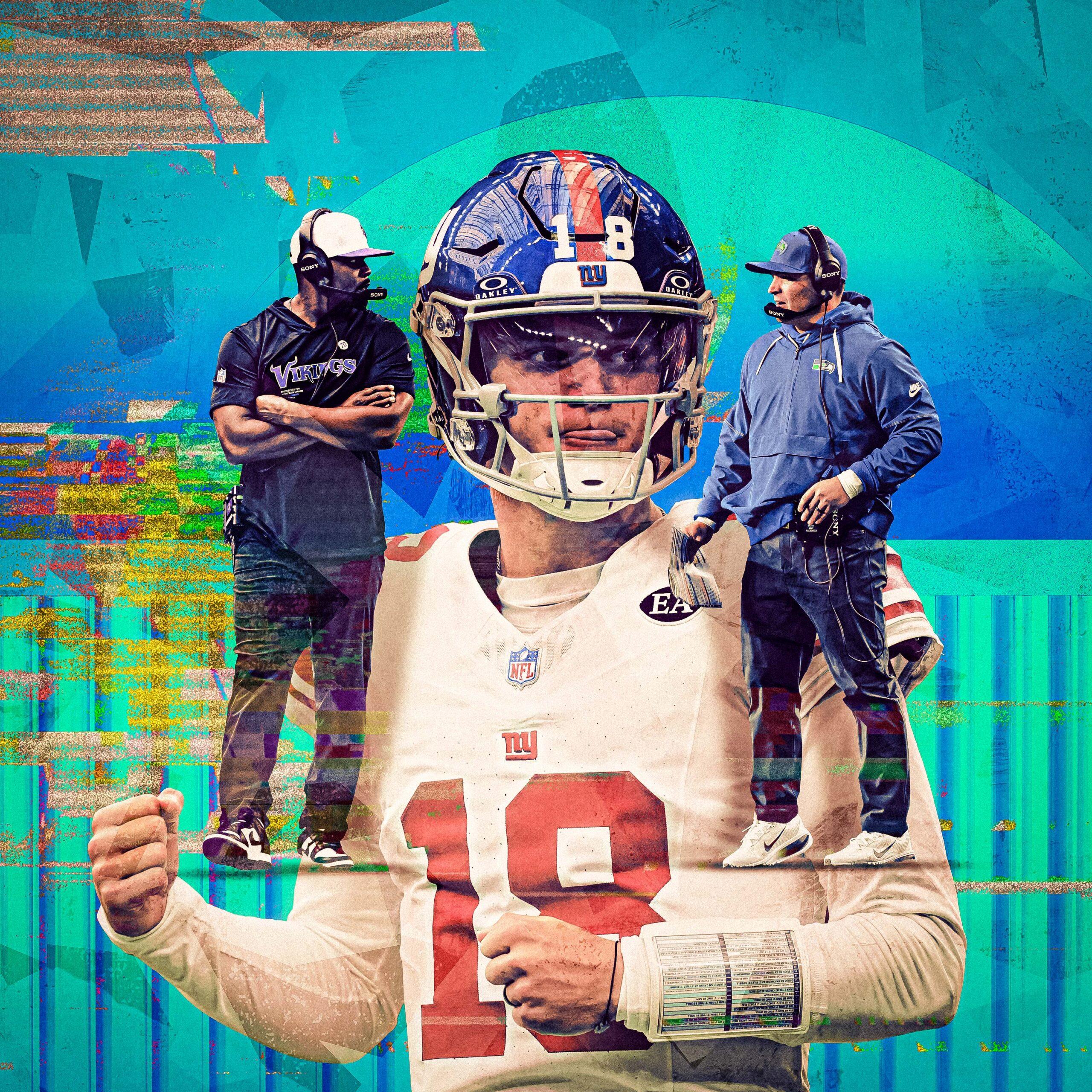
The Vikings are somehow 6-0 despite having a totally unwatchable offense. They rank 23rd in points per game even though they’ve played defenses like Miami’s, New Orleans’s, and most recently Indianapolis’s in Sunday’s ugly 16-10 win. Minnesota is winning almost exclusively because of their defense, which is top three in points allowed, yards allowed, and turnovers forced per game. And that unit is absolutely dragging the Vikings toward the playoffs no matter how poorly the rest of the team plays.
Defensive coordinator Brian Flores should go ahead and clear space on a shelf for the Assistant Coach of the Year award, because there’s no other assistant in the same galaxy when it comes to giving their team a winning edge. Flores has Minnesota first in the league in blitz rate so far this year at 68 percent, and there’s a 25.9-point gap between its defense and second place—a greater distance than what’s between second and last place.
Purple jerseys are crowding the line of scrimmage on every snap, then flying into the backfield from all angles, making this defense one of the most fascinating units I’ve ever watched. One of my favorite subplots of Flores’s blitzes is seeing when the percentages spike, and letting that indicate how much—or how little—respect he has for a quarterback’s ability to solve his defensive puzzle. Flores reached new heights on Sunday, blitzing the Colts’ Daniel Jones at the highest single-game mark this season—and the highest rate a Flores defense has hit since 2023, his first year with Minnesota. Jones was flummoxed all day, finishing the game with four sacks, an interception, and barely over 100 yards passing. And for as much as I wanted to watch the film and just laugh at the absurdity of any offense getting blitzed this often, the tape actually made me kind of sad for Jones. I don’t know how anyone is supposed to consistently sort out where the unblocked defenders might be coming from going up against Flores. But I’ll do my best.
After watching Minnesota’s blitzes this week, it seemed to me that they were based around where the tight end lined up. In the first clip, Minnesota is in its “8-up” defensive front, with just three defenders off the ball and the rest threatening to rush the passer. After the snap, the unblocked rusher (safety Harrison Smith) comes from the top of the screen, blitzing between the tackle and tight end where no offensive player can account for him, and the Vikings drop two defenders from the line of scrimmage to play a three-deep, two-under zone blitz.
This is called an “eyes” concept, meaning the two underneath defenders’ zones aren’t fixed to a specific spot, but rather they’re dictated by where the quarterback is looking. Dropping defenders based on the quarterback’s eyes makes it more likely that the underneath guys will get into the passing window of the quarterback’s “hot” read, and the pass rush will get home before the quarterback has time to find another option. No one is open when Jones starts feeling the pressure, and he concedes a sack to Smith as a result.
Flores has also done a great job of attacking offenses when they’re under center trying to set up play-action passes. He’s blitzing offenses a mind-numbing 78 percent of the time when they’re under center, the third-highest rate since 2020—only trailing himself in 2023 and the 2020 Steelers. Blitzing under-center offenses is a great tactic, because quarterbacks have to turn their backs to execute a play-action pass and won’t have any idea where the rushers are coming from or what coverage lurks behind them. In the clip below, Minnesota is blitzing the “open” side—away from the tight end—to get rushers in Jones’s face once he completes the run fake. None of the Vikings get through unblocked, but the blitz forces the Colts’ offensive line into one-on-one matchups. And because the Colts were trying to set up a passing concept involving just two receivers, Minnesota’s “eyes” blitz once again leaves nobody open, and forces Jones to concede another sack to the Vikings pass rush.
When a defense gets into an offense’s backfield as often as Minnesota’s does, it’s no surprise they have a chance to win every week. And if people are at home watching and feel like this defense is getting by with a gimmick—they’re not totally wrong. But remember: Buddy Ryan’s 46 defense was a gimmick too, as were the “Blitzburgh” Steelers under Dick LeBeau and Dom Capers. The “gimmick” in question just happens to be blitzing so relentlessly that opposing quarterbacks and offensive coordinators fall to their knees. This approach has proven itself effective in every era of football, and it’s why I’m going to keep betting on the Vikings to compete this season regardless of how awful their offense has been.


What Went Well: Seattle Shutting Down Kenneth Walker III
Chiefs running back and Super Bowl LX MVP Kenneth Walker III was the NFL’s leading rusher through the first six weeks of the season, and he came into Sunday night’s game against the Seahawks hoping to show why his former team still needed him. Instead, Seattle won 20-3 and proved that the most important pieces of their championship group were still on the roster. Walker finished with just 36 yards on 14 carries, the lowest output he’s had in a game with 10 or more carries since Week 14 last season. And without his ability to create big gains on the ground, Kansas City didn’t have any hope of moving the ball against the league’s best defense.
Everyone knows Seattle’s front seven is as good as it gets, but the Seahawks don’t just cut their defensive linemen loose to wreak havoc on run plays. There’s an added layer of technical brilliance on top of all their talent that keeps them a step ahead of opposing offenses. I want to take a look at why that is, so that everyone has a clear understanding of how the combination of their talent and the execution of head coach Mike Macdonald’s scheme makes for such a dominant combination.
First, there’s the way Seattle’s raw talent impacts the game, starting with the clip below. Kansas City attempts an inside zone run out of 13 personnel (one back, three tight ends). Because the Seahawks are in “nickel” (five defensive backs on the field), the Chiefs have a theoretical size advantage that should open up space for Walker in the run game. But this run ultimately loses a yard on a tackle by linebacker Tyrice Knight because the Seahawks still deploy the right defensive scheme to stop the run. By walking safety Nick Emmanwori down to the line of scrimmage, Seattle presents a traditional 3-4 defensive front and allows its defensive linemen to occupy blockers long enough for Knight to run through an open gap. Pay close attention to linemen Leonard Williams and Demarcus Lawrence, who both destroy Kansas City’s tackles and take away any space for Walker to cut back or bounce outside.
In the next clip, Kansas City knows that Seattle is going to stay in nickel personnel, so they decide to leave three receivers on the field and attempt to force the Seahawks to give them a 4-3 type of front—which makes it a little easier to double-team defensive tackles and get interior linemen up to the linebackers. If brute strength can’t move the Seahawks off the ball, surely cunning schematics will open up a crease, right? Wrong. This attempt to run inside zone is just as useless as the last one, because Williams is still unblockable one-on-one and defensive end Derick Hall sets the edge so well that Walker (again) is unable to escape. Seattle has true ass-kickers up front.
Pure offensive mass couldn’t get it done, and neither could smaller bodies in condensed formations. So eventually, Chiefs head coach Andy Reid said “screw it” and decided to see whether the offense could create enough literal space across the field to find Walker a running lane. In the next clip, Kansas City is in the shotgun and using a 3x0 formation, meaning there’s a tight end opposite the three-receiver set. From a coaching perspective, this is one of the best ways to put stress on a defense: Putting a tight end on one side often forces a corner into the box, and the three-receiver side often puts the nearest linebacker in space. Doing this makes a defense pick its poison: either playing with one high safety to load the box and keep the corner from fitting the run, or playing with two high safeties to protect a linebacker from being matched up against a slot receiver.
Knowing that Seattle loves to play with two-deep safeties, Reid and Kansas City’s offense has to assume that running the ball here will gain at least a few yards. Wrong again, and this is where the sophistication of Seattle’s defense kicks in. Up front, Williams is executing a “primary-to-secondary” technique against a double-team, knifing past Kansas City’s left tackle to cut Walker off, then disengaging after Walker cuts back. In doing so, Williams makes life easier for three defenders: Knight, middle linebacker Ernest Jones IV, and safety Julian Love. Cutting Walker off means Jones doesn’t have to hurry to his gap responsibility, and that Knight can be patient and fit whatever gap Williams doesn’t. And because Knight can be patient defending the run, Love isn’t in a hurry to clean up any missed tackles or open gaps left between the tackles. This is beautiful execution by Seattle’s front, and it’s the reason they can stop the run so effectively without having to commit extra bodies.
I said in Winners and Losers this week that Kansas City probably won’t ever have to deal with a defense like this again, and that bodes well for their run game. But for the rest of the teams on Seattle’s schedule: good luck.
What Went Well: J.J. McCarthy’s Unforeseeable Game
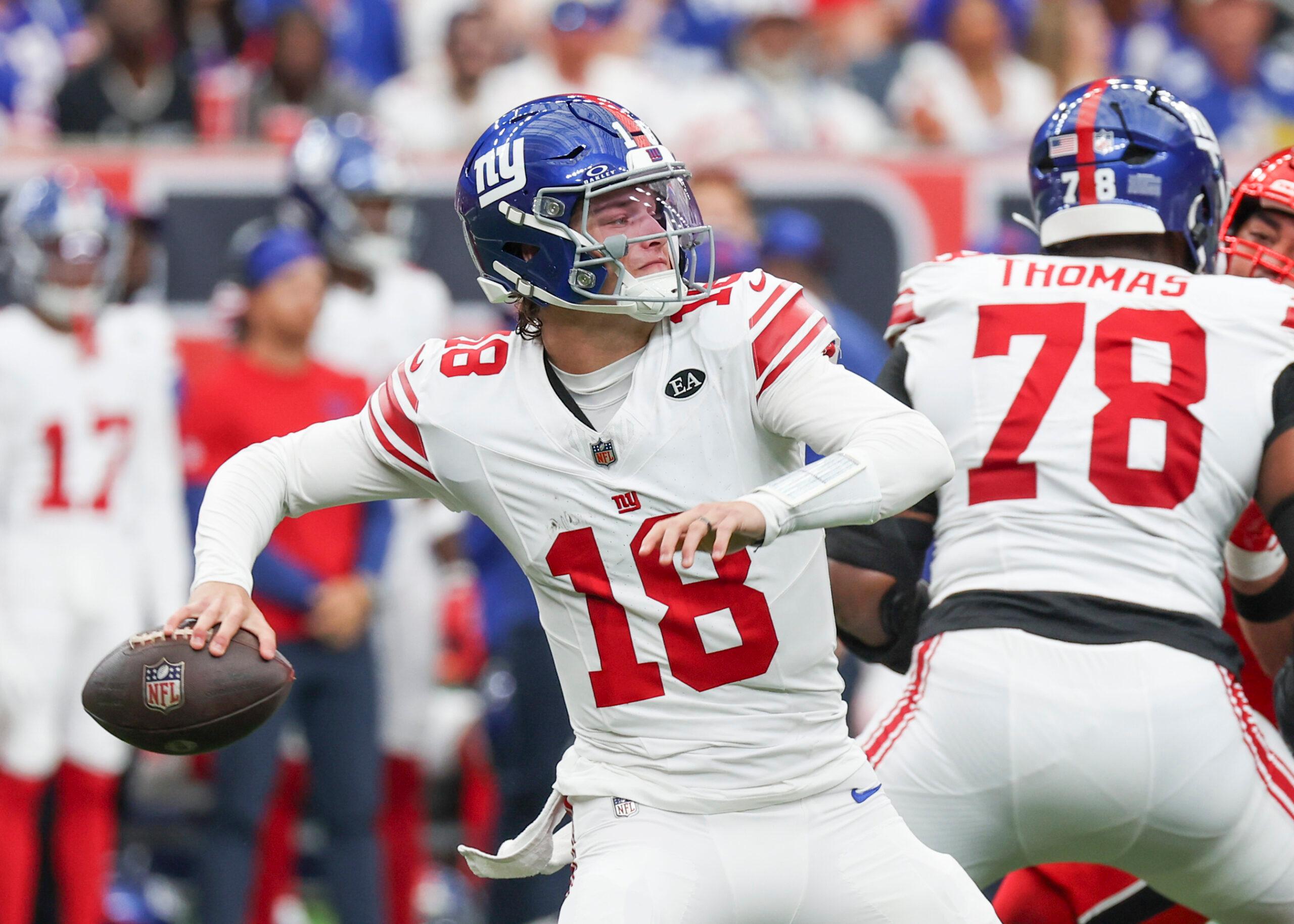
I don’t care how much of an optimist his biggest fans are, there’s no way anyone would’ve reasonably expected quarterback J.J. McCarthy to lead this Giants offense to a 27-21 overtime win over the Texans, especially not by averaging 9 yards per pass attempt and completing 71 percent of his throws.
McCarthy was as close to reaching a flow state on Sunday as he’s ever been in the league, and offensive coordinator Matt Nagy set him up for success by relentlessly attacking every weak point in Houston’s underperforming defense. In the clip below, New York lines up in a 3x0 formation similar to what we discussed in the Seahawks-Chiefs game. In Seattle’s example, I mentioned how these formations force defenses to make hard decisions between defending the run or the pass—but it’s also an extremely effective way to uncover whether a defense is playing in man or zone coverage.
When McCarthy gets to the line of scrimmage and sees safeties lined up over tight ends Thomas Fidone and Isaiah Likely, he knows Houston’s playing man-to-man. A clean pocket gives him enough time to confirm the coverage and find his mismatch: receiver Malik Nabers running a fade route against cornerback Kamari Lassiter. Lassiter’s had a beleaguered year in coverage already, and he probably can’t cover someone as explosive as Nabers on his best day. Nabers gets a step on him and tracks McCarthy’s back shoulder throw for a gain of over 40 yards.
Nagy must have anticipated that Houston’s defense would be more aggressive against McCarthy given how poorly he played as a starter last season, so he used that aggression to his advantage. In the next clip, McCarthy finds rookie receiver Malachi Fields for an easy chain-moving completion on a corner route, throwing into a wide open void in Houston’s coverage. The Texans are playing what looks like a form of “2-read”—a variation of Cover 4 that can morph into Cover 2 depending on what routes the receivers run. If the slot (or inside receiving threat) runs a route to the flats, the cornerback converts from a deep zone player to a flats defender (instead of asking a linebacker to chase that route down) and forces the quarterback to hold the ball longer looking for downfield options.
The one hole in this coverage is between the corner and safety—which the corner is supposed to mitigate by sinking into that hole and then rallying up to any checkdowns. But because Fields is lined up inside the numbers (and thus closer to the ball), he has more space to run into the hole in the zone before the corner recognizes what’s happening, and McCarthy slings it to him as the throw is available.
McCarthy wasn’t carried by Nagy on Sunday, though—he was in an excellent rhythm and made some plays out of structure as well. In the clip below, Houston tries to turn up the pressure with a zone blitz, rushing linebacker Henry To’oTo’o and cornerback Derek Stingley Jr. McCarthy does an excellent job of evading Stingley’s unblocked pressure, stepping up in the pocket, and keeping his eyes downfield long enough to find an open Nabers crossing the field. These were the kinds of plays that eluded McCarthy when he was in Minnesota. Frankly, he was one of the worst quarterbacks I can remember watching whenever he was pressured. The fact that he’s making plays like these in his first start as a Giant has to be a relief for him, and a potentially season-saving development for New York’s offense.
The Texans have been a rough watch on defense this year, so I’m holding space for the possibility that McCarthy’s impressive performance on Sunday might not suggest a career revival. But I did see enough to at least approach his next start with more intrigue than doubt—and a bit more belief in Nagy’s ability to put his players in position to succeed.
What Went Well: Tampa Bay’s Dominant Defensive Showing
The Buccaneers don’t always rank among the league’s elite defenses, but every once in a while head coach Todd Bowles can dial up a great game plan. I’ve watched him make the Eagles offense look like a high school operation in the playoffs; I’ve seen him flummox great quarterbacks like Dak Prescott; and I’ve seen him stay a step ahead of top-tier play callers like Kyle Shanahan and Sean McVay.
Bowles has been in his bag so far this season, despite Tampa Bay’s 2-5 start, and Sunday’s 43-13 win over what was a hot Panthers team is the latest showing in his strong campaign. The Bucs blew Carolina out despite recording just 64 passing yards. Tampa Bay’s defense set their offense up with several scoring opportunities thanks to four forced turnovers and five sacks.
We talked earlier about how effective Minnesota’s defense is at crowding the line with blitzers—and how Seattle wins by taking the opposite approach, sitting back with two-deep safeties and forcing offenses to earn their yards the hard way. Tampa Bay exists between those two worlds, using several different coverage concepts to keep quarterbacks guessing, but still willing to send enough pressure to force mistakes. In the clip below, Panthers quarterback Bryce Young is goaded into an interception by Tampa Bay's zone blitz. Once again, we see an offense in a 3x0 formation, but Bowles declines to participate in the run-vs.-pass dilemma. Instead he decides to blitz two defenders from Carolina’s three-receiver side. This is an intentional choice to force Young to throw the ball to a “hot” read, and Young doesn’t see that safety Tykee Smith is waiting for the quick throw the entire way. You can see Young’s reaction after the interception, recognizing that he allowed Bowles to fool him into a poor choice.
Bowles doesn’t always have to play the all-or-nothing game that comes with blitzing, either. In the next clip (a strip-sack-turned-touchdown), Carolina is trying to run a “dagger” concept to pick up a big chunk through the air. But Tampa Bay is playing a Cover 4 concept that creates brackets on the deepest receivers in each safeties’ area—meaning multiple receivers are double-teamed as they run deep downfield. The only option for Young is a deep in route, which needs time to develop, therefore leaving him vulnerable in the pocket. Edge rusher Al-Quadin Muhammad closes in and knocks the ball out of Young’s hand.
You know a defense has the upper hand when blitzes are creating interceptions and good coverage is leading to sacks. Young hasn’t looked as bad as he did Sunday all year long, a credit to Bowles’s play calling. If Bowles keeps dialing up game plans like what we’ve seen so far this year, Tampa Bay can reclaim this division and get back in the playoffs.
All-22 Spotlight: Drake London’s Red Zone Touchdown
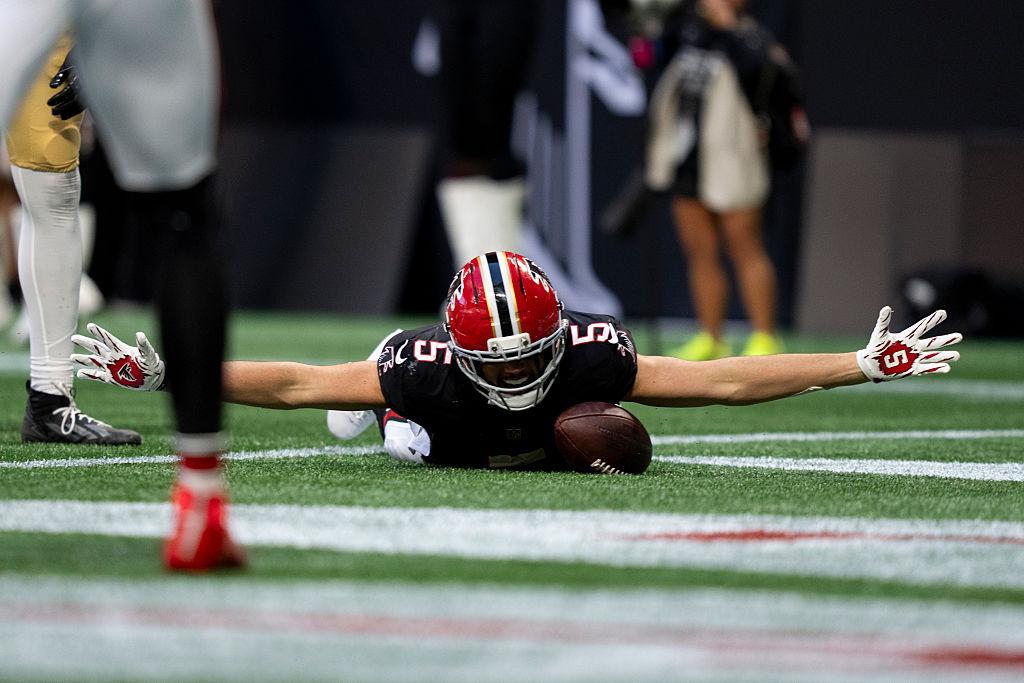
All season I’ve been saying that Cover 4 is a necessary coverage in the red zone and hoping that a team would get beat in a way that justifies my rationale. Finally we have the perfect example after Atlanta’s 29-20 upset win over San Francisco: receiver Drake London’s 21-yard touchdown catch.
In the clip below, Atlanta motions running back Bijan Robinson out to receiver to create an empty set, and San Francisco rotates into a Cover 3 zone in hopes of taking away quick underneath throws. Atlanta’s not looking for a quick dump-off, though, they’re running a “four verts” concept to push the ball into the end zone. London has to fight through an underneath defender’s attempt to reroute him in the slot, but there’s no one left to cover him once he gets up the field. Quarterback Michael Penix Jr. drills the throw to London before San Francisco cornerback Renardo Green can break up the pass.
Penix does a good job of moving the safety out of the middle of the field, but therein lies the problem for the 49ers defense. Cover 4 would give them another defender in this exact area, and would have been a more effective way to force a pass underneath. Without the extra deep defender, there’s just too much space to cover downfield, and Penix doesn’t have to be perfect—he just has to get the ball into the end zone.
Defensive coordinator Raheem Morris has been doing an otherwise good job this season, but this was too easy a touchdown for the Falcons. I’d bet we see the 49ers in Cover 4 any time they’re in the red zone next week.
All-22 Spotlight: Robert Spillane and Christian Elliss Take Ben Johnson’s Bait
As a former linebacker and current coach, I can’t emphasize enough how little you actually see with your own two eyes during a play. There’s a saying in football: See a little to see a lot, which essentially means putting the puzzle together without actually seeing the entirety of its shape. A motion in one direction might mean the ball is going the opposite way, or the route of one receiver might tell you what the entire passing concept may be. Guess right often enough, and you’ll be hailed as one of the game’s best.
We don’t often talk about when those guesses go terribly wrong, though. Robert Spillane and Christian Elliss are one of the better linebacker duos in the league, but even they can be caught gambling at times—and Bears head coach Ben Johnson sought them out on a few occasions in Thursday’s 30-24 win over the Patriots. In the clip below, Chicago uses a play-action pass to set up a variation of a “dagger” concept—where the slot receiver runs a deep crossing route instead of the usual vertical. Spillane clearly assumes it's the traditional version of this passing concept and tries to jump underneath the deep in route, never even noticing receiver Luther Burden III screaming across the field behind him. Elliss bit on the play-fake way too hard and ran himself out of his coverage area, leaving nobody close to tackle Burden once he catches the ball.
Johnson and quarterback Caleb Williams found loads of success attacking the voids left by New England’s linebackers on Sunday, completing 11 of 14 passes between the numbers for 163 yards and a touchdown. I’d bet New England spends a little more time in passing drills this week, making sure Elliss and Spillane have a better feel for what’s happening behind them.
All-22 Spotlight: Penei Sewell … Slot Receiver?
Shout out to my Ringer colleague Lindsay Jones, who made sure I didn’t miss this in the midst of Sunday’s action.
When I first heard that Lions tackle Penei Sewell ran a route in the red zone, I figured Dan Campbell was getting too cute with a reverse pass or some formation that made it impossible for Green Bay’s defense to track Sewell as he released on a screen.
What I didn’t expect was Sewell lining up in a bunched-receiver set and then running a drag route to set up a “mesh” concept with receiver Jameson Williams. Not only did Sewell run the route how he was supposed to, he even executed some of its finer details. When he saw cornerback Keisean Nixon waiting to cover him, he stopped his route—exactly as he should against zone coverage. When outside linebacker Barryn Sorrell dropped in coverage underneath Sewell’s drag, he shuffled back into an open area to make himself available again. And because he executed this so well, he actually drew enough attention from linebacker Ty’Ron Hopper that it opened up a passing lane for quarterback Jared Goff to find Williams—and for Williams to run into the end zone. Sewell has real gravity as a receiver, enough to be a decoy for one of the fastest players in football.
Bravo, big fella. Bravo.