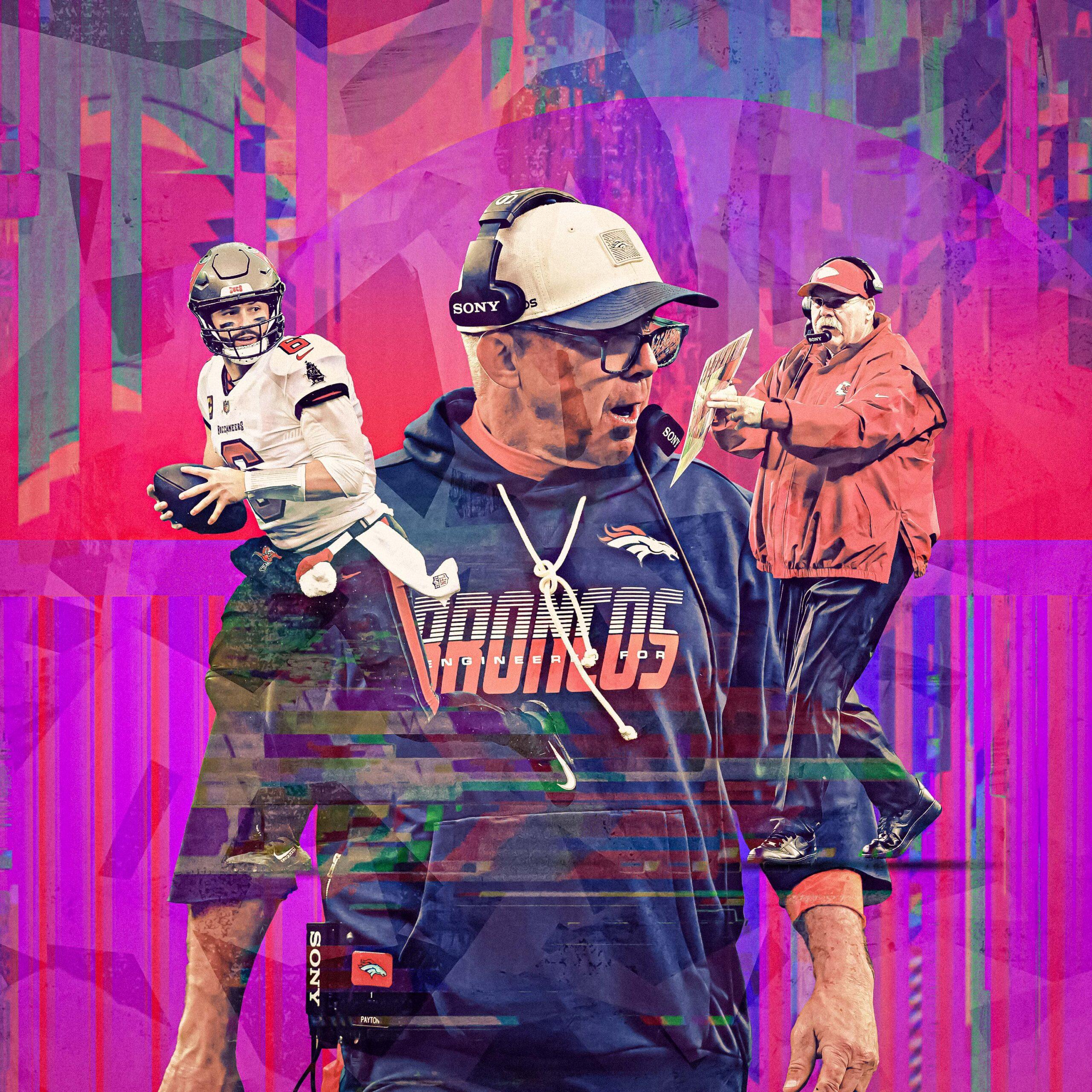

Week 8 of the Ball Knower’s Notebook is here! In it, we’re looking at the best, worst, and most interesting action from this week’s games and explaining why things are (or aren’t) working via the all-22 camera angle.
In this edition, we take a look at Kansas City’s failed go-ahead sequence against the Broncos, how Tampa Bay dominated a game without a single completion, Detroit’s performance in the run game, and much more! Let’s talk some ’ball.
What Went Wrong: The Kansas City Chiefs’ Late-Game Sequence
For about three and a half quarters of Sunday's game between the Chiefs and Broncos, Kansas City was the better team. Quarterback Patrick Mahomes was dialed in, throwing for 321 yards and three touchdowns, and Denver’s defense was helpless as it tried to stop running back Kenneth Walker III.
After Denver battled back to take a late-game lead, everything seemed set up for Mahomes to show once again why he’s one of the most inevitable stars in football history. He had a long completion to a wide-open Travis Kelce, and Walker helped get the ball inside the 5-yard line with less than a minute to go. At that point, I felt like I could get a head start on preparing dinner because there was no way Kansas City wouldn’t punch the ball into the end zone.
But after a first-and-goal at the 4-yard line turned into second-and-goal at the 1-yard line, Kansas City called three ineffective plays that Denver seemed to know were coming, and it lost the game 28-24. That late-game sequence has brought back debates about why the Chiefs don’t run quarterback sneaks with Mahomes (or anyone else) and how a team with this championship pedigree can be a yard away from victory and not deliver. Let’s dive into the film and see what happened.
The Chiefs’ first-down play—a 3-yard rush from Walker—was the only one where they gave themselves a true chance to win. Kansas City lines up in a condensed formation but has multiple receivers on the field to force the Broncos to bring on more defensive backs. It tries to take advantage of those numbers by running the ball with a “duo” concept, which both creates double-teams at the point of attack and forces defensive backs to tackle. If cornerback Patrick Surtain weren’t some 6-foot-2 athletic marvel, Walker would probably have run right through this tackle, and the Chiefs would be winners.
Second down featured my least favorite play call in this sequence. The Chiefs opt for their usual shtick of bluffing that a receiver is motioning across the formation, then having him sprint back out toward the end zone as the defense lets its guard down. Is part of my disdain related to how often plays like these worked against the Eagles in Super Bowl LVII? Who’s to say. But I do know that Denver was all over this approach. The Broncos defensive backs switched coverage responsibilities just before the snap, and cornerback Ja’Quan McMillian jumped on this play—forcing Mahomes to roll out and throw the ball away.
The third-down play was a relatively uneventful tackle for no gain, but it set up a dramatic fourth-and-goal at the 1-yard line that ultimately resulted in a Mahomes sack. In the clip below, the Chiefs are going all out to create confusion for Denver’s defense, using motion to force the Broncos defenders to talk through who guards whom and running three separate receivers through the middle of the end zone, hoping that one would be uncovered. But it doesn’t work because Denver seems to be anticipating a play exactly like this one, and you can see that in the single-file line of defenders at the snap, each taking a receiver in man coverage as he releases downfield.
I don’t think that Mahomes ever considered that the Broncos would cover this crossing-route concept this well. Kelce is open for a brief second, and rather than hitting him, Mahomes pump-fakes out of concern that the throwing window will close too quickly. Mahomes attempts to escape the pocket and extend the play, but he ultimately gets sacked to end the game.
The Chiefs don’t necessarily have to bring back the quarterback sneak to be effective in these goal-to-goal situations, but they can’t pretend that things are OK as is. Kansas City currently has the league’s fourth-worst goal line expected points added per game, even though it’s averaging the fifth-most goal line plays per game. Things might even out as the season goes along, but I wouldn’t want this team to lose a chance of winning its division or making a deep playoff run because the offense stagnates in key situations.
What Went Well: The Tampa Bay Buccaneers Over-Establishing the Run
Seeing teams run the ball in bad weather scratches my Football Guy itch in a way that sophisticated modern passing games and perfectly designed coverages just can’t.
So I enjoyed watching the Bucs dominate the Falcons on their way to a 16-0 victory—and only realized they hadn’t completed a pass when I checked the box score in the second half. Tampa Bay didn’t just win without a completion: It attempted only three passes in the game. I’m sure the rain and quarterback Baker Mayfield’s previously injured thumb had a lot to do with why Tampa leaned on the run on Sunday, but it’s also true that any team that can put up 324 rushing yards in a single outing should hand the ball off as often as it pleases.
Running back Bucky Irving led the way on Sunday with 170 yards on 27 carries—and backup Kenneth Gainwell added another 140 rushing yards. But I was more impressed with the design of Tampa Bay’s run game than either player’s individual brilliance. Offensive coordinator Zac Robinson had Atlanta’s defense figured out, and he routinely took advantage of it. The first example comes in the clip below, with the Bucs in a two–tight end set. Atlanta rolls a safety down over the pair of tight ends to get an extra defender to fit the run, but Tampa Bay runs inside zone in the opposite direction, and Irving has a wide-open lane down the middle of the defense.
This is because receiver Chris Godwin Jr. motions in to account for Atlanta safety Jessie Bates III, giving the Bucs enough blockers to pick up every defender in the box. Usually, you’ll see receivers used in blocking schemes like “duo,” where they’ll block safeties or linebackers at the point of attack. I’d imagine that’s what Atlanta was expecting when Bates rolled down into the box. But Tampa used that assumption to its benefit. They do it again in the clip below, this time in a three–tight end set using backup tight end Bauer Sharp the same way they used Godwin. That set up an easy cutback on this inside zone run.
Tampa Bay did a great job of using these heavier personnel groupings to manipulate Atlanta’s safety rotation and take advantage with downhill runs. In this clip, the Bucs are back in a two–tight end set, but this time tight end Cade Otton lines up as a fullback in the backfield. Otton is the extra blocker in a “counter” scheme, where he and guard Cody Mauch wrap around the formation to create a crease on the left edge. Because the Falcons rotated safety Xavier Watts over Godwin in the slot, the linebackers are confined inside the box and can’t get to the running lane. Irving gained almost 15 yards on the play—and Godwin’s block on Watts made him a nonfactor in stopping this run.
After several effective downhill rushes, it’s inevitable that a defense will get caught leaning forward and give up a big run on the edge. In this last clip, the Bucs use Sharp like a fullback and run a variation of a toss sweep. This one is a “crack” toss, where Godwin lines up at receiver but blocks a defensive end, tackle Justin Skule gets to the second level and blocks a linebacker, and Sharp chases down a cornerback on the perimeter. Bates is again rotated down, away from the direction of the run, so there’s no extra defender at the point of attack. That offensive numbers advantage leads to big runs like the one Irving had on this play.
Tampa Bay ranks fourth in the NFL in explosive run rate this season even though it’s played multiple games with an undrafted free agent at quarterback. If that keeps up and the defense stays as good as it’s been the past few weeks, they can keep winning these types of games. And personally, I’m hoping they have six more weeks of bad weather to force them to dig this deep in their bag again for their rushing attack.

What Went Wrong: The Dallas Cowboys’ Red Zone Defense
We opened this season by talking about how poor the Cowboys defense looked on film, and I was hoping that some things might get ironed out between then and now, especially after they brought in defensive consultant Mike Pettine to help out coordinator Christian Parker.
Silly me—nothing has changed in the slightest. Dallas has allowed the most yards per game and seventh-most points per game this season, and now it sits at 3-5 after an embarrassing 33-30 home loss to the supposed-to-be-rebuilding Cardinals. Arizona benched quarterback Jacoby Brissett for Gardner Minshew in this game and still outgained the Cowboys 467 yards to 261 and scored 23 points between the fourth quarter and overtime.
Just about everything is bad for Dallas’s defense right now, but nothing stands out quite as much as how it performs in the red zone. By expected points added, the Cowboys have the fifth-worst red zone passing defense. They regularly miscommunicate coverage responsibilities, lose sight of receivers, and get little pressure on opposing quarterbacks. That’s why Minshew was able to convert three straight fourth-quarter drives into touchdowns to tie the game and give the Cardinals a shot to win.
In the clip below, Dallas is trying to set up a “peel” blitz, with linebacker Shemar James blitzing and edge rusher Donovan Ezeiruaku responsible for the running back if he releases on a route. Ezeiruaku is clearly pointing at running back Tyler Allgeier and acknowledging his responsibility, but he still manages to bumble the wheel route. That blown coverage renders the blitz moot—and frankly, it wouldn’t have mattered because the rushers all got picked up anyway. Allgeier is wide open, and his reception gets the Cardinals inside the 5-yard line.
Leaving Ezeiruaku in man coverage probably isn’t ideal, but I can forgive aggressive play calling that risks these kinds of mismatches. What I can’t understand is how this defense repeatedly breaks down on running coverage concepts that almost every NFL team uses. In the next clip, Dallas is in a variation of Cover 4 against the Cardinals’ two-by-two receiver set. Cornerback Daron Bland is in press coverage at the bottom of the clip. And linebacker DeMarvion Overshown and safety P.J. Locke should be sharing coverage responsibility against tight end Trey McBride.
If McBride runs a route that breaks underneath, Overshown will take it and Locke will work to double-team the next most dangerous option. If McBride goes over the top, Locke will cover him and Overshown will help elsewhere. But neither covers McBride as he breaks out on a corner route, leading to an easy Cardinals touchdown and my least favorite thing in football: a group of defenders bickering in the end zone about who was supposed to be covering the wide-open man.
Assuming that Bland was supposed to be in man coverage there, that coverage breakdown was Locke’s fault, because of either a miscommunication or a poorly executed play. And it wasn’t the only time Arizona attacked an area that Dallas’s safeties should’ve been covering, either. In our final clip, Arizona’s in an empty formation, and Dallas is again in Cover 4. This time, the coverage bust comes from James and safety Alijah Clark up the middle of the field as receiver Michael Wilson streaks to the back of the end zone to catch the game-tying touchdown. As in our last clip, there’s supposed to be a shared responsibility between the two defenders, with linebackers taking any route that’s breaking underneath and safeties taking anything over the top. But Clark is so focused on taking away in-breaking routes from receiver Devin Duvernay that he doesn’t even see Wilson behind the defense until it’s too late.
Dallas is playing itself out of what should be an easy path to winning the NFC East because its defense can’t stop a nosebleed. With each passing week, I feel more certain that Parker will be a one-and-done experiment at DC and that head coach Brian Schottenheimer’s goodwill with the fan base will be used up because of this whiff of a hire.
What Went Well: The Detroit Lions’ Answer for the Minnesota Vikings Defense
Going up against the Vikings defense, which is known for blitzing relentlessly and making life miserable for offensive lines, Lions head coach Dan Campbell did exactly what I’d expect of him: He ran directly into the teeth of the defense and proved who’s tougher. Detroit’s 19-15 win handed the Vikings their first loss of the season, and the score was an accurate representation of how unorthodox this game was.
What ultimately won the game for the Lions was that 164 of their 230 rushing yards came after halftime. And while they made some big gains happen just by lining up and trying to mash the Vikings between the tackles, my favorite runs came as a result of play calling ingenuity. Detroit used its multiple–tight end sets to get into “full house” formations, meaning that there are three players in the backfield who can be used to misdirect defenses and get a numbers advantage at the point of attack. That’s how Lions running back Jahmyr Gibbs sprang for a 30-yard touchdown in the second half: Tight ends Brock Wright and Sam LaPorta motion into the backfield and fake that they’re lead blocking to the offense’s right—then change direction. Receiver Amon-Ra St. Brown helps out with a well-timed block on safety Josh Metellus, and that leaves no defenders in Gibbs’s way as he hits top speed.
The full house sets also helped the Lions use the Vikings’ blitzes against them. In the next clip, the Lions use a motion similar to a “counter” run—but this time, they’re running outside zone, with two lead blockers responsible for blowing the edge rusher off the ball. The Vikings love to blitz the side of the tight end and try to do so with cornerback Isaiah Rodgers. But it's a wasted effort, as the ball goes to the opposite side. Receiver Isaac TeSlaa is blocking Metellus this time, and the combination of that block and Detroit’s tight ends gets Gibbs on the perimeter against a cornerback.
This reliable run game meant that quarterback Jared Goff had to spend less time in the pocket trying to evade the blitzes Vikings defensive coordinator Brian Flores threw at him. I’ll be curious about whether more teams around the league steal this approach against Minnesota’s defense and whether Flores can figure out how to combat it.
Monday Night Spotlight: Caleb Williams Breaks Down the Seattle Seahawks Defense
Just a week after Mahomes and Co. had to use every bit of their energy to squeak out yardage against the Seahawks, Bears quarterback Caleb Williams strolled into Lumen Field and had the best performance of any quarterback against the Seahawks all season. In Chicago’s 34-17 win, Williams finished with 247 yards and just one touchdown, but he expertly navigated the pocket and attacked the middle of Seattle’s defense with one in-breaking route after another.
Williams completed 18 of his 23 throws between the numbers, averaging 9 yards per attempt and putting up a passer rating of 101. The Seahawks pride themselves on forcing quarterbacks to make throws into tight windows or under pressure, but neither seemed to affect Williams on Monday. Whether he was checking the ball down to his running backs or pushing it downfield to his receivers, everything was working well for him.
Since Williams returned from his injury in Week 6, he has had a blistering passer rating of 111.3 and a completion rate of 74 percent, both ranking in the top five in the league. If he keeps this up, he will be in the MVP conversation despite his time missed to injury—and Chicago will be considered a legitimate Super Bowl contender.


All-22 Spotlight: Joe Burrow and Tee Higgins Beat the Blitz
I love when a great quarterback and great receiver are totally dialed in with each other. That’s where quarterback Joe Burrow and receiver Tee Higgins are right now, with Higgins leading the league in yards per reception and ranking second in total receiving yards. And while Cincinnati’s 43-36 win over the Titans was much more competitive than it should’ve been for a Super Bowl hopeful like the Bengals, that was not the fault of Burrow and Higgins, who connected 10 times for 155 yards and two touchdowns.
My favorite completion between the two was Higgins’s game-tying 18-yard touchdown catch late in the fourth quarter. In the clip below, Tennessee is trying to blitz to the side of running back Samaje Perine—but Burrow, Perine, and left guard Dylan Fairchild see it coming the whole way. That’s a function of recognizing defensive alignments and deducing what’s coming next. The safety lines up right behind the blitzing linebackers, and the linebackers’ forward-leaning posture stands out in comparison with the other linebacker at the top of the screen. Once the ball is snapped, Fairchild and Perine pick up the blitz easily, and Burrow drills the throw to Higgins.
Burrow’s throw shows us how quarterbacks can beat the blitz with their arm. You’ll sometimes hear passers talk about throwing “into the blitz” by targeting a hot route that runs into the void left by the rushing defenders. But if that throw isn’t there—and it wasn’t, based on Cincinnati’s passing concept—the next best option is throwing the ball “away from rotation.” When defenses blitz, one safety typically rolls down over a receiver, and the other rolls to the middle of the field. With the right timing, a quarterback can fire a ball into the space left by the rotating safeties, all while the defender’s back is turned. That’s how this completion was made, and Burrow perfectly placed the ball on Higgins’s back shoulder to keep him from getting crushed after the catch.
I don’t know whether the Bengals are actual contenders at this point in the season, but I can appreciate witnessing this offense do things like that every single week.
All-22 Spotlight: An(other) Awful Interception From Justin Herbert
We haven’t spent any time talking about the Chargers offense in our notebook entries—why would we? This unit is where joy and optimism go to die in a deluge of unblocked blitzers and unsuccessful rushing attempts.
But sometimes, things get so cartoonishly bad that it’d be wrong not to bask in the mess. The Chargers actually outgained the Rams in Sunday’s 24-9 loss, outperformed them on third down, and had fewer penalties—yet they still lost by two scores because quarterback Justin Herbert cannot stop throwing interceptions. His latest meatball sub landed in the hands of Rams cornerback Trent McDuffie, who didn’t have to work all that hard to force the turnover.
I gasped at the interception on Sunday, but going from the broadcast angle to the all-22 cameras turned my shock into disgust. See for yourself in the clip below. Herbert turns around after his play-action fake and sees absolutely nothing open. Receiver Quentin Johnston is blanketed on his in-breaking route, and Herbert’s dump-off option, Ladd McConkey, is being closely covered. Charlie Kolar has a brief moment of appearing open, but the Rams are in zone coverage and McDuffie is waiting for his crossing route the entire time. Herbert double clutches before throwing the pass, as if he knows the play is doomed, but he throws to Kolar anyway because that’s what the design of the play asks him to do.
Any quarterback who throws a pick this bad deserves to be chided, and this isn’t even close to the worst of his turnovers this season. Herbert seems to have forgotten how to identify zone coverage—or he’s not willing to risk getting hit while he waits for things to develop. But taking Herbert out of the equation for a second, I have to ask: What the hell is this play call even supposed to be accomplishing? McConkey is being wasted as a check-down option instead of pushing downfield, and Kolar isn’t fast enough to get across the field and draw defensive attention away from Johnston’s in-breaking route. This play might be more effective near the red zone, when defenses are more likely to play man coverage or overreact to a run fake. But the Rams’ lack of respect for the Chargers’ outside run game means that this play had no shot from the beginning. Watch the Rams linebackers and defensive backs—not a single one reacts to the run fake.
That’s a symptom of a broken offense, and Herbert’s season is a reflection of a broken quarterback. On play-action passes, Herbert has the league’s second-worst expected points added, the third-highest quarterback hit rate, and third-highest scramble rate. Offensive coordinator Mike McDaniel was hired to give Herbert more explosive pass potential without exposing him to more punishment—and he’s failed miserably at that task. But while he’s been the least valuable coordinator hired last offseason, the Chargers are so committed to his failed offensive vision that I doubt firing him would change anything.
So they just keep trotting out this failed experiment each week, daring to see how bad things can get. And each week, it seems to be a little worse than last time.