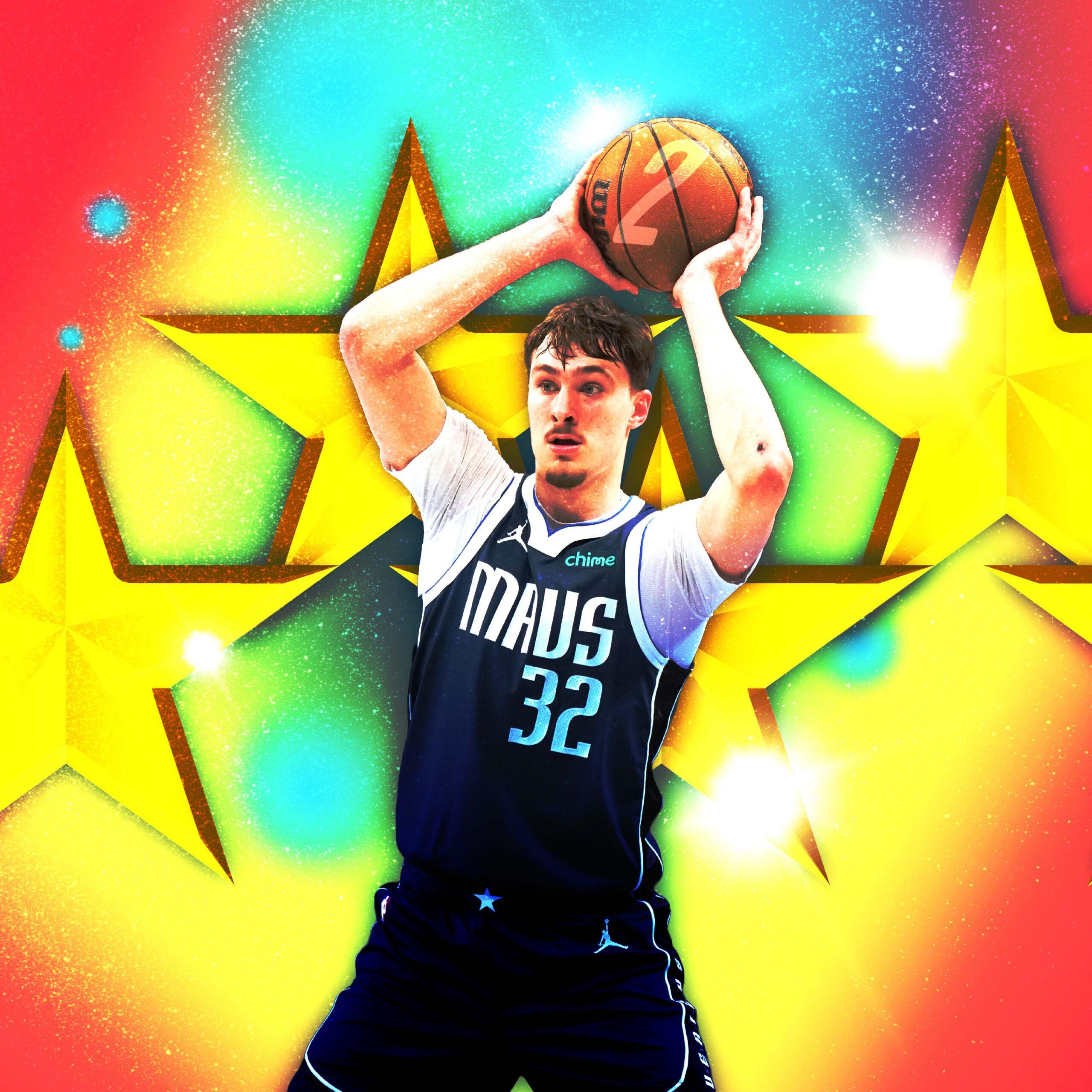

At the center of a Venn diagram of inescapable hype, bottomless potential, and impossibly seasoned skill sits Cooper Flagg, who is somehow still a teenager.
The reigning NBA Rookie of the Year has exceeded pretty much every expectation ever bestowed on him. His first season was a stunning campaign, spotlit with flares of prodigious talent and an innate feel for a game he’ll almost certainly master soon. As the youngest player in the league, Flagg led the Dallas Mavericks in total points, rebounds, and steals; tied for first in assists; and finished second in blocks. His stake-planting performances were a revelation: He exploded for 51 points in just 33 minutes against the Magic, 49 points and 10 rebounds against the Hornets, and 45 points and nine assists against the Lakers. In those three games, Flagg committed a grand total of five turnovers. (His true shooting percentage was above league average in 17 of the 21 games in which he scored at least 25 points.)
So here I sit, thinking about Flagg with opening night just a couple of weeks away. Two questions come to mind: (1) How much better is he about to be? And (2) why isn’t the anticipation surrounding said leap a bigger deal? This eventful summer may be the answer to the latter question; it was jam-packed with buzzy free agent signings and trades that may affect the title race. And as far as ascending face-of-the-league candidates go, Victor Wembanyama has lapped the field and left little room for debate. I get all that. But Flagg isn’t a normal second-year player. And the situation he’s about to step into is so much more advantageous and respectable than it was last season. Kyrie Irving is healthy. Dusty May has replaced Jason Kidd as Dallas’s head coach. Masai Ujiri now oversees a team that Nico Harrison had warped beyond recognition.
As a rookie, Flagg not only had to familiarize himself with the kind of speed, size, and schematic intricacies he’d never experienced before but also had to grapple with ghosts from a bygone era—the blend of delusion and pain from the Luka Doncic trade, which had happened just four months before the 2025 NBA draft. The team still employed too many people like Anthony Davis and Klay Thompson, who weren’t able or willing to downshift properly and prioritize a rookie who needed to exist at the center of their collective orbit.
It was an unfair aftermath for Flagg to land in. A rocket launching from rubble. Flagg infamously began his career out of position as a point guard, largely because Dallas’s frontcourt was overcrowded. Davis, Daniel Gafford, Dereck Lively II, Dwight Powell, Marvin Bagley III, and Moussa Cisse were all on the roster, which lacked any established playmakers while Irving was out recovering from ACL surgery. (It’s probably no coincidence that Dallas had an above-average offense when Flagg shared the court with real point guards like Brandon Williams or Ryan Nembhard—something that didn’t happen alongside any other teammates who logged at least 150 minutes with him.)
More on the NBA
The more Kidd had Flagg playing point guard, the less efficient he and his team were. Desirable field goal attempts were few and far between. According to Basketball Index, Flagg ranked 134th out of 136 rookies in half-court shot quality. Even his good looks were … not good. Last year, 150 players attempted at least 140 shots that were deemed wide open by the NBA’s tracking data. Flagg ranked dead last in effective field goal percentage, right behind Dyson Daniels.
But for all his processing errors and missed jump shots, Flagg’s first-year flaws can easily be explained by his surroundings, the likes of which are typically endured by any no. 1 pick tasked with fixing a broken franchise. Spacing was a struggle, defense was optional, and establishing actual winning habits was ultimately frowned upon. But he dealt with the discomfort about as well as anyone could, constantly searching for solid ground in a city that was still sifting through an unprecedented NBA trauma. Not every prospect could recover from the abysmal splits he submitted last year. He was one of the worst 3-point shooters in the league, settled for far too many long 2s, and helmed an offense that finished 3.5 points per 100 possessions below league average when he was on the floor.
And … I pretty much couldn’t care less about any of it. The only teenage rookies in NBA history who’ve scored more points than Flagg were Carmelo Anthony, LeBron James, Luka Doncic, and Kevin Durant. All of their true shooting and effective field goal percentages were lower than Flagg’s. This isn’t a 19-year-old who lost his way. It’s a generational prodigy who spent months tinkering, learning, and enduring through the type of struggle that will benefit him in the long run. Year one forced Flagg to develop by forcing him to think through thorny circumstances instead of consistently putting him in a position to succeed. Trial and error. He responded by rarely looking flustered. It was almost eerie how instantaneously he belonged.
The only player I’d trade him for is Wemby. I still think Kon Knueppel deserved to win Rookie of the Year, but my criteria for that award shouldn’t be confused with the infinite optimism I have about what Flagg will soon be.
Sometimes it seems like there’s a halo above his head. Will he make his first All-Star appearance or even snag a spot on one of the All-NBA teams? Can he average something like 27 points, eight boards, and six assists per game? Will catchall metrics recognize him as one of the 15 to 20 best players on the planet? There are several reasons to think all of the above are somewhat realistic, with perhaps the biggest cause for optimism being Kyrie.
To get a couple caveats out of the way, yes, Irving’s 34 years old and missed all of last season rehabbing a torn ACL. If a team that’s closer to winning it all (like the Detroit Pistons) wants to offer real assets for Irving before the trade deadline passes, the Mavericks would be foolish not to pay attention. But if that doesn’t happen and one of the greatest sidekicks in NBA history stays put, Kyrie works well on or off the ball and can streamline Flagg’s responsibilities and make his job so much easier than it was.
The attention Kyrie draws on the court is an obvious boon. But he and Flagg should also be able to run a pretty good two-man game. Flagg can set ball screens, roll into space, and either knock down a 10-footer or swing the ball to an open shooter—a form of attack that wasn’t at his disposal much last year.
Even when he isn’t on the court with Irving, Flagg may be able to run the show by himself. He already demonstrates key ingredients like patience, and he rarely makes bad pass turnovers. When he dribbles off a screen and surveys the floor, he has an unhurried, unbothered aura that can’t be taught. It’s effortless and natural. This is a person who was born to dominate the NBA someday. If we were able to track plays that make you think, “Holy shit, that was special,” Flagg would easily rank in the top 10. That has to matter. Take the pass below as an example. Either you can get downhill, bait Wemby into taking a step away from his man, and then sneak a lob over his head at the absolute perfect speed, or you can’t:
Either you have enough strength and improvisational touch to make an off-balance push shot look like it was your intention the moment you caught the ball, or you don’t:
It’s easy to daydream about someone whose career trajectory resembles the ascent up Everest. But watching Flagg is still a visceral experience, powerful enough to snap you into the present moment. How did he do what I just saw him do? Get ready for a lot of that.
Flagg slogged through last season, but his skill set is tailor-made for collaboration and velocity. This isn’t someone who needs the ball to be successful. He’s currently listed at 6-foot-10 (and he’s still growing!), and his instincts on the weakside go hand in hand with his seemingly endless reservoir of energy. He’s a loose Champagne cork in the open floor, but he also knows when to cut through gaps and can finish in the paint with either hand.
This year he’ll have younger, more complementary teammates who can shoot, pass, and dribble. Skilled athletes who can accentuate Flagg’s grace from baseline to baseline—he may lead the league in fast-break points this season—while affording him a little more room to work in the half court.
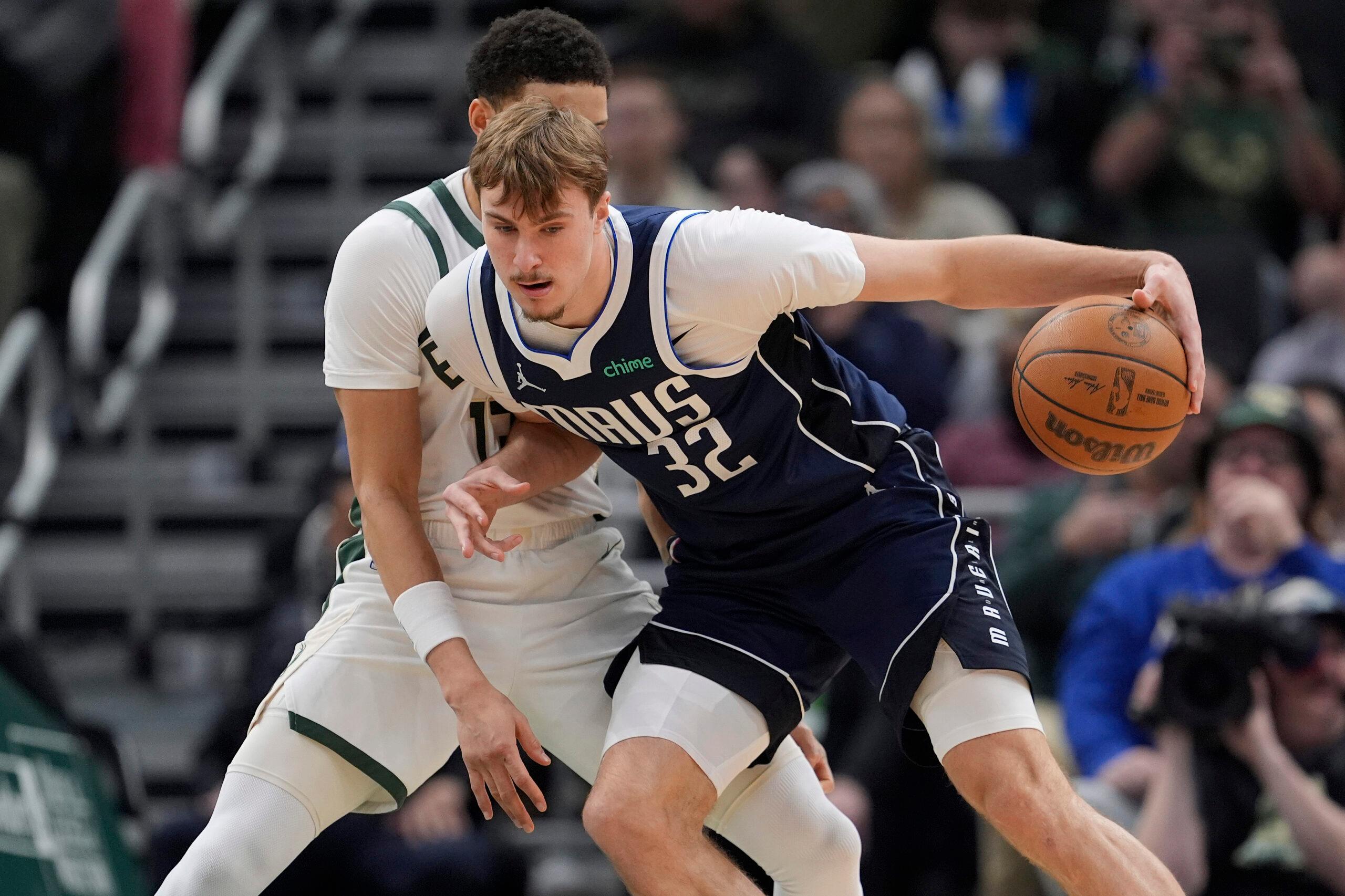
Cooper Flagg dribbles against Ryan Rollins of the Bucks on March 31
Max Christie, a prototypical 3-and-D fixture, is returning. Zaccharie Risacher was acquired to gallop up and down the sideline, dunk, and knock down corner 3s. Santi Aldama is a relatively unheralded ideal acquisition who can pick and pop, attack closeouts, and punish mismatches in the post. Rookie forward Morez Johnson Jr. will fly around, embrace the dirty work, and turn up his high motor on the boards. And Irving’s teams usually have a pretty high transition frequency and perform better in that category when he’s on the floor.
Improvement is a given, but some areas matter more than others. A tighter shot selection is achievable, and there’s no reason to believe Flagg’s accuracy on long 2s and spot-up 3s won’t bounce up. (Flagg is already an excellent free throw shooter.) How much better will that jumper be, though? Can he consistently punish on-ball defenders who duck under screens or rise up over or crash through bigs in a drop? Will he space the floor for others?
For the entire organization, this summer was a series of baby steps in the right direction. But I still don’t think that Dallas will be good enough to make the play-in. Its roster remains imperfect and is at the start of a rebuild. Irving, P.J. Washington, and Daniel Gafford are possible trade fodder; Lively is always hurt; and it’ll take time for the incoming pieces to adjust to a new environment in the incredibly competitive Western Conference. But at the same time, if there’s one team that’s likely to be ahead of schedule this season, it’s probably the Mavericks. Flagg’s mix of upside and maturity transports you to a hypothetical first-round series where he just scored 37 points in a shocking Game 2 win over the Oklahoma City Thunder.
There are juicier subplots occupying our current NBA discourse, but give it a few months. Flagg may just consume them all.